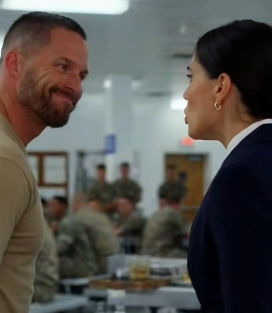
The silence that followed my question didn’t just settle over the cafeteria – it crushed it. Every breath in that room felt too loud.
“Do you know who I am?”
Time didn’t slow. It stopped.
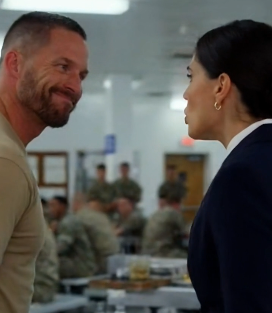
The hum of the industrial refrigerators became deafening. Near the salad bar, a young Lance Corporal sucked in a sharp breath. Even Marshall’s own breathing hitched – the first crack in his armor.
My shoulder pulsed where his hand had struck me. I didn’t flinch. I didn’t look away. I forced him to see me. Really see me.
Twenty minutes earlier, I had walked into that cafeteria in jeans and a faded gray sweater. No makeup. Hair pulled back. I looked like someone’s tired aunt visiting base for a tour.
Staff Sergeant Marshall had taken one look at me standing in his lunch line and decided I was a joke.
“Civilians wait outside, sweetheart,” he’d said, loud enough for his table of buddies to hear. They laughed.
I held up my visitor badge. Calmly. Politely. “I was told I could eat here while I waited.”
He stepped closer. The smirk. That awful smirk. “I don’t care what you were told. Move.”
When I didn’t move fast enough, his hand came down hard on my shoulder and shoved me sideways into the tray rack. Metal clattered. A fork hit the floor. Someone gasped.
That’s when I turned around and asked him the question.
“Do you know who I am?”
He recovered fast. Puffed his chest out. “I don’t care WHO you are – “
The double doors at the back of the cafeteria swung open.
Three people walked in. Two men, one woman. Dark suits. Earpieces. The kind of walk that makes a room go quiet on its own.
Marshall’s buddies stopped laughing.
The woman in front locked eyes with me. Gave me the smallest nod. Then she turned to Marshall and pulled a black leather wallet from her jacket.
The badge caught the fluorescent light.
Marshall’s face went the color of wet paper.
Because the badge didn’t say what he expected. It didn’t say what ANYONE in that cafeteria expected. And when the woman finally spoke, the words she said about me—about who I actually was, and why I had really come to that base that morning—made Staff Sergeant Marshall’s knees physically buckle against the cafeteria tile.
“Staff Sergeant,” the agent’s voice was like ice. “You just physically assaulted Dr. Evelyn Vance.”
She paused, letting the name hang in the air, but it meant nothing to him. Not yet.
“She is the Deputy Inspector General for the Department of Defense.”
A wave of murmurs rippled through the room. The title was a mouthful, but the words “Inspector General” hit like a physical blow. Everyone in uniform knew what that office was. They were the auditors. The investigators. The career-enders.
Agent Miller, the woman with the badge, wasn’t finished. “We are here with her to conduct a full audit of your unit’s equipment procurement and readiness reports.”
She took a step closer to him, her voice dropping to a near whisper that still carried across the silent room. “And you, Sergeant, just became Exhibit A for ‘Command Climate Failure’.”
Marshall looked from her, to the two dead-serious agents flanking her, and then back to me. To the tired-looking woman in the gray sweater he had just shoved.
His jaw worked, but no sound came out. The swagger, the arrogance, it all just melted off him, leaving behind a terrified, confused man.
“I… I didn’t…” he stammered, looking at me pleadingly. “I thought you were just… some lady.”
“That’s the problem, Sergeant,” I said, my voice quiet but firm. “You thought I was ‘just some lady’. So you thought you could push me around.”
I gestured to the young Lance Corporal who was still frozen by the salad bar. “What if I had been his mother visiting the base? Would that have been acceptable?”
The Lance Corporal, a kid named Peterson, flinched when I mentioned him.
Marshall had no answer. His career was flashing before his eyes, and he knew it was already over.
“Staff Sergeant Marshall,” Agent Miller said, her tone all business now. “You need to come with us.”
One of the male agents stepped forward. “Please place your hands behind your back.”
The click of handcuffs was the only sound in the entire cafeteria. As they led him away, Marshall didn’t look at his buddies. He didn’t look at the agents. He kept looking at me, his eyes wide with a horrifying understanding.
He hadn’t just made a mistake. He had confirmed our worst suspicions.
We had been investigating his unit for two months. Not for bullying, but for something far more serious.
Reports of missing high-value equipment. Night-vision goggles, advanced communication gear, even a crate of specialized body armor plates. All signed for. All vanished.
The paperwork was perfect. Too perfect. Major Davies, Marshall’s commanding officer, had signed off on every page, assuring the Pentagon that his unit was 100% mission ready. But anonymous tips suggested otherwise.
The tips spoke of a culture of fear. They said people like Marshall enforced a code of silence. No one dared to question the official record.
So I decided to come see for myself. Not as a DoD official arriving with a motorcade, but as a nobody. I wanted to feel the air on the base, to see how people treated someone with no apparent rank or power.
Staff Sergeant Marshall had given me the perfect, undeniable data point in less than five minutes.
We walked him to a small, windowless interrogation room in the base’s administrative building. I sat across the table from him while Agent Miller and Agent Hayes stood against the wall.
For the first ten minutes, he was just a puddle of apologies. “A misunderstanding,” he kept saying. “I’m not that guy, I swear.”
I let him talk until he ran out of steam. Then I slid a file across the table.
“This isn’t about the cafeteria, Marshall,” I said softly.
He hesitantly opened the folder. Inside were shipping manifests for ceramic armor plates. His signature was at the bottom of each one, confirming receipt of the goods.
“We have sworn testimony from a supply clerk in Germany that these crates were half-empty when they were loaded onto the transport plane,” I said. “But you signed for them as full. Why?”
His face went from pale to ghostly. The assault in the cafeteria was a career-ender. This was prison time.
“I… I just signed what the Major told me to sign,” he whispered. “Major Davies. He handles all that.”
“He told you to sign for equipment that wasn’t there?”
He nodded, a man completely broken. “He said it was a paperwork foul-up. That the rest would come later. He said it was above my pay grade to ask questions.”
“And you used your position to make sure nobody else asked questions either, didn’t you?” Agent Hayes chimed in from the corner. “You fostered an environment where junior Marines were too scared to report a safety issue, let alone grand larceny.”
Marshall put his head in his hands. He was a bully, but he was also a pawn. A stupid, arrogant pawn in a much bigger game. And he had just handed us the king.
“He’s been selling it,” Marshall mumbled into his hands. “The gear. To a private contractor. Some buddy of his from a past deployment.”
It was the twist we had suspected but couldn’t prove. Major Davies, a decorated officer with a stellar reputation, was systematically gutting his own unit’s readiness for profit. He was stealing the very equipment his soldiers would need to survive in a conflict.
And he used thugs like Marshall to keep everyone in line.
Marshall’s confession gave us everything we needed. But I wanted to see this through to the end.
“Agent Miller, stay with him,” I ordered. “Agent Hayes, you’re with me. We’re going to pay a visit to Major Davies.”
Major Davies’s office was neat and orderly. Awards and commendations lined the walls. A picture of him shaking a general’s hand sat on his desk. He greeted us with a confident, polished smile.
“Dr. Vance, what a surprise,” he said, extending a hand. I didn’t take it.
“Major. We have a problem.”
His smile didn’t waver. “I’m sure we can sort it out. What seems to be the issue?”
“The issue,” I said, placing a hand on the back of a visitor’s chair but not sitting, “is that your unit’s readiness reports are a work of fiction. And we now know why.”
He finally showed a flicker of concern, but quickly masked it. “I assure you, Doctor, my reports are accurate. I pride myself on the readiness of my men.”
“Do you?” I asked. “Do you pride yourself on soldiers having to train with last-generation equipment because their new gear has been sold off? Do you pride yourself on body armor that’s missing its life-saving plates?”
His face tightened. “Those are outrageous accusations.”
“I have Staff Sergeant Marshall in an interview room right now,” I said, watching his eyes carefully. “He’s being remarkably cooperative. He’s telling us all about your little side business.”
For the first time, raw panic flashed across the Major’s face. He had underestimated his bulldog. He thought Marshall was loyal, or at least too dumb to flip.
“Marshall is a hothead,” Davies spat, his composure cracking. “Whatever he’s telling you is a lie to save his own skin.”
“Is it?” I took a step closer. “Then you won’t mind if my team starts seizing every piece of communication you own? Your computers, your phones. We’ll find the contractor you’ve been selling to, Major. We always do.”
He looked from me to Agent Hayes, who stood by the door like a statue, his hand resting inside his jacket. Davies saw there was no way out. The well-practiced charm, the confident smile, it was all gone. All that was left was a common criminal in a fancy uniform.
He collapsed into his expensive office chair, his shoulders slumping in defeat. “My career… it’s over.”
“Your career was over the moment you decided to value money more than the lives of your soldiers,” I told him, my voice devoid of any sympathy. “Agent Hayes, secure him.”
Later that evening, long after Davies and Marshall were in custody and the base was buzzing with news of the arrests, I found who I was looking for.
Lance Corporal Peterson was sitting on a bench outside the barracks, staring into the distance.
I walked over and sat down next to him, leaving a respectful distance between us. He tensed up when he saw me.
“Relax, Corporal,” I said gently. “I’m not here to cause more trouble.”
He swallowed hard. “Ma’am… Dr. Vance… I’m sorry about what happened. What he did.”
“You have nothing to be sorry for,” I replied. “In fact, I wanted to thank you.”
He looked at me, confused. “Thank me for what? I didn’t do anything. I just stood there.”
“You did more than you think,” I said. “When he shoved me, you gasped. I saw your face. You knew it was wrong. In a room full of people who were either laughing or looking away, you reacted.”
I paused, letting that sink in.
“That tells me your moral compass works just fine. You were just in a situation where you felt powerless to follow it.”
He looked down at his boots. “He’s… Staff Sergeant Marshall is an intimidating guy.”
“I know. People like that thrive on making others feel small. They use their rank, their voice, their size, to create fear. Because fear guarantees silence.”
I looked out at the setting sun. “But the thing is, Peterson, true strength isn’t about the stripes on your sleeve or how loud you can shout. It never has been.”
He looked up at me, listening intently.
“True strength is integrity. It’s doing the right thing, especially when it’s hard. It’s having the courage to speak up when you see something wrong, even if your voice shakes.”
“That day in the cafeteria,” I continued, “you felt powerless. But now, the most powerful people on this base are gone, and you’re still here. Their power was a house of cards. Yours is real. It’s inside you.”
A single tear rolled down his cheek, and he quickly wiped it away.
“I have a feeling,” I said with a small smile, “that this base is going to be a much better place from now on. And it’s going to be because of soldiers like you.”
He finally looked at me, and for the first time, I didn’t see a scared kid. I saw a future leader.
Before I left the base, my team confirmed that the missing gear would be replaced immediately. The investigation had uncovered a deep-seated problem, but it also started the healing.
My job wasn’t about punishment. It was about fixing what was broken, and ensuring the good men and women in uniform had everything they needed to do their jobs safely and effectively.
Sometimes, that means taking down a Major.
And sometimes, it just means wearing an old sweater and seeing who treats you with decency, and who does not. Because a person’s true character isn’t shown in how they treat their superiors, but in how they treat the person they believe has nothing to offer them.
That, in the end, tells you everything you need to know.