
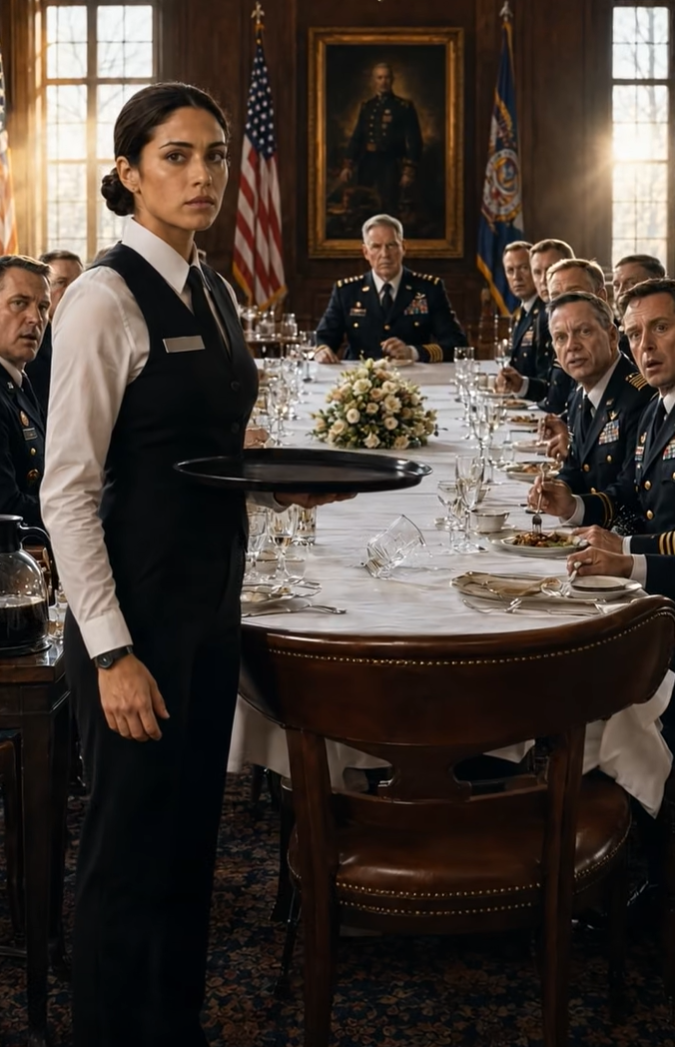
The room went silent before anyone understood why.
One question had done it.
Not a shouted order. Not an accusation. Just six words from a four-star general seated at the head of the polished command table.
“Where did you serve, Staff Sergeant?”
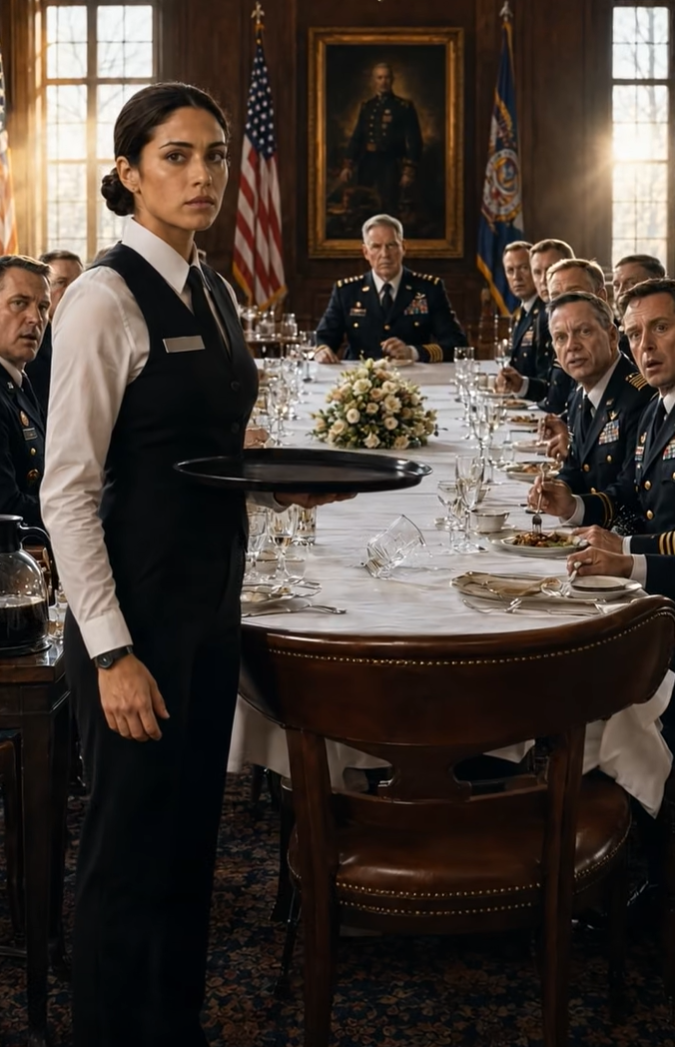
Forks stopped halfway to open mouths. A knife slipped against porcelain with a sharp, guilty scrape. Somewhere near the center of the table, a crystal glass came down too hard, the sound cracking through the officers’ dining hall like a warning shot.
Captain Hargrove froze mid-sentence.
A moment ago, he had been laughing easily, his voice smooth with the confidence of a man used to being heard. Now the words died in his throat as if someone had cut the wire behind them.
Every eye turned.
Not toward the general.
Toward the woman standing beside the table with a coffee pot in one hand and a tray balanced perfectly in the other.
Marisol Vega did not move.
For three years, she had been invisible in that room.
That had been the point.
She knew when to refill a cup before a colonel asked. She knew which officers took black coffee and which wanted cream placed silently at their right hand. She knew how to pass behind chairs without brushing a sleeve, how to lower plates without sound, how to become part of the polished wood and white linen.
Quiet.
Useful.
Forgettable.
Because invisible people were not questioned.
Invisible people were not remembered.
Invisible people survived.
But General Whitmore was staring at her now, and there was nothing casual in his expression. He was not looking at her like a man confused by a name tag. He was looking at her like someone had opened a sealed room in his memory.
Like something he had buried had just walked in carrying coffee.
Marisol felt the old instinct rise fast and sharp.
Smile.
Deflect.
Say he must be mistaken.
Step back into the safe, careful life she had built after everything that happened on the road no one spoke about unless they had been there.
But Whitmore’s eyes held hers.
And in them, she saw recognition.
Not of who she was now.
Of who she had been.
Slowly, Marisol set the coffee pot down.
Then she lifted her chin.
“Afghanistan, sir.”
The dining hall seemed to tighten around the word.
Whitmore leaned forward by less than an inch, but the movement changed the gravity of the entire room.
“Where in Afghanistan?”
There was no soft answer to that.
No harmless version.
No way to bury a place once it had been named.
Marisol’s fingers curled once against the edge of the tray before she released them.
“Khost Province,” she said. “Route Red Ash. Third convoy rotation.”
The reaction was immediate.
Color drained from Captain Hargrove’s face.
One of the colonels looked down at his untouched plate.
Someone at the far end of the table whispered something too low to catch, but the fear in it carried.
Even the flags along the wall seemed suddenly still.
Route Red Ash.
The name moved through the room without anyone repeating it.
A road marked in classified reports.
A convoy that should not have made it out.
A mission buried beneath medals, silence, and official language polished clean of blood and terror.
By eleven-thirty that morning, the officers’ dining hall at Fort Meridian had gleamed like a place built for power and permanence. Sunlight poured through the tall windows, flashing against knives and forks laid with military precision. The long command table looked untouched by chaos, untouched by doubt, untouched by anything that did not belong.
But now Marisol stood at the center of it.
And everything that room had tried to hide was looking back.
She was no longer the server.
No longer the woman who moved quietly behind important men.
No longer the person they forgot the moment she left the room.
She was a memory.
A witness.
A name that should have stayed buried in an after-action report no one wanted reopened.
General Whitmore rose from his chair.
Every officer at the table straightened.
Captain Hargrove opened his mouth, but no sound came out.
Whitmore’s gaze never left Marisol.
His voice dropped lower.
“Tell me,” he said, “were you the one who pulled me from the wreckage?”
Marisol’s breath caught.
Because the man sitting three seats down from the general – the one who had gone pale the moment she said Red Ash – wasn’t supposed to be alive either.
And he was the reason she had spent three years pretending to be no one at all.
She turned her head slowly toward Captain Hargrove.
And what she said next made every officer in that room reach for something to hold onto.
“No, sir.”
Her voice was quiet, but it cut through the room’s tension like a field medic’s shears.
She did not look at the four-star general.
Her eyes were locked on Captain Hargrove.
“I pulled you from the wreckage, General. He was the one who left you in it.”
A gasp went around the table.
It was a direct accusation. An impossible one.
Captain Hargrove, the decorated hero of the Red Ash convoy. The man whose official report cited his “bravery under fire” and “decisive leadership in a moment of crisis.”
Hargrove shot to his feet, his chair scraping violently against the floor.
“That’s a lie! General, this woman is… she’s clearly confused. She was discharged. Unfit for duty.”
His voice was a little too loud. A little too shaky.
The confidence he wore like a uniform was peeling at the edges.
General Whitmore held up a hand.
The gesture was small, but it commanded absolute obedience. Hargrove fell silent, his face a furious, blotchy red.
“Dismissed,” Whitmore said to the room at large. “All of you.”
There was a scramble of chairs, a clatter of cutlery dropped by unsteady hands. No one spoke. No one looked at Marisol or at Hargrove. They simply fled, leaving the three of them in the vast, silent room.
The general, the captain, and the server who remembered everything.
Whitmore walked slowly around the table until he stood beside Marisol. He wasn’t looking at her now. His gaze was fixed on Hargrove, who stood stiffly by his chair.
“Captain,” the general said, his voice dangerously soft. “You wrote the after-action report. You said Staff Sergeant Vega suffered… what was the phrase? ‘Acute combat stress reaction.’ You claimed she froze.”
“She did, sir,” Hargrove snapped back, regaining a sliver of his composure. “She became unresponsive. I had to take command of her unit and extract the survivors. Including you, sir.”
Marisol didn’t say a word. She just watched him.
She remembered the dust. It was in her mouth, her eyes, her lungs. It tasted like metal and fear.
She remembered the sound of the lead vehicle vaporizing. The sudden, terrible silence that followed the blast before the shooting started.
She did not freeze.
She had been returning fire.
Whitmore turned his calm, assessing eyes toward her.
“Staff Sergeant Vega. Tell me what happened.”
And so, she did.
“We were twenty minutes out from the checkpoint,” she began, her voice low and steady. “Then-Lieutenant Hargrove was in the third vehicle. I was in the fourth, with you, sir. You were a colonel then.”
She spoke of the IED. The ambush that followed from the ridges on both sides of the narrow road.
“Our Humvee rolled. It landed on its side. Your leg was pinned, sir. The cabin was filling with smoke.”
She could still smell it. The acrid scent of burning fuel and wires.
“I tried to get a signal out, but the radio was dead. I looked for Lieutenant Hargrove.”
Here, her eyes flickered back to the captain.
“I saw him. His vehicle was damaged but upright. He got out. He looked right at our Humvee. Right at us.”
Hargrove shook his head. “This is insane. I was organizing a defensive perimeter!”
Marisol ignored him, her focus entirely on the general.
“He didn’t organize anything, sir. He ran. He and two of his men abandoned their position and ran for the rocks at the far end of the pass. They left us.”
The silence that followed was heavier than anything that had come before.
“I got you out, sir,” Marisol continued quietly. “I used the pry bar from the toolkit. Specialist Miller helped me. After we got you clear, we went back for the others.”
Her voice cracked for the first time.
“We only found Miller’s dog tags afterwards. He went back for the driver.”
General Whitmore’s face was unreadable, a mask of stone. He remembered waking up under a canvas sheet, a medic leaning over him. He remembered pain, and shouting, and the thud of helicopter blades.
The details before that were a black, concussive void.
“Captain Hargrove,” the general said slowly. “Your report states you pulled me from the vehicle yourself. It’s why you received the Silver Star.”
“And I did!” Hargrove insisted, stepping forward. “With all due respect, General, you were delirious. She’s twisting the memory of a chaotic event. It’s a classic sign of trauma. She’s created a new narrative to cope.”
He sounded so reasonable. So professional.
It was her word against a decorated captain. Her word against an official report signed and sealed years ago.
She had known this would happen.
When she’d first tried to contest his report, she was shut down. Hargrove’s father was a retired two-star general with friends in high places. A troubled Staff Sergeant with a shaky story stood no chance.
They suggested she take an honorable discharge. For her “health.”
So she did. She disappeared.
But she didn’t go far. She took a civilian job right here, at Fort Meridian, the base where Hargrove was eventually stationed. She watched him walk into this dining hall for three years, his uniform gleaming, his laughter echoing off the walls.
She waited. Not for revenge. For the truth.
“There is one more thing, sir,” Marisol said, pulling the general’s attention back to her.
She reached into the small pocket of her server’s apron. Her fingers trembled slightly as she pulled out a small, tarnished object.
She held it out on her palm.
It was a small, silver compass, the kind often given as a keepsake. Engraved on the back were the initials ‘T.W.’
“This was in your pocket, sir,” she said. “When the vehicle rolled, it fell out and got wedged under the dashboard.”
Whitmore stared at the compass. His father had given it to him when he first joined the army. ‘T.W.’ for ‘Thomas Whitmore.’ He’d thought it lost forever in that wreck.
“I couldn’t get it out with my fingers,” Marisol said. “By the time I pulled you free, the fire was spreading. I had to leave it.”
Her eyes lifted to meet Hargrove’s once more. The captain’s face was a mask of confusion. He didn’t understand the significance of the compass.
“I came back to this base, sir, because I knew he was here,” Marisol said. “I knew one day, he’d get comfortable. He’d make a mistake.”
“This proves nothing!” Hargrove scoffed. “A trinket!”
“It proves I was there, sir,” Marisol said to the general. “It proves I was the one beside you in that cabin. But it’s not the only thing I have.”
This was the moment. The reason for the three years of silence. The long, patient game.
“When I was discharged, they wouldn’t listen to me,” she said. “It was my word against his. But I knew someone else saw what he did.”
Hargrove’s smug expression began to crumble.
“Specialist Miller was killed, sir. But there was one other man from Lieutenant Hargrove’s vehicle. Corporal Davis. His report listed Davis as killed in action, body not recovered.”
“He was!” Hargrove blurted out. “The vehicle was hit after…”
“It was hit after you abandoned it,” Marisol corrected him calmly. “But Corporal Davis wasn’t killed, sir. He was thrown clear by the blast. Badly.”
General Whitmore’s eyes narrowed. “What are you saying, Vega?”
“I’m saying Captain Hargrove filed a false report to cover his cowardice. It was easier to list Davis as dead than to explain why he was found a hundred yards away from the vehicle he was supposed to be defending.”
A cold dread crept into Hargrove’s face. “She’s bluffing. There’s no one.”
“For three years, I’ve used my evenings and my pay from this job to find him,” Marisol said, her voice filled with a righteous fire that had been banked for too long. “I searched VA hospital records, disability claims, homeless shelters. Six months ago, I found him.”
She pulled out her phone.
“He’s in a long-term care facility in San Antonio. The blast took his legs and damaged his vocal cords. He can’t speak. But he can type.”
She tapped the screen, her hands now perfectly steady. She found the contact and pressed the video call button.
A second later, a man’s face appeared on the screen. He was gaunt, with tired eyes, sitting in a wheelchair. A nurse stood beside him.
General Whitmore stared at the screen. “Corporal Davis?”
The man on the screen gave a slow, deliberate nod.
Hargrove looked like he had seen a ghost. Sweat poured down his face. “No. It can’t be.”
“General,” Marisol said, holding the phone out. “This is former Corporal Frank Davis. Frank, this is General Whitmore. Can you tell him what you saw on Route Red Ash?”
The nurse held a small tablet in front of Davis. He began to type slowly, with a stylus held in a special brace on his hand.
The words appeared on the tablet’s screen, large and clear.
LT. HARGROVE RAN.
HE SAW THE HUMVEE FLIP.
HE SHOUTED 'EVERY MAN FOR HIMSELF.'
HE LEFT US.
HE LEFT US ALL.
Each sentence was a hammer blow.
Captain Hargrove stumbled back, knocking his chair over completely. The sound echoed in the dead-silent hall.
“It wasn’t like that… the situation was… compromised…” he stammered, his words dissolving into meaningless panic.
General Whitmore took the phone from Marisol. He looked at the face of the man on the screen, a soldier his army had left behind, a man declared dead because a coward’s lie was more convenient than the truth.
“Corporal Davis,” the general said, his voice thick with emotion. “Frank. I am so sorry. We failed you. I failed you.”
Davis typed again.
NO SIR.
VEGA DIDNT. SHE FOUND ME.
SHE NEVER GAVE UP.
Whitmore ended the call and handed the phone back to Marisol. He turned to face the trembling, utterly broken Captain Hargrove.
The softness in the general’s voice was gone, replaced by steel.
“Captain, you are under arrest. You will be escorted to the stockade to await a general court-martial for violation of UCMJ Article 99: Cowardly Conduct, Article 107: False Official Statements, and Article 134: Conduct Unbecoming an Officer.”
He didn’t even look at Hargrove as two military police officers, summoned silently via a text, entered the room and took him by the arms.
Hargrove didn’t resist. His career, his honor, his entire fabricated life had just been dismantled by a quiet server with a coffee pot.
When he was gone, the room was finally still.
General Whitmore turned back to Marisol. He looked at her, truly looked at her, for the first time. Not as a subordinate, not as a server, but as an equal.
“You saved my life, Staff Sergeant,” he said.
“I was a soldier, sir,” she replied simply. “I did my duty.”
“No,” he said, shaking his head. “Your duty ended when they processed your discharge papers. What you did for Corporal Davis… what you did for the truth… that was something more.”
He paused, his gaze sweeping around the empty, opulent dining hall.
“This room,” he said, “is a place for people who make decisions. For years, I believed everyone at this table earned their place. You’ve shown me that sometimes the most important person in the room isn’t sitting at the table at all.”
He looked her straight in the eye.
“I won’t ask you to reenlist. You’ve fought more than enough. But I am creating a new civilian oversight position within my command. An ombudsman. Someone who can investigate soldier complaints that get ‘lost’ in the system. Someone who can speak for those who have no voice.”
He smiled, a genuine, tired smile.
“Someone who knows how to find people who don’t want to be found. And who believes that the truth is worth waiting for. The job is yours, if you want it.”
Tears welled in Marisol’s eyes. Not of sadness or anger, but of relief. Of vindication.
After three years of being invisible, she was finally being seen.
“I accept, sir,” she said, her voice clear and strong.
The truth is not always loud. Sometimes, it is quiet, patient, and underestimated. It can be hidden under medals and buried in false reports. But it never truly dies. It simply waits for a person with enough courage to speak it, no matter how long it takes. And in the end, character is not measured by the rank on your shoulders, but by the integrity you carry in your soul.



