By the time Major Grant Mercer stepped onto the tarmac at Falcon Ridge Airfield, the morning already belonged to him.
It always did.
The first thing people noticed was his voice – a hard, jagged sound that cut through rotor wash and radio chatter like a blade through canvas. The second was the scar running from the corner of his left eye to his jaw. The third, if they dared look long enough, was the Delta Force badge on his chest.
After that, people stopped noticing anything at all. They lowered their eyes. They stepped out of his path. They prayed he kept walking.
Falcon Ridge was running hot that morning. Nearly eighteen hundred personnel were preparing for a critical deployment. Helicopters stood in lines, rotors ticking in the heat. Fuel trucks rolled past in controlled bursts. Screens inside command shelters flickered with encrypted maps and countdown clocks.
Everything had to move with ruthless precision.
And Grant Mercer ruled precision with fear.
“Where’s my final flight sequence?” he barked at a captain crossing the lane.
“Uploading now, sir.”
“‘Now’ is not a time. It’s an excuse.”
The captain stiffened and moved faster.
Then he saw her.
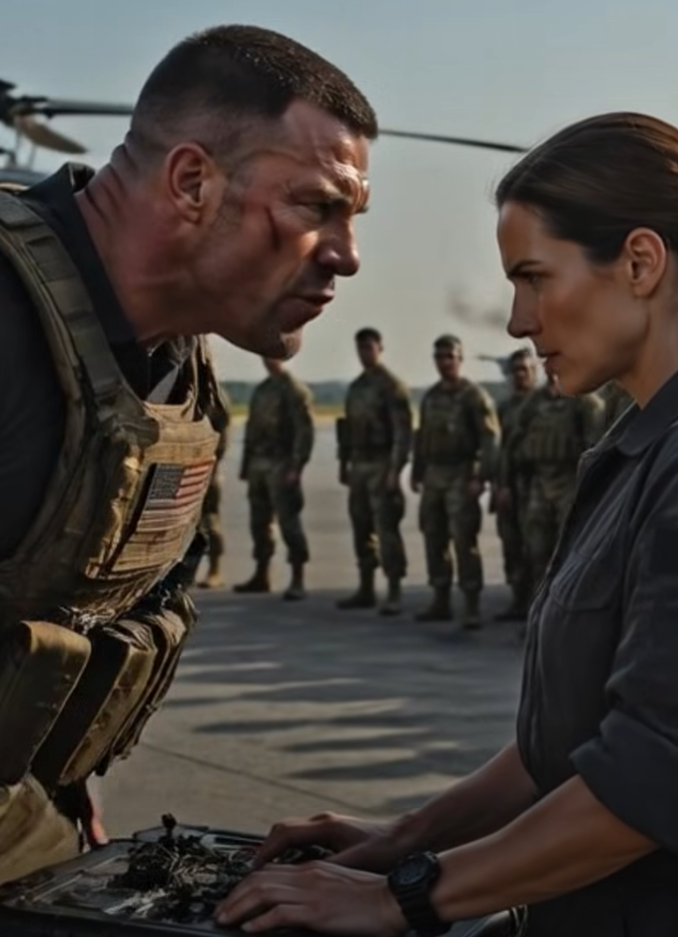
She stood in his assembly corridor as if she had every right in the world to be there. Plain utility coveralls. No visible insignia. Hair pulled back in a severe knot. Hands steady over an open communications case wired into a hardened relay unit on the edge of the runway.
Around her, the airfield boiled with motion. She seemed untouched by it.
Grant slowed.
That alone made nearby people nervous.
“You,” he shouted. “You’re blocking my runway.”
She did not flinch. She did not snap to attention. She barely looked up.
“I need ten more minutes.”
Several heads turned.
Grant gave a short laugh – the kind soldiers recognized instantly. It was not amusement. It was the sound of someone deciding that humiliation was about to become public entertainment.
“No,” he said, stepping closer. “You need to move. Now.”
Her fingers continued moving over the case.
“Interrupt this sync,” she said evenly, “and you lose encrypted continuity for the entire launch package.”
Someone loading a transport crate froze.
Someone near the command van muttered, “Oh, no.”
Grant heard the tension ripple outward and mistook it for support.
He moved closer until he towered over her. “Do you know who you’re talking to?”
Her eyes stayed on the case. “A man delaying a secure deployment because his ego got there first.”
The nearest crew chief looked physically ill.
Grant’s face darkened. “I said move,” he snapped. “I’m the Delta commander here.”
Only then did she lift her head.
Her face was not defiant in the theatrical way he expected. It was worse. It was composed. Cold. Entirely free of fear.
“Then act like one.”
The sentence landed like a slap.
Around them, the runway changed. Motion slowed. Conversations died. It was the kind of silence that gathered not from peace, but from expectation – the silence before impact.
“You think coveralls make you invisible?” Grant hissed.
She said nothing.
It enraged him more.
“Look at me when I’m speaking to you.”
“I already did,” she replied.
A faint, dangerous smile touched his mouth. Everyone who knew Major Mercer recognized that smile. It meant he had crossed from anger into cruelty.
“Maybe you don’t understand what happens to people who interfere with my mission.”
She rose slowly to her feet.
She was shorter than he was. Narrower in the shoulders. Grease-dark smudges at one cuff. Nothing about her appearance suggested force. Yet there was something in the way she stood – balanced, relaxed, centered – that made one old sergeant in the third row of observers suddenly take one step backward.
“I understand exactly where I am,” she said.
Grant leaned in. “Then move.”
“No.”
The word was quiet.
That, more than anything, was what undid him.
He reached forward and shoved her hard in the shoulder.
It was the sort of move powerful men made because the world had rewarded it a thousand times before. He expected the usual sequence. A stumble. An apology. Obedience.
Instead, the next two seconds rewrote his life.
Her hand caught his wrist before he even understood she had moved. Her body turned with fluid, devastating economy. Her hip dropped under his center of gravity. His own momentum became a weapon against him.
And then the commander people feared most at Falcon Ridge was airborne for one impossible, humiliating instant — before she drove him flat onto the tarmac.
The impact exploded across the runway.
A sound like a cracked board. A violent grunt forced from Grant’s lungs. Dust lifting in a ring around his body. Gasps breaking from a hundred throats at once.
Grant Mercer lay on his back, staring up at the sky, every ounce of air ripped from him.
The woman in coveralls stepped away as calmly as if she had just moved a toolbox.
No triumph. No performance. Just complete control.
A pilot half-climbing into a helicopter stopped with one boot on the skid. A logistics lieutenant actually removed his sunglasses, as if the event might look different without them.
Someone in the crowd whispered, “Who the hell is she?”
Grant forced a breath into his lungs. Then fury came rushing in behind it.
He rolled to one elbow, face red with disbelief. “You stupid—”
A voice cut across the runway before he could finish.
“Stand down.”
It was not loud. It did not need to be.
General Roman Hale walked out from between two command vehicles with the kind of authority that altered gravity around him. Silver-haired. Immaculate. Every officer who saw him straightened instantly.
He reached the center of the scene, took one measured look at Grant on the ground, one look at the woman in coveralls, and then turned to the crowd.
“Stand down,” he repeated.
Then he said her name.
And the entire airfield went still — because the woman Major Mercer had just shoved wasn’t a contractor. She wasn’t support staff. She wasn’t civilian maintenance.
“Major, allow me to formally introduce you to Chief Warrant Officer Katherine Vance.”
A new kind of shock rippled through the onlookers. A Warrant Officer Five was a living legend, a technical master who advised generals. They were rarer than diamonds.
But the name Vance… the name landed differently in Grant’s gut. It was a ghost from a past he had buried six years deep under ambition and lies.
General Hale’s eyes never left him.
“Major,” he said quietly, “get up.”
And for the first time in his life, Grant Mercer obeyed a command with trembling hands — because he finally recognized the face under the grease.
It was the face from the photograph in his locked desk drawer. The one he swore no one had ever seen. The one of him standing next to a smiling young specialist. Specialist David Vance. Katherine’s brother.
The man whose death Grant had pinned on a ghost.
As Grant staggered to his feet, shame and old fear warring on his face, General Hale spoke again, his voice now flat and cold. “Everyone, back to your posts. Now.”
The crowd melted away, a tide of uniforms receding until only the three of them were left in the vast, humming silence of the tarmac. The heat shimmered off the asphalt.
Katherine Vance had already returned to her work. Her fingers moved with the same infuriating calm.
“Katherine,” General Hale said, his tone softening slightly.
“Final encryption sequence is locked, sir. They’re good to go,” she reported, not looking at either of them. The sync was complete.
Hale nodded slowly. He turned his gaze back to Grant, whose immaculate uniform was now scuffed with dust and disrespect.
“You have anything to say for yourself, Major?” the General asked.
Grant’s mouth was dry. Words, his greatest weapon, failed him. He looked from the General to the woman who had just dismantled his authority without raising her voice.
“It was… a misunderstanding, sir,” he finally managed to rasp.
Katherine let out a soft, humorless sound. “No. It was very clear.”
She closed the lid of her case, the latches clicking shut with finality. Now she turned, and her eyes, clear and steady, locked onto Grant’s. There was no anger there. There was something far worse: knowing.
“Six years ago, you called my brother sloppy,” she said, her voice even. “You wrote in your report that Specialist David Vance failed to check his sector, that he compromised your position. That his mistake got him killed.”
Each word was a nail being hammered into Grant’s carefully constructed reality.
“That’s the official record,” Grant said, his voice tight.
“It was a lie,” Katherine stated. It was not an accusation. It was a fact. “My brother was meticulous. He was the best radio tech in his unit. He never would have made that mistake.”
General Hale stood by, a silent judge. He knew parts of this story, Grant realized. He had to. This was no accident.
“I have a mission to lead, General,” Grant said, trying to pivot back to solid ground.
“You have a briefing to attend,” Hale corrected him. “In my office. Ten minutes. Both of you.”
He turned and walked away, leaving Grant alone with the ghost he thought he’d escaped.
“That takedown,” Grant said, needing to fill the silence. “Where did you learn that?”
“My father,” Katherine replied, her gaze distant. “He said you always have to be prepared for bullies who think their rank is a weapon.”
She picked up her case and walked off toward the command center, leaving Grant standing on the tarmac he no longer owned. The scar on his face seemed to burn.
In General Hale’s sterile, quiet office, the mission details were laid out on a large screen. A remote compound. A high-value asset, an informant codenamed ‘Sparrow,’ to be extracted.
“This is a delicate one,” Hale began, his eyes fixed on Grant. “Sparrow has information that can prevent a significant escalation of force in the region. He’s our only way in.”
Then the General looked at Katherine. “Chief Vance is here because the entire operation hinges on her technology.”
He gestured to a small, sleek device on the table.
“This is the Nightingale,” Katherine explained, her tone all business. “It’s a real-time predictive threat analysis system. It collates intel streams, satellite data, and local comms chatter to paint a true picture of the battlefield. It flags bad intel and highlights unseen threats.”
She paused, then looked directly at Grant.
“For instance,” she continued, her voice clinical, “had it been deployed six years ago outside Kandahar, it would have flagged the inconsistencies in the source reports for your raid. It would have told you that the ’empty’ building your source pointed you to was, in fact, an occupied enemy position. It would have told you that you were walking into a trap.”
The air went out of the room. It was a direct, professional execution.
Grant felt a cold dread creep up his spine. She had built the very thing that would have saved her brother. And now he was forced to rely on it.
General Hale looked at him. “The mission is yours to lead, Major. But Chief Vance has operational oversight on all intelligence. Her word is final. Is that understood?”
“Sir,” Grant said, the word tasting like ash. “What you’re really asking is if I can follow an order from her.”
“I’m not asking, Major. I’m telling you.”
The flight to the deployment zone was long and silent. Grant sat with his team, Delta operators who had followed him into hell and back. They shot him confused, questioning glances. They had seen their invincible commander thrown to the ground and then dressed down. The myth of Grant Mercer was cracked.
He didn’t speak. He just stared at the bulkhead, the events of the past and the uncertainty of the future churning within him. He was being forced to lead a mission that would prove he was a fraud, spearheaded by the sister of the man he had wronged.
This wasn’t just a mission. It was a reckoning.
When they landed, the air was thick and hot. The rescue was set for 0200 hours. The final briefing was tense. Katherine stood at the front, her laptop projecting maps and data streams.
“Sparrow is held here,” she said, pointing to a small building in a walled compound. “But Nightingale is flagging heavy signal jamming and a thermal signature pattern that suggests a much larger force than we were told.”
A captain on Grant’s team spoke up. “Our human intel says it’s lightly guarded. Just a handful.”
“Your human intel is six hours old,” Katherine countered without looking at him. “My data is from six seconds ago. They know we’re coming.”
The old Grant would have scoffed. He would have trusted the gut feeling, the aggression, the plan already in motion.
But the old Grant was gone, left on the tarmac at Falcon Ridge.
He looked at the data on the screen. He saw the cold, hard logic in it. He saw the kind of certainty his own arrogance had blinded him to six years ago.
“We adjust the plan,” Grant said, his voice quiet but firm. “We go in quiet. No breach and clear. We treat it like it’s a fortress.”
His team looked at him, surprised, but they nodded. For the first time, he wasn’t leading with his ego. He was leading with information. He was leading with caution.
The operation began under a moonless sky. They moved like shadows, slipping over the compound wall. Instantly, Katherine’s voice came over the comms, patched directly to Grant’s earpiece.
“Hold. Movement, east corner. Two patrols converging.”
Grant froze his team. They waited. Two minutes later, a heavily armed patrol passed exactly where they would have been. A close call that would have ended the mission before it started.
He let out a slow breath. He trusted her.
They reached the building where ‘Sparrow’ was being held. It was quiet. Too quiet.
“It’s a trap,” Grant whispered into his comm. “They’re waiting for us inside.”
“I agree,” Katherine’s voice replied. “But Sparrow is in there. Nightingale confirms his biometric signature. He’s in the basement.”
Grant was faced with an impossible choice. The same kind of choice from Kandahar. Go in hard and risk a firefight, or find another way.
Then he saw it. A maintenance tunnel grate a few yards from the building. It wasn’t on the schematic.
“Vance, is there a tunnel system under me?”
A few seconds of silence. “Stand by… Yes. Old sewer lines. According to city records, one branch runs directly beneath that building.”
This was it. The moment of truth.
“We’re going in through the sewer,” Grant said to his team. “No entry through the main building.”
They pried the grate open and descended into the dark, foul-smelling tunnel. It was a risk. A huge one. But it felt right. It felt smart.
They found Sparrow huddled in a dark, damp basement cell, just as the data predicted. He was a terrified man in his late forties. As they helped him to his feet, he looked at Grant with wide, fearful eyes.
“I know you,” Sparrow whispered in broken English. “Kandahar. The raid. I was your interpreter.”
Grant’s blood ran cold. It couldn’t be.
“I ran,” the man said, trembling. “After the ambush… you told your men to say the young soldier messed up. The radio boy. I heard you. I ran because I knew you would not leave witnesses.”
This was him. The one person on Earth, besides Grant, who knew the whole truth. Fate, in its cruel, precise way, had made him Grant’s objective. To save his own career, he now had to rescue the man who could end it.
Suddenly, all hell broke loose. The team upstairs must have realized they weren’t taking the bait. Explosions rocked the building above.
“They’re coming down!” one of Grant’s men yelled.
“We move now!” Grant ordered, pushing Sparrow ahead of him. “Back through the tunnel!”
As they scrambled back, an RPG blast collapsed the tunnel entrance behind them, raining down concrete and dirt. They were trapped.
“Vance, we’re cut off!” Grant yelled into the comm. “The main exit is blocked!”
“Working on it,” her voice came back, strained but steady. “There’s an older access point at the north end of the tunnel, but… it’s outside the compound wall. You’ll be exposed.”
“It’s our only shot,” Grant said.
They ran. Dust and smoke filled the narrow space. As they reached the exit ladder, another explosion rocked the tunnel. A piece of shrapnel, white-hot, sliced through Grant’s leg. He cried out and fell, his leg buckling under him.
“Sir!” his sergeant shouted, turning back.
“Get him out of here!” Grant roared, pointing at Sparrow. “That’s the mission! Go!”
He tried to get up, but the pain was blinding. His team was hesitating, their loyalty to him warring with his order.
“I’m not leaving you, Major!”
“That’s an order, Sergeant! Get him to the extraction point!” Grant yelled, propping himself up against the wall and raising his rifle. He would hold them off. Buy them time.
It was the call he should have made in Kandahar. Team first. Mission first. His own life, a distant third. In that moment, lying in the filth and darkness, he finally became the leader he’d only ever pretended to be.
He heard his team retreat, dragging a protesting Sparrow with them. He heard the enemy soldiers getting closer. He took a deep breath and prepared for the end.
Then, a new sound. A grinding of metal from above. A circle of light appeared. A cover was being moved.
A figure rappelled down into the tunnel. It was Katherine Vance.
She landed lightly beside him, a medical kit already in her hand. “I told you, Major. I have operational oversight.”
She wrapped a tourniquet around his leg with practiced efficiency. “There’s an emergency vehicle two blocks away. My ride.”
“My team… Sparrow…,” he grunted through the pain.
“They’re clear,” she said. “They made it to the chopper. You did good, Grant.”
She called him Grant. Not Major. Not Mercer.
They made it out. The debriefing back at base was a quiet, formal affair. Sparrow, safe and sound, gave his testimony. He spoke of the looming regional threat, and then he spoke of Kandahar. He told them everything.
A board of inquiry was convened. Major Grant Mercer did not fight the charges. He stood before the panel, no longer hiding behind his scar or his rank, and confessed to everything. He had falsified the report. He had smeared a dead soldier’s name to protect his ambition.
He was stripped of his command, his decorations, and his title. He was given a discharge that was honorable only on a technicality. The career he had killed for was over.
On his last day at Falcon Ridge, he was packing a single duffel bag in a small, bare room. He was just Grant Mercer now, a man with a bad leg and a heavy past.
The door opened. It was Katherine. She wasn’t wearing coveralls or a uniform, just simple civilian clothes.
He looked at her, expecting condemnation. But her face was unreadable.
“I’m sorry,” he said, and the words came from a place so deep inside him he barely recognized his own voice. “For your brother. For what I did. I was a coward. I was afraid, and I let him pay the price for it.”
Katherine was silent for a long moment, studying him. She wasn’t there to grant him forgiveness. That wasn’t hers to give.
“My brother, David, he looked up to his commanders,” she said softly. “He believed in the uniform. He believed that the men leading him were honorable.”
Grant flinched, the words hitting their mark.
“You failed him then,” she continued, her voice unwavering. “But in that tunnel, when you chose to sacrifice yourself for your team, for the mission… you honored him. You finally acted like the man he thought you were.”
She placed a small, folded flag on his neatly made bed. It was the flag from her brother’s funeral.
“The inquiry cleared his name,” she said. “His record is clean. Everyone knows he was a hero.”
Grant looked at the flag, then back at her, his eyes shining with unshed tears. He had lost everything—his career, his reputation, his pride. But in the process, he had found something he’d thrown away long ago: his honor.
True strength isn’t found in a loud voice or a chest full of medals. It is found in the quiet courage to face the truth, especially when that truth is your own failure. It’s about choosing to do the right thing, not when it’s easy, but when it costs you everything. And sometimes, the most rewarding victory is not about winning the battle, but about finally winning the war within yourself.