
A Quiet Stand on a Hot Training Field
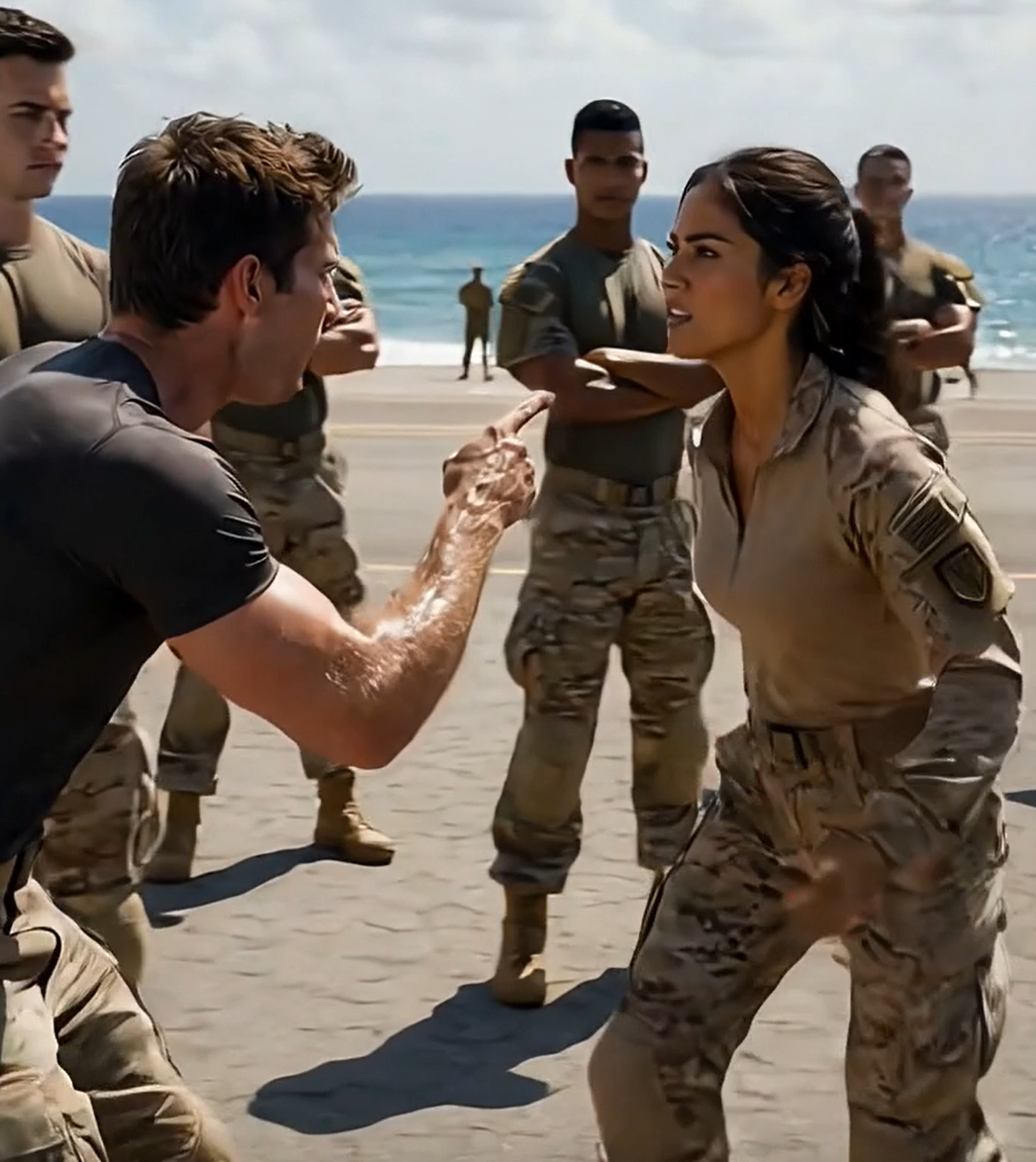
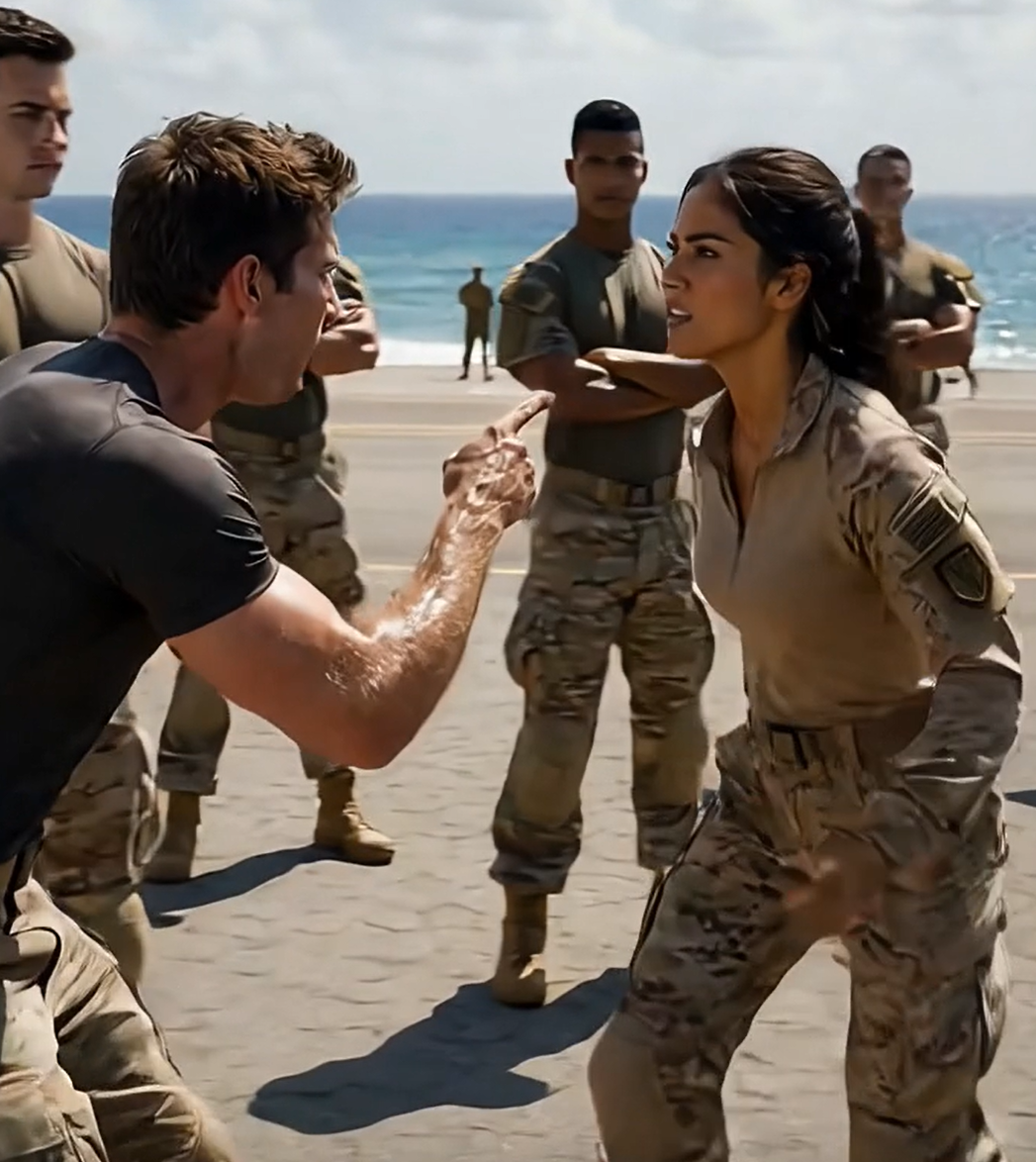
“Hey! Move out of the way!” The shout cut through the late-afternoon heat as boots hammered the pavement. Cadets were changing stations on the training field, sweat darkening their fatigues, the air shimmering above the asphalt. Lieutenant Kara Vance, 5 feet 6 inches tall and unassuming to anyone who judged by size alone, stood calm and still at the center of the path. She didn’t flinch when Jared Conway, the loud favorite of the barracks and self-proclaimed “king” of the base, shouldered into her with the kind of force that would unsettle most grown men. She barely blinked.
A ring formed almost immediately — cadets drifting in with the same curiosity that gathers around any brewing scene. A few whistled, others laughed, some simply waited to see what would happen next. Age and rank often make people quieter; youth and bravado can make them louder. On that day, the volume came from the crowd.
Jared flexed for his audience, grin wide, voice easy and cutting. “What’s the matter, sweetheart? Lost? This is the big boys’ field. Maybe the kitchen needs an extra set of hands.” The taunt landed with the cheap satisfaction of a joke told for the chorus, not the truth.
Kara’s response was stillness. She tipped her head slightly, as if listening for something beyond the noise. She didn’t answer. Her breathing stayed steady. In that pause, those closest to her leaned in, expecting a retort. None came.
The silence worked on Jared like sand in a wound. He stepped in close and jabbed a finger into her collarbone. “I’m talking to you. Say you don’t belong here, and I’ll let you walk.” His tone was the kind that seeks surrender, not conversation.
A bead of sweat traced a slow path along Kara’s temple. When she finally spoke, her voice was so measured and quiet that the cadets had to hush to hear it.
“Last warning.”
It drew a roar of laughter. Jared’s face flushed. The hand that had bragged its way through more than one rough “training accident” reared back, heavy with intent. It started as a punch. It did not end that way.
What followed took four seconds. Four seconds is the time it takes to pick up a dropped glove, or to decide not to say something unkind. It was also long enough for momentum to reverse, for power to trade places. Jared lunged. Kara moved once, then once more, economy of motion where others would waste energy. The next sound was the gasp of a circle of witnesses watching their favorite story change mid-sentence. Jared was face-down on the asphalt, his own arm folded behind him with precision, his breath ragged and shocked. The laughter was gone.
And then came the part that no one expected — the part that silenced even the thought of laughter.
A black SUV rolled onto the edge of the field and braked hard. Doors opened. A four-star general stepped out and, for a moment that would be retold for years in that place, he ran. The weight of those stars did not slow him. He crossed the pavement at a near sprint and stopped in front of Kara as if the world had narrowed to the space between them.
He snapped to attention. His voice, when it came, carried both authority and apology. “Ma’am, my apologies. Is the primary target secured?”
The words hit like a bell in a chapel. The title was unmistakable. Respect, clear as daylight, cut through the haze of bravado and dust. The cadets went from spectators to statues.
Jared’s breath hitched. He twisted his head against the asphalt. “Dad?” he rasped, disbelief scraping through the word. “What… what did you just call her?”
The four-star did not look at his son. His eyes were on Kara, and they were tired and full of something far heavier than anger. A tear escaped, carving a clean line through the grit on his cheek. Rank speaks loudly in uniformed places, but what showed on his face was not rank. It was a father staring at a hard truth.
“She,” he said quietly, “is Inspector Vance. And on this operation, I report to her.”
Kara adjusted her hold by the slightest degree. Jared yelped. “The target is secure,” she said, still calm, still quiet. “He is officially your problem now, General.”
Two military police officers who had stepped out with the general moved in. They took Jared to his feet. His right arm hung uselessly by his side, not broken, but taught a firm lesson. The cuffs closed with a metallic finality that carried across the field.
“Dad, tell them it was a joke,” Jared pleaded, eyes wet, voice thin. “Tell them.” But the general could not lift his son out of that moment. He had tried to lift him for too many years already.
“I warned you,” the general said, each word a weight. “Arrogance ruins the person who wears it.” He turned away as his son was led to the waiting vehicle, shame and love locked in a painful handshake inside his chest.
The ring of cadets started to dissolve, each trying to blend into anonymity. It was too late for that. Kara’s gaze swept the group, cool and steady, and found the young man with a phone in his hand. He fumbled it and it clattered to the ground.
She picked it up and held it out to him. She did not raise her voice. “You have a choice,” she said. “If you record harm and keep it for gossip, you are a bystander. If you record harm and bring it forward, you are a witness.” She released the phone into his shaking hand and turned to the general. “My office. Ten minutes.” Then she walked away, each step measured, as if to say that leadership is most real when it is least performed.

Behind a Closed Door, the Real Work Began
Ten minutes later, the base commander’s office felt smaller than usual. Wood paneling, a desk polished by years of hands, framed commendations on the wall — all the familiar symbols of a long career. General Robert Conway stood at attention in front of his own desk. Inspector Kara Vance sat in his chair, a plain folder open in front of her. The silence wasn’t awkward. It was intentional, instructive, and heavy.
The general spoke first, his voice catching at the edge. “I am sorry, Inspector. I never believed my son would go this far, not with an officer.”
“He has broken three cadets’ noses,” Kara said evenly. “He has been formally accused of hazing eleven times. Each complaint was withdrawn or misplaced. A promising private named Sam Peters left the service three weeks after a so-called training accident with your son.” She did not raise her tone. Facts do not need volume to carry weight.
The general sat, the four stars on his shoulders feeling newly heavy. “I knew he was arrogant. I thought service would shape him.”
“Or you trusted your rank to protect him from consequences,” Kara answered, not unkindly, but without yielding. “You believed you could manage the fallout. That belief enabled harm.”
He flinched. “That isn’t fair,” he tried, already hearing the hollow space in those words.
Kara slid a photograph across the desk. A young man in a hospital bed looked back at him. Bruising that would fade. A sadness that might not. “Sam Peters,” she said. “Top of his basic training class. Spoke of a twenty-year career. He told his recruiter this was his calling.”
She placed a document beside the photo. It was a formal complaint from Peters against Jared Conway, detailed and careful. Beneath it, a withdrawal filed two days later, crisp and unexplained. “Sam’s father is a mechanic,” she continued. “His mother teaches school. They did not have a connection to an office like this. All they had was a son with a dream. Your son took that from him, and he learned to do it because those around him protected power instead of people.”
The general’s eyes traced the lines of the form, then the lines of the young man’s face. “I never saw this complaint,” he said, the words tasting like rust.
“No,” Kara replied. “A captain in your son’s chain of command buried it. He was counting on the idea that being useful to the base commander’s family could become useful to his own career.”
There it was — not a single bad apple, not a single bad day, but a small culture quiet enough to spread. It was a truth most institutions eventually face: if you do not name the behavior you value, you will inherit the behavior that is easiest.
Kara’s expression softened with memory. “When I was a new cadet, our drill instructor cut an imposing figure. One morning, the smallest member of our platoon fumbled his rifle. The biggest recruit started to mock him. We braced for the instructor to pile on. Instead, he stood nose to nose with the loud one and said, ‘The strength of a unit is measured not by its strongest member, but by how it treats the one who’s struggling.’ Then he made the big recruit carry the smaller one’s pack the rest of the day — not as punishment, but as practice in responsibility.”
She closed the file. “Strength is quiet. It is control in place of swagger. It protects instead of preying. My office exists to test for that. We call the program Project Chimera. We plant ourselves where numbers suggest trouble — disappearing complaints, too many accidents, too many promising people washing out without explanation. We blend in as the ‘weakest link’ and wait. The way a unit treats the person it thinks has the least power tells us everything.” She paused only long enough to let the point settle. “Your base failed the test today.”
Clear Consequences, Real Repair
The general lowered his head into his hands. The tears that hadn’t fallen on the field arrived now, heavy with more than humiliation. They were the tears of a father realizing his love had become an easy path for his son, not a firm guide. They were the tears of a leader recognizing where he had looked away. After a long breath, he asked the question all responsible people eventually ask when faced with hard news. “What happens now?”
“Now you lead,” Kara said. “Your son will face a court-martial. Striking a superior officer is the smallest of his offenses. Everyone who shielded him will be accountable for their part. And every cadet who stood and laughed today will complete ethics and leadership training. I will oversee it personally.”
She stood and moved to the window. Outside, the base continued its rhythm — vehicles moving, commands called, the work of service unfolding. “You will call Sam Peters and his parents. You will apologize. You will offer him a clear path to return, with a guaranteed safe duty station of his choosing. Then you will use this failure to rebuild your command from the ground up. You will speak about it openly. You will make it clear that strength here is measured by how we treat the person with the least voice. If you cannot do that, I will recommend that someone else does.”
The general looked up. Some of the old steadiness returned to his posture, but it was different now — not armor, more like resolve. “I will,” he said. “You have my word.”
“Good,” Kara replied. “Your word is what I came to test.”
Six Months Later, A New Story Took Root
News of what happened on the training field spread quickly, as stories do in close communities. But it was not the quick takedown or the black SUV that stayed in people’s minds. It was the look on a general’s face when he chose honesty over pride, and the calm voice of a woman who did not need to shout to be heard.
Coronado Naval Base began to look and feel different. The general showed up in places he had not often been — the mess hall, the night shift’s end, the early muster — not to inspect, but to listen. He opened forums where a private could speak plainly about a problem without risking a career. He made the story of Sam Peters a part of every new recruit’s first week, and he named his own mistake without softening it. Ownership has a way of clearing the air. People can breathe, and then they can change.
Jared Conway’s chapter closed with formality and consequence. He was dishonorably discharged and sent to military prison. The title “king” flaked away quickly, the way false crowns do when real light hits them. In the barracks, his name became a caution rather than a boast.
Kara Vance stayed for a time. She did not lecture. She did not posture. She watched, asked steady questions, and set an example that did not require spotlight. One afternoon on the same field where things had come undone, a large cadet bumped a smaller cadet and knocked her gear to the ground. For a breath, the old habit twitched in the air — the quick joke, the shrug, the show of superiority. It passed. He stopped, apologized sincerely, knelt to gather the gear, and helped her adjust a strap that was cutting into her shoulder. It took less than a minute. It said more than any speech.
Kara noticed from a distance and allowed herself the smallest smile. Change often announces itself softly.
A few days later, the general found her by the docks. Ships rose and fell with the tide, that old, dependable motion that makes hard days feel a little less sharp. They stood without speaking for a while. Then he said, “I spoke with Sam Peters again yesterday. He’s re-enlisted. He’s top of his new technical class. His father called and cried. He thanked me.”
“I’m glad,” Kara said. It was not elaborate, and it didn’t need to be.
“You didn’t just find a problem,” the general added. “You saved a base. And you reminded me what these stars are supposed to be for.”
She turned, the waterlight catching her face. “Command is a position,” she said. “Leadership is a service. The difference shows up most clearly when someone vulnerable needs help.” She offered a crisp nod. Her work there was complete. There would be another base, another pattern to test, another group of people who needed a clear mirror held up to them.
The Lesson That Outlasts the Headlines
Not long after she left, a new class of recruits stood on that same hot pavement for morning drills. If you had walked by, you might have missed all the signals of what had changed. You might have seen nothing more than lines of uniforms moving together, voices calling cadence. But if you listened closely, you would have heard a different kind of tone in the way instructions were given and received. You would have seen it in small actions — a canteen shared, a question asked with patience, a gentle correction offered in private and not performed for a crowd.
The moral of the story is not about a perfect leader or a flawless base. It is about what happens when someone stands quietly, refuses to be rattled, and tells the truth with actions first and words second. It is about a father who stopped protecting an image long enough to protect what mattered. It is about a unit learning that the surest sign of strength is how it treats the person with the least to give back.
Four seconds on a training field turned into months of honest work. Real leadership often looks like that — a sharp turning point, followed by many steady steps in the same direction. Quiet strength, like a well-worn path, does not call attention to itself. It simply gets people where they need to go.
In the end, the most powerful person on the base wasn’t the tallest or the one with the heaviest rank. It was the woman who understood how far steadiness can reach, who spoke softly and made every word count. We live in a world that often confuses loudness for authority. Stories like this remind us that the strongest voices are often the ones that do not need to shout. They earn respect not by demanding it, but by protecting it — especially for those who cannot protect themselves.
That is a lesson worth carrying, whether you wear a uniform or not. It is the kind of strength that holds a family together in a tough season, that steadies a workplace when tempers run hot, that helps a community show up for the person having the hardest day. The measure is simple and timeless: be the one who steps in, not the one who looks away. Be the witness, not the bystander. And when your moment comes — whether it lasts four seconds or four months — meet it with the quiet confidence that needs no applause to prove it exists.



