
A calm morning becomes a turning point
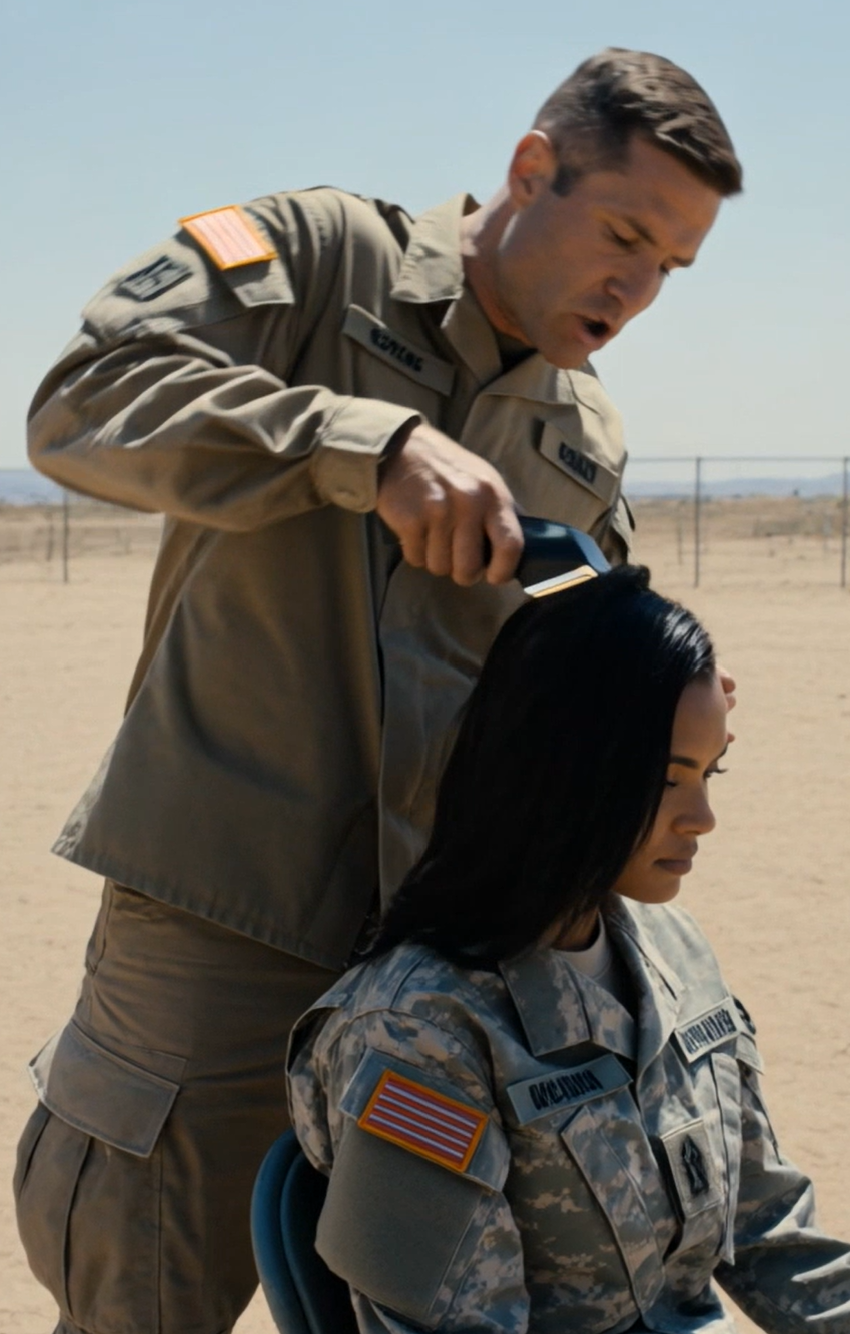
The desert training yard started the day as it always did—still, spare, and bright. A light breeze moved the dust. The only sound was the faint buzz of electric clippers cutting through the quiet. A recruit everyone knew as Shelby sat on a metal chair, hands resting on her knees, eyes steady on the horizon as if she could see past it.
Sergeant Lance stood above her, chin high, clippers humming in his hand. His words cut as sharply as the blades. “Take it all off. Pretty girls do not belong in my unit.”
Shelby did not argue. She did not plea. She stayed still and calm, like someone who had learned how to breathe through a storm. Around them, tension gathered in the sun-baked air, felt by everyone but her.

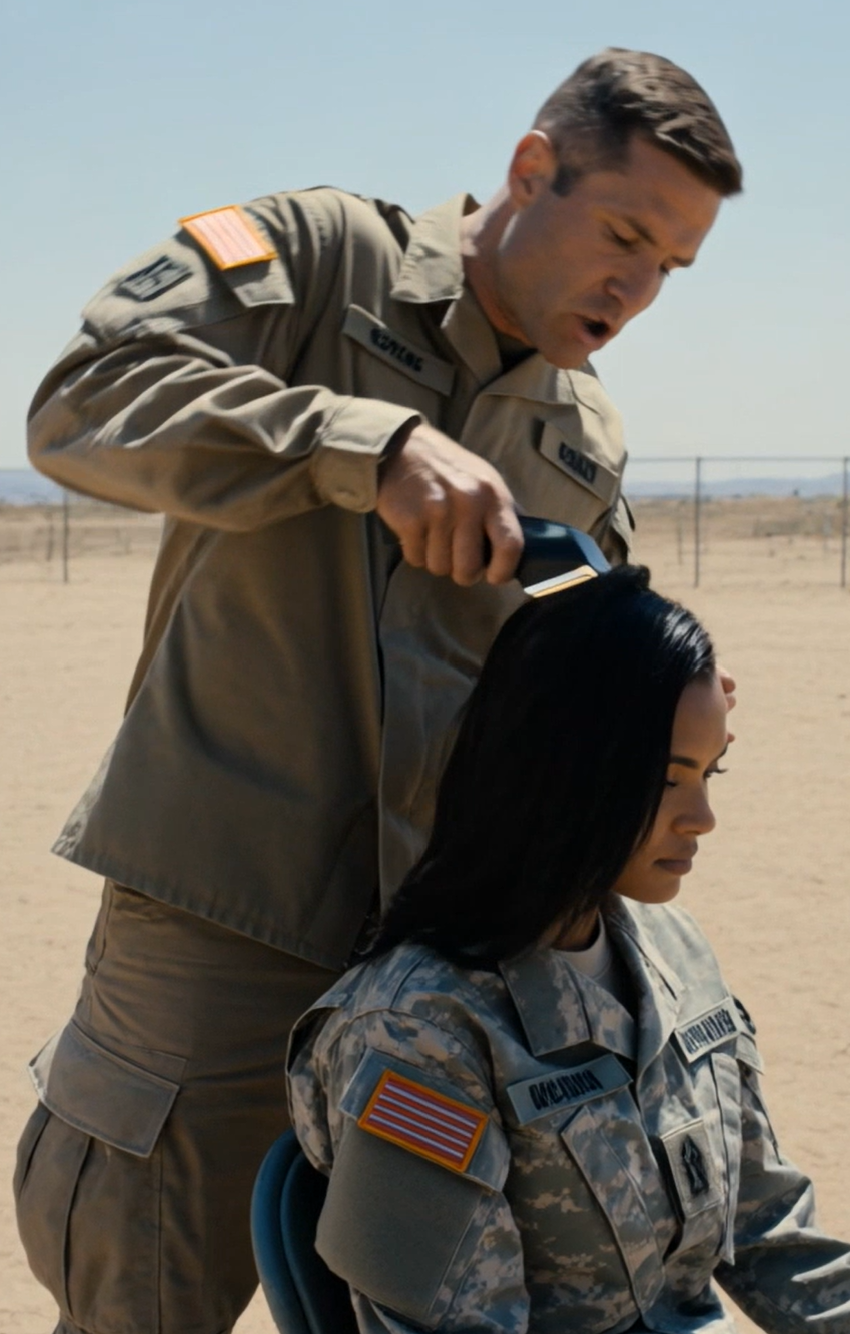
The first strands fell onto the dusty ground. Then more followed. Soon, a small drift of dark hair circled the chair. Shelby did not wipe her face or look down. She kept her gaze on the far distance and breathed slowly, in and out, as if she were somewhere else entirely—watching, waiting, and taking it all in.

Sergeant Lance laughed and motioned toward a nearby corporal holding up a phone. “Smile for the camera,” he said. “This is how we break the soft ones.”
Across the yard, the platoon stood frozen. They knew Lance’s temper. They knew his pride. They knew he believed no one would challenge him. He saw Shelby as someone he could shame, scare, and push out.
He misjudged her completely.
When the last lock of hair drifted down, the clippers went quiet. Lance clapped his hands together as if to mark a job done. “There. Now you look like a soldier.”
Shelby rose slowly. She did not brush away the loose hair on her shoulders. She did not look at the ground. She lifted her chin and met his eyes. The air shifted. The nerves no longer came from her. They came from him.
“You are right, Sergeant,” she said evenly. “I do not belong in this unit.”
With a careful motion, she reached into her boot and drew out a small metal badge that flashed in the sun. It was not a scrap of paper or a handkerchief. It was official identification.
Lance stepped back. The confidence left his hands first, then his face.
“My name is Major Theresa Hollis, Army Criminal Investigation Division,” she announced, voice clear across the yard. “For the last three weeks, I have not been training. I have been building a case.”
Two Military Police soldiers stepped from behind the barracks, handcuffs already in their hands. Lance looked left, then right, searching for a way out that was not there.
“You are done, Sergeant,” Major Hollis said, steady and sure.
As the MPs moved in, she turned to the corporal with the phone and took it gently but firmly. She angled the screen so Lance could see it.
“And so you understand,” she said quietly, “this video is not headed to your friends. It is already someplace much larger.”
She tipped the screen so he could read the header at the top of the live broadcast and see the growing count of viewers. His knees softened. The color drained from his face until he looked almost grey.
“No,” he whispered, the wind carrying the word away. “No, no, no.”
Major Hollis ended the stream with one calm tap. The screen went dark, but what mattered had already been seen. In real time, a senior noncommissioned officer had revealed his own abuse. There would be no burying it now.
“Him too,” Hollis said, nodding toward Corporal Davis. The young man stood frozen, his arm still lifted where the phone had been.
Another pair of MPs approached. Davis did not fight. He could not even look the Major in the eyes.
“I was just following orders,” he mumbled, voice thin and shaky.
Major Hollis held his gaze, calm and direct. “You filmed a crime and broadcast it for entertainment. That makes you part of it. The orders we choose to follow say more about us than the orders we refuse.”
Gravel crunched under boots as the MPs led both men away. The yard grew silent again. This time, it was not the silence of fear. It was the quiet that settles after a difficult truth finally lands.
The undercover truth comes into focus
The recruits—young men and women who had run, marched, and learned beside “Shelby”—looked at her with new eyes. They had seen her push through long days without complaint, help others when they stumbled, and keep her own counsel. She had seemed quiet, almost ordinary. Now the picture was clear. She was a Major. An investigator. And more than that, a steady hand willing to do the right thing in the open air of a hard place.
Hollis drew a slow breath and let the lines of command soften on her face. She was still a Major, but her role had shifted. She was now there to protect, to explain, and to set things right.
“I am Major Hollis,” she said again, voice even. “I am sorry for the disguise. I was sent here because this base received multiple complaints over the last year—complaints that were filed correctly but never addressed.”
Her eyes traveled from one recruit to the next, steady and respectful.
“Many of you have been targets of Sergeant Lance’s so-called methods. Some of you were pressured for money just to get weekend passes. Some of you were forced into punishing drills in the middle of the night. And one of you—”
Her gaze found a slight young man at the back. Private Miller straightened in surprise.
“One of you was denied medical care for a stress fracture because the sergeant decided you were faking.”
Miller swallowed. He had made the anonymous call that set this all in motion. He had not imagined it would lead to this moment or this kind of justice.
“We could not just remove him quietly,” Hollis continued. “We had to show how the system around him protected his behavior. We needed evidence so clear that no one could deny it or lock it in a drawer.” She touched the bristle of her newly shorn hair. “He thought cutting my hair would make me feel small. He did not understand something very basic. Hair does not make a soldier. A uniform does not make a soldier.”
She tapped the center of her chest. “This does. Your integrity. Your courage. Your care for the person next to you. That is what makes a soldier. He tried to take that from all of you.”
Across the line, shoulders loosened. For the first time in weeks, many of them felt sure footing under their boots again.
“Training is paused,” Hollis said. “Each of you will be debriefed. Tell the truth, the whole truth. From this point forward, you are protected. Your chain of command is listening.”
She gave a small nod and walked toward the administrative building. Behind her, the wind lifted wisps of cut hair and carried them off, as if sweeping away the last of a bad spell.
Accountability climbs the chain of command
Inside headquarters, the pace shifted to a rush. Colonel Richards, the base commander, walked behind his desk, jaw tight, phone still buzzing from calls. The livestream had reached far and fast.
“Major, what were you thinking?” he said as she entered. “You broadcast that on a public channel tied to the Pentagon. I have generals asking if this base has turned into a punishment camp.”
Major Hollis stood at ease, steady and respectful. “Sir, that was the purpose. Sergeant Lance had a protector. Someone blocked complaints before they reached you. We needed to make the facts public and undeniable.”
The Colonel stopped. He studied her face—the set of her jaw, the raw scalp with its dark shadow, the calm in her eyes.
“A protector?” he asked, more quietly now.
Hollis set a sealed evidence bag on his desk. Inside lay the phone she had taken from Corporal Davis. “The corporal kept records,” she said. “Text messages, instructions, numbers. He did not understand he was keeping a log of a crime.”
She tapped the evidence bag. “I have only begun to review it all, but one pattern is clear. They complained often.”
“Complained about what?” the Colonel asked, leaning forward.
“About the cut their captain was taking,” Hollis said, voice even.
The Colonel sank into his chair as if he had been hit by a strong wind. “Captain Reynolds,” he said, half-statement, half-question.
“Yes, sir,” Hollis replied. “Lance shook down trainees for cash and favors. But he did not keep it all. He sent twenty percent to Captain Reynolds. In exchange, he received glowing evaluations and cover when complaints arose.”
The room went quiet enough that the hum of the air system sounded loud. Disbelief crossed the Colonel’s face, then settled into tired anger. He had trusted Reynolds. Many had.
“Reynolds was a fast-tracker,” he said, almost to himself. “Hand-picked from above.”
“Sir,” Hollis said gently, “sometimes the brightest shine covers the deepest rot. This was not only about money. It was also about pride. The captain liked the numbers Lance produced and chose not to ask how they were made, as long as his share arrived and the unit looked good on paper.”
The office door opened. Captain Reynolds stepped in with a file and a practiced smile. “Colonel, you wanted to see me? I am hearing the most outrageous—”
He stopped. He saw Major Hollis. He saw her shaved head. He saw the evidence bag. Color drained from his face as the reality of the situation settled on him like a heavy coat.
“Captain Reynolds,” Hollis said clearly. “We were just discussing financial irregularities within your command.”
Training and habit carried him forward. He tried to sound relaxed. “Major, I am not sure what you think you have. If an NCO misbehaved, it is news to me. I run a tight ship.”
“So tight,” Hollis replied, “that you did not notice weekly cash deposits into your account matching exactly twenty percent of what was taken from trainees? Digital trails are stubborn things. They do not fade just because someone wishes they would.”
This was the second layer of the case. The texts had pointed the way. The subpoena her team executed earlier that day traced a clean line from Lance’s cash to Reynolds’s bank account. The records sat on Hollis’s tablet, time-stamped, verified, and ready.
Reynolds looked from Hollis to the Colonel. In the pause that followed, his confidence deflated. The performance was over. There were no lines left to say.
“Colonel, I can explain—” He did not finish. Richards raised a hand.
“No, Captain. You cannot,” the Colonel said, voice level. “You can explain it to Major Hollis and to the Inspector General’s investigators. They will be here within the hour. Your service here is finished.”
Two MPs stepped in from the hallway. Captain Reynolds did not resist. He lowered his eyes and walked between them, smaller than his uniform.
When the door closed, the Colonel turned to Hollis. “Good work, Major. That rot ran deeper than I knew.”
“Just doing my duty, sir,” she said.
He shook his head. “This took more than duty.” His eyes drifted to her close-cropped hair. “Go to the infirmary. Get checked. Then take some leave. That is an order.”
Hollis nodded, stepped outside, and let the sun warm her face. It felt like a new day for the whole post.
Three months later: a new kind of ceremony
Under the same open sky, the scene could not have been more different. The recruits who had once trained under Lance stood straight and proud in dress uniforms. They looked steady, confident, and ready. Their new drill sergeant—a tough, fair woman who drove them hard and treated them with respect—called them to attention. The formation moved as one.
Colonel Richards took the podium. His voice carried pride and relief. “Today we recognize a class of soldiers who carried more than most on their way to this field. You showed resilience, integrity, and honor. You are what we hope to be.”
He introduced a guest. Major Theresa Hollis walked onto the stage in formal dress. A soft shadow of dark hair had grown in, and she wore no hat. Applause rolled across the field and did not stop for a long moment. Rules bent in the face of gratitude.
After the ceremony, families wrapped their arms around newly minted soldiers and posed for photos. Private Miller approached Major Hollis. The anxious recruit she remembered was gone. A steady young soldier stood before her.
“Major Hollis,” he said, voice clear. “We never thanked you properly.”
She smiled warmly. “You do not need to thank me, Private. You did the work. You stayed when it was hard. You trusted the process again, even after it let you down. You became the soldiers you were meant to be.”
Miller shook his head. “We stayed because you showed us how. You showed us strength is not about shouting or fear. It is about standing up for what is right, even when you are standing alone.”
He held up a small box. “We all chipped in. It is not official, but we wanted you to have it.”
Inside lay an Army Commendation Medal purchased from the base store. Simple and heartfelt, it said what words could not. It honored what she had given up and what she had helped them regain.
With careful hands that trembled just a little, Miller pinned the ribbon on Hollis’s uniform beneath her official decorations. It was light in weight but heavy with meaning.
Hollis looked from the medal to the faces gathered around her—soldiers now, and something more like family. They had not been forged by cruelty. They had been shaped by fairness, courage, and care. In that moment, the lesson stood whole and clear.
The lesson that lasts
Sergeant Lance had ordered a haircut to strip away identity and dignity. He meant to humiliate. Instead, he unmasked himself. He showed everyone what real weakness looks like. He did not break Major Hollis. He revealed what could not be broken.
True strength is not found in putting people down. It grows in the choice to serve, to protect, and to do the right thing when there is a cost. Real leadership does not crush people to make them tough. It lifts them up so they can discover the strength they already carry.
For those recruits, for the leaders on that post, and for the thousands who watched a calm woman stand her ground under the desert sun, that truth settled in and stayed. As they moved forward in their service—and in their lives—it guided them the way a good compass does, steady and sure.
In the end, the haircut meant to degrade became a mark of resolve. The video meant to amuse a small circle became a bright light that showed a wider problem. And an undercover Major reminded all who watched that integrity, compassion, and accountability are not just lines in a handbook. They are the living heartbeat of a healthy unit and the trust between those who wear the uniform and the people they serve.
That is why, when the last notes of the graduation march faded, the new soldiers stood a little taller. They had learned to tell real strength from empty bravado. They had seen a leader ask nothing of them that she would not risk herself. Because of that, they left the field not only trained, but changed—ready to carry forward a standard they knew how to live, not just salute.



