
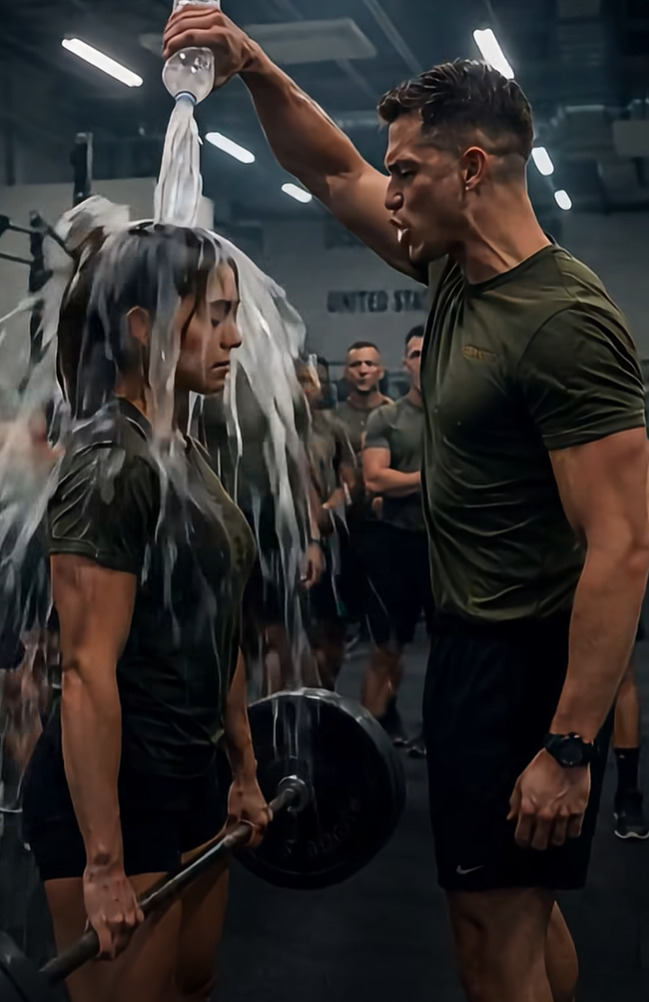
The first thing I felt wasn’t anger. It was the cold.
Water slid down my scalp, soaked through my uniform, and clung to my skin like a second layer of humiliation. Laughter erupted around me – sharp, careless, cruel.
I stood there, motionless, in the center of a room that had already decided I didn’t belong.
And in that moment, I realized something terrifying: none of them were going to stop him.
I had been in the unit for exactly one day. One. That was all it took for them to label me, judge me, and reduce me to something less than human. Not because I failed. Not because I was weak. But because I was the only woman in a room full of men who’d never been told “no” without consequences.
The gym smelled like iron, sweat, and ego. When I walked in, everything didn’t stop – but it shifted. Conversations twisted. Eyes followed. Silence formed between words.
“Don’t get in the way,” one of them muttered, not even looking up.
“This isn’t for you, sweetheart,” another added, louder.
I didn’t respond. I’d trained in places where silence meant survival. Where emotion was a liability. I moved to a machine and started my routine. Focused. Precise.
And that – my silence – was what triggered him.
His name was Sergeant Brennan. Tall. Built like a threat. He stepped forward like he owned the air I was breathing.
“You deaf?” he snapped.
I paused. Slowly turned my head. And before I could say a word, he picked up a full water jug off the bench and emptied it over my head.
The room exploded. Laughter. Whistling. Someone slow-clapped. Brennan smirked, waiting for me to cry. To run. To break.
I didn’t move. I just stared at him, water dripping from my chin onto the rubber mat.
That’s when the side door slammed open.
Commander Hollis walked in – the kind of man whose footsteps made grown soldiers stand straighter. The laughter died instantly. Brennan’s smirk twitched.
The Commander’s eyes swept the room. Then landed on me. On the puddle. On the empty jug in Brennan’s hand.
His jaw locked. And then he said the eight words that turned every face in that room to stone.
“Soldier… do you know who her father is?”
Brennan’s mouth opened. Nothing came out.
The Commander took one step closer, and what he said next made Brennan’s knees actually buckle.
“Her father is Michael Thorne. The man who cleans the barracks you sleep in.”
A wave of confusion washed over the room. Not a General. Not a politician. A janitor. The tension broke for a second as a few soldiers exchanged bewildered glances. Brennan almost looked relieved, as if this was some kind of joke.
Hollis’s voice dropped, becoming dangerously quiet. “And he’s the man who taught me everything I know about honor.”
The silence that followed was absolute. It was heavier than any physical weight. Brennan’s face went from confused to pale.
“He taught me that a person’s worth isn’t measured by the rank on their collar or the muscle on their bones,” Hollis continued, his gaze burning a hole through Brennan. “It’s measured by the integrity of their work when no one is watching.”
He turned his head slightly, addressing the entire room now. “Every single one of you walks on floors he has scrubbed. You use facilities he keeps sanitary. You benefit from his labor every single day, and you don’t even see him.”
Hollis took another step toward Brennan, who flinched. “This man, Michael Thorne, served this country for twenty years. He saw more action in his first tour than you’ve seen in your video games.”
The Commander’s voice was laced with a deep, personal history that I hadn’t even fully understood myself. My dad never talked about his service.
“He left the service with a chest full of medals he keeps in a shoebox, and he chose a quiet life. A life of service in a different way. A life you clearly think is beneath you.”
Hollis pointed a rigid finger at Brennan. “You want to prove how tough you are, Sergeant? You will report to Michael Thorne every evening at eighteen hundred hours. You will be his assistant.”
A nervous snicker came from the back of the room. Hollis’s head snapped in that direction.
“You will mop the floors. You will scrub the latrines. You will take out the trash. And you will do it until Mr. Thorne tells me you’ve learned what it means to do an honest day’s work. Is that clear?”
“Sir, yes, sir,” Brennan choked out, his voice barely a whisper. The arrogance was gone, replaced by a profound, soul-crushing humiliation.
“Get out of my sight,” Hollis commanded. “All of you.”
The room emptied in record time, soldiers scrambling over each other to escape the Commander’s wrath. Soon, it was just him and me, standing in the puddle.
He looked at me, his expression softening from granite to something like concern. “Are you alright, Thorne?”
“I’m fine, sir,” I said, the words coming out steady despite the trembling in my hands.
He handed me a dry towel from a stack on a nearby bench. “Your father is a good man, Sarah. One of the best I’ve ever known.”
I just nodded, not trusting myself to speak. I had never wanted this. I had never wanted his name, his past, to be a shield for me. I wanted to earn my place on my own.
In the days that followed, the atmosphere changed. The open hostility disappeared, but it was replaced by something just as isolating: an awkward, fearful deference.
Soldiers would part like the Red Sea when I walked down a hallway. No one would sit at my table in the mess hall. They weren’t my peers anymore; I was a minefield, an extension of the Commander’s authority.
I was more alone than ever.
Every evening, I’d see Brennan. He’d be pushing a mop bucket, his face a mask of sullen resentment. My dad would be there, quiet as ever, showing him how to mix the cleaning solution or how to properly wring out a mop.
My dad never said a word to him about what happened. He just treated him like any other person who needed to learn a job. That seemed to frustrate Brennan more than anything.
One night, I stayed late in the comms room, going over training manuals. When I left, I passed the barracks they were cleaning. The hallway was empty except for them.
Brennan slammed a mop into the bucket, splashing dirty water on his boots. “Why don’t you just say it?” he snarled at my dad.
My dad paused his sweeping and looked up. He was a small man, made smaller by age, his back slightly stooped. “Say what, son?”
“That I’m a piece of garbage. That I’m not fit to wear the uniform. Just get it over with.”
My dad leaned his broom against the wall and walked slowly toward him. He looked at Brennan, not with anger, but with a weary sort of pity.
“I don’t think you’re a piece of garbage,” he said, his voice soft. “I think you’re scared.”
Brennan recoiled. “I’m not scared of anything.”
“You’re scared that you’re not as strong as you pretend to be,” my dad said gently. “Real strength isn’t about making other people feel small. It’s about knowing you have the power to lift them up, and choosing to do it.”
He gestured to the floor. “This work… it’s not a punishment. It’s a lesson. There’s dignity in it. It’s honest. You start with a mess, and you leave it better than you found it. That’s all any of us can try to do in life.”
Brennan just stared at him, speechless. For the first time, the anger in his eyes was replaced by a flicker of confusion. Of thought.
I slipped away before they could see me, my heart aching with a pride so fierce it almost hurt.
The unit was scheduled for a three-day field exercise in the mountains. It was grueling. Navigation, survival skills, endurance tests. It was my chance. My chance to prove I was more than Michael Thorne’s daughter.
I pushed myself harder than anyone. I carried my own weight and then some. I was the first to volunteer for the toughest tasks. Slowly, tentatively, a couple of the other soldiers started talking to me. Asking my opinion on a map reading. Sharing a ration pack.
On the second day, a storm rolled in. Not a gentle rain, but a violent, whipping deluge that turned the trails to mud and the sky to a dark, angry gray. Visibility dropped to near zero.
We were making a river crossing on a rope bridge we’d constructed when a flash flood surged down the mountain. The water level rose in an instant, tearing at the anchors.
A young soldier named Peterson lost his footing on the far side and was swept into the raging current. He was a weak swimmer, and panic contorted his face as he was pulled downstream.
The protocol was clear: throw a line, don’t go in. The current was too strong. But Peterson was being dragged toward a series of rapids. He wouldn’t last a minute in there.
While everyone else was fumbling with ropes, yelling into their radios, one person moved.
It was Brennan.
He sprinted along the riverbank, keeping pace with Peterson. He wasn’t yelling. He was watching. Calculating. Just like I’d seen my dad do when fixing a broken pipe or a faulty wire. He was looking for a solution, not reacting to the chaos.
He saw a fallen log that had jammed between two large boulders about fifty yards downstream, creating a small, calmer pocket of water. It was Peterson’s only chance.
“Thorne!” Brennan yelled, his voice cutting through the roar of the river. “Your pack! Rope!”
I didn’t hesitate. I was already moving, shrugging off my heavy pack. We’d worked together in silence for a week, but in that moment, we understood each other perfectly.
He secured the rope around his waist while I, along with another soldier, braced ourselves, wrapping the other end around a thick tree trunk.
“When I go, give me slack, but be ready to pull!” he ordered.
Then he did something I never expected. He plunged into the churning, icy water.
It was a suicidal move. The current grabbed him instantly, but he was powerful. He fought it, swimming with controlled, desperate strokes, aiming for that spot just above the logjam. He reached Peterson just as the younger soldier was about to be pulled into the rapids.
Brennan wrapped an arm around Peterson’s chest, shielding him with his own body as they slammed against the fallen log.
“Pull!” he screamed, his voice strained.
We pulled. We dug our heels into the mud, the rope cutting into our hands. The force of the river fought us for every inch. Other soldiers joined in, a human chain of grit and determination.
Slowly, painfully, we dragged them back toward the bank. They emerged from the water, gasping, bruised, and hypothermic, but alive.
Later that night, huddled around a miserable fire in a makeshift shelter, the unit was different. The silence around me was gone. It was replaced by nods of respect. By shared stories.
Brennan sat apart from the main group, staring into the flames. I walked over and sat down beside him. We didn’t speak for a long time.
“Why did you do it?” I finally asked.
He looked at me, his eyes reflecting the fire. “Your dad said something to me. He said real strength is about lifting people up.”
He paused, a wry, tired smile touching his lips. “He also told me to always check the integrity of my knots. And to notice when something is out of place. I noticed Peterson’s face. He was more scared than I was.”
We sat in comfortable silence after that.
When we got back to base, there was an official inquiry. Brennan received a formal reprimand for breaking protocol and endangering himself.
He also received a medal for valor. Commander Hollis pinned it on him himself in front of the entire company.
The next evening, I saw Brennan walking toward the barracks with a mop and bucket. His “punishment” detail had officially ended, but he was still going.
I caught up with him. “You don’t have to do that anymore.”
He shrugged. “I know. But Michael… your dad… he was going to teach me how to use the floor buffer tonight. And he likes to talk while we work.”
A few weeks later, I was walking past the mess hall after hours and I saw them. My dad and Sergeant Brennan, sitting at an empty table, sharing a thermos of coffee, laughing about something.
They weren’t a janitor and a soldier. They weren’t a punishment and a penance. They were just two men, sharing a quiet moment of friendship before starting an honest day’s work.
I finally understood. My father’s strength wasn’t in some hidden rank or heroic past he kept secret. His strength was in his character. It was in his quiet dignity, his unwavering integrity, and his belief that every single person, and every single job, has value.
He didn’t need to be a general to be a great man. He just needed to be himself.
And that quiet, unassuming strength was the most powerful force I had ever witnessed. It could change a man, it could unite a team, and it had, without a doubt, saved a life. True honor isn’t found in the glory of the spotlight, but in the humble, thankless work done in the shadows. It’s about leaving every place, and every person, a little better than you found them.



