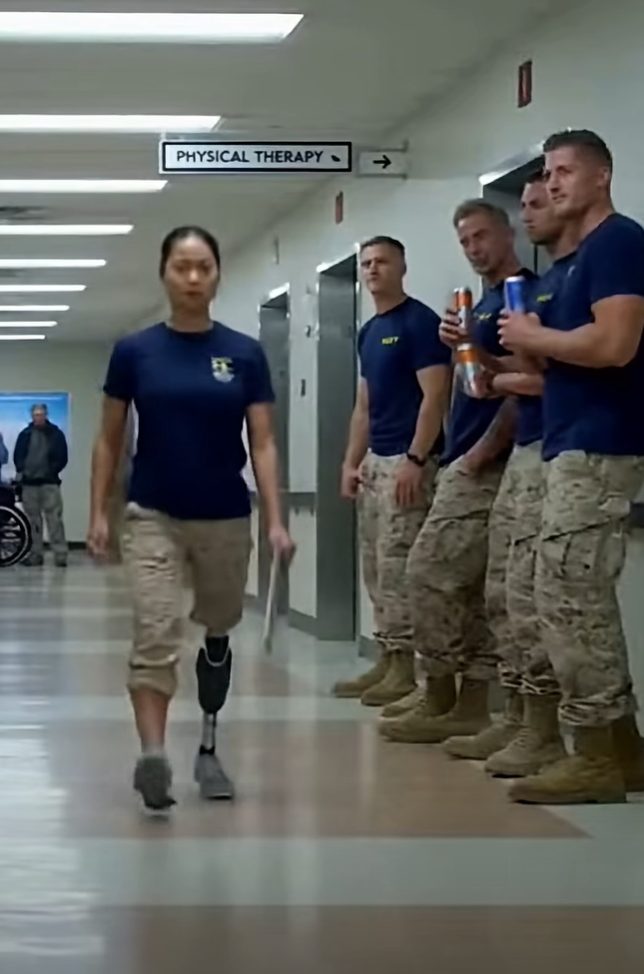
The San Diego VA Medical Center hallway smelled like disinfectant and burnt coffee – a familiar scent that usually brought me a perverse comfort. My name is Sarah, and I’m twenty-nine years old. I was walking toward physical therapy, each click of my prosthetic echoing in the quiet.
It was titanium and carbon fiber, a part of me now, replacing what an IED in Kandahar had stolen three years ago. Most days, I didn’t think about it, not really. It was just how I moved.
Then I heard him. “Jesus, look at her limp,” one of the SEALs muttered. There were five of them, all in their late twenties, fresh out of BUD/S, leaning against the wall near the elevator. They were drinking energy drinks, full of themselves.
I kept walking, trying to project an aura of indifference. My physical therapist always said, “Keep your head up, focus on the goal.” It was usually good advice.
“Bet she was a desk jockey,” another one said, louder this time. “Admin types always cry about their ‘injuries.’” My face burned. My hands clenched into fists. I wasn’t a desk jockey. I was a helicopter pilot. I’d flown seventeen combat missions. I’d pulled three wounded Marines out of a hot zone with hydraulics failing. But I kept walking.
“Ma’am, you need help?” The tallest one stepped in front of me, blocking my path. He wore a smirk, and something in my gut twisted. “Maybe you should use the wheelchair entrance. You’re holding up traffic.”
Behind them, other vets in the hallway had stopped. An elderly man with a walker. A young guy with burn scars. A woman pushing an empty wheelchair. All watching. My throat felt tight, but I forced the words out. “I’m fine.”
“Doesn’t look fine.” He glanced back at his buddies. “Looks like someone got a medical discharge for a boo-boo and now wants sympathy points.”
“Move,” I said, my voice barely a whisper.
“Or what?” He leaned closer. “You gonna run after me?”
That’s when the elevator dinged.
Everyone turned. General Marcus Webb stepped out. Four stars on his collar. Seventy-two years old, with steel-gray hair and a ramrod-straight back. He’d commanded JSOC. He’d overseen operations in three wars. Every servicemember in that hallway recognized him instantly. The SEALs straightened. The smirk vanished from the tall one’s face. “Attention,” someone whispered.
General Webb walked straight toward them. His eyes locked on the SEAL blocking my path. The hallway went completely silent. Even the intercom seemed to stop crackling.
“Name,” the General said. His voice was quiet. Cold.
“S-Staff Sergeant Miller, sir. SEAL Team Three.”
“SEAL Team Three,” the General repeated. “You just graduated BUD/S?”
“Yes, sir.”
“Then you don’t know SHIT yet.” The General stepped past him and stood next to me. “Lieutenant Chen here flew CH-47s. She evacuated forty-three wounded in twelve months. She lost her leg pulling a bird out of a firefight when most pilots would’ve bailed.” My eyes stung. I hadn’t expected this.
“But that’s not why I’m here,” the General continued. He turned to face all five SEALs now. The elderly vet with the walker had moved closer. More people were gathering. “I’m here for my appointment. Same one I’ve had every Tuesday for six years.”
The General reached down. His fingers found the hem of his right pant leg. He rolled it up slowly, revealing what nobody in that hallway had ever seen. A prosthetic leg. Older model than mine. More scarred. The kind they gave out in the nineties. “Lost it in Mogadishu,” he said. “1993. I commanded the Rangers there. Got hit in the firefight. Spent two years learning to walk again.” My breath caught. Staff Sergeant Miller’s face had gone white.
“Every person in this hallway,” the General continued, his voice carrying now, “has earned their place here. Every. Single. One.” He looked at me, then back at the SEALs. “And if I ever hear about any of you disrespecting a wounded servicemember again, you’ll find yourself – “
The General stopped mid-sentence. His eyes had shifted to something on my uniform. A small pin I wore above my ribbons. A memorial pin. His hand moved to his own chest, where an identical pin sat. “Where did you get that?” His voice had changed. Softer now. Almost shaking.
I touched the pin. “It was my co-pilot’s. Emily Webb. She didn’t make it out of the crash. I promised her – ” The General’s hand was trembling now. “Emily was my daughter.”
The hallway felt like all the air had been sucked out. My vision blurred. “Sir, I… I tried to pull her out. The fuel line was – “
“I know.” The General’s voice cracked. “I read the report. Fifteen times. You stayed with her. You held her hand while the fire – ” He stopped. Tears ran down his weathered face. Everyone in that hallway stood frozen.
The General reached into his pocket. Pulled out a folded piece of paper. His hands shook as he unfolded it. “This is what she wrote,” he whispered. “Her last letter. She mailed it two days before the mission.” He began to read aloud, and I recognized Emily’s handwriting, Emily’s words: “Dad, if anything happens to me, find Sarah Chen. She’s the best pilot I know. The best person I know. Tell her…”
What Emily Said
He couldn’t finish it right away.
He tried. His mouth opened, and nothing came out for a good three seconds. The paper shook in his hands. And General Marcus Webb, four stars, JSOC, Mogadishu, thirty-eight years of not flinching at anything – he just stood there in a VA hallway on a Tuesday morning and could not speak.
I knew that feeling. I’d had it for three years.
Finally he got his breath back and kept reading. His voice was low, and the hallway was so quiet you could hear the fluorescent light above us buzzing. “Tell her I wasn’t scared because she was there. Tell her I knew we’d both make it, and when I was wrong about that, I was still glad it was her next to me. Tell her she has a habit of checking the altimeter twice every time she banks left, and I used to think it was annoying and then I realized it was the reason we were still alive. Tell her – ” He stopped again. One breath. “Tell her she’s going to be fine. She doesn’t believe that yet. But she will.”
I put my hand over my mouth.
I don’t know why that was the gesture my body made. It just was.
Emily had written that two days before the mission. She’d known something, or she’d felt something, or maybe she was just the kind of person who wrote letters like that the way other people bought extra batteries. Prepared. Always prepared. I’d yelled at her once for triple-checking the pre-flight checklist and she’d looked at me completely straight-faced and said, “Sarah, the checklist exists because someone died not doing it.” That was Emily. Twenty-six years old and already more serious about staying alive than anyone I’d ever met.
She didn’t stay alive. And I did. And for three years that fact had sat in my chest like a piece of shrapnel that the surgeons decided to leave in.
The Five Minutes After
The General folded the letter back up.
He didn’t make a production of it. Just folded it along the same worn creases, the way you fold something you’ve unfolded a hundred times, and put it back in his breast pocket.
Then he looked at me for a long moment. Not the way someone looks at you when they’re trying to figure out what to say. The other kind. The kind where they already know and they’re just letting it land.
“She talked about you in every letter,” he said. “For eight months.”
I didn’t know what to do with that. My brain kept trying to find the right response and coming up empty.
Staff Sergeant Miller and his four buddies had not moved. They were still standing there, but they’d changed shape somehow. Smaller. Not physically, but the way a room feels smaller after something real happens in it. Miller’s energy drink was still in his hand and he looked like he’d forgotten it existed.
The elderly man with the walker – I found out later his name was Don Purcell, Korea vet, eighty-one years old, came to the VA every week for blood pressure medication – Don had gotten himself up close enough to hear. He wasn’t looking at the SEALs. He was looking at the General and me like he was watching something he’d been waiting a long time to see.
The woman with the empty wheelchair had sat down in it herself. I noticed that. She just quietly sat down.
General Webb turned back to the five of them.
He didn’t raise his voice. That was the thing about him, I’d learn later – he almost never did. “You five will find your commanding officer today. You’ll tell him what happened in this hallway. All of it. You’ll tell him General Webb witnessed it and expects a full account.” He paused. “And then you’ll come back here, and you’ll apologize. To Lieutenant Chen. And to every other person in this hallway you made feel small.” His eyes moved down the line. “You don’t have to mean it yet. But you’ll do it. And maybe in ten years, when you actually know something, you’ll understand why.”
Miller opened his mouth. Closed it. Nodded once. “Yes, sir.”
What She Made Me Promise
We ended up in the cafeteria.
Not because either of us planned it. The General had his appointment, I had mine, and somehow we both just walked past our respective hallways and ended up at a corner table with two bad cups of coffee between us.
He asked me about the crash. The real version, not the report version.
I told him. All of it. The hydraulic failure at four hundred feet. The way the bird started pulling left and I couldn’t correct it. Emily on the radio staying completely calm, running through the emergency checklist, her voice totally even, and me thinking, she’s going to be the one who gets us out of this. The impact. The fuel smell. The fire that started in the tail section and moved faster than fire should move. Me getting my door open. Her door jammed.
I told him about the forty seconds I spent trying to get her out.
I don’t know why I told him all of it. Maybe because he’d already read the report fifteen times and there was nothing I could say that would be worse than what he’d already imagined.
He listened without interrupting. He held his coffee cup with both hands and he listened.
When I finished he said, “She made you promise something.”
It wasn’t a question.
“Yeah,” I said.
“What was it?”
I looked at my coffee. The pin on my chest felt warm, which was crazy, it was a piece of metal, but it felt warm. “She said, ‘Don’t let this be the thing that ends you.’ She said it twice. She was very – ” My throat caught. “She was very specific about it. She said, ‘I mean it, Sarah, don’t you dare.’ Like she was annoyed at me for something I hadn’t done yet.”
The General made a sound that was almost a laugh. Almost. “That was Emily.”
“Yeah.”
He reached across the table and put his hand over mine for a second. Just a second. Then he picked his coffee back up. “Are you keeping it?”
I thought about the three years. The prosthetic. The physical therapy every Tuesday. The nights that were bad and the mornings that were worse and the slow, grinding work of building a life that looked nothing like the one I’d planned.
“I’m trying,” I said.
“Good.” He nodded once. “That’s all she asked for.”
Tuesday After Tuesday
That was fourteen months ago.
I still go to physical therapy on Tuesdays. The click of the prosthetic doesn’t bother me the way it used to, or maybe it does and I’ve just stopped keeping score.
General Webb and I have coffee after our appointments most weeks. He’s teaching me to play chess. I’m terrible at it. He finds this genuinely funny, which is the only time I’ve seen him look his age in a good way.
Miller came back three days after the hallway. He came alone, without the other four. He stood in front of me in the same spot and apologized without any preamble or excuse-making. I don’t know what happened to him after that, whether it stuck or not. People are complicated and I’m not in the business of deciding who’s redeemable. But he came back. That counted for something.
Don Purcell, the old man with the walker, stopped me in the parking lot that same Tuesday and shook my hand for a long time without saying anything. Then he said, “You flew CH-47s?” I said yes. He said, “My son flew Hueys in Vietnam. He came home.” Just that. He came home. Don said it the way you say something that you’ve been grateful for every single day for fifty years and the gratitude still hasn’t worn smooth.
I thought about Emily on the drive back.
I do that. I think about Emily. I think about what she’d say about the chess, about Don, about the pin on my chest that used to feel like a wound and now feels like something else. Something I don’t have a clean word for.
She’d probably tell me I was being dramatic. She’d check the altimeter twice and tell me to focus.
I’m focusing.
I’m trying.
That’s all she asked for.
—
If this one got to you, pass it along to someone who needs to read it today.
For more stories that show how moments of tension can reveal true character, check out “You Missed A Spot, Mop Guy.” – The Day A Cafeteria Janitor Exposed A Colonel’s Deadly Secret, or read about the unexpected turn of events in “She Was The Only Woman In The Unit – So They Drenched Her. Then The Commander Walked In.” and “He Humiliated Me In Front Of Fifty Soldiers – Then My Father Walked Through The Door”.