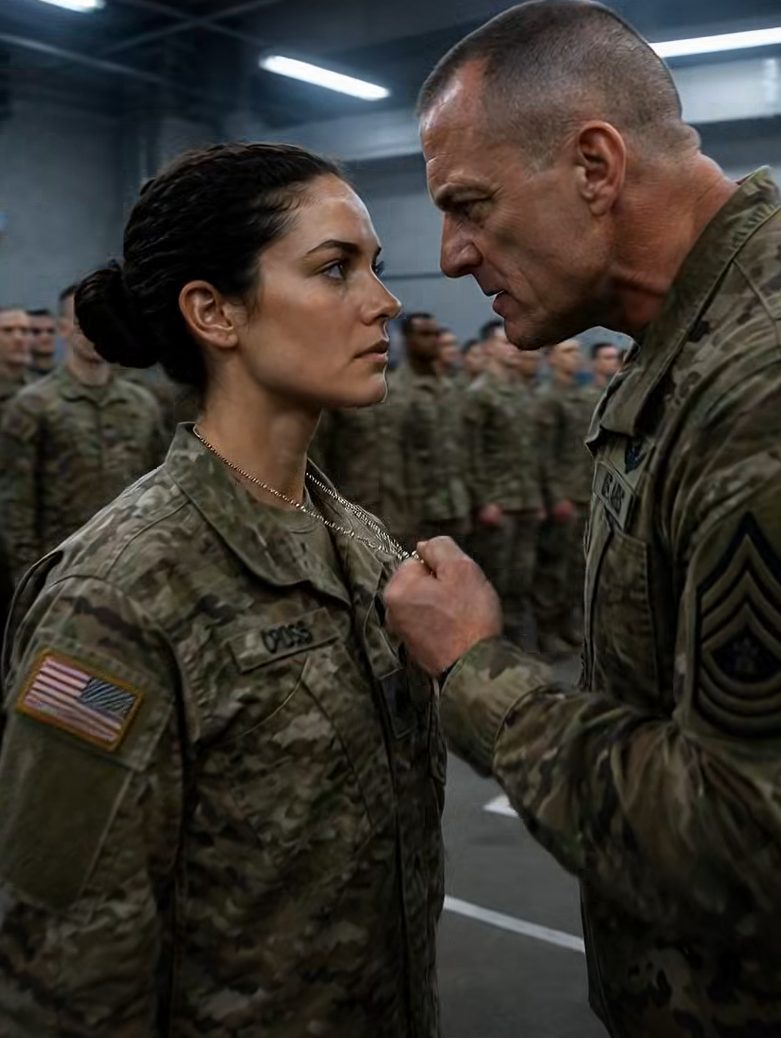
He yanked her dog tags like he was trying to start a fight.
“Let’s see if the Army got at least one thing right about you.”
The metal chain snapped tight against the back of Corporal Cross’s neck, forcing her chin up under the harsh fluorescent lights. A few soldiers laughed – too quickly, too sharply – before realizing this wasn’t humor. It was a performance. And Sergeant Harlow expected an audience.
She didn’t move. Didn’t flinch. Didn’t reach for the chain digging into her skin.
She stood perfectly still inside the white inspection square. Boots aligned. Hands flat at her sides. Eyes locked forward like he wasn’t even there.
That… bothered him. More than fear ever could.
“Look at me when I’m talking to you, Corporal.” His breath hit her cheek, hot and sour with coffee. The chain bit deeper. “You think you’re better than the rest of us? You think those little tags mean something?”
She said nothing.
A bead of blood slid down her collarbone where the chain had broken skin. Nobody in the hangar moved. Nobody breathed.
Harlow smiled. He thought he was winning.
He flipped the tags over to read her name out loud – wanted the whole room to hear him mock it. His eyes scanned the stamped metal once. Then twice.
The color drained from his face.
His hand started to shake.
Because the name on those tags wasn’t “Cross.” That was the name on her uniform. The name stamped into the metal was a name every soldier on that base had been briefed about forty-eight hours ago – the name of the officer flying in from Washington to investigate him.
And standing in the doorway behind her, holding a clipboard and watching the entire thing unfold, was a young Specialist who Harlow had dismissed just an hour earlier as some paper pusher from headquarters.
The Specialist, a man named Davies, met Harlow’s terrified gaze. He simply tapped his pen against the clipboard, a tiny, crisp sound that echoed in the sudden, suffocating silence of the cavernous hangar.
Harlow’s hand, which had been gripping the chain like a vice, went limp. The dog tags clattered against the front of the Corporal’s uniform.
He took a stumbling step back, his face a mask of disbelief and pure, unadulterated panic.
“Colonel… Vance?” he whispered, the name tasting like ash in his mouth.
Corporal Cross, or rather, Colonel Eleanor Vance, finally broke her posture. She didn’t look at him. Not yet.
She slowly raised a hand to her neck, her fingers coming away with a smear of her own blood. She looked at it for a moment, her expression unreadable.
Then, her eyes, cold and sharp as chipped ice, moved to meet his.
“Sergeant Harlow,” she said, her voice quiet but carrying the weight of absolute authority. It cut through the hangar more effectively than any shout ever could. “You were saying something about my tags?”
The nervous laughter from minutes ago was a distant memory. Now, the other soldiers in formation looked like statues, their faces pale. They were no longer spectators at a hazing; they were witnesses at a career execution.
Harlow opened and closed his mouth like a fish, but no sound came out. Sweat was beading on his forehead, tracing paths through the grime of the morning’s exercises.
“I… I didn’t…” he stammered, his mind racing for an excuse, an escape hatch that didn’t exist. “It was a… a readiness test, Colonel. To test her composure under pressure.”
Vance gave a small, humorless smile. “Is that what you call it? Interesting terminology.”
She took one step out of the inspection square, a clear violation of the rules he’d been enforcing with an iron fist. But no one, least of all Harlow, was going to call her on it.
Specialist Davies walked forward, his footsteps echoing on the concrete floor. He stopped beside Vance and held out the clipboard without a word.
Vance took it, her eyes scanning the top sheet. “Specialist Davies has been meticulously documenting your… ‘readiness tests’ for the past seventy-two hours, Sergeant.”
She looked back up at Harlow. “He’s noted eighteen separate incidents of verbal abuse, four instances of unauthorized physical contact with junior personnel, and this,” she gestured to her neck, “which will be classified as assault.”
Harlow’s eyes darted around the room, looking for an ally, a friend, anyone. He found only the downcast gazes of the soldiers he had terrorized for months. There was no support here. Only a quiet, simmering resentment that was finally about to boil over.
“This is a misunderstanding,” Harlow pleaded, his voice cracking. “I run a tight unit. I build character. I make soldiers.”
“No, Sergeant,” Vance said, her voice dropping even lower, more personal. “You break them. And I’m here to find out why.”
She looked past him, her gaze sweeping over the young faces in the formation. “At ease,” she commanded.
The soldiers visibly relaxed, a collective sigh of relief moving through their ranks.
“Sergeant Harlow,” Vance said, turning her attention back to him. “You will hand over your command duties to Sergeant Miller, effective immediately. You will then report to the base commander’s office and wait for me there. Is that understood?”
Harlow nodded dumbly, his entire world collapsing in the space of five minutes. He looked at Sergeant Miller, a quiet but competent NCO he had often ridiculed, who now stared back at him with a neutral, almost pitying expression.
As Harlow turned to walk away, defeated, Vance spoke again, her voice stopping him in his tracks. “And Sergeant? You should know that ‘Vance’ is my married name.”
Harlow paused, confused.
“My maiden name,” she continued, her voice hardening with a sorrow he couldn’t comprehend, “was Peterson.”
The name hung in the air. It meant nothing to Harlow. It was just another name.
But for Eleanor Vance, it was everything.
An hour later, she sat in the base commander’s office. She had traded the Corporal’s fatigues for her own crisp Class A uniform, the silver eagle of a Colonel gleaming on her shoulders. The small cut on her neck was covered by a discreet bandage.
Across the desk, Sergeant Harlow sat stiffly, flanked by a shell-shocked Base Commander who looked like he wanted to be anywhere else on Earth.
“The investigation,” Vance began, opening a new file folder, “is not just about you, Sergeant. It’s about a culture. A culture you’ve fostered, and that you, Commander,” she said, nodding to the man beside Harlow, “have allowed.”
The Commander paled.
Vance focused back on Harlow. “Let’s talk about Private Daniel Peterson.”
Harlow frowned, genuinely searching his memory. “Peterson? I don’t… I’ve trained hundreds of soldiers, Colonel.”
“He was here six months ago,” Vance said, her voice dangerously calm. “A good kid from Ohio. Eager. A little clumsy, maybe. But he had heart. You called him ‘Butterfingers Peterson.’”
A flicker of recognition crossed Harlow’s face, followed by a dismissive shrug. “He was soft. Couldn’t hack it. He washed out.”
“He didn’t ‘wash out,’ Sergeant,” Vance corrected him. “You drove him out. You made him do push-ups in the motor pool until his palms bled. You ‘lost’ his mail from home for three weeks straight. You upended his footlocker during inspection every single day because you found his tidiness ‘arrogant.’”
She slid a photograph across the desk. It showed a smiling young man in a freshly issued uniform, his eyes bright with promise.
“Daniel Peterson was my little brother,” she said softly.
The air went out of the room. Harlow stared at the photograph, then back at Vance’s unyielding face. The puzzle pieces clicked into place with horrifying clarity. This wasn’t a random inspection. This wasn’t just about a complaint.
This was personal.
“He called me a week before he signed his discharge papers,” Vance continued, her voice thick with emotion she refused to let break. “He told me he wasn’t good enough, that he was a failure. He said a Sergeant Harlow taught him that. He said you made him believe he was worthless.”
“I… I was just trying to toughen him up,” Harlow mumbled weakly. “That’s my job.”
“Your job is to build soldiers, not to shatter a young man’s spirit so completely that he gives up on his dream,” she countered, her voice rising with righteous anger. “My brother joined the Army to be part of something bigger than himself. He wanted to serve. And you… you took that from him. For what? To feel powerful? To get a laugh from a few nervous privates?”
She took a deep, steadying breath. “When my brother came home, he wasn’t the same. The light was gone from his eyes. He sold his car to pay back his signing bonus. He wouldn’t even look at the flag. That’s what you did, Sergeant.”
This was the twist no one saw coming. Not just that she was the investigator, but that the root of the investigation was tied to her own family, to her own blood.
“After my brother told me what happened,” Vance said, “I started digging. I made some calls. And I found out that Danny wasn’t the first. You have a long, documented history of this. Soldiers transferring out, soldiers requesting discharge. Good soldiers. All from your unit.”
She looked at the Base Commander. “A pattern that should have been addressed years ago.”
The Commander swallowed hard. “Sergeant Harlow’s unit has high performance metrics…”
“Because he runs them on fear!” Vance snapped. “Metrics aren’t soldiers, Commander. People are. And you have been failing them by letting this man’s ego go unchecked.”
Over the next two days, Colonel Vance interviewed every soldier in Harlow’s former platoon. She did it not in an intimidating office, but in the casual setting of the mess hall, a coffee in her hand.
One by one, the stories came tumbling out. Stories of humiliation, of petty cruelties, of a constant, grinding pressure that had nothing to do with combat readiness and everything to do with one man’s need for control. Sergeant Miller confirmed everything about Private Peterson, his voice heavy with the guilt of having stood by and watched.
They all thought they were complaining about Harlow. But what they were really doing was giving testimony for Danny Peterson, and for every other soldier who had been pushed down instead of built up.
On the third day, Vance called Harlow back into the office.
“Sergeant,” she began, her tone all business now. “The investigation is complete. You are being charged with assault, dereliction of duty, and multiple counts of conduct unbecoming a Non-Commissioned Officer. You will face a court-martial.”
Harlow just stared at the table, a broken man.
“But that’s not all,” Vance continued. She gestured for Specialist Davies to open the door.
A young man in civilian clothes walked in. He was taller, his shoulders broader than in the photo, but his eyes were still hesitant. It was Daniel Peterson.
Harlow looked up, his eyes widening.
Vance had flown her brother to the base.
“Danny,” Vance said gently. “There’s something I need you to hear.”
She turned to Harlow. “Sergeant. You owe this man an apology.”
Harlow looked from the formidable Colonel to the young man he had tormented. All the bluster, all the arrogance, was gone. He saw not ‘Butterfingers Peterson,’ but a person whose life he had carelessly damaged. Maybe for the first time, he understood the real-world consequence of his actions.
His shoulders slumped. “I… I’m sorry, Peterson,” he said, his voice barely a whisper. “What I did… it was wrong. There’s no excuse.”
Daniel just nodded, not with forgiveness, but with a quiet sense of closure.
But Vance wasn’t finished. This was never about simple revenge. It was about restoration.
She turned to her brother. “Danny, Sergeant Miller and the Base Commander have reviewed your training record. Aside from the… ‘difficulties’… you were an excellent trainee. Your marksmanship scores were exceptional.”
She paused. “The Army is offering you a formal apology. And they are offering you a chance to reenlist, with a clean slate. You can start over, in a new unit, with a command that will support you. You can even choose your first duty station, within reason.”
Daniel looked shocked, his eyes darting between his sister and the Commander. “Really?”
“Really,” Vance confirmed. “Your dream isn’t over. It was just on pause.”
A slow smile spread across Daniel Peterson’s face, the first genuine, hopeful smile he’d had in months. It was the same smile from the photograph. The light was coming back into his eyes.
Two weeks later, Sergeant Harlow was formally reduced in rank to Private and processed for dishonorable discharge. The Base Commander was officially reprimanded and reassigned to a desk job in the Pentagon, his path to promotion permanently blocked.
Sergeant Miller was promoted to Platoon Sergeant, and the climate in the unit began to change almost overnight. The fear was replaced by respect.
Colonel Eleanor Vance stood on the tarmac, watching a transport plane take off. Onboard was her brother, Private Daniel Peterson, heading to a new post in Germany. He was starting over. He was healing.
She reached up and touched the smooth, cool metal of her own dog tags. They weren’t a symbol of rank or power. They were a reminder. A reminder of who she fought for. Not just a country, but for the people in it. For the quiet ones, the ones who get pushed down, the ones like her brother.
True leadership, she knew, wasn’t about the authority you wielded over others. It was about the responsibility you took for them. It wasn’t about demanding respect through fear, but earning it through service, protection, and lifting people up. That was the real measure of a soldier. It was the lesson her brother had almost been forced to forget, and the one she would spend her career making sure others would always remember.
For more stories of unexpected heroism and standing up to bullies, check out The General Rolled Up His Pant Leg in the Middle of the VA Hallway or discover how “You Missed A Spot, Mop Guy.” – The Day A Cafeteria Janitor Exposed A Colonel’s Deadly Secret. You might also appreciate the tale of when She Was The Only Woman In The Unit – So They Drenched Her. Then The Commander Walked In.