
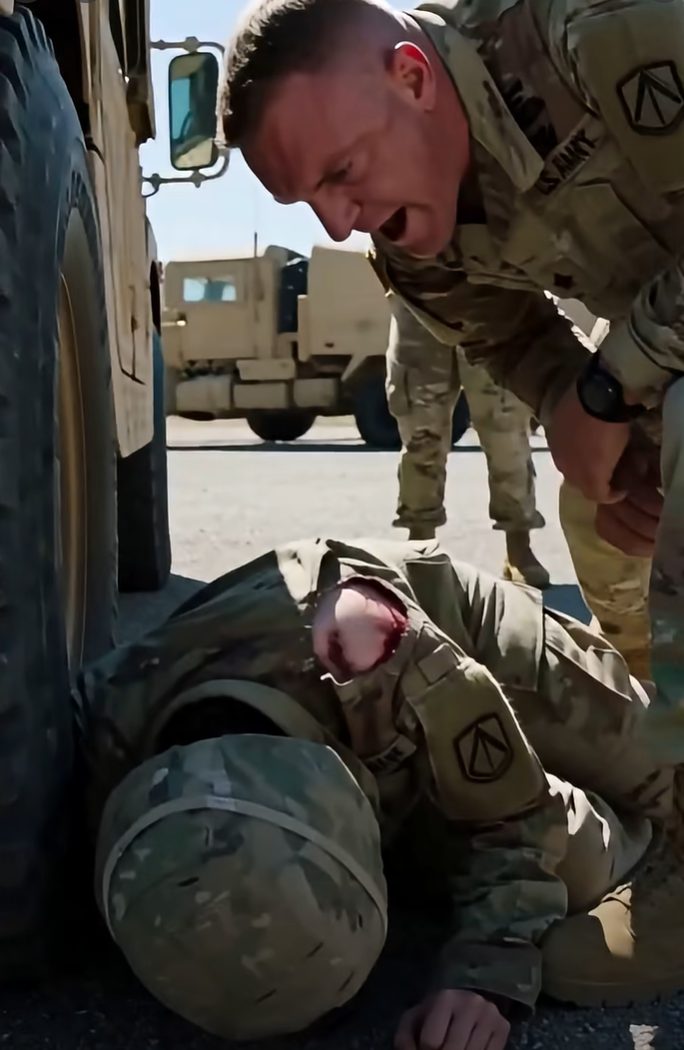
The first thing I tasted wasn’t blood. It was gravel. Grease. And the cold realization that the chain of command had already failed me.
My name is Specialist Roxanne Vance. I’m 23. I’m a medic. And three minutes ago, I was just walking back from the pharmacy with a crate of saline.
Now I was curled in the fetal position behind the motor pool, with five pairs of combat boots circling me like wolves.
“We know you filed the IG complaint,” Sergeant Bruckner whispered. His voice was too quiet. That dangerous kind of quiet. “We know you kept the logbook.”
I tried to speak. Gravel scraped my split lip. “The narcotics discrepancies aren’t my fault. I just count the vials.”
That’s when Private Hatcher stepped forward and ground his boot into my right hand.
“You think because your old man is some big-shot Navy guy, you’re untouchable out here?” he hissed. “This is OUR house.”
They knew exactly where to hit me. Abdomen. Kidneys. Thighs. Places the uniform would hide. Bruckner punched like a man who spent his weekends in off-base boxing gyms – and I think he did.
I didn’t scream.
My dad raised me better than that. Master Chief Thomas Vance. He used to sit on the porch in Coronado at 0400, cleaning a dive knife, telling me: “The world doesn’t care about your intentions, Roxie. Only your leverage.”
I had no leverage. Not yet.
When they finally walked away – unhurried, synchronized, like kings of the supply line – Bruckner knelt down and pressed his mouth to my ear. He smelled like wintergreen tobacco.
“You fell off an LMTV. That’s the story. One word about the Fentanyl log, and next time we do this at your apartment. Understood?”
“Yes,” I choked.
“Good girl.”
I lay in the dirt for ten minutes before I could move. My collarbone was screaming. My uniform was torn, soaked with melted snow and blood from my nose.
I didn’t call the MPs. Bruckner’s brother-in-law worked that desk.
I didn’t call the chaplain. He’d hand me a pamphlet on stress management.
I dialed a ten-digit number I memorized when I was six years old.
It rang twice.
No “hello.” No greeting. Just that calm, gravelly voice – the same voice that used to read me bedtime stories with a sidearm on the nightstand.
“Vance.”
“Dad.”
Silence. Three thousand miles of it. My father knows every tone in my voice – tired, angry, lying. This was none of those. This was the sound of air leaking out of a damaged vessel.
“Where are you, Roxanne?”
“Fort Carson. Behind the 4th ID motor pool. I can’t walk, Dad.”
“Who did it?”
“Sergeant Bruckner. Four others. They said they’d come to my apartment if I talked.”
I heard a zipper close on the other end. Keys rattling. Boots on concrete.
“Listen to me carefully,” he said. His voice didn’t rise. It dropped. The whole line dropped about ten degrees. “You crawl underneath that transport vehicle. You stay out of sight. You don’t look for a medic. You don’t talk to your sergeant.”
“Dad — where are you?”
“I’m at the airfield in Coronado. We just spun down from a training rotation. I’m with the boys.”
I couldn’t breathe. “The boys?”
“We’re taking a bird. We’ll be at the Fort Carson gate in ninety minutes. Do not move.”
The line went dead.
I dragged myself under the LMTV, into the grease-dark shelter of the axle. The noon siren wailed across the post.
Ninety minutes.
My world shrank to the smell of diesel and the throbbing in my ribs. Every scrape of a boot on the gravel outside my metal cave sent a jolt of pure terror through me.
Time became a sticky, slow-moving substance. My watch was shattered, the face a spiderweb of glass.
I pressed my good hand against my ribs, trying to count my breaths. In, out. The medic in me was trying to do a self-assessment. The soldier in me was trying not to panic. The daughter in me was just trying to hold on.
Then I heard voices again. Bruckner’s. And Hatcher’s.
“You think she’ll talk?” Hatcher asked, his voice nervous.
“She won’t,” Bruckner said, his tone dripping with confidence. “She’s a soldier. She knows what happens to snitches.”
They were close. So close I could see the scuffed toes of their boots just beyond the massive tires.
“Still,” Hatcher pressed, “the old man. The Navy Chief. What if she calls him?”
Bruckner laughed, a low, ugly sound. “What’s he gonna do? Sail a battleship up to Colorado? By the time any complaint he makes goes through channels, we’ll be reassigned. This is the Army, kid. We take care of our own.”
I held my breath, praying they wouldn’t bend down, wouldn’t check under the truck just in case.
“I need to grab the spare toolkit from this one,” Bruckner said. “Then we’re meeting my brother-in-law. He says the Colonel is starting to ask questions about the inventory audits.”
The back of the LMTV dipped as one of them climbed onto it. Metal clanged against metal.
My heart was a drum against my ribs.
They were talking about it. Right here. The stolen narcotics, the audits, the cover-up. They were arrogant. They felt invincible.
Finally, the truck shifted again as they jumped off. Their footsteps faded, leaving me alone once more in the greasy dark.
I let out the breath I’d been holding in a shaky, silent sob.
The ninety minutes felt like a lifetime. The sun shifted, and the shadows under the truck grew longer.
Then I heard it. A sound that didn’t belong.
It wasn’t the rumble of a Humvee or the whine of a generator. It was the deep, percussive chop of rotor blades, growing closer. A sound I knew from my childhood, from watching my dad’s teams depart from North Island.
It was the sound of a Black Hawk helicopter. And it was flying too low, and too fast, directly towards the main gate.
At Gate 1, two young MPs were checking IDs with the bored rhythm of a long Tuesday afternoon. Then the radio in their guard shack crackled to life.
“Gate 1, this is Tower, be advised you have an unscheduled inbound, call sign ‘Nighthawk,’ requesting immediate landing zone access at your location.”
The senior MP grabbed the handset. “Tower, say again? There’s no LZ here, this is the main gate.”
“Nighthawk says it’s an emergency. They’re not taking no for an answer, Gate 1. They’re on the ground in thirty seconds.”
The MPs looked at each other, then up at the sky. The Black Hawk, stripped of markings and painted a flat, non-reflective black, was already descending. It wasn’t landing on a helipad. It was landing in the visitor parking lot, kicking up dust and scattering loose paper.
The ramp dropped before the turbines even began to spool down.
Six men stepped out. They weren’t in uniform. They wore jeans, hoodies, and hiking boots. They looked like a group of friends who had gotten lost on the way to Pikes Peak, except for the look in their eyes.
My father was the first one off. He wasn’t running. He walked with a purpose that made running look slow. He strode directly toward the baffled MPs.
“I’m Master Chief Thomas Vance,” he said, not showing an ID, just letting his voice carry the weight. “There’s a medical emergency on this post. We’re here for Specialist Vance.”
The young MP stammered, “Sir, I can’t just let you on post. I need to call my CO—”
My dad didn’t break stride. One of the men with him, a man built like a refrigerator with a calm, unnerving smile, simply stepped in front of the MP. He didn’t touch him. He just stood there. It was enough.
My dad was already on his phone, not making a call, but looking at a tracking dot on a map. My phone. He knew exactly where I was.
He and four of the men commandeered an abandoned electric cart someone had left by the visitor’s center. They moved with a silent, fluid synchronicity. They didn’t need to speak. They just knew.
I heard the whine of the cart’s motor getting closer. I saw the beam of a flashlight dance across the gravel.
“Roxanne.” It was my dad’s voice.
I tried to answer, but only a croak came out.
A hand reached under the truck. Strong, steady. “It’s okay, kiddo. We got you.”
It was a man I remembered from backyard barbecues, a man they called Preacher. He and another SEAL gently, expertly, slid me out from under the chassis.
My dad knelt beside me. He didn’t gasp. His face became a mask of cold, controlled fury. His eyes took in my torn uniform, my split lip, the dirt ground into my skin.
Then he saw my right hand, swollen and purple, with the distinct tread pattern of a combat boot pressed into the back of it.
He said nothing. He just gently touched my fingers. The temperature in the air around him dropped another twenty degrees.
“Where’s the logbook?” he asked me, his voice a low rumble.
“In my wall locker. Taped to the top, under a false bottom,” I whispered.
He nodded to one of his men, a wiry guy with a laptop bag slung over his shoulder they called Ghost. Ghost just nodded once and disappeared toward the barracks.
My dad looked at Preacher. “Find them.”
It wasn’t a request.
Preacher helped me sit up and handed me a bottle of water. “Where were they headed, Roxie?”
“To meet Bruckner’s brother-in-law,” I rasped. “He’s an MP.”
Preacher’s calm smile widened just a fraction, but it didn’t reach his eyes. “Well, that simplifies things.” He and two others vanished into the dusk.
My dad stayed with me. He pulled a medical kit from his pack — a real one, far better than what I had access to — and began cleaning my cuts with practiced efficiency.
“I have to tell you something, Dad,” I said, my voice shaking. “I think this is bigger than just them. They were worried about the Colonel asking about inventory audits.”
He paused, looking me straight in the eye. “I know.”
I was confused. “You know?”
“Roxie,” he said softly, “that training rotation I mentioned? It was a cover. We’ve been in Colorado for a week. We were working with the DEA, watching this post.”
My jaw dropped. “What? Why?”
“The narcotics discrepancies you reported weren’t the first. There have been whispers for months. Overdoses in Colorado Springs, a new supply chain of pure, military-grade fentanyl hitting the streets. Your complaint put Bruckner on the map as a person of interest. We were building a case. Your call just moved up the timeline.”
This was the first twist. They weren’t here just for me. They were here because I had stumbled into the middle of a federal investigation.
Suddenly, a black sedan with official plates screeched to a halt beside us. A full-bird Colonel jumped out, his face red with anger. The Base Commander.
“Master Chief Vance!” he boomed. “What is the meaning of this? You land an unauthorized aircraft on my post? You have armed civilians roaming my base? I will have you all in the brig!”
My father stood up slowly. He was a foot shorter than the Colonel, but in that moment, he towered over him.
“Colonel Mathers,” my dad said, his voice quiet. “I suggest we have this conversation in private.”
“I will not!” the Colonel blustered. “You are in violation of a dozen regulations—”
My dad held up a hand, and the Colonel, to my utter shock, fell silent.
“Sir, five of your soldiers beat a female medic unconscious because she reported them for stealing Schedule II narcotics from your pharmacy. Her name is Roxanne Vance. She is my daughter.”
The Colonel’s face paled slightly.
“Furthermore,” my dad continued, his voice like ice, “Sergeant Bruckner and his crew aren’t just selling a few vials. They’re the main distribution hub for a network that’s poisoning the city your base is supposed to protect. And it’s happening under your command.”
“Those are serious accusations, Master Chief,” the Colonel said, his tone wavering.
“They are,” my dad agreed. “And I have the proof. But before we get to that, let’s talk about Kandahar. 2012. A young lieutenant, fresh out of West Point, gets himself captured by insurgents during an unauthorized patrol. Your son, I believe.”
Colonel Mathers froze. The color drained completely from his face. This was the leverage.
“His unit was ready to write him off. A tragic loss,” my dad said, his voice flat. “But a certain SEAL team, against their better judgment, went in off-book and pulled his butt out of the fire. No reports were filed. No medals were given. A favor between professionals.”
The Colonel looked like he was going to be sick. “You.”
“Me,” my dad confirmed. “So, you have two choices, Colonel. You can try to bury this, in which case I will burn your career to the ground and turn this entire base over to the FBI. Or, you can give me your full cooperation for the next two hours, and we will cut the cancer out of your command together. Your choice.”
For a long moment, the only sound was the distant hum of the post.
Then, the Colonel straightened up, his face a grim mask. “What do you need, Master Chief?”
Just then, Preacher and his men returned, escorting Sergeant Bruckner, Hatcher, and the other three. They weren’t beaten or bruised. They were just…terrified. Preacher had a way of getting inside people’s heads without ever throwing a punch.
They also had Bruckner’s brother-in-law, an MP sergeant named Wallace, his face a mask of disbelief.
“They were all at the E-Club, celebrating,” Preacher reported. “Wallace was buying.”
My dad walked over to Bruckner, who was trying to project an air of defiance.
“You have the right to remain silent,” my dad said calmly. Bruckner scoffed.
“But I don’t think you will,” my dad continued. “Because Ghost is currently in your barracks room with my daughter’s logbook. And in about five minutes, he’s going to find the 200 vials of Fentanyl you have hidden inside the hollowed-out torso of the CPR dummy in the supply closet.”
Bruckner’s tough-guy facade crumbled. He looked at Wallace, his brother-in-law, who shook his head in panic.
“Oh, and Wallace,” my dad added, turning his cold gaze on the MP. “We know about the off-base storage unit you rented under your mother’s maiden name. The DEA is already there. They’re very interested in the half a million dollars in cash they just found.”
It was a total, systematic dismantling. They had been outmaneuvered at every turn.
With Colonel Mathers’ authority, CID was brought in, but my dad’s men and the feds he’d brought with him ran the show. The entire ring was brought down in less than an hour. The evidence was overwhelming.
My dad made sure I was taken to the base hospital, where he stood guard until a trusted doctor, a friend of the Colonel’s, had personally overseen my care. My collarbone was fractured, not broken. My right hand was badly bruised but would heal. The cuts and scrapes were superficial.
The emotional wounds were another story.
Later, as I sat in a clean hospital bed, my dad pulled up a chair.
“I’m sorry you had to go through that, Roxie,” he said, his voice softer than I’d heard it in years.
“You knew,” I said. “You knew and you let me walk into it.”
He shook his head. “No. I never would have let that happen if I knew they would physically harm you. We knew Bruckner was the guy. We didn’t know how desperate he was. Your call… it changed the mission from ‘observe and build a case’ to ‘protect my daughter at all costs.’”
He reached out and gently took my good hand.
“I always told you about leverage,” he said. “But maybe I didn’t explain it right. Your leverage wasn’t me. It wasn’t my team. Your leverage was your integrity. It was that logbook. It was you doing the right thing, meticulously, day after day, even when it was dangerous.”
He looked me in the eye. “All my leverage—the helicopter, the team, the favor from the Colonel—none of it would have meant a thing without your truth to back it up. I didn’t save you, Roxie. I just provided support. You saved yourself the moment you decided to start keeping that log.”
And that was the most rewarding part of it all. It wasn’t the sight of Bruckner being led away in cuffs. It wasn’t even the justice of the situation. It was understanding that my own quiet courage had been the key that turned the lock.
Months later, after a full investigation that rocked the Medical Command, I was honorably discharged from my enlistment and given a commendation for my integrity. The Fentanyl ring was prosecuted to the fullest extent of federal law.
I decided to go back to school, to become a physician’s assistant. My dad helped me move into my new apartment near campus.
As he was leaving, he handed me a small box. Inside was a simple dive knife, just like the one he used to clean on the porch.
“Leverage isn’t about having the biggest weapon in the fight,” he told me, hugging me tightly. “It’s about having the truth on your side. That’s a weapon no one can ever take from you.”
I finally understood. True strength isn’t about the absence of fear or the power to intimidate. It’s about looking injustice in the eye and doing the right thing, armed with nothing but your own character. That’s a lesson that serves you just as well behind a barracks as it does in any other part of life.
For another story about someone who underestimated a soldier, check out when He Grabbed Her Dog Tags To Humiliate Her – He Didn’t Know Who She Really Was, or read about The Day A Cafeteria Janitor Exposed A Colonel’s Deadly Secret. And if you’re interested in more military tales, you might enjoy The General Rolled Up His Pant Leg in the Middle of the VA Hallway.



