
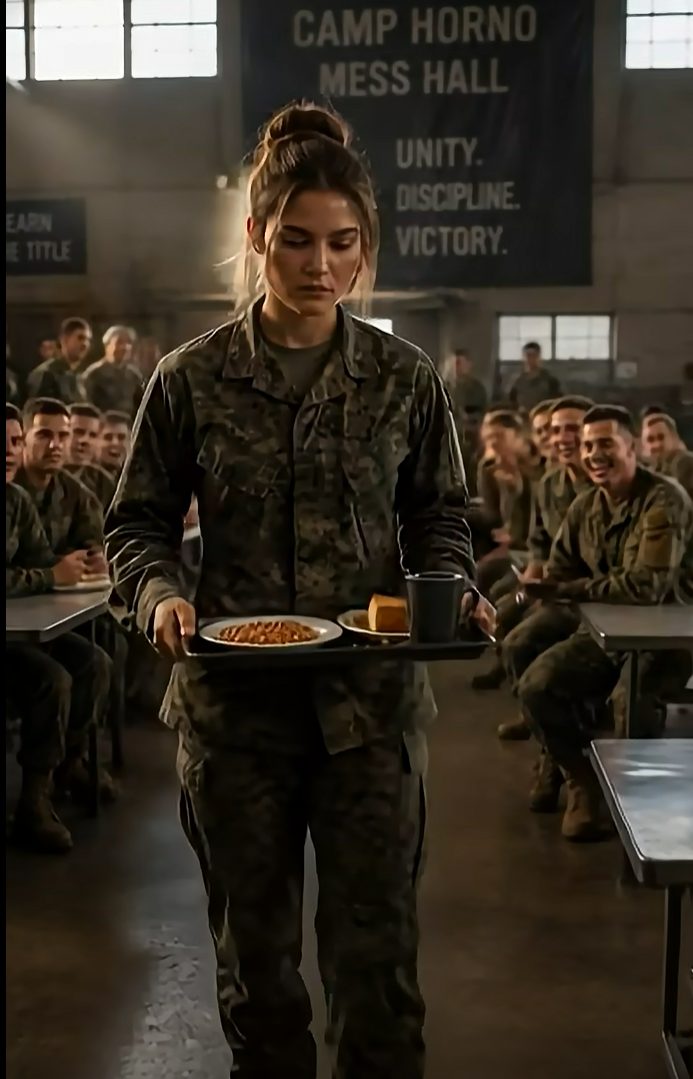
My name is Nora Jane Bishop, and the easiest way to vanish on a military installation is to let people believe they’ve already figured you out.
That was exactly what I was doing at Camp Horno the afternoon Gunnery Sergeant Derek Voss knocked my tray out of my hands.
I was twenty-two. Camouflage utilities, no visible unit patch, no rank displayed anywhere a chow line’s worth of Marines would think to look for it, and no expression that invited conversation. Officially, I was present on temporary administrative reassignment. That was the version living in the paperwork. The real version was classified high enough that most of the men in that mess hall didn’t even hold the correct clearance to be lied to about it properly.
Four years. That’s how long I’d spent moving through places where noise arrived just ahead of the blood – Helmand, Al Hudaydah, northern Syria, and one particular runway outside Kabul I still saw whenever I closed my eyes too fast. I knew what arrogance sounded like in five languages. I knew what fear smelled like on men performing bravery for an audience. And I had learned, the hard way, the specific danger of falling in love with your own deadliness in rooms full of people looking for a reason to resent it.
So when Derek Voss looked me over in that mess hall and decided I was the easiest thing in the room, I recognized him before he opened his mouth.
I’d met his type on every continent.
The tray hit the floor with a sound like a gunshot – aluminum on concrete, green beans and powdered mashed potatoes skidding wide – and every head in the room turned toward me at once. Voss stood close enough that I could smell the coffee on his breath, his jaw set in the particular way of men who had never once been hit back.
I did not move. I did not blink. I simply looked at him the way I had learned to look at things I was about to take apart.
What He Thought He Was Looking At
He was big. Six-two, maybe six-three, with the neck of a man who’d spent fifteen years making other men feel small about their necks. Three chevrons and two rockers on his collar. Eight years on me, minimum. The kind of Marine who’d been a Gunny long enough that the rank had stopped being something he wore and started being something he was.
There were maybe forty people in that mess hall. A Tuesday in October, 1340 hours, the lunch rush already thinning out. I remember the specific quality of the light – California October through institutional windows, flat and colorless, the kind of light that makes everyone look slightly unwell.
Voss looked at me like I was a piece of furniture that had gotten into the wrong room.
“You’re in the wrong line, sweetheart.”
He said it loud. Not to me, really. To the room.
There were a few sounds. Not laughter exactly – more the sound of men deciding whether to laugh. A dozen Lance Corporals and Sergeants watching to see what the Gunny had caught.
I looked at the tray on the floor. Green beans. The mashed potatoes had gone maybe four feet. There was a milk carton on its side still spinning slowly.
I looked back at him.
“Pick it up,” I said.
Not a request. Not a challenge. Just two words in the same voice I’d used to talk men through things they didn’t think they’d survive.
Voss blinked. It was fast, almost nothing, but I’d spent four years reading faces in conditions where reading them wrong got people killed. I saw it.
“Excuse me?”
“The tray,” I said. “Pick it up.”
The Thing About Men Like That
Here’s what I knew about Derek Voss before I knew anything about Derek Voss: he’d never had to explain himself to someone smaller than him. That’s the whole architecture of a man like that. Everything they are is built on the assumption that size is the last argument, and the last argument always goes their way.
What I also knew: he was performing. He’d knocked my tray because there were forty people watching and I was small and female and wearing no insignia he recognized. I was a prop. An easy five seconds of theater that would get retold at a table somewhere that night.
What he didn’t know, couldn’t know, because nothing in the room told him: the last time someone had tried to make me small in front of an audience, I’d been twenty years old in a forward operating base in Helmand Province, and the man doing it had been a British SAS warrant officer with a grudge about women in fieldwork. That situation had resolved itself in a way that still got referenced in certain briefings I was never officially supposed to have attended.
I had no intention of doing anything dramatic. I wasn’t angry. Anger is expensive and I’d learned to spend it carefully.
I just wasn’t going to move.
Voss stepped closer. A few inches. His voice dropped, which meant it was now between us instead of for the room. “You need to watch your mouth, Lance Corporal.”
I let him finish. Then: “I’m not a Lance Corporal.”
“I don’t see any rank.”
“No,” I said. “You don’t.”
What Happened at 1347
He was still working out what to do with that when the mess hall door opened.
I didn’t look. I knew the footsteps. I’d been working alongside Chief Warrant Officer Sandra Pruitt for fourteen months by then, and she walked like someone who’d long ago stopped caring whether you heard her coming. Heavy-heeled, no adjustment for audience. She came across that floor like she owned it, which in any room she walked into, she functionally did.
Pruitt was forty-one. Gray starting in at the temples. The kind of face that had been pretty once and had decided somewhere along the way that pretty wasn’t the most useful thing it could be. She stopped about six feet short of us and looked at the tray on the floor, the scattered food, Voss, me.
She said nothing for a moment.
Then, to Voss: “Gunnery Sergeant.”
He turned. Saw her rank. His posture shifted – not much, but enough.
“Chief Warrant Officer.”
“Is there a situation here?”
Voss did the calculation fast. You could see it. He’d walked into something he didn’t have the full picture on, and he was smart enough to know it, and not quite smart enough to know how deep it went.
“No situation, ma’am. Accident with the tray.”
Pruitt looked at me. I looked back at her. We’d had maybe ten thousand of these small exchanges over fourteen months – wordless, two-second transactions that contained entire conversations.
She looked back at Voss.
“Clean it up,” she said. “Then come find me. Room 14, Admin B. Bring your Staff Duty log from the last thirty days.”
It wasn’t a punishment, exactly. It was something worse. It was being handed a task that made clear, in front of forty people, that he’d just become someone’s errand.
He stood there for one beat too long.
Then he bent down and picked up the tray.
What Nobody in That Room Knew
I wasn’t on administrative reassignment.
The paperwork said I was, and the paperwork was good – Pruitt’s people were thorough – but the actual reason I was at Camp Horno had to do with a pattern of procurement irregularities that had started in a logistics unit out of Twentynine Palms and ended, provisionally, with a name on a list that I’d been handed in a parking garage in Oceanside at seven in the morning nine days earlier.
I can’t tell you the name. Still can’t, actually. What I can tell you is that the name was attached to a rank higher than Gunnery Sergeant, and the investigation was the kind that required someone unremarkable to move through the installation without drawing attention, eating in the mess hall, watching who sat with who, logging what got said.
Voss had just made me remarkable.
That was the part that actually bothered me. Not the tray. Not the sweetheart. The operational exposure.
I ate dinner in my room that night, which was a converted storage office in Admin B with a cot and a window that looked out onto a parking lot. Pruitt came by around 2100. She sat on the one chair and I sat on the cot and we went through the day’s log.
“Voss is clean,” she said. “For what it’s worth.”
“I know.”
“Wrong place, wrong type, wrong day for him.”
“I know that too.”
She looked at me. “You handled it right.”
I didn’t say anything.
“Some of them need to see it,” she said. “Someone not moving. It does something.”
The Part I Didn’t Expect
Three days later, Voss found me at 0600 outside the Admin building. I was coming back from a run, which I did early enough to avoid the kind of company that asked questions. He was standing by the door like he’d been there a while, holding two cups of coffee from the mess hall, the paper kind, steam coming off them in the cold.
He held one out.
I stopped. Looked at it. Looked at him.
His face was doing something uncomfortable. Not shame, exactly. More like a man trying to find the right word for a thing he didn’t have a word for.
“I don’t know what you do,” he said. “And I figure I’m not supposed to know. But I know what I did was wrong and I know it wasn’t an accident.”
I took the coffee.
It was bad coffee. The mess hall stuff always was, that particular bitterness of industrial urns that never got properly cleaned. I drank it anyway.
“Okay,” I said.
“That’s it?”
“What else do you want?”
He thought about that. “I’ve got a daughter,” he said. “Seventeen. She wants to enlist.”
I waited.
“I think about the guys she’s going to run into.” He stopped. Started again. “I think about whether I’m one of those guys.”
I looked at him for a moment. He was, and he’d been, and he probably would be again in some smaller way he wouldn’t catch himself doing. That’s how it works. But he was also standing outside a building at 0600 holding bad coffee, trying to find the edge of something in himself he’d never had to look for before.
“Tell her to learn how to make people pick up their own trays,” I said.
I went inside.
What Camp Horno Taught Me
The investigation wrapped six weeks later. I can’t tell you how. I can tell you I left the installation on a Thursday morning in a rental car with a laptop bag and no ceremony, the same way I’d arrived.
Pruitt shook my hand in the parking lot of Admin B. She had the handshake of someone who’d decided a long time ago that handshakes were the only physical contact worth having with colleagues.
“Good work,” she said.
“You too.”
“They’ll send you somewhere cold next,” she said. “They always do.”
She was right. But that’s a different story.
What I kept from Camp Horno, the thing that stayed: the forty faces in that mess hall, all of them turned toward me at once, waiting to see what I’d do. All of them running the same calculation, assigning me to the category they already had ready.
None of them saw what I actually was.
That was the job. That was always the job.
I got in the car and drove north on the 5 and ate a gas station sandwich somewhere around San Clemente and didn’t think about Derek Voss again for almost two years, until I got a letter – forwarded three times, which meant it had gone through channels to find me – from an address in Oceanside.
His daughter had enlisted.
She’d done well in training.
He thought I’d want to know.
I folded the letter and put it in the inside pocket of my jacket and didn’t write back, because I didn’t have a return address that was real. But I kept it. I’ve moved it from jacket to jacket for six years now.
It’s in the one I’m wearing today.
—
If this one hit you somewhere, pass it along to someone who’d get it.



