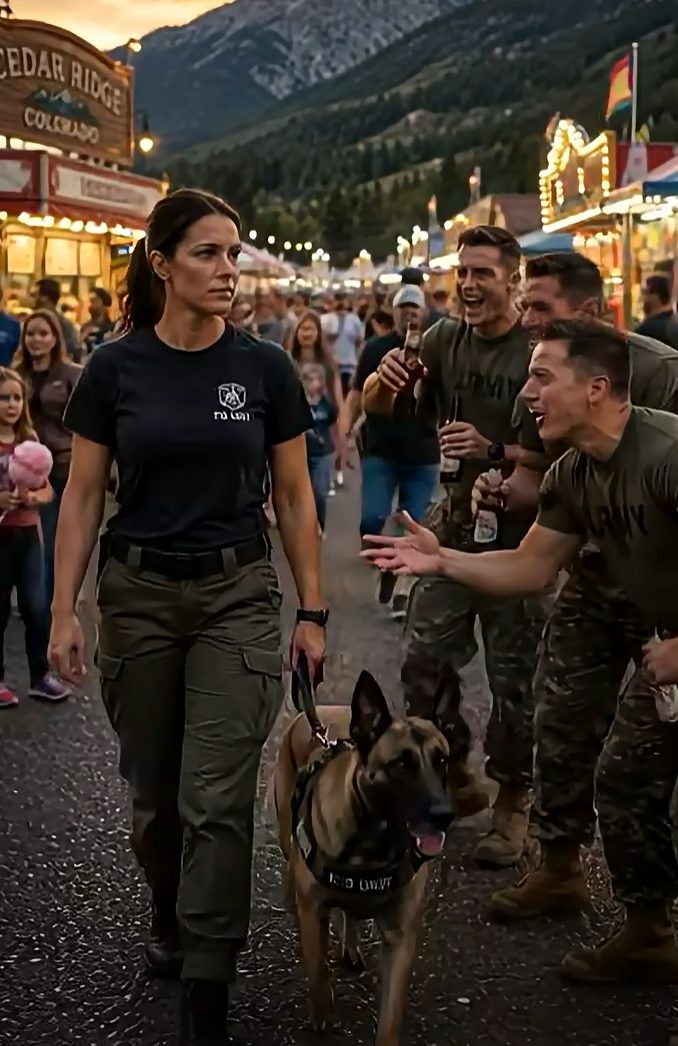
The summer fair in Cedar Ridge, Colorado felt like a patchwork quilt of small-town tradition – funnel cake smoke drifting through the heat, country music blaring from worn speakers, children weaving between booths, and veterans standing in quiet lines beside a flag display. It was loud, crowded, alive. The kind of place where noise swallowed everything whole. That was exactly why trouble found it so appealing.
Megan Cross moved steadily through the crowd, a Belgian Malinois pacing at her left heel. The dog – Blade – wore no vest, no markings, no hint of warning. Just a short leash, a closed mouth, and eyes that tracked everything at once. Anyone familiar with Military Working Dogs would have recognized the discipline immediately. The three soldiers who spotted her didn’t recognize discipline. They only saw someone worth testing.
They were young, rowdy, and drunk – uniforms hanging loose, laughter sharp and careless.
“Yo, that dog bite?” one of them called out, stepping directly into her path.
Megan didn’t slow. “Keep moving,” she said quietly – not to them, but to Blade.
Another soldier let out a mocking laugh. “She thinks she’s special.”
Blade’s ears twitched once. Nothing more.
The third soldier – taller, harder in the eyes – leaned in close enough for the smell of beer to reach her first. “Hey, sweetheart. I’m talking to you.”
Megan stopped. She turned with deliberate calm, her face composed, her voice level. “I don’t want trouble. Step back.”
That calm only made it worse. Some people mistake stillness for weakness. Men like these took it as an invitation.
The Part Nobody Tells You About Working Dogs
Blade was seven years old and had cleared buildings in Kandahar.
Megan had gotten him eighteen months after her discharge, through a program that placed retired Military Working Dogs with former handlers. She hadn’t requested him specifically. She’d submitted paperwork and waited, the way you wait for anything the military controls: without expectation, without complaint. Then she’d gotten a call from a kennel master in San Antonio who said, “We’ve got a dog here who won’t work for anyone. Keeps sitting down. Keeps looking at the door.” The kennel master paused. “He worked with you, didn’t he?”
She drove fourteen hours to get him.
Blade had done two tours with her. He’d located an IED outside Jalalabad that would have taken out a convoy of eight. He’d held a perimeter in Helmand Province for forty minutes while a medevac came in. He’d also, on a quiet Tuesday in 2019, pressed his head against her knee in a parking lot outside the VA hospital in Colorado Springs and stayed there for eleven minutes without moving, which was longer than she’d cried.
She didn’t talk about any of that. Not at the fair. Not usually anywhere.
What people saw was a woman with a big tan dog. What they made of that was their business.
Three Guys Who Didn’t Read the Room
The tall one’s name, she’d learn later, was Garrett Pruitt. Twenty-three years old, stationed at Fort Carson, down for the fair weekend with two buddies named Dale and someone everyone just called Rook. They’d been drinking since noon. Not the sloppy kind of drunk – the loud kind, the kind that makes men feel wider than they are.
Garrett stepped closer when she told him to step back.
That was the first mistake.
“Drop dead,” he said. Then he looked at Blade with a grin that didn’t reach his eyes. “Your dog won’t save you.”
Megan didn’t say anything. She’d been in situations where speaking made things worse and she’d learned to identify them fast. This was one.
But Blade knew before she did.
His body didn’t change dramatically. That’s what people never understand about trained dogs. They don’t bark, don’t lunge, don’t make a show. The change is subtle and total: weight shifts forward, spine straightens, head drops two inches, and the eyes fix. Not the wandering, curious look of a dog watching the world. Something else. The kind of focus that makes the air around it feel different.
Garrett felt it. He just didn’t know what he was feeling yet.
“What’s it gonna do,” Dale said, but his voice had gone up half a step.
Rook had already taken one step back without appearing to notice he’d done it.
What “Locked In” Actually Looks Like
Megan had one hand on the leash. She didn’t tighten it.
Blade was in what handlers call a passive threat posture – not commanded, not released, just present in a way that communicates something primal to the human nervous system. Prey instinct runs deep. Deeper than alcohol, deeper than bravado. Garrett Pruitt’s body understood something that Garrett Pruitt’s brain was still arguing with.
His grin slipped.
Just a fraction. Just enough.
“You need to walk away right now,” Megan said. Her voice was the same as it had been. Level. No heat in it.
“Or what,” Garrett said. But he’d stopped moving forward.
She didn’t answer that. She didn’t need to. Blade’s eyes had not moved from Garrett’s face in forty seconds. Not to check the crowd, not to look at Megan, not to track the country music or the funnel cake vendor or the kids running past. Just Garrett. Just that face. The way a scope stays on a target.
Garrett looked down at the dog.
The dog didn’t look away.
“Hey,” Rook said from behind him. “Garrett. Man. Come on.”
The Moment the Fair Went Quiet
It happened in stages.
First the people nearest them felt it – that particular shift in crowd energy when something stops being background noise and starts being a situation. Heads turned. Conversations dropped off mid-sentence. A woman pulled her daughter closer without explaining why.
Then a man in a VFW cap moved out of the flag display line and positioned himself about ten feet to Megan’s left. He didn’t say anything. He just stood there, arms crossed, watching.
Then two more. One of them still holding a paper cup of lemonade.
Garrett Pruitt was drunk but he wasn’t stupid. He could count.
“Whatever,” he said. He said it to the space in front of him, not to anyone in particular. The word doing the work that retreat couldn’t do with dignity intact.
He turned. Dale fell in beside him. Rook was already gone.
Blade watched them go. All three. Tracked them until they were thirty feet away, forty, until the crowd absorbed them. Then he sat. Clean, precise, no drama. Just sat and looked up at Megan.
She reached down and touched his ear once.
That was it. That was the whole transaction.
Afterward
The VFW man walked over. His name was Don Hatch, seventy-one years old, Vietnam vet, Cedar Ridge resident since 1987. He looked at Blade the way men who know things look at other things they know.
“MWD?” he said.
“Retired,” Megan said.
Don nodded. Looked at her. “You too?”
“Yes sir.”
He didn’t ask which branch, which theater, how long. He just nodded again and went back to the flag display. The two men with him did the same. The lemonade one hadn’t spilled a drop.
The crowd unknotted itself. The country music came back into focus. Kids ran past again.
Megan stood there for a moment.
She was thirty-four years old. She’d been out for three years. She still had mornings where she woke up at 0430 by reflex and lay in the dark listening to her apartment building breathe. She still sat with her back to walls in restaurants. She still did a sweep of any new room she entered, not consciously, just the way you swallow.
She hadn’t wanted trouble at the summer fair in Cedar Ridge. She’d wanted funnel cake. She’d wanted to walk Blade somewhere with open space and noise and the particular comfort of crowds that don’t know your name.
She got all of that.
What Garrett Pruitt Did Next
Three days later, a handwritten note showed up at the Cedar Ridge VFW post addressed to “the woman with the dog at the fair.” Don Hatch called the number on the envelope and reached Megan on a Tuesday afternoon while she was repainting her kitchen.
She drove to the post. Don handed her the envelope.
The note was from Garrett. Two pages, pencil, handwriting that slanted left the way left-handed people write when they’re trying to write right-handed. Or the way people write when they’re not sure what they’re doing.
He’d looked her up. He didn’t say how. He wrote that he’d found out she was former Army, former handler, two tours. He wrote that he was sorry. Not the kind of sorry that explains itself into almost-not-sorry. Just: I was wrong. I was drunk and I was stupid and I was wrong.
He wrote that he’d been having a bad year. He didn’t elaborate. He wrote that he’d talked to someone on base about it. He’d made an appointment. He wasn’t sure why he was telling her that except that it felt like she should know.
The last line said: That dog looked at me like he already knew everything I’d done wrong. I don’t know. I just thought you should know he got through.
Megan read it twice, standing in the VFW parking lot in the afternoon heat.
She folded it and put it in her jacket pocket.
Blade sat beside her, watching a pigeon on the far curb with mild professional interest.
She didn’t write back. She didn’t need to. Some things close without ceremony, without anyone declaring them closed. The note was already doing what it needed to do, which was exist. Which was be sent.
She drove home. Fed Blade. Finished the kitchen.
Second coat. Pale yellow. The kind of color that makes a room feel like morning even when it isn’t.
—
If this one stayed with you, pass it on to someone who’d get it.
For more wild tales from the front lines, check out what happened when she stepped into a Marine base in a towel and left with everything she came for, or read about how my hands were shaking but I didn’t put down the cornbread and the time the Gunny knocked my tray on the floor in front of the whole mess hall.