
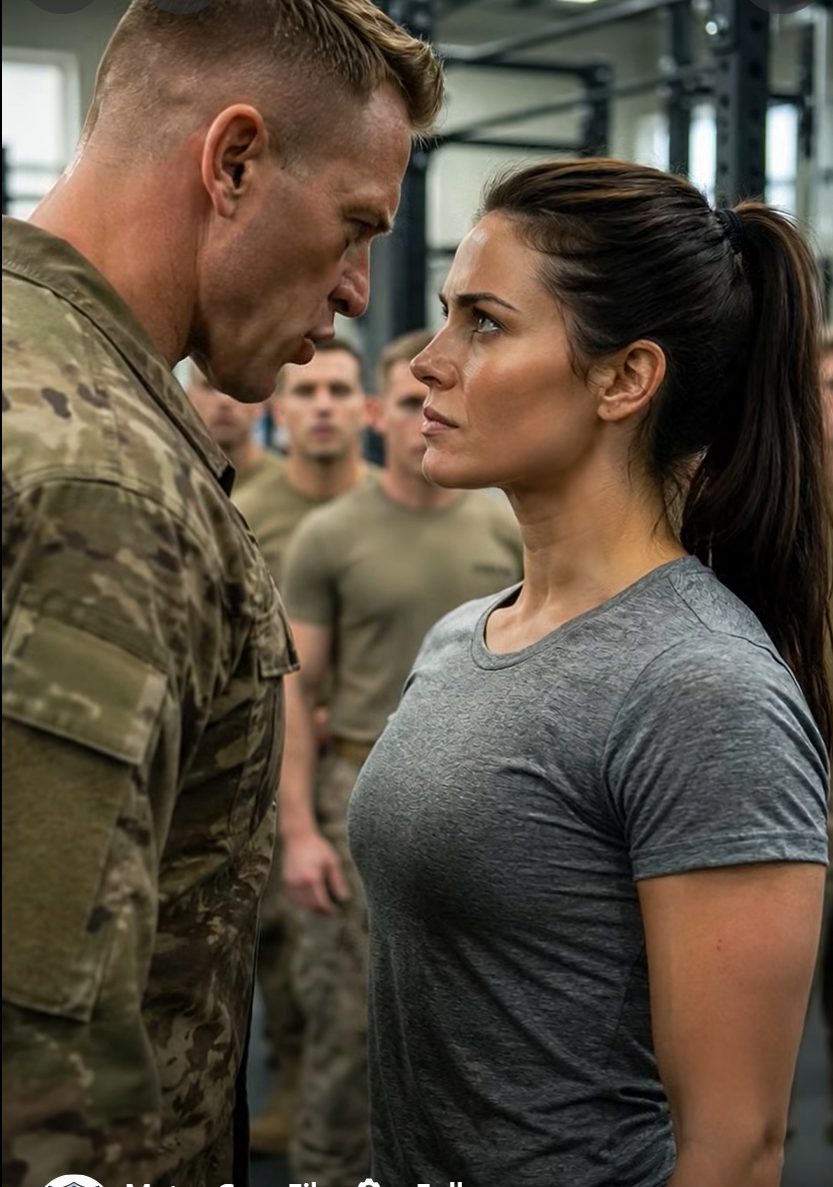
The room went silent the moment she asked that question.
Not the kind of silence you ignore. The kind that tightens your chest… that makes every person suddenly aware of where they’re standing and who they’re standing next to.
Because something about her tone didn’t match the way she looked.
She shouldn’t have sounded that calm.
The laughter had started before anyone really thought about it.
A careless joke. A quick smirk. A few too-loud chuckles bouncing off the walls of the Fort Braddock training floor.
“Ma’am, this is a military training facility, not a yoga studio.”
More laughter followed. Sharper this time. Meaner.
The woman didn’t react.
She stood just inside the entrance, wearing a plain gray shirt, black leggings, and scuffed running shoes. No rank. No insignia. Nothing to suggest she belonged there.
Just a small duffel bag and a stillness that didn’t fit.
A private by the pull-up bars leaned over to his buddy. “She’s lost.”
Another muttered, “Wrong building, sweetheart.”
More laughter.
Still… she didn’t move.
She scanned the room slowly. Not nervously. Not awkwardly.
Carefully.
Like she was memorizing faces.
That was when Staff Sergeant Daniel Cross stepped forward.
His boots hit the floor with purpose, shoulders squared, jaw locked tight. The kind of man who owned every space he walked into… because no one had ever told him he didn’t.
“You hear me?” he said, voice cutting through the room. “You walk into the wrong place?”
Her eyes shifted to him.
And that was the first crack.
No fear.
No embarrassment.
Just… focus.
It irritated him instantly.
“This area is restricted,” Cross added, stepping closer. “Active personnel only.”
“I know,” she replied.
The room quieted… just a little.
Her voice wasn’t defensive. It wasn’t apologetic.
It was steady. Almost bored.
Cross tilted his head, studying her now.
“You know?”
“Yes.”
A soldier near the bench press snorted. “Then why are you dressed like you’re late for Pilates?”
The room laughed again.
She turned her head toward the voice.
No glare. No anger.
Just a look.
And it lasted just long enough.
Long enough for the soldier’s grin to falter… for him to realize she had seen everything. The way he stood. The way he spoke. The way his confidence depended on the approval of the man in front of him.
Then she looked away.
That stung more than any insult.
Cross stepped closer, closing the distance between them to just a few feet.
Up close, he was imposing. Broad. Controlled. Used to being obeyed without question.
Behind him, the younger soldiers watched, waiting. Learning.
“Name,” he demanded.
She didn’t answer immediately.
Behind him, someone whispered, “She really thinks she belongs here.”
Another voice followed, quieter but sharper. “Recruiting messed up big time.”
A ripple of laughter spread again.
She finally spoke.
“Blake.”
Cross frowned slightly.
“First name?”
“Ava.”
“No rank?”
She held his gaze.
“Not today.”
A few soldiers actually scoffed out loud.
Cross’s expression hardened.
“Not today,” he repeated slowly. “That supposed to be funny?”
“No.”
“Then explain yourself.”
For a moment… she didn’t look at him.
Her eyes drifted past his shoulder.
To the lines taped on the floor where formation should have been tight and disciplined… but wasn’t.
To the soldiers leaning instead of standing straight.
To the water bottles left open.
To the phones casually placed face-up.
To the small, careless details that didn’t belong in a place like this.
Then she looked back at him.
“No need,” she said quietly.
Something shifted.
Not loud. Not obvious.
But enough.
Cross let out a short, humorless laugh.
“You walk in here like this… refuse to identify yourself properly… and tell me there’s no need?”
She didn’t respond.
And that silence… it got under his skin.
He stepped even closer now.
“You’re about ten seconds from being escorted out.”
She blinked once.
Then asked, calm as ever…
“By who?”
The Question That Didn’t Make Sense Yet
Nobody laughed that time.
Cross opened his mouth. Closed it.
The question sat there in the middle of the training floor like something dropped from a great height. Not aggressive. Not sarcastic. Just a genuine, practical inquiry. By who.
As if she already knew the answer and was giving him the chance to figure it out first.
Cross looked left. Then right. His guys were still there, still watching, still waiting for him to do what he always did – flatten the situation, restore order, make the awkward thing stop being awkward.
But something in his throat wasn’t cooperating.
“Any one of these soldiers,” he finally said.
She nodded once. Slowly.
“Which one?”
Another pause. Longer.
Private Garrett, the one who’d made the Pilates crack, had gone very still near the bench press. His water bottle was on the floor. His phone was face-up on the bench. He was suddenly aware of both.
Cross turned back to her. His jaw was tight.
“I don’t know who you think you are, but – “
“I know exactly who I am,” she said. “The question is whether you do.”
What Nobody in That Room Knew
Fort Braddock’s evaluation program had been running quietly for eleven months.
It wasn’t advertised. It wasn’t posted on any internal memo that junior enlisted would ever see. It existed in a two-page directive that lived in the office of Colonel Patricia Hess, who had authorized it after a string of readiness reviews came back with numbers that looked fine on paper and felt wrong in practice.
The problem wasn’t equipment. It wasn’t training hours logged or PT scores.
The problem was culture. Specifically: what happened in rooms when nobody important was watching.
Ava Blake had been doing this for three years before she ever set foot at Braddock. She’d walked into motor pools in Georgia, mess halls in Virginia, and a field operations tent in New Mexico where a senior NCO had spent forty minutes talking about a female logistics officer in terms that would’ve ended his career on the spot if anyone above his pay grade had been in the room.
Nobody above his pay grade had been in the room.
That was the whole point.
She carried no recording equipment. She needed none. She had a memory that her instructors at Quantico had described, in a fitness report she’d read once and never thought about again, as “functionally photographic under stress conditions.” She remembered the private’s name – Garrett, T., the nametape had read, though he’d been too far away for most people to clock it. She remembered the angle of Cross’s shoulders when he stepped forward. She remembered which soldiers had laughed loudest and which ones had gone quiet and looked at the floor.
The ones who looked at the floor were always the most interesting.
She’d been at the facility for six minutes before Cross approached her. In those six minutes she’d seen enough.
Cross
He was thirty-four. She’d pulled his file two days ago.
Eight years in. Two deployments, one commendation, one formal reprimand that had been quietly buried in the kind of paperwork shuffle that happened when the person doing the burying liked you. His PT scores were excellent. His retention rate among junior soldiers was not. Four transfers out of his unit in eighteen months, all requesting reassignment, none of them citing specific incidents.
That was the tell. Specific incidents leave paper trails. Requesting reassignment with no reason given means someone decided the paper trail wasn’t worth what it would cost them.
She hadn’t come to Braddock because of Cross specifically.
But she wasn’t surprised he was the one who’d walked toward her.
Men like Cross always walked toward her. That was useful.
He was still standing close, arms crossed now, trying to recalibrate. She could see him working through it – the way his eyes had gone slightly less certain, the way his weight had shifted back half an inch without him realizing it.
“You need to identify yourself,” he said. “Right now. Or I’m calling the desk.”
“Call the desk,” she said.
He stared at her.
“Go ahead,” she added.
He didn’t move.
Because calling the desk meant admitting he didn’t already know. And Cross was not a man who admitted things like that in front of his soldiers.
She waited.
The Part Where It Shifted For Real
What broke it wasn’t Cross.
It was a kid near the back wall. Young, maybe nineteen, standing straighter than anyone else in the room. He’d been quiet the whole time. Hadn’t laughed at the Pilates joke. Hadn’t muttered anything to his neighbor. He’d just watched.
When the silence stretched past the point of comfort, he spoke up.
“Sergeant Cross.” His voice was careful. Measured. “Maybe we should let her – “
“Did I ask you, Whitfield?”
Whitfield. She filed it away.
“No, Sergeant.”
“Then stand there and be quiet.”
Whitfield went quiet. But he didn’t look down.
She noticed that. She noticed everything.
Cross turned back to her, and the frustration had curdled into something harder. He’d been patient, by his own standards. He’d given her chances to back down, to apologize, to become small the way people became small when he applied the right pressure.
She hadn’t.
And now it was personal.
“Last time,” he said. “Who sent you here and what is your authorization to be on this floor.”
She reached into the duffel bag.
The room tensed. Stupid, she thought, not for the first time. The instinct people had – that any reach into any bag was a threat. She moved slowly, deliberately, and pulled out a single folded piece of paper.
She held it out.
Cross took it. Unfolded it.
He read it once. Then again.
His face didn’t collapse. He wasn’t the collapsing type. But something left it – some quality of certainty that had been there since he’d walked across the floor toward her, that had probably been there for years, the unexamined belief that he was always the most important person in whatever room he was standing in.
He refolded the paper. Handed it back.
He didn’t say anything.
“I’ll need the room cleared,” she said. “Except for Sergeant Cross and – ” she looked toward the back wall, ” – Private Whitfield.”
Nobody moved for a beat.
Then they moved.
What the Paper Said
She never told anyone exactly what was on it. That wasn’t how it worked.
What she told Colonel Hess, three days later, in a debrief that lasted two hours and forty minutes, was that the authorization had come from two levels above the post commander and that Cross had recognized the letterhead before he’d read the first sentence.
Hess asked about the room. About what she’d seen in those six minutes before Cross approached.
Ava described it. All of it. The phones. The posture. The open water bottles. The way the laughter had moved through the group – who started it, who amplified it, who held back. The soldier who’d said wrong building, sweetheart and the specific register of his voice, which was the register of someone who said things like that often and had never once been told to stop.
Hess listened without interrupting.
When Ava was done, Hess asked one question.
“Whitfield. The one you kept.”
“Yes.”
“Why him?”
Ava thought about it for a second. Not because she didn’t know the answer, but because she wanted to get the words right.
“He was the only one who looked uncomfortable,” she said. “Not scared. Not performing. Actually uncomfortable. Like he’d been watching that room for months and didn’t know what to do about it.”
Hess nodded.
“And Cross?”
Ava set her pen down on the edge of the table.
“Cross is good at the parts of this job that are visible,” she said. “He’s been doing the invisible parts wrong for a long time, and nobody made it cost him anything.”
She picked the pen back up.
“Until now.”
After
The formal process took six weeks.
Cross wasn’t discharged. That’s not usually how it goes. He was reassigned, retrained, flagged for a supervisory review that would follow him for the next two years whether he liked it or not. Two of the soldiers who’d been loudest that morning received counseling statements. The one who’d said wrong building, sweetheart received something more significant, because when Ava pulled the thread on his record, she found the thread had been pulled before and tied off by someone who shouldn’t have tied it.
Whitfield was flagged for a leadership track review. Hess made that call herself, which wasn’t standard procedure, but Hess had been in the Army for twenty-six years and knew what she was looking at.
Ava was back at Fort Braddock six months later.
Different building. Different unit. Same gray shirt, same black leggings, same scuffed shoes.
She walked in carrying the duffel bag.
Nobody laughed.
—
If this one stayed with you, pass it along to someone who’d get it.
For more intense stories about unexpected twists, check out He Slapped Her in Front of Two Thousand Troops. Then Nobody Moved. or see what happened when She Told Him She Was “Saving Time.” He Was Still Laughing When She Shot.. You might also enjoy reading about how He Reached for Her Hair and Learned Who She Was Too Late.



