
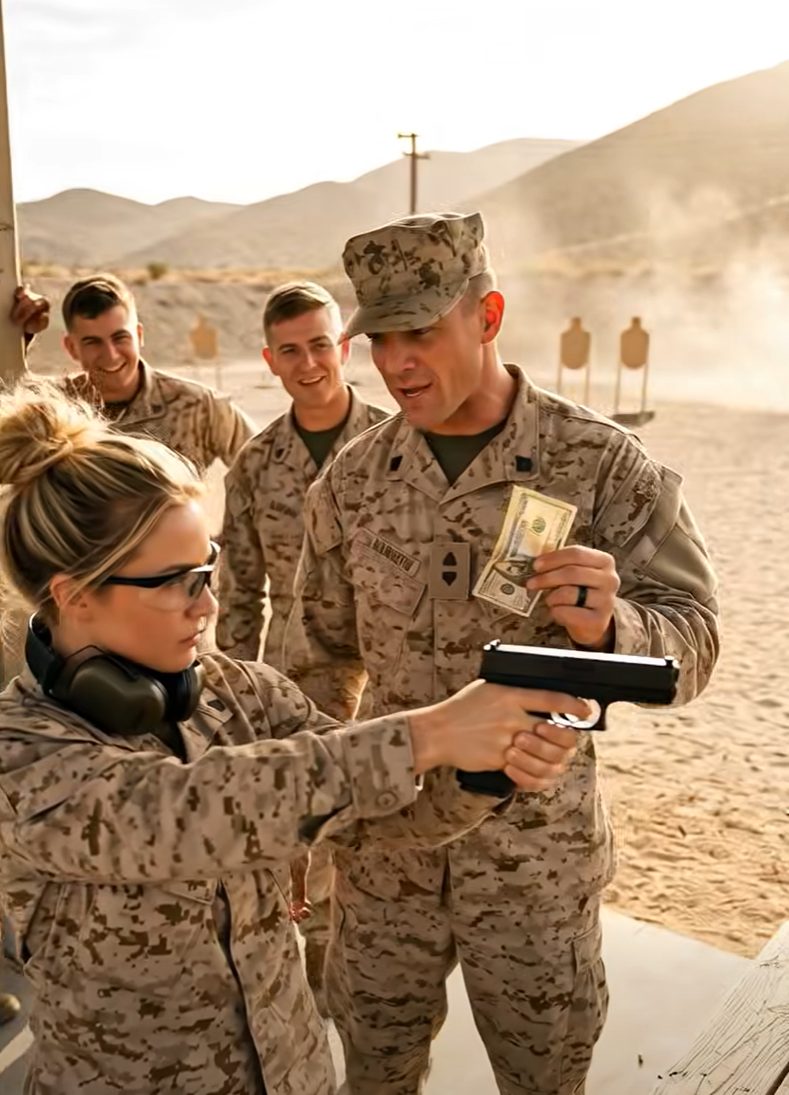
“You really thought I was just some girl holding a gun for fun?” – I chambered a round beneath the Marines’ mocking laughter, right before my six shots turned their little bet into a nightmare no one at the range would ever forget.
“Shooter down! Somebody call 911!”
That scream cut through the range before the first body even hit the concrete.
My name is Rachel Voss, and the moment Sergeant Michael Ducker turned from mocking me to reaching for his pistol, I knew this afternoon had stopped being a stupid ego contest and become something far worse.
One second, the Marines behind him were grinning, waiting for me to embarrass myself. The next, two sharp cracks came from somewhere beyond the parking lot wall – not from the firing line, but behind us, wrong angle, wrong rhythm, wrong sound. Real incoming. Not range fire.
The gray-mustached range officer folded like somebody had yanked his strings. Blood sprayed across bay six. A woman near the vending machine dropped screaming. Everyone else did what civilians always do when violence shows up uninvited: they froze half a beat too long.
“Down!” I shouted.
Ducker stared at me like he hadn’t processed the change yet. Then a third shot snapped over our heads and punched sparks off the steel frame behind lane eight. His training kicked in. He went low fast, barking at his Marines to cover the line.
I was already moving.
The Glock rental felt cheap in my hand, but weight is weight and sights are sights. I slid behind the concrete divider, grabbed the injured woman by her wrist, and dragged her flat. She was bleeding from the shoulder, panicked, trying to crawl the wrong way.
“Look at me,” I said. “You move when I move. That’s how you live.”
Ducker landed beside me, breathing hard now, pride gone clean out of his face. “You military?”
“Was.”
Another round cracked through the signboard over the check-in desk. Too controlled to be random. Too patient to be panic. Whoever was out there had elevation on the lot and eyes on the exits.
One of the younger Marines – Lance Corporal Ethan Kim, if I remembered Ducker introducing them right – pointed toward the far berm. “Top of the maintenance shed!”
I risked one glance and saw it: a figure in sun-faded work coveralls, rifle braced, face hidden behind dark eye protection.
Then he shifted just enough for me to catch the tattoo climbing his neck.
My stomach dropped.
I knew that tattoo.
I had watched the man wearing it die seven years ago in Helmand.
And now he was aiming straight at me.
What I Was Doing at That Range in the First Place
I need to back up about forty minutes, because none of this makes sense without the stupid thing that started it.
I’d driven to Desert View Shooting Range outside Tucson on a Wednesday afternoon because I had nowhere better to be. That’s the honest version. I was three months out of a job I’d taken to stay busy, my lease was up at the end of October, and I had the kind of free time that turns ugly if you don’t do something physical with your hands.
I shoot. I’ve shot since I was nine years old and my uncle Dennis took me to a gravel pit outside Flagstaff with a .22 and a bag of aluminum cans. I shot through two deployments, one with the Army and one as a contractor, and I shoot now because it’s the one thing that still makes my brain go quiet.
So I was in bay four, working through a box of 9mm at fifteen yards, nothing fancy, when Ducker and his four Marines set up in the bays beside me. Young guys mostly. Loud. The kind of loud that’s performing for each other.
I didn’t pay them much attention until one of them – not Kim, the other one, heavyset kid named Rourke – made a comment about my grip. Then Ducker made a comment about Rourke’s comment. Then somehow, the way these things always go, there was a bet on the table.
A hundred dollars said I couldn’t put six rounds inside a four-inch circle at twenty-five yards with a rental Glock I’d never fired.
I should’ve said no. I know that. But Ducker had that particular smile that men sometimes get when they’ve already decided what you are, and I’ve never been good at walking away from that smile.
I took the bet.
I was two rounds into proving my point when the shooting started from outside.
The Tattoo That Shouldn’t Exist
His name had been Warren Dale Pruitt. Staff Sergeant, Army, attached to our unit for a six-week stretch near Sangin in 2017. He had that tattoo – a black scorpion, body starting at his collarbone, tail curling up behind his left ear – because he’d gotten it in Kandahar on a dare, which was exactly the kind of decision Warren made.
I watched him take a round through the chest on a Tuesday morning clearing a compound that was supposed to be empty. I watched the medic work on him for eleven minutes. I watched him stop moving.
I signed the paperwork. I wrote the letter to his mother in Baton Rouge. I carried his name in my chest for seven years the way you carry names like that: heavy, quiet, permanent.
Dead men don’t brace rifles on maintenance shed rooftops in Tucson.
But the tattoo was right. The build was right. The way he held the rifle, left elbow tucked in slightly because he’d broken that arm in 2015 and it never healed quite straight – that was right too.
I had about four seconds to decide whether I was losing my mind or whether something had gone very wrong in the story I’d been told.
I decided it didn’t matter. Not right now. Right now he was shooting at people.
Moving When Everyone Else Was Still
Ducker had good instincts. He’d gotten his Marines down and was running a head count, checking for wounds, doing exactly what he should. The woman I’d dragged behind the divider – her name was Carol, she told me later, Carol Finch, retired schoolteacher from Marana – had stopped trying to crawl the wrong way and was pressing her own palm against her shoulder like I’d told her.
“I need to get to the back exit,” I said to Ducker.
He looked at me. “That’s toward the shooter.”
“The back exit opens into the maintenance lot. If he’s on the shed roof, the shed wall gives me cover to close distance.”
“You’re going to close distance. With a rental Glock.”
“You have a better plan?”
He didn’t. He had a service pistol and four Marines and a room full of civilians who were going to start making bad decisions inside the next two minutes. He needed to hold the interior. I was the spare piece.
“Kim goes with you,” he said.
Kim was already looking at me. Twenty-three, maybe. Steady eyes. Not frozen. I nodded at him and he fell in behind me without a word.
We moved low along the back wall, past the overturned vending machine, past a man in a Stetson who was pressed flat under a bench with his hands over his head. Past the check-in desk where the clerk had gotten himself behind the gun safe and was doing fine. Through the fire door at the back, slow, shoulder first.
The maintenance lot was gravel and white afternoon sun. The shed was maybe sixty feet ahead, a low metal building with a peaked roof, and I could see the figure up there shifting his position. He’d seen the fire door open.
Kim pressed against the exterior wall to my left. He had his M18 out, which meant Ducker had made a decision about arming civilians or Kim had been carrying personal, and I didn’t ask.
“On my count,” I said.
Three Seconds to Figure Out If He Was Real
We went on three. I angled wide right, drawing his attention, while Kim pushed up along the shed wall toward the ladder bolted to the near side. The figure tracked me, and I went down behind a concrete parking barrier as a round kicked gravel two feet to my left.
Close. Patient shooter. Good fundamentals.
Warren’s fundamentals.
I came up and put two rounds toward the roofline, not to hit, just to make him move. He moved. Kim hit the ladder.
What happened next took about eight seconds and I’ve run it back in my head probably four hundred times since.
The figure turned toward Kim on the ladder and I had a clean angle. Center mass. Twenty-five feet. I could make that shot in my sleep.
I didn’t take it.
I don’t know exactly why. Maybe it was the tattoo. Maybe it was the way he moved. Maybe I am, underneath all the practical wiring, still the kind of person who needs to be sure.
I shouted instead. “Warren.”
He stopped.
Just for a beat. Just long enough.
Kim cleared the roofline and hit him from the side, and they went down together on the flat section behind the peak, and I heard the rifle clatter off the roof and hit the gravel below, and then Kim was yelling that he had him, he had him, stay down, stay down.
I stood up from behind the barrier.
My hands were not shaking. I noticed that. Some part of me filed it away.
What They Found When the Police Arrived
His name wasn’t Warren Pruitt. That took about four hours to establish, and by then I was sitting in a folding chair in the Desert View parking lot wrapped in one of those foil emergency blankets that do nothing except make you feel like a baked potato, talking to a Pima County detective named Sandra Marsh who had the specific energy of someone who had seen everything and was tired of it.
His name was Gary Dale Pruitt. Warren’s younger brother. Twenty-eight years old. The tattoo was a match because he’d gotten the same one after Warren died, same artist, same placement. He’d shown it to their mother the week after the funeral and she’d cried for an hour.
He’d found my name in Warren’s service records. I don’t know how, exactly. Marsh said that part was still being worked out. He’d found my name and decided, in the logic that grief sometimes builds when it goes wrong and has nowhere to go, that I was responsible. That I’d made a call that got Warren killed. That someone needed to answer for it.
He wasn’t entirely wrong about the call. I’ve never said he was.
But he’d shot a sixty-three-year-old range officer named Phil Garrett through the hip, and Carol Finch through the shoulder, and he’d been working his way toward something worse.
Marsh asked me why I’d called out the name instead of taking the shot.
I thought about it for a second.
“Because I wanted to know if I was right,” I said.
She wrote something down. Didn’t respond to that.
Ducker found me about an hour later, after the ambulances had cleared and the Pima County tape was up and the Marines were giving statements in a cluster near the far end of the lot. He stood in front of me for a moment with his hands in his pockets.
“About the bet,” he said.
“Forget the bet.”
“You made the shot, though. Before everything went sideways. Both rounds inside the circle.”
I looked at him.
“Just saying,” he said.
He held out his hand. I shook it. He walked away.
Carol Finch was out of surgery by nine that evening. Phil Garrett needed two more operations over the following month but kept the hip. Gary Pruitt was in custody, and somewhere in Baton Rouge a mother was getting the worst kind of phone call for the second time in seven years.
I drove home with the windows down. Tucson at night smells like warm dust and creosote and something faintly sweet I’ve never been able to name. I didn’t turn the radio on. I just drove, and let the dark come in through the windows, and didn’t think about anything in particular.
My hands stayed steady the whole way.
—
If this one got to you, pass it along to someone who’d understand why she didn’t take that shot.
For more gripping tales from the front lines and beyond, check out how My Squad Leader Pushed Me Into a Ditch Without Knowing Who My Father Was, or the intense moment My Opponent Outweighed Me by Ninety Pounds. The Whole Base Was Watching. And don’t miss the story where He Shaved My Scalp in Front of the Whole Company. He Had No Idea Why I Was Really There.



