
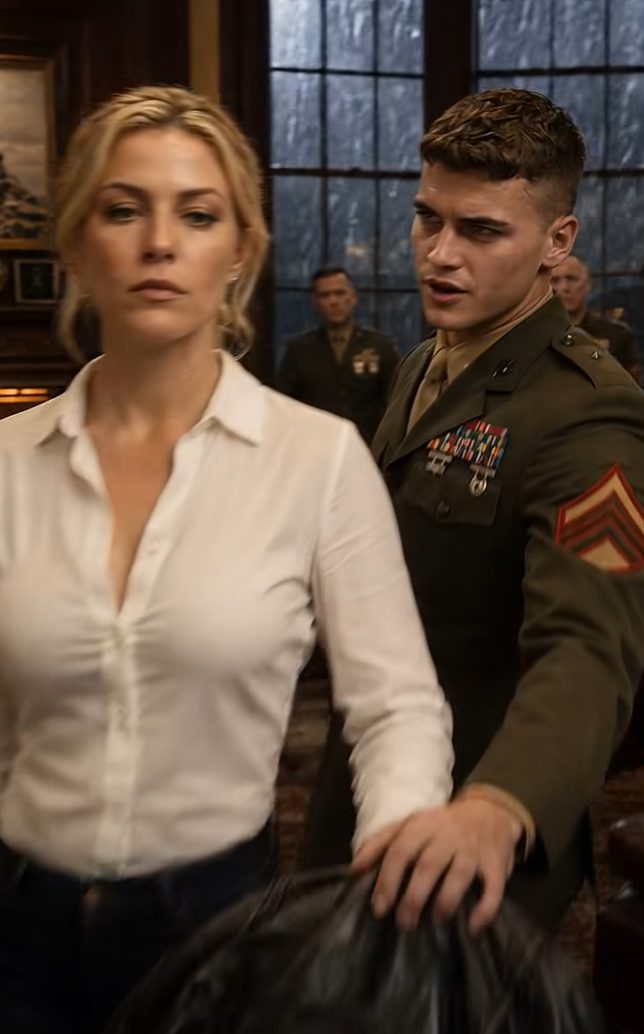
The first mistake Lance Corporal Mason Cole made was laughing at the woman’s call sign.
The second mistake was doing it loud enough for the entire officer’s club to hear.
The third mistake was touching the black leather flight jacket folded over her chair.
He pinched the sleeve between two fingers, like it was a costume from a thrift store.
Then he read the patch and grinned.
“Python Four?” he said. “Cute. What’d you do, scare mice in supply?”
The silence hit the room faster than a slammed door.
One moment, there had been low laughter, clinking glasses, and the soft murmur of old war stories.
The next, every sound seemed to vanish.
Even the ice shifting in whiskey glasses sounded sharp enough to cut skin.
Captain Eliza Grant did not turn around at first.
She kept one hand wrapped around her water glass.
Her fingers stayed loose, almost calm, though the knuckles carried old scars.
She watched tiny bubbles rise through the lemon slice floating against the rim.
She listened to the young Marine behind her laugh again.
It was quieter this time.
Less certain.
A laugh that knew too late it had walked into the wrong room.
Outside the tall windows, rain dragged silver lines down the glass.
The Atlantic wind struck the Camp Lejeune officer’s club in hard, wet bursts.
Every gust made the old panes tremble in their frames.
Inside, brass plaques glowed against dark wood walls.
Framed photographs stared down from every corner.
Men and women in desert dust.
Helicopters frozen above gray seas.
Faces of friends who had come home changed.
Faces of friends who had not come home at all.
The room carried history in its walls.
It smelled of polished wood, rain-soaked wool, black coffee, and expensive bourbon.
Eliza wore civilian clothes.
Dark jeans.
A white blouse.
No ribbons.
No rank.
No medals.
Nothing that announced what she had survived.
Nothing that warned careless men to measure their words.
Only a thin scar beneath her left jaw broke the softness of her face.
Only her eyes suggested there were places inside her no one entered twice.
Mason Cole did not know that.
He saw a woman sitting alone near the fireplace.
He saw blonde hair pinned low at the nape of her neck.
He saw a worn flight jacket with a patch that looked older than his enlistment.
He saw two corporals beside him, watching to see how far he would take it.
So he took it farther.
“Python Four,” he repeated, stretching the words like a punchline.
He gave the patch another little tug.
“Sounds like a gamer tag.”
No one laughed.
That should have stopped him.
It did not.
Some men mistake silence for permission.
Others mistake patience for weakness.
Mason made both mistakes at once.
Eliza finally turned.
Slowly.
Not with anger.
Not with embarrassment.
Not even with surprise.
She looked first at his hand on her jacket.
Then she lifted her eyes to his face.
Her expression did not change.
That made it worse.
“Take your hand off it,” she said.
Her voice was low.
It should not have carried past their table.
Somehow, it reached every corner of the room.
Mason smiled like someone had rewarded him for being foolish.
His shoulders loosened.
His chin lifted.
He was still performing for the two corporals beside him.
“Or what?”
Eliza did not answer immediately.
She looked past him.
At the far end of the bar, a retired colonel set his glass down.
He did it carefully, without a sound.
At the poker table, three majors stopped pretending they were focused on their cards.
One of them folded a winning hand without looking down.
Near the wall of photographs, a Navy commander straightened in his chair.
His face had gone still.
Not shocked.
Not confused.
Recognizing.
Nobody walked toward Mason.
Nobody grabbed his wrist.
Nobody told him to shut his mouth.
That was the first thing Eliza truly noticed.
Not the insult.
Not the smug grin.
Not even the hand resting on leather that had crossed burning skies.
It was the stillness.
The way several men in the room looked at Mason.
They looked at him like he had stepped over a line painted in blood.
They looked at him like something had already begun.
Eliza let one breath pass.
The rain scratched softly at the windows.
The fire cracked behind her, throwing gold light across the floor.
Mason’s smile twitched.
She let another breath pass.
Still, she did not stand.
She did not reach for the jacket.
She did not raise her voice.
She only said, “You have five seconds.”
Mason chuckled.
It came out too thin.
“One.”
His smile tightened.
The two corporals beside him shifted their weight.
Neither one looked amused anymore.
“Two.”
A man near the bar closed his eyes briefly.
Someone else whispered something that did not reach the room.
One of Mason’s corporals leaned closer.
“Bro,” he muttered.
The warning was quiet.
It was also too late.
Three
Mason’s hand was still on the jacket.
He knew it. Everyone in the room knew it. His fingers had stopped moving but they hadn’t let go, and that small frozen fact was the loudest thing in the building.
“Three,” Eliza said.
She still hadn’t stood up.
That was the part Mason couldn’t read. Every instinct he had, every bar fight he’d half-started in Jacksonville and half-finished in Wilmington, told him that people who meant it got to their feet. They squared up. They made themselves big.
Eliza Grant was still sitting in her chair like she was waiting for a bus.
“Four.”
The corporal to Mason’s left, a guy named Pruitt who’d been in for three years and had the good sense God gave a fence post, stepped back. Not far. Just one boot-length. Enough distance to say not me without saying a word.
The other one, Hatch, stayed put. He was twenty, dumb, and loyal in the way that gets people hurt.
Mason finally pulled his hand off the jacket.
He did it slow, like it was his idea.
“Relax,” he said. “It’s just a jacket.”
Eliza looked at him for a moment without speaking.
Then she picked up her water glass and finished what was left of it.
She set it down.
She stood.
She was not tall. Five-six, maybe. The white blouse had no drama to it. The dark jeans were the kind you bought because they fit, not because they looked like anything. She was thirty-eight years old and she looked it, and none of that mattered even slightly.
Because when she stood, the retired colonel at the bar also stood.
Not aggressively. Not rushing. He just came off his stool and turned to face the room the way a man turns when he hears his name called.
The three majors at the poker table did the same thing. One of them crossed his arms. The Navy commander by the photographs put both boots flat on the floor.
Nobody said a word.
Mason looked around the room and understood, slowly, that something had been true for several minutes that he was only now learning.
What Python Four Actually Meant
The jacket was from 2007.
Eliza had been twenty-three when she earned the call sign, flying AH-1Z Vipers out of a forward operating base in Helmand Province that didn’t officially exist in any press release and barely existed in any map. She’d flown 211 combat missions over four deployments. She’d taken fire on sixty-one of them.
The scar under her jaw was from a piece of shrapnel that came through the canopy on a night extraction gone wrong over the Sangin Valley. The crew chief behind her lost two fingers. The Marine they were pulling out made it home to his kids in Boise. Eliza had kept flying with blood soaking into her collar because there were still two birds in the air that needed a lead.
She’d been awarded the Distinguished Flying Cross twice.
The second one had a “V” device. Combat valor.
The citation was framed in the hallway outside the commanding general’s office, forty feet from where Mason Cole was currently standing.
He didn’t know any of this.
He hadn’t read the walls. He hadn’t looked at the photographs. He hadn’t noticed the way every senior officer in the room had greeted Eliza when she walked in two hours earlier, the handshakes that lasted a beat longer than protocol required, the way Colonel Dwight Farris had stood up from his dinner to do it.
Mason had seen a woman alone at a table near a fireplace.
He’d seen what he wanted to see.
The Corporal Speaks
Pruitt was the one who finally said something.
“Sir,” he said, and then stopped, because Eliza wasn’t a sir, and he didn’t know what she was, and his mouth got ahead of his brain and stalled out.
“Ma’am,” he tried.
Eliza looked at him.
“I apologize,” Pruitt said. “For all three of us.”
Mason turned his head. “The hell you do.”
“Cole.” Pruitt’s voice dropped. “Stop. Talking.”
Something in the way he said it landed different than anything else had. Mason heard it. His jaw shifted. He looked back at Eliza, then at the colonel who was still standing at the bar watching, then at the photographs on the wall, and some slow piece of machinery turned over in his head.
“Who are you?” Mason asked.
It came out smaller than he intended.
Eliza considered him.
“Captain Eliza Grant,” she said. “Marine Attack Squadron 369. Currently assigned to HQMC aviation branch.”
She paused.
“Formerly Python Four.”
Silence.
“I’ve been flying combat rotary-wing since before you enlisted,” she said. “I’ve buried eleven people I flew with. I’ve written nine letters to parents who never got to see their kids again. I’ve sat in two different hearings about two different crashes and answered every question they put to me, and I went back up both times.”
She picked up the flight jacket.
She didn’t put it on. Just held it folded over one arm.
“That patch,” she said, “is not a gamer tag.”
What Happened Next
Mason Cole said nothing.
His face did a complicated thing. Not embarrassment exactly. Not yet. Something earlier than that. The moment right before embarrassment, when the brain is still trying to find a door out and realizing all the doors are locked.
Hatch, the younger corporal, had gone the color of old chalk.
Pruitt was staring at the floor.
Colonel Farris walked over from the bar. He was sixty-one years old, built like a man who’d stopped caring about how he looked sometime around the second Gulf War, and he moved without hurry.
He stopped beside Eliza.
“You doing alright?” he asked her.
“Fine, Dwight.”
Farris looked at Mason. Not with heat. Just looked, the way you look at a problem you’re calculating.
“Son,” he said. “Do you know what a DFC with valor means?”
Mason didn’t answer.
“It means someone did something in combat that most people in this room couldn’t have done,” Farris said. “It means they did it while people were shooting at them. It means the people who were there that day signed their names to a piece of paper saying so.” He tilted his head slightly. “Captain Grant has two of them.”
The fire popped behind Eliza.
Rain hit the windows in a hard gust.
Mason’s mouth opened.
Then closed.
“I didn’t know,” he said.
“No,” Eliza said. “You didn’t try to know.”
That was the difference, and she didn’t explain it further, and she didn’t need to.
After
Mason Cole stood at attention in Colonel Farris’s office at 0730 the next morning.
He didn’t sleep much. Pruitt told him later he looked like a man who’d spent the night arguing with himself and losing every round.
The formal counseling statement took forty minutes. Farris read parts of Eliza’s service record aloud, not to punish Mason with specifics but because he believed men learned better from facts than lectures. The eleven names. The 211 missions. The night in Sangin. The shrapnel. The crew chief’s fingers.
Mason sat with his cover in his hands and didn’t move.
Eliza had not requested any formal action. That was the part that stayed with Mason longest afterward. She’d had every mechanism in the UCMJ available to her and she’d declined all of it. She’d said what she needed to say in the officer’s club, in front of the people who needed to hear it, and she’d gone home.
She hadn’t needed the system to handle it for her.
She’d handled it herself.
Pruitt ran into her three weeks later at the PX. He stopped her and apologized again, properly this time, with eye contact and no excuses. She told him he’d done the right thing and to keep doing it. She bought a bottle of water and left.
He told Mason about it.
Mason didn’t say much.
But he started reading the walls after that. The photographs. The plaques. The citations. He started arriving early enough to actually look at them, the faces above the brass nameplates, the dates, the places he’d only ever seen as locations on a news ticker.
He never touched another person’s jacket.
He never again mistook silence for permission.
He learned, eventually, that patience and weakness are not the same country. They don’t even share a border.
Some lessons cost nothing.
Some cost everything.
This one cost Mason Cole one night’s sleep, forty minutes in a colonel’s office, and whatever version of himself he’d been before he walked into that room.
He got off cheap.
—
If this one hit you, pass it to someone who needs it.
For more tales of unexpected encounters and powerful women, check out what happened when she walked into the cage alone or when two thousand sailors went completely silent. You might also enjoy the story of the tattoo on the man who was supposed to be dead.



