
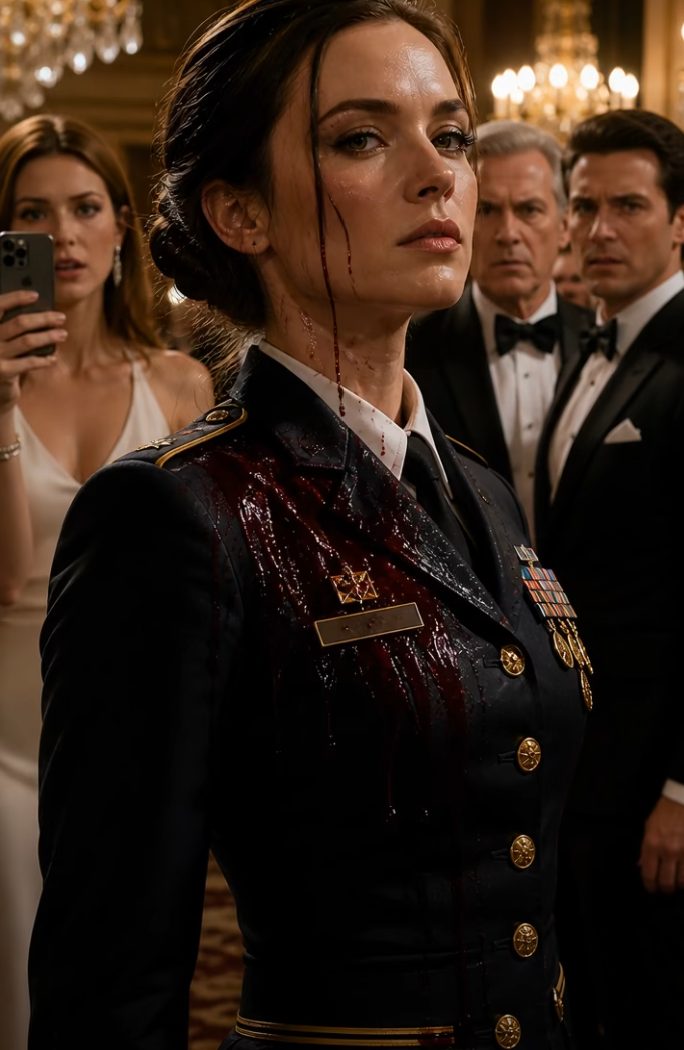
My sister threw red wine across my dress uniform and told me I didn’t belong in that ballroom, my father told security to take me out before I embarrassed his future son-in-law, and I looked at the stain running over my ribbons, checked the countdown on my watch, and said, “You’re right. I don’t,” because in sixty seconds the room was about to learn why I had really come.
The glass snapped against marble so hard people heard it over the jazz.
A second later, cold red wine hit my chest.
It spread fast across my Class A uniform, soaking the fabric, dripping over my ribbons, sliding down buttons I had lined up less than an hour earlier. Around me, conversations stalled. Forks stopped halfway to mouths. Three hundred people in black tie and silk gowns suddenly had something better to stare at than the engagement party.
Me.
My sister Jessica stood two steps away in white satin, still holding the empty crystal glass like she had done something clever.
“Seriously?” she said, loud enough for half the ballroom to hear. “You couldn’t even change before showing up?”
I had been inside maybe ten seconds.
Four steps past the door. That was all.
My father came up beside her, adjusting his cuff links with that same polished irritation he used whenever my existence landed in the wrong room.
“What is that?” he said, nodding at my uniform. “You think this is some kind of charity event?”
A few people laughed. Softly. The safe kind of cruel.
Jessica folded one arm across her waist and looked me over like I was a stain she hadn’t planned for.
“I spent months on this night,” she said. “And you walk in dressed like this. Do you have any idea how that looks next to Preston?”
Preston stepped forward right on cue.
Tailored tuxedo. Expensive watch. Smile so smooth it looked practiced in mirrors. He wasn’t angry. That would have required feeling something.
He was amused.
That told me everything.
My father leaned closer. “You embarrass him,” he said. “You embarrass this family.”
Family.
That word always showed up right before someone wanted permission to do something ugly.
“Go clean yourself up,” Jessica said, flicking her fingers toward the exit. “Or better yet, just leave.”
“Actually, don’t bother,” my father added. “Get out now before I have security escort you out.”
I looked down at the wine. A drop gathered at the edge of one medal, hung there for a second, then fell to the marble floor.
I didn’t wipe it off.
Instead, I rolled back my sleeve just enough to expose my watch and pressed the side button.
The screen lit up.
00:60.
The countdown started.
When I raised my eyes again, Jessica was still smirking. My father was already straightening his jacket like the problem had been handled. Preston’s smile was still there too, but smaller now. Sharper.
I said, very calmly, “I’ll go.”
Jessica gave a short laugh.
Then I added, “But you’ve got one minute.”
That changed something.
Not much. Not all at once. But enough.
Jessica blinked. “What is that supposed to mean?”
My father scoffed. “This isn’t your base, Mackenzie.”
I didn’t answer him. I didn’t need to.
The only one doing the math now was Preston.
He looked at my face, then at the watch, then back at me. I could almost see the thought moving behind his eyes. Because humiliation looks a certain way. Panic does too.
I didn’t look humiliated.
I didn’t look panicked.
I looked patient.
And patience in the wrong moment makes smart people nervous.
Preston pulled a folded bill from his jacket pocket and let it fall at my feet.
A hundred dollars.
“Here,” he said smoothly. “Get the uniform cleaned and save yourself the embarrassment.”
More quiet laughter.
“My morning income probably beats your monthly salary,” he added.
My father actually smiled at that.
Jessica leaned into him, pleased again, thinking the room had come back to her side.
But the seconds kept moving.
Fifty.
Forty-three.
Thirty-five.
No one was eating anymore. No one was talking. Even the band had started sounding far away, like the music belonged to another building.
Jessica pulled out her phone and aimed it at me.
“Say something,” she said. “At least give me a good clip.”
Nine seconds.
Preston looked toward the entrance.
Five.
My father shifted his weight.
Three.
I lifted my chin.
Two.
One.
And just before the doors at the far end of the ballroom exploded open, I looked at Preston and said, “Your contract was terminated five minutes ago.”
Then the heavy sound of boots hit the marble, and the entire room went still.
What Preston Didn’t Know About Me
I should back up.
Not far. Just enough.
Preston Hartley had been a defense contractor for eleven years. Mid-tier firm, federal clients, the kind of work that sounds important at dinner parties and means almost nothing to the people actually doing the job. He wore his clearance like a lapel pin. Dropped it into conversations the way some men drop the name of their golf club.
I’d known about Preston for eight months before Jessica brought him home.
Not because I cared about my sister’s love life. I didn’t, particularly. She’d dated a string of men who all had the same basic shape: expensive, confident, and allergic to anything that required them to be accountable. Preston fit the pattern so cleanly I almost didn’t notice him at first.
But I noticed the firm.
Hartley Group. Small. Profitable. And six months ago, flagged in an internal review that crossed my desk through channels I’m not going to describe in detail here. What I can say is that I work in federal contracting oversight. Have for four years. Before that, eight years active duty, which is where the uniform came from and why it still fits.
The review wasn’t my case. I wasn’t assigned to it.
But when I saw the name of the principal on the contract, I made a call.
One call. To a colleague named Dennis, who has the kind of face nobody remembers and the kind of mind that doesn’t miss anything. I told him what I knew. He did the rest.
That was February.
By April, they had enough.
By May, the case had moved up two levels and acquired three additional investigators and a federal prosecutor named Carol Baum who, from what Dennis told me, had a perfect record and the temperament of someone who genuinely enjoyed this part of the job.
The termination notice had been processed that afternoon. The contract, pulled. The firm, frozen pending full review.
Preston didn’t know any of that when he dropped the hundred-dollar bill at my feet.
He didn’t know it when he smiled at my father.
He didn’t know it when Jessica aimed her phone at me and asked for a good clip.
He found out sixty seconds later, same as everyone else.
The Doors
Six people came through.
Four of them I recognized. Two I didn’t, but their suits told me enough. Dennis was in the middle, which was unusual. He typically let other people walk point. The fact that he’d come himself meant the case had gotten bigger than he’d told me.
He walked straight across the ballroom floor without looking at anything except Preston.
Three hundred people got very quiet very fast.
Jessica lowered her phone.
“Preston Hartley,” Dennis said. He didn’t raise his voice. He didn’t need to.
Preston’s smile did something complicated. It tried to stay in place. It didn’t quite make it.
“There must be some mistake,” he said.
Dennis handed him a document. Thick. Folded in thirds.
“You’ll want to read page four,” Dennis said. “Specifically the part about the Luxembourg accounts.”
A woman near the back of the room made a sound. Not a word. Just a sound.
My father took one step toward Dennis, and one of the two suits I didn’t recognize stepped sideways, not aggressively, just enough. My father stopped.
Jessica looked at me.
Her face had gone a color I don’t have a good word for. Not pale exactly. More like the blood had just decided it had somewhere else to be.
“What did you do?” she said.
I picked up the hundred-dollar bill from the floor. Held it out toward Preston.
“Keep it,” I said. “You’re going to need it.”
The Part Nobody Talks About
Here’s the thing about moments like that one.
They don’t feel the way you think they will.
I’d spent eight months carrying this. Knowing what I knew and not being able to say it. Sitting through a Christmas dinner where Preston held court for two hours about government inefficiency while I ate my mother’s pot roast and said nothing. Watching my father shake his hand and tell him he was exactly what this family needed.
I thought when the moment finally came, I’d feel something large. Satisfaction, maybe. Or relief.
What I actually felt was tired.
And a little sad, if I’m being honest, which I don’t always like to be about my family.
Not sad for Preston. He made choices. Deliberate, documented, financially motivated choices. Whatever happens to him next, he built that road himself.
Sad for Jessica, maybe. A little. She was going to have to take apart a life she’d spent a year constructing. The venue deposit was gone. The dress was bought. The invitations had already gone out for a June wedding.
None of that was my fault. I know that. But I still felt it sitting in my chest somewhere, the particular weight of watching someone’s plans collapse in real time.
She wasn’t crying. Not yet. Jessica doesn’t cry in public. She saves it, stores it up, and then releases it in private where it can’t be used against her. That’s the one thing we have in common.
My father had gone very still. He was watching Dennis and Preston and the two suits he didn’t recognize, and something was moving across his face that I’d never seen there before.
Not anger.
Not embarrassment.
Calculation.
He was already figuring out how to position himself. How to be the man who didn’t know. The father who’d been deceived along with everyone else. He’d have it worked out by the time they left the building.
I’ve known him for thirty-four years. That’s the most honest thing I can tell you about him.
What Jessica Said After
They cleared the room in under twenty minutes.
Not the whole room. Preston and his lawyer, who materialized from somewhere near the bar looking like he’d been expecting this and had already billed the first hour. Two of the people who’d come in with Dennis stayed. The rest of the guests drifted toward the exits in clusters, talking in low voices, some of them pulling out their phones.
Jessica found me near the coat check.
She still had the empty crystal glass. She’d been carrying it the whole time, I realized. Just holding it.
“Did you know?” she said. “Before we were engaged. Before Christmas. Did you know then?”
“No,” I said. “I found out in February.”
She absorbed that.
“You could have told me.”
“I couldn’t,” I said. “Active investigation. I couldn’t tell anyone.”
“You’re my sister.”
“I know.”
She looked down at the glass. Turned it once in her hand.
“I loved him,” she said. And then, quieter: “I think I loved him.”
I didn’t say anything to that. There wasn’t a right answer. There was just the fact of it, sitting there between us on the marble floor next to the coat check counter and a stack of numbered tags.
She set the glass down on the counter very carefully.
“The wine,” she said. “I’m sorry about that.”
“It’s a uniform,” I said. “It’ll clean.”
She nodded. Didn’t look at me.
“I’m not sorry I said you didn’t belong here,” she said. “I was angry and I meant it.”
“I know you did.”
“But I’m sorry about the wine.”
That’s Jessica. She’ll split the apology right down the middle and hand you only the half she can afford. I’ve never gotten a whole one from her in my life.
I took it anyway.
The Hundred Dollars
Dennis caught me near the exit.
“You didn’t have to come tonight,” he said.
“I know.”
“Carol’s going to ask how you knew the timeline.”
“Tell her I guessed.”
He gave me the look he gives me when I’ve said something technically true and completely useless.
“The uniform was a choice,” he said.
“I had a function,” I said. “Before this. It ran long.”
That was true. It had run long. There’d been a ceremony at 1700, a reception after, and I’d driven forty minutes across the city in my Class A with a garment bag on the back seat that I never ended up needing.
He looked at the stain across my chest. The wine had dried to a dull rust color across two of my ribbons. The fabric underneath would probably be fine with a good cleaning.
“You could have changed,” he said.
“Yeah,” I said.
I picked up my coat from the counter.
The hundred-dollar bill was in my pocket. I was going to mail it back. Not to Preston, obviously. To whatever legal fund the firm’s lower-level employees were going to need when this whole thing finished unwinding, which Dennis had told me quietly would take a while.
There were people in that company who hadn’t known. Assistants. Junior staff. People who’d just needed a job.
They were going to need the money more than I needed the gesture.
Outside, the city was doing what it does on a Thursday night in late October: cold, loud, indifferent. Taxis. Someone’s music from a window above. A couple arguing in front of a restaurant across the street, their breath making small clouds in the air.
I stood on the steps for a minute.
Checked my watch.
The countdown was gone. Just the time now. 9:48 p.m.
I walked to my car.
—
If this one got under your skin, pass it on. Someone out there needs to read it.
If you’re ready for more intense stories, you might enjoy reading about The Man Who Feared Nothing Stood at Attention. My Sister’s Face Fell Apart., or discover what happened when I Laughed at Her Call Sign in the Officer’s Club. I Had No Idea Who She Was. And for a truly gripping tale, check out I Recognized the Tattoo on the Man Who Was Supposed to Be Dead.



