
My family wore my failure like a badge of honor.
To them, I was the Naval Academy dropout – the embarrassment who’d “settled” for a dead-end admin job at an insurance firm. The one who couldn’t hack it. The one who quit.
They never knew the truth.
I am a full-bird Colonel in Air Force Special Operations – a ghost who has spent fifteen years operating in classified shadows for reasons that don’t make headlines and never will.
But that day, at my brother’s Navy SEAL graduation, I stood quietly at the back of the crowd, invisible in cheap civilian clothes.
My father, a retired Navy Captain, was holding court with his old friends. His voice carried – loud enough to reach me.
“Jack is the real pride of this family,” he boomed. “He’s got the grit his sister never had. She was just… too soft for service.”
My mother sighed, casting me the same look she always did – pity wrapped in disappointment. “At least Samantha has a steady job,” she said. “Even if it’s just pushing paper.”
I stayed silent. They didn’t know I’d briefed the Joint Chiefs of Staff the week before.
The ceremony began.
Rear Admiral Wilson stepped onto the podium – a living legend. The kind of officer my father idolized, quoted, worshipped.
As the Admiral’s steel-gray eyes swept across the crowd, my pulse spiked.
He stopped.
His gaze locked onto me.
The air vanished.
Then – without a word – he stepped off the podium.
“Dad… where’s the Admiral going?” my brother whispered.
My father straightened his tie, already smiling, convinced the Admiral was approaching him.
He wasn’t.
Wilson walked past my father as if he didn’t exist.
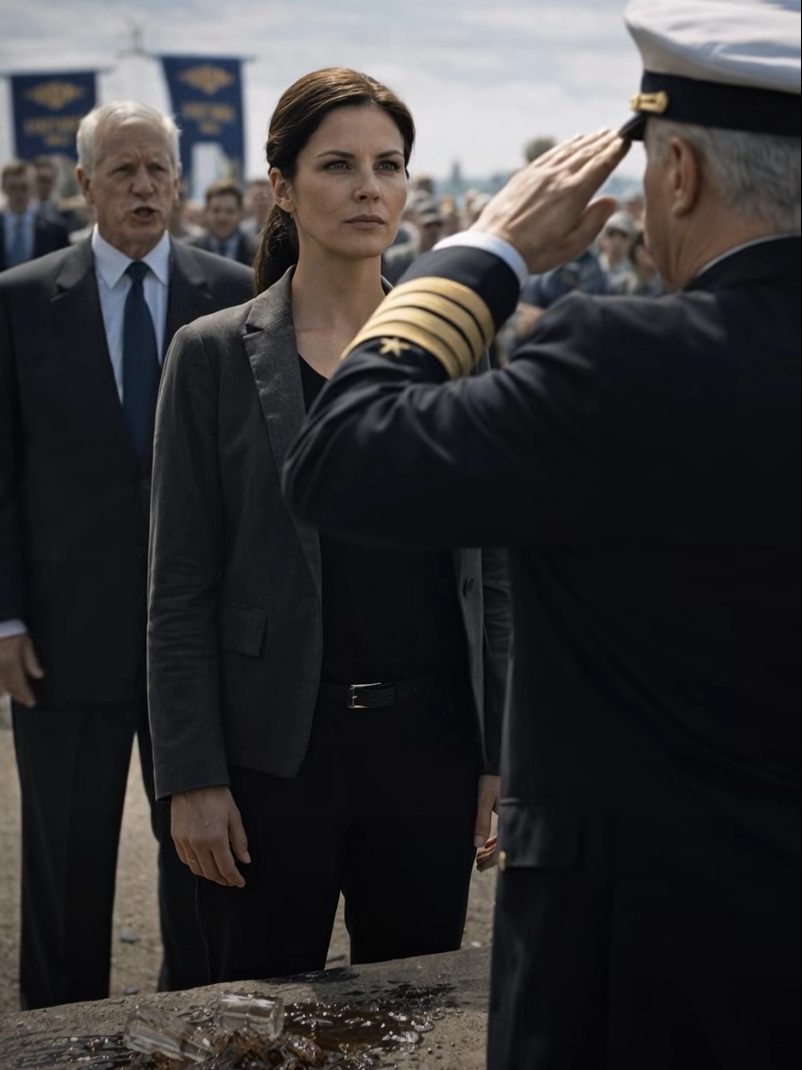
He stopped directly in front of me – the family disappointment.
“Colonel Hayes,” the Admiral said, his voice echoing through the frozen crowd. “I didn’t expect to see you here.”
Silence detonated.
My father’s glass slipped from his hand and shattered on the concrete.
“C-Colonel…?” he stammered, staring at me like he’d seen a ghost.
The Admiral ignored him. He raised his hand and delivered a sharp, unmistakable salute – one commander to another.
“Why is a senior officer out of uniform?” he asked calmly.
I lifted my chin and met my father’s eyes for the first time in fifteen years.
“It appears my cover is blown, Admiral.”
The Version of Me They Built
The story my family told about me had been running so long it had its own mythology.
I was twenty-one when I left Annapolis. No explanation they found satisfying. No dramatic breakdown they could point to. I just went quiet one week and was gone the next, and the vacuum I left behind filled up fast with their interpretations.
Dad’s version: I cracked under pressure. Couldn’t keep up with the men. He never said it that plainly but the shape of it was always there in the way he talked around me, past me, about me.
Mom’s version was kinder and somehow worse. She thought I’d had some kind of episode. She’d pressed a therapist’s card into my hand at Christmas that first year back, her voice soft, her eyes full of something that looked like grief. She’d been grieving the daughter she expected. I was standing right there.
Jack’s version – my brother, the golden one, the one who would go on to earn his Trident and stand on that parade ground in his dress whites – Jack never really had a version. He just absorbed Dad’s. By the time he was eighteen he was already looking at me the way Dad did. Slightly confused. Slightly disappointed. Like I was a math problem that didn’t resolve.
The insurance firm cover was my idea. It was almost funny, actually – I’d floated it to my handler and he’d laughed for a solid ten seconds before agreeing it was perfect. Nobody asks follow-up questions about insurance. Nobody wants to know more. It’s a conversational black hole, and I lived inside it for fifteen years at every family dinner, every holiday, every obligatory phone call where Mom asked if I was “seeing anyone” and Dad asked nothing at all.
I filed claims. I processed paperwork. I attended birthday parties with a bottle of wine and a smile that didn’t require maintenance.
In between, I ran operations I can’t name in countries I won’t specify, alongside people whose faces I still see when I close my eyes.
What Annapolis Never Knew
I didn’t wash out.
That’s the part that would break my father’s brain if he ever heard it plainly stated. He built his whole narrative on my failure, and the foundation of that narrative was wrong.
I was recruited. Quietly. By people who needed someone with my particular combination of skills – languages, specifically. I’d grown up with my grandmother, Dad’s mother, who spoke three of them. She’d raised me on Russian folktales and Farsi poetry and Mandarin soap operas and I’d absorbed all of it the way kids absorb things before they know they’re learning. By the time I hit Annapolis I was functional in four languages and conversational in two more, and somebody noticed.
The recruitment conversation happened in a room with no windows. I was twenty. The man across the table had no rank insignia I could identify. He told me what they needed. He told me what it would cost. He was honest about the cost, I’ll give him that. He said: your family will think you failed. You will not be able to correct them. Not for a long time. Maybe not ever.
I thought about my father. The way he talked about service. The way he’d raised us on the idea that sacrifice meant something – that you gave things up for something larger than yourself.
I signed.
And then I went home and let my father decide what my leaving meant.
The Fifteen Years I Carried
There’s a particular kind of loneliness in being misunderstood by people who love you. Or who are supposed to.
I don’t want to make it sound like I was a martyr. I wasn’t. I chose this. I’d choose it again, probably. The work mattered. Some of what I did – I know for certain it mattered, even if the people whose lives it changed will never know my name.
But there were moments. Christmas Eve, 2019, sitting in a hotel room in a city I won’t name, watching a video my mom had sent of the family opening presents. Jack’s kids tearing into boxes. Dad laughing at something. Mom in her red sweater, the one she wore every year. The normalcy of it. The warmth.
And me, in a room that smelled like bleach and old carpet, with a burner phone and four hours until a briefing.
I called nobody. Sent a text that said Happy Christmas, love you all. Got three back. Jack’s said You good? which was more than he usually managed.
That was the job. You make peace with the gap or you don’t last.
I mostly made peace with it. Mostly.
The Ceremony
Jack’s graduation was a big deal. Dad had been building to it for a year, calling me with updates, his voice carrying a pride he’d never once used when talking about me. BUD/S class. Hell Week. The Trident. He said these words like prayers.
I almost didn’t go.
My handler had raised an eyebrow when I mentioned it. “Wilson’s going to be there,” he said. “You know that, right?”
I knew. Rear Admiral Dennis Wilson had been my commanding officer twice in my career, at two different points in two different theaters. He knew exactly who I was and what I did. He was also, by a coincidence I could not have engineered, my father’s personal hero. Dad had a framed photo of Wilson on the wall of his study. Had since I was a kid.
I told my handler I’d be careful. He gave me the look he always gave me when he thought I was underestimating a situation.
I wore the civilian clothes on purpose. Jeans. A plain dark jacket. No jewelry, no rank, nothing that would catch light or attention. I got there early enough to position myself at the back edge of the crowd where I could see everything and be noticed by almost no one.
Dad found me anyway. Of course he did.
“Samantha.” He said my name the way you’d say the name of a town you’d driven through once and didn’t think much of. “Glad you could make it.”
Mom hugged me. Tight, actually. She always hugged tight, which was the thing about her I could never quite resolve with everything else.
“You look tired,” she said.
“Long week,” I said.
Which was true. I’d been in a secure briefing room for eleven of the previous fourteen days. But she meant it differently and I let her.
When Wilson Saw Me
The ceremony started and I let myself relax by degrees. The sun was out. The water behind the parade ground was flat and silver. Jack looked good up there – strong, composed, the kind of man who’d earned what he was about to receive. I felt something watching him that I hadn’t expected. Pride, clean and uncomplicated. Whatever was broken between us, he’d done the work. That was real.
I was watching Jack when Wilson stepped to the podium.
And then I wasn’t watching Jack anymore because Wilson was scanning the crowd with the systematic attention of a man who’d spent decades assessing rooms, and his eyes found me the way a searchlight finds a ship.
I saw the exact moment he recognized me.
He didn’t react visibly. He’s too good for that. But there was a half-second pause, a small recalibration, and then he kept speaking, kept moving through his prepared remarks, and I thought maybe it would be fine. Maybe he’d just note my presence and let it go.
He didn’t let it go.
When he stepped off the podium mid-ceremony, I felt the crowd shift. People craning. Dad straightening up, already performing, already preparing whatever he’d say to Wilson when the Admiral reached him.
I watched my father’s face as Wilson walked past him.
That’s the moment I’ll carry. Not what came after. That specific moment – my father’s smile going uncertain, then confused, then blank – as the man he’d idolized for thirty years passed him without a glance and kept walking.
Toward me.
Cover Blown
Wilson stopped two feet away. Up close he looked older than the last time I’d seen him, which had been in a room that also had no windows, going over an operation that had taken eight months to plan and forty-one hours to execute. He’d aged in the way that serious men age – more weight in the face, more stillness in the eyes.
“Colonel Hayes,” he said. “I didn’t expect to see you here.”
I heard my father’s glass hit the concrete.
“Sir,” I said.
Wilson looked at me the way he always had – direct, no performance in it. “Why is a senior officer out of uniform?”
The crowd around us had gone completely still. My mother had her hand over her mouth. Jack, somewhere in the formation, had turned to look. I could feel him looking.
I said, “It appears my cover is blown, Admiral.”
Wilson almost smiled. I know what his almost-smiles look like. “Your brother’s a good man,” he said. “You should be proud.”
“I am, sir.”
He held the salute for a full beat longer than protocol required. Then he nodded once, turned, and walked back to the podium like nothing had happened.
My father said my name. Not Samantha. Just Sam. Quiet, like he was testing whether it still worked.
I turned to look at him. He was shorter than I remembered, or maybe I was just standing differently. His face had gone through several things in the last thirty seconds and hadn’t settled on any of them yet.
“The insurance firm,” he said.
“Cover,” I said.
He opened his mouth. Closed it.
My mother was crying. Not the pity-grief kind. Something else.
Jack had broken from the formation, which he absolutely was not supposed to do. He crossed the parade ground in his dress whites and stopped in front of me and for a second neither of us said anything.
Then he said, “How long?”
“Fifteen years,” I said.
He put his arms around me. Big guy. He’d always been bigger than me. He held on longer than I expected.
Behind him, my father was still standing in the same spot, holding the broken stem of his glass, the look on his face one I’d never seen from him before.
Not disappointment.
Not pity.
Something that looked, for the first time, like he was trying to figure out who I actually was.
I didn’t help him with that. I let it sit.
Wilson was back at the podium. The ceremony resumed. The sun stayed out.
I stood at the edge of the crowd in my cheap jacket, a ghost with a name again, and watched my brother receive what he’d earned.
—
If this one got under your skin, pass it along to someone who needed to hear it.
If you’re interested in more stories about family drama and military life, you might enjoy reading about My Sister Calling My Military Career “Government Camp” or when My Sister Threw Wine on My Dress Uniform. And for another tale of a powerful moment of recognition, check out The Man Who Feared Nothing Stood at Attention.



