“THIS’LL BE QUICK. HOPE THE CAMERAS CATCH IT.”
The training officer’s smirk. Slow. Deliberate. The kind worn by men who’ve never lost.
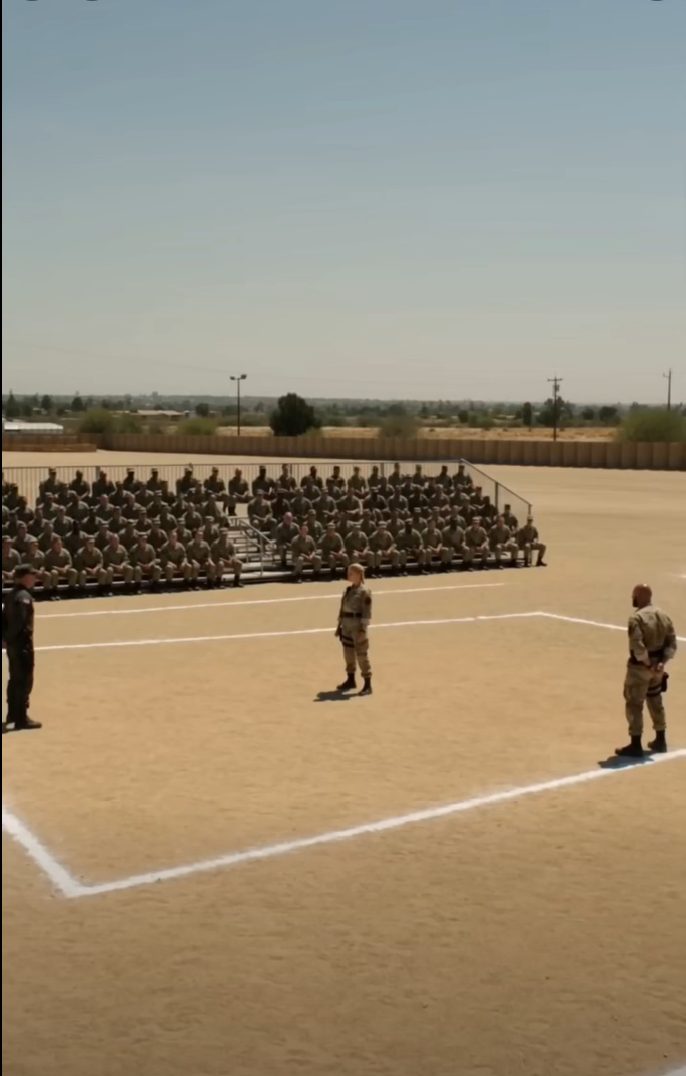
A desert battlefield baked white under a merciless sun. The crowd pressed shoulder to shoulder, restless, electric. Hundreds of eyes finding her – then staying.
One woman. Three men.
She could hear them before they spoke. The low murmurs passing mouth to ear. The sharp exhale of someone placing a bet. The dry scratch of boots shifting in anticipation.
They saw a punchline.
She let them.
The whistle split the air.
The first man came in loud – a guttural roar, weight thrown forward, all aggression and no discipline. She felt the displaced air before his hands reached her. Stepped inside it. Used it.
He hit the ground before the crowd registered he’d moved.
The second hesitated. Half a second. Enough.
Her elbow found the soft architecture of his jaw. The sound was quiet. Final.
The third didn’t roar. He circled. Smarter. She tracked the shift in his weight, the subtle drop of his shoulder – and was already moving when he committed. Sand kicked up around them in a brief, violent cloud.
Then stillness.
She stood over all three, chest rising and falling with the same rhythm as before. No faster.
The crowd didn’t gasp. They just – stopped. Every sound swallowed at once, as if the desert itself had inhaled and forgotten to breathe out.
She adjusted her left sleeve.
Old habit.
The ink beneath was faded at the edges. A compass rose, its points worn soft by years and sun and things she didn’t talk about. She’d gotten it in a port city whose name she no longer said aloud. Back when the unit still existed on paper.
The officer’s face had gone the color of dry chalk.
His smirk wasn’t there anymore. She wasn’t sure when it had left.
“Phantom Unit,” he said. Barely. The words fell out of him like something he hadn’t meant to drop.
He knew what it meant. What it cost to earn. What it cost to survive.
She said nothing.
She never did.
The Name Nobody Said Out Loud
Phantom Unit wasn’t on any current roster. Hadn’t been for six years.
The official line was that it had been dissolved, restructured, absorbed into something with a longer acronym and a smaller mandate. The unofficial line was that the people who knew what it actually did weren’t the kind to say so at dinner parties. Or anywhere else.
She’d been twenty-four when she got tapped. Corporal Renata Voss, three years in, two commendations nobody could explain without a security clearance, and a psych evaluation that the reviewing officer had signed off on with the note: unusual. Which, from Colonel Dennis Pruitt, who’d seen two wars and a coup from the inside, was about the highest compliment available.
The unit had nine people when she joined. She was the eighth.
The ninth came in three weeks later. A quiet guy from Tulsa named Gary who laughed too loud at his own jokes and made coffee every morning at 0500 whether anyone wanted it or not. Gary was gone by the second year. Not dead. Just – redirected. That was the word they used. Redirected.
She never found out where.
She stopped asking after the third time someone redirected the question back at her.
What the Compass Rose Means
The tattoo wasn’t unit-issue. Nothing about Phantom was issue. No patches, no insignia, no challenge coins passed around at dive bars with a knowing look. The whole point was that you didn’t look like anything.
She’d gotten it done on a Thursday in a city on the coast, a port city with a name she’d decided not to carry anymore. The artist was a retired merchant sailor named Tomasz who worked out of a shop the size of a closet and charged by the hour and didn’t ask questions. She’d sat in the chair for ninety minutes with her left forearm turned up and told him: compass rose, simple, no color.
He’d done it in silence. She respected that.
The unit was still active then. Eight people running operations that didn’t generate paperwork in the traditional sense. The kind of work that happened in the margin between what governments admitted doing and what they actually needed done.
She’d been good at it.
Better than good.
There was a version of her that had trouble with that fact, with what it said about her specifically that she was good at it. She’d sat with that version for a while, early on, in a series of bad hotel rooms in a series of forgettable cities. Then she’d put it somewhere and moved on.
You didn’t last long in Phantom if you couldn’t put things somewhere and move on.
The Three Men on the Ground
The first one was already sitting up, one hand pressed to the back of his skull, blinking at the sand between his knees like it owed him an explanation. His name was Carver – she’d seen it on the roster that morning. Big guy, former collegiate wrestler, the kind of physical confidence that came from never having met its ceiling.
He’d met it now.
The second was still flat. Not unconscious, just stunned, his jaw working around a silence he couldn’t quite fill. She’d pulled the elbow strike. Not all the way down, but enough. He’d feel it for a week. Maybe two.
The third – the smart one, the circler – was already on his feet. He’d gotten up fast, faster than the other two, and he was standing about four meters back with his arms loose at his sides and an expression she recognized. Not anger. Not embarrassment.
Recalibration.
He was running the footage in his head. Trying to find where he’d gone wrong. She could tell because she used to do the same thing, after, in the early years. Stood in the shower or sat on the edge of a cot and ran it back frame by frame until she found the decision point.
She almost told him. Almost.
Instead she looked back at the officer.
The Officer
His name was Trent Halvorsen. She’d done the reading before she got here – she always did the reading. Fifteen years in, current rank of Master Sergeant, three overseas deployments, a reputation for running hard evaluations and a harder mouth. The men under him called him Halvo. Not to his face.
He was standing about twelve feet from the edge of the circle, clipboard at his side, and he had the look of a man whose internal monologue had just switched languages mid-sentence.
“Phantom Unit.” Again. Like saying it twice would make it make more sense.
She walked toward him. Not fast, not slow. Just walked.
He held his ground, which she noted. Some of them stepped back without meaning to. Halvorsen didn’t. Whatever else he was, he wasn’t that.
“Voss,” he said. First time he’d used her name all morning. Before it had been you and she and, once, sweetheart, which she’d filed away without reacting to.
“Sergeant.”
“You want to tell me what the hell that was.”
“You asked for a demonstration.”
He looked at the three men. Carver was up now, standing with the careful posture of someone pretending their back didn’t hurt. The second one – Ruiz, she thought – had made it to one knee. The circler, whose name she hadn’t caught, was just watching.
“I asked for a sparring evaluation,” Halvorsen said.
“You got one.”
He looked at her for a long moment. She let him look.
There was a specific thing that happened sometimes, in moments like this, where the person in front of her was doing the math and the math wasn’t adding up to anything comfortable. She’d seen it on four continents and in at least eight languages. The expression was always roughly the same. Something behind the eyes adjusting.
Halvorsen had it now.
“How long were you in,” he said. Not really a question.
“Long enough.”
“Phantom Unit’s been dark for six years.”
“Yes.”
“So what are you doing here.”
She glanced back at the circle. The sand was still settling. The crowd had found its voice again, a low collective murmur, but nobody was moving. Nobody was pulling out their phone or turning to their neighbor with a joke. They were just standing there, watching her the way you watch something you’re trying to memorize.
She turned back to Halvorsen.
“Training,” she said.
He almost laughed. She could see it start somewhere around his mouth and then stop, because it didn’t know what it was laughing at or whether that was the right response.
“Training,” he repeated.
“Your program had an opening. I applied. Here I am.”
“You applied through the standard portal.”
“I did.”
He looked down at his clipboard, then back up at her. “Your file’s got a twelve-page gap.”
“Yes.”
“Classified.”
“Yes.”
“And you’re not going to tell me what’s in it.”
She said nothing.
He exhaled through his nose. Looked at the three men again. Looked at the crowd, which was still watching. Looked back at her.
“All right,” he said, finally. The word landed like something he’d been holding for a while and decided to set down.
He made a note on the clipboard. She couldn’t read it from this angle. Didn’t try.
What She Didn’t Say
There were things she could have told him.
She could have told him about the eighteen months in the eastern region whose name she’d also retired, running a two-person cell with a woman named Dorota Krawczyk who could pick a lock in the dark with a bent paperclip and who made the best terrible coffee of anyone Renata had ever known. Dorota was alive. Teaching middle school science somewhere in the Pacific Northwest. They didn’t stay in touch, which was the arrangement, but Renata had checked once, just to check.
She could have told him about the morning in year three when she’d gone thirty-six hours without sleep and still had to put two people on the ground in a stairwell without making noise, and how afterward she’d sat in a supply closet for four minutes with her back against the wall and her hands perfectly still and thought about absolutely nothing, because nothing was the only option available.
She could have told him why she’d applied for a training position at a facility in the middle of nowhere with a salary that was embarrassing by any standard.
But that was the part she was still working out herself.
There was a version of the answer that had to do with wanting to be useful in a way that didn’t require her to disappear afterward. A version that had to do with the particular exhaustion of carrying work that could never be acknowledged, not by anyone, not even in the oblique way veterans sometimes acknowledged things to each other in parking lots and airport bars.
A version that had to do with being thirty-one years old and tired of only existing on paper when it was convenient.
She adjusted her sleeve again. The compass rose disappeared back under the fabric.
Halvorsen was still watching her.
“Formation’s at 0600 tomorrow,” he said.
“I’ll be there.”
He nodded once. Turned away. Called out to the crowd to disperse, to get back on the schedule, to stop standing around like they’d never seen a sparring evaluation before.
They moved. Slowly. A few of them glanced back.
Carver caught her eye as he walked past. He held it for a second. Then he dipped his chin. Just slightly.
She didn’t nod back.
But she noticed.
—
If this one stayed with you, pass it on to someone who’d get it.
For more stories of proving them wrong, check out My Family Called Me a Dropout for Twenty Years. Then a Four-Star Stopped Mid-Ceremony to Salute Me., or read about when My Sister Called My Military Career “Government Camp” in Front of Her Friends and the time I Was Wearing My Dress Uniform When My Sister Threw the Wine. She Had No Idea What Was Walking Through Those Doors..