
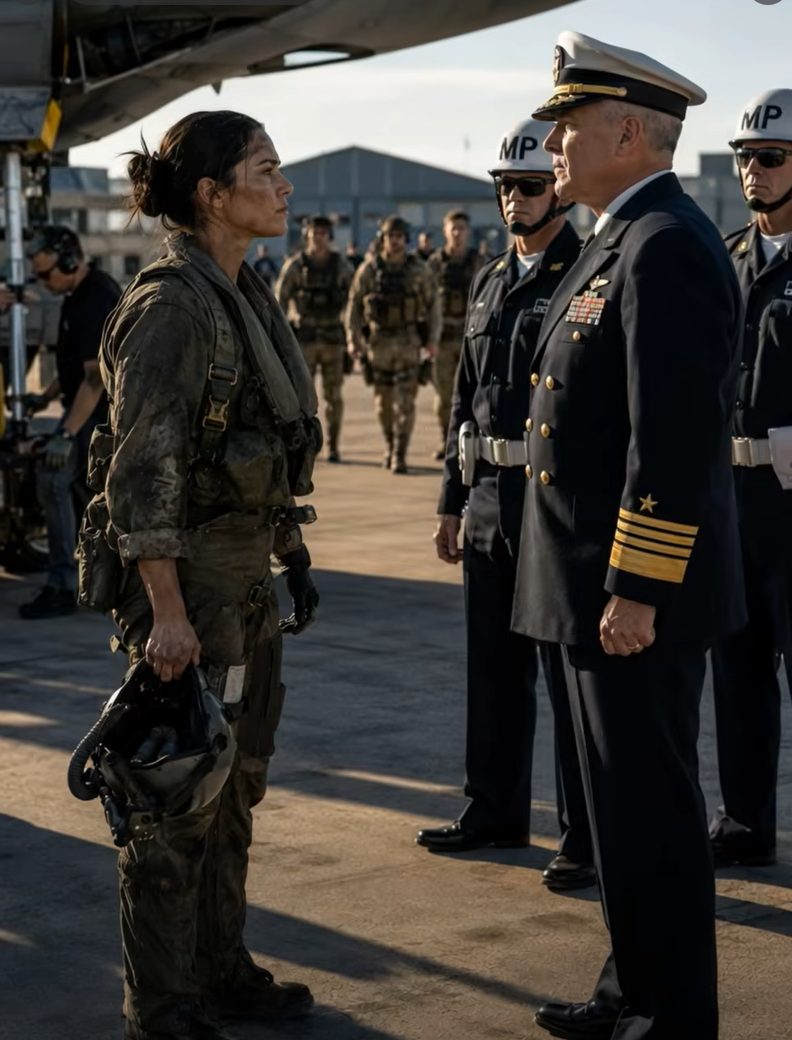
My name is Captain Naomi Vance, and the day an admiral tried to have me removed from Naval Air Station Oceana began less than ten minutes after I stepped out of a jet with seventy-two hours of classified hell still clinging to me.
I had just come off a mission no one on that runway had clearance to even acknowledge. My flight suit was streaked with hydraulic fluid, dust, and the faint, stubborn scent of burned metal. My shoulders ached from too many hours strapped into a cockpit and not enough time outside it. My body wanted water, a debrief, a locked room, and maybe ten minutes where I wasn’t still thinking in coordinates and threat assessments.
Instead, I was met by Admiral Leonard Shaw.
He stood waiting on the tarmac like a photograph – uniform immaculate, shoes polished to a mirror shine, two military police positioned just behind him. His expression carried that familiar edge: the kind worn by men who believe order is something you can enforce through appearances alone.
I knew his type before he opened his mouth.
Traditionalist. Political. Distrustful of anything that didn’t fit neatly into a chain of command he could display and explain. Special operations? People like me? We were tools to be used quietly – or problems to be removed.
He looked me over once.
That was all it took.
“What unit are you attached to?” he asked.
“Tasked transit,” I replied.
It was the truth.
It was also exactly the kind of answer he hated.
Shaw stepped closer, his gaze sweeping over everything – my sidearm, my gear, my unpressed suit, the exhaustion I hadn’t bothered hiding.
“You do not walk armed across my runway looking like this,” he said sharply. “Surrender your weapon and prepare to clear this installation.”
At first, I thought it was posturing.
Then he gave a small nod to the MPs.
That told me everything.
Behind him, a cargo crew slowed. Farther down the runway, a SEAL team heading toward another transport eased their pace – not stopping, just… noticing. Heat shimmered off the concrete in wavering lines, and I remember thinking how surreal it was.
After everything I had just survived – My next problem wore stars on his collar.
“I’m on orders,” I said, keeping my voice level.
“So was everyone who ever hid behind that phrase,” Shaw snapped. “I am not running a circus for special operations mythology. You will comply – or you will be detained.”
One of the MPs stepped forward.
Young. Hesitant. Not aggressive – just following direction.
That mattered.
I reached for my radio.
“Do not touch that,” Shaw barked.
Too late.
I keyed the line.
“Voodoo Actual, this is former F-22 asset Archangel Seven requesting identity confirmation on Oceana runway, priority immediate.”
The words had barely left my mouth – When everything changed.
It wasn’t loud.
It wasn’t dramatic.
It was immediate.
The SEAL team fifty yards away stopped as one.
Not staggered.
Not confused.
Instant.
Every head turned toward me.
One of the chiefs froze like someone had just pulled him backward through time. Another shifted his stance, posture tightening – not with tension, but recognition.
The MP in front of me hesitated.
Admiral Shaw didn’t.
He just frowned, expression hardening, already convinced I was escalating a bluff.
He wasn’t.
Three years earlier, in a valley in Afghanistan, “Archangel Seven” wasn’t just a call sign.
It was a ghost.
Attached to a pilot who flew below safe altitude through active fire to cover a trapped assault team.
A pilot who took a hit.
Went down.
And didn’t stop fighting.
A pilot who picked up a rifle that wasn’t hers, held a perimeter that wasn’t supposed to exist, and stayed alive long enough for extraction to become possible.
Most people had only heard fragments.
Rumors.
Distorted versions passed through briefings and bars.
But the men now staring at me – They knew exactly what happened.
And when the first SEAL broke formation and started walking toward us, something in his face made it clear:
This wasn’t curiosity.
This was recognition.
This was memory.
This was debt.
The distance between us closed slowly, deliberately, like something inevitable.
I watched it happen.
And for the first time since stepping onto that runway – I saw uncertainty flicker across Admiral Shaw’s face.
Because the silence he had just created – Was no longer his to control.
And whatever came next…
The Man Walking Toward Us
His name was Senior Chief Dale Pruitt.
I didn’t know that yet. I’d find it out later, in pieces, the way you find out most things in that world – sideways, through other people’s mouths, weeks after it matters.
What I knew in that moment was the walk. Measured. No hurry. The kind of walk that says I have done worse things than this before breakfast and I will do them again and none of it impresses me. He was maybe forty, sunburned to leather, with the kind of face that had been broken at least once and hadn’t been fixed by anyone who cared about symmetry.
He didn’t look at Shaw.
He looked at me.
And when he got close enough that I could see the color of his eyes – pale gray, almost colorless in the Oceana sun – he said one word.
“Kandahar?”
Not a question, exactly. More like a lock clicking open.
“Adjacent,” I said.
He nodded. Just the once.
Then he turned to Admiral Shaw with the particular expression of a man who has run out of patience for theater.
“Sir,” he said. “With respect. You may want to make a call before this goes further.”
Shaw’s jaw moved. “Senior Chief, this is not your – “
“Sir.” The word again. Flat as asphalt. “Make the call.”
What Shaw Didn’t Know
There are things that don’t go in reports.
Not because they’re classified – though some are. But because the men and women who were there make an unspoken agreement to leave certain things in the dirt where they happened. You don’t write down the moments that break the rules of what’s possible. You don’t file a form for the time someone did something that shouldn’t have worked and worked anyway. You let those things live in the people who saw them, and you trust that’s enough.
The valley had no name on any map I’ve seen since.
We were three hours into a support run when the assault team’s comms went sideways. I was at altitude, clean air, watching a grid square go wrong in real time on my sensors. The team was pinned in a dried riverbed – six men, two of them already down, taking fire from three directions. The QRF was twenty-two minutes out.
Twenty-two minutes is a long time.
I made a decision.
I brought the jet down to a level that would have gotten me grounded under any normal set of circumstances and I made enough noise and enough heat that the firing positions shifted – not because I could take them out cleanly, not at that angle, but because I could make them think about me instead of the men in the riverbed. I took a hit on the third pass. Something in the left engine that I won’t get into. The jet told me it was done and I believed it and I put it down in the flattest piece of ground I could find, which wasn’t flat and wasn’t much ground.
I walked away from it.
Barely.
My sidearm was still on my hip and the rifle I found was not mine and the man it had belonged to didn’t need it anymore, and I am not going to describe the next forty minutes in any more detail than that.
The QRF arrived.
Everyone who was still alive came out.
That’s what matters.
The rest of it – the part that turned into rumors, into fragments passed through briefings and bars – that’s not mine to narrate. That belongs to the men in the riverbed. They can tell it however they want. They earned that.
What I know is that Pruitt was one of them.
And he remembered.
Shaw Makes the Call
The admiral looked at Pruitt for a long moment.
Then he looked at me.
His face was doing something complicated – the math of a man recalculating, not because he wants to, but because the numbers aren’t adding up the way he needs them to. Shaw was not a stupid man. I want to be clear about that. Stupid men don’t make admiral. He was a man who had built a very precise model of how things worked, and I was a variable that didn’t fit the model, and that bothered him somewhere below the professional level.
He pulled out his phone.
I don’t know who he called. I never found out. The conversation lasted maybe ninety seconds and consisted almost entirely of Shaw saying “yes, sir” in decreasing intervals, his posture changing in small, incremental ways – shoulders dropping a quarter inch, chin coming down, the mirror-shine certainty going slightly dull.
He hung up.
He looked at me.
“Captain Vance,” he said. Formal now. No edge. “You’re cleared.”
That was it.
No apology. No explanation. Just the door opening that had been shut thirty seconds ago.
I nodded once.
The young MP stepped back. He looked relieved, actually – like he’d been holding something heavy and someone finally told him he could put it down.
Pruitt
He fell into step beside me as I walked toward the operations building. Not escorting me. Just walking the same direction, the way people do when they have something left to say and aren’t sure how to open it.
We got about forty yards before he spoke.
“Heard you were out,” he said. “Heard you’d gone civilian.”
“Almost,” I said. “Kept getting pulled back.”
“Yeah.” He looked straight ahead. “Know the feeling.”
We walked another twenty yards.
“Kowalski made it,” he said. “The one they thought wouldn’t. He’s got two kids now. Lives in Boise.”
I didn’t say anything.
“Thought you’d want to know,” he said.
I did want to know. I’d thought about Kowalski maybe three hundred times since that riverbed and never had a clean way to find out, and now here was this man telling me in the middle of a Virginia tarmac like it was nothing, like good news was just something you handed someone while walking.
My throat did something.
I kept walking.
“Thank you,” I said.
He nodded. That was the whole exchange. He peeled off toward the SEAL transport and I kept going toward the ops building and neither of us looked back, because that’s not how it works, that’s not the kind of moment you underline.
The Debrief
The room they put me in was small, fluorescent-lit, and smelled like old coffee and dry-erase markers. Standard. Two men from my actual chain of command were already there – a colonel named Fischer I’d worked with twice before, and a civilian whose name I was never given and didn’t ask for.
They debriefed me for four hours.
I told them what they needed. I kept what wasn’t theirs. That’s the job.
Fischer walked me out after. He was a quiet man, economical with words in a way I’d always respected. At the door he stopped and said, “Shaw’s going to be annoyed about this for a while.”
“Probably,” I said.
“You handled it right.”
I didn’t answer that. I wasn’t sure “right” was the word for any of it – not the runway, not the radio call, not the valley three years back. Right implies you had a clean set of options and chose the best one. Most of the time you just have the options you have and you pick fast and you live with it.
Fischer went back inside.
I stood in the parking lot for a minute. Just standing. The sun was lower now, the heat off the concrete less brutal. Somewhere on the other side of the base, jets were moving. The sound of them – that specific, bone-deep sound – was the closest thing I had to a home address.
I thought about Kowalski in Boise.
Two kids.
I thought about the valley with no name on any map.
Then I stopped thinking about it, because that’s also part of the job.
I found my car.
I drove to the gate.
The guard checked my credentials, waved me through, and I pulled out onto the road heading west, the base shrinking in my mirrors, the next set of coordinates already forming somewhere in the back of my mind.
Shaw would be annoyed.
Pruitt’s team would be wheels-up by morning.
Kowalski had two kids in Boise.
The jet was still in pieces in a valley with no name.
And I had maybe six hours before someone called with the next thing.
That’s the job.
—
If this one stayed with you, pass it to someone who gets it – or someone who needs to.
If you enjoyed this wild tale, you might like hearing about the rookie who wrote the K9 manual, or perhaps the general who saluted her. And for another dose of unexpected turns, check out what happened when she turned around and he dropped to his knees.



