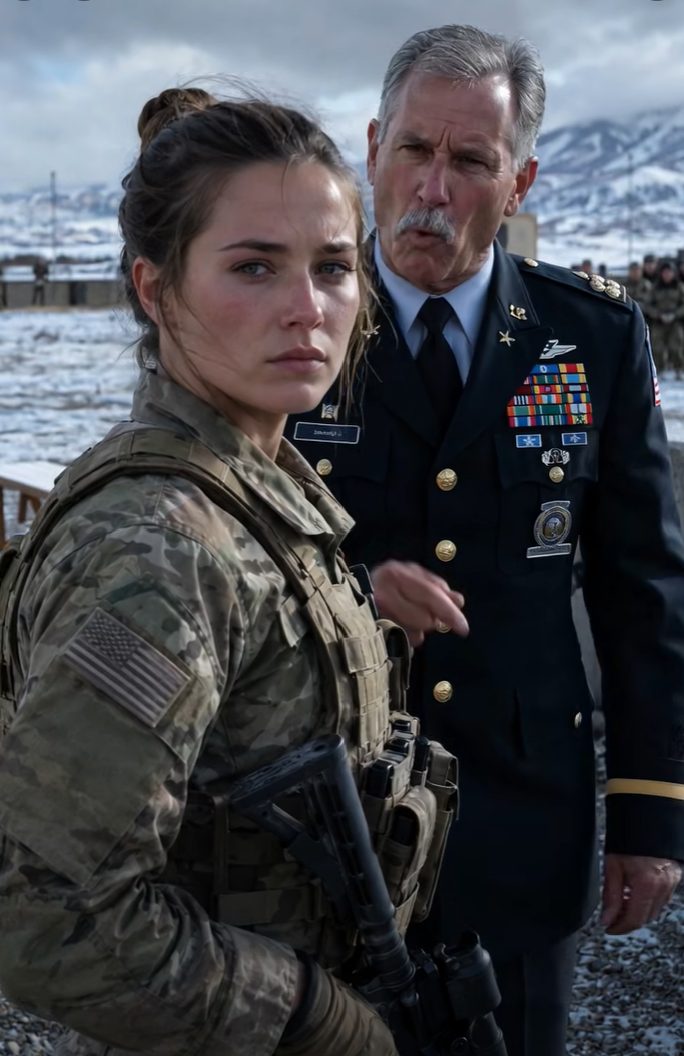
The morning air in Wyoming cut like glass. Frost clung stubbornly to the edges of the shooting range, and the distant ridges shimmered beneath the muted gray sky, as if the mountains themselves were holding their breath. Private Harper’s boots crunched against the gravel, each step echoing louder than it should have, yet she didn’t flinch.
Her fingers tightened around the rifle, feeling the cold steel bite through her gloves. She was supposed to be a clerk. Paperwork, requisitions, coffee runs, the quiet work nobody respected until it went missing.
But that morning, standing in front of men who had already decided she was a joke, Harper was about to show them that “just a clerk” could mean something very different.
“Hold the line. Don’t laugh yet,” someone barked from behind her.
The infantry guys leaned lazily on their rifles, smirking like this was entertainment arranged just for them. Harper heard every low chuckle, every whisper, every little cough meant to hide a laugh.
She squared her shoulders and drew in a slow breath. “Five rounds. Watch closely,” she muttered, almost too softly for anyone else to hear.
Colonel Davis stood near the line with his salt and pepper mustache and the hard, amused eyes of a man who enjoyed watching people fail. His uniform was sharp. His smile was sharper.
“Five rounds, Private Harper,” he said, loud enough for everyone to enjoy. “Try not to embarrass yourself.”
The laughter came immediately.
They called her a POG, a Person Other than Grunt, and Harper had learned to swallow the word like bitter medicine. Most days, she ignored it. Today, it landed differently.
The rifle felt heavy in her hands, awkward at first, but not unfamiliar. Fifty yards ahead, a standard paper silhouette stood trembling in the wind. Cold air tugged at her uniform and pulled loose strands of hair from her tight bun.
She exhaled slowly.
Crack.
Nothing.
No hole appeared in the paper.
A laugh broke from somewhere behind her, then another. “Did she even hit the berm?” someone called.
Harper’s jaw tightened, but her eyes did not move.
Crack.
Second shot.
Still nothing.
The wind flicked the paper target as if it were mocking her too. The laughter grew bolder now, crueler, fed by the sight of her silence.
“Garden hose stance!” one soldier shouted. “You shooting with your eyes closed, Harper?”
She did not answer.
Her breath steadied. Her shoulders softened. The rifle stopped feeling like an object in her hands and became something quieter, something exact, something obedient.
Crack.
Third shot.
Crack.
Fourth.
Crack.
Fifth.
Then silence, except for the wind moving over the frozen range.
Five rounds fired. No visible impact on the target.
Harper lowered the rifle slightly, her gaze still fixed forward. Colonel Davis stepped closer, already grinning, already preparing the kind of comment that would follow her for months.
“Well, that was…” he began.
“Hold.”
Range Master Sergeant Diane Foster’s voice sliced through the air.
The laughter died so suddenly it felt like someone had shut a door on it. Foster moved past the firing line, past the untouched target, her boots grinding over gravel with deliberate calm.
Everyone watched her.
She did not stop at fifty yards.
She kept walking.
All the way to the concrete backstop thirty yards beyond.
Harper stood still, but something in the air changed. Even the men who had been laughing seemed to feel it before they understood it.
Foster knelt near the wall. Her gloved fingers moved across the concrete, tracing something small, tight, impossible.
Then she rose slowly.
The color had drained from her face.
Her eyes locked onto Harper’s, and for the first time that morning, there was no ridicule in the range master’s expression. There was recognition. Respect. And beneath it, fear.
“Check the back wall,” Foster said.
Three words.
That was all it took to silence every soldier on the range.
The men moved closer, one by one, their boots slowing as they saw what Foster had found.
Five impacts.
Tight together.
Compressed into a perfect grouping on the concrete backstop, exactly where a human chest would have been if the target had stood farther out.
Colonel Davis stared at the untouched paper target. Then at the wall. Then at Harper.
His face shifted from red to white.
“What the hell kind of…” he started.
“Sir,” Foster interrupted, calm but firm. “Those aren’t misses. She wasn’t aiming at the target we gave her.”
A murmur moved through the soldiers like cold smoke.
Someone whispered, barely loud enough to hear, “What file?”
Harper lowered the rifle fully.
And for the first time, Colonel Davis looked at her not like a clerk, not like a joke, but like a secret he should have been warned about.
The File Nobody Asked About
Her name wasn’t always Harper.
That part came later, after a courthouse in Billings, after a judge who didn’t ask too many questions, after a woman named Roberta Vance signed some paperwork and walked out into a parking lot and lit a cigarette she didn’t even want.
Roberta Vance had been twenty-six when she enlisted the first time. Different branch. Different name. Different country, technically, though the details of that last part were the kind of thing that took three federal departments and a very bored archivist to untangle.
She’d grown up in a house outside of Sheridan where the nearest neighbor was four miles of dirt road away. Her father, Glen, was not a warm man. He was not a cold man either. He was a practical man, which is its own category entirely. Glen taught her to shoot the way other fathers taught their kids to drive: early, without ceremony, and with the clear expectation that she’d be better at it than he was by the time she turned twelve.
She was ten when she passed him.
He never mentioned it again.
The Army didn’t know any of that. The Army knew Private First Class Mara Harper, twenty-nine, administrative specialist, one minor disciplinary note for an incident involving a supply sergeant and a disputed equipment manifest. Clean record otherwise. Excellent typing speed. Unremarkable fitness scores. No flag on the file.
No flag.
That was the part Foster kept coming back to.
What Foster Knew
Diane Foster had been running qualification ranges for eleven years. Before that, she’d done two tours, one in a place she didn’t discuss and one in a place nobody remembered anymore. She’d seen good shooters. She’d seen great ones. She’d seen a man once who could consistently hit a four-inch group at three hundred yards with iron sights in a crosswind, and she’d told her husband about it that night over dinner like she was describing a UFO sighting.
What she’d just seen on that backstop was not that.
What she’d just seen was five rounds through a paper target, through the paper cleanly enough that the entry wounds were nearly invisible from the front, and into the concrete wall behind it at a grouping you could cover with your palm.
The paper target had holes in it. Small, clean, almost surgical. She’d missed them because she’d been looking for the ragged tears a standard round makes when it hits paper at range. These were different. Controlled. Like someone had decided exactly how much the bullet would disturb the material it passed through.
That wasn’t marksmanship.
That was something else.
Foster walked back to the firing line. The soldiers had stopped laughing. A few of them were doing the math quietly, the way men do when they realize they’ve been wrong about something and haven’t decided yet whether to admit it.
Davis was still standing near Harper. He hadn’t moved.
“Private,” Foster said.
Harper looked at her.
“Where’d you learn to shoot?”
Harper was quiet for a second. Not evasive. Just the kind of quiet that comes before an honest answer you haven’t had to give in a while.
“Wyoming,” she said. “Mostly.”
The Conversation After
Davis pulled Foster aside. Thirty feet from the group, voices low, which accomplished nothing because the range was flat and quiet and everyone heard anyway.
“What do you mean there’s no flag?”
“I mean what I said, sir. Her file is clean. Administrative track, no combat training beyond basic, no marksmanship program beyond standard qualification. She shot Expert on her initial qual and nobody thought much of it.”
“Expert.”
“Yes, sir.”
“And nobody thought much of it.”
Foster looked at him. “She’s a clerk, sir. People see what they expect to see.”
Davis rubbed the back of his neck. He had the look of a man recalculating something important. “Who else has seen this?”
“Everyone on the range just now.”
He turned and looked at the group of soldiers, who were doing a very bad job of pretending they weren’t watching him.
“Get me her full jacket. Everything. And I want to know who signed off on her placement.”
“Yes, sir.”
He walked back toward Harper. She was standing exactly where she’d been, rifle at her side, expression flat. Not defiant. Not smug. Just waiting, the way people wait when they’ve done something they knew was coming and have already made their peace with whatever comes next.
“At ease, Private,” Davis said.
She hadn’t been at attention.
He didn’t seem to notice.
“You want to tell me what that was?”
Harper looked at the backstop. Then back at him. “Five rounds, sir. Like you asked.”
“Don’t.” His voice was quiet now, which was worse somehow than when it was loud. “Don’t do that. I’m not asking for the smart answer. I’m asking what I just watched.”
She held his gaze for a moment. “I was aiming at the back wall.”
“Why?”
“Wind,” she said. “The target was moving. A moving target at fifty yards in that crosswind gives you maybe a sixty percent chance at center mass. The backstop doesn’t move.”
Davis stared at her. “So you compensated for wind drift by aiming through the target.”
“Yes, sir.”
“Through it.”
“The paper’s not the point, sir. The point is what’s behind it.”
Nobody said anything for a long time.
One of the infantry guys, a big kid from Georgia named Pruitt who’d been loudest with the garden hose comment, sat down on a range bench and looked at the ground.
What Came Next
The call went up the chain that afternoon.
Foster filed the range report with the grouping measurements attached, and by evening there were two people in Davis’s office who hadn’t been there that morning. Harper didn’t know their names. She wasn’t supposed to. She found out later that one of them had driven four hours from a facility she’d never heard of, and the other had flown in from somewhere that didn’t show up on the manifest.
They asked her questions for two hours.
Mostly about Wyoming. Some about Billings. A few about a name she hadn’t used in three years, which told her they’d done some digging already and she didn’t need to pretend otherwise.
She answered everything straight. That had always been her approach. The lie that gets you through the room is the lie you have to maintain forever, and she was tired.
When they were done, the shorter of the two men, gray jacket, no rank insignia, the kind of face you’d forget before you left the room, set a folder on the table in front of her.
She didn’t open it.
“You know what’s in there?” he asked.
“Probably,” she said.
“You’ve been doing administrative work for fourteen months.”
“Yes.”
“By choice?”
She looked at the folder. “I needed a break.”
He nodded slowly, like that was the answer he’d expected and the answer he respected. “Break’s over,” he said.
The Range, the Next Morning
She was back out there at 0530.
No audience this time. Just Foster, a fresh set of targets, and a rack of weapons she hadn’t been issued through any standard channel. The cold was worse than the day before. Ice had formed along the edge of the firing line overnight, a thin skin of it that cracked under her boots like old glass.
Foster handed her a coffee without being asked. Harper took it.
They stood there for a minute, not talking, watching the sky go from black to the particular dark blue that comes right before sunrise, when the mountains are just shapes.
“You could’ve just qualified,” Foster said. “Passed the standard. Gone back to your desk.”
Harper drank the coffee. “Yeah.”
“Why didn’t you?”
Harper looked down the range. The new targets were set at a hundred yards. Then two hundred. Then a shape at the far end she couldn’t quite make out in the dark.
“I don’t know,” she said. “Pruitt made that garden hose comment.”
Foster made a sound that was almost a laugh. “That’s it?”
“That’s enough.”
The sun broke over the ridge. Light hit the range in one flat wave, and Harper set down the cup, picked up the first rifle, and started checking the action with her eyes half-closed, going by feel.
Foster watched her hands.
“You know they’re going to want you for something you probably won’t be able to talk about,” she said.
“I know.”
“And you’re okay with that.”
Harper chambered a round. Settled her stance. Found the first target at a hundred yards, which at this point was basically a formality.
“I’ve been okay with it for a while,” she said.
She fired.
The target didn’t move.
The one behind it did.
—
If this one got under your skin, pass it to someone who’d feel it too.
If you’re curious for more stories about unexpected prowess, check out how she set down a military ID and the sergeant’s smile never fully recovered, or read about the time my instructor said “sure, give it a shot” – he didn’t know I used to do it for real. And for another tale of underestimation, see what happened when the Marine sergeant told me to go home before I embarrassed myself.