
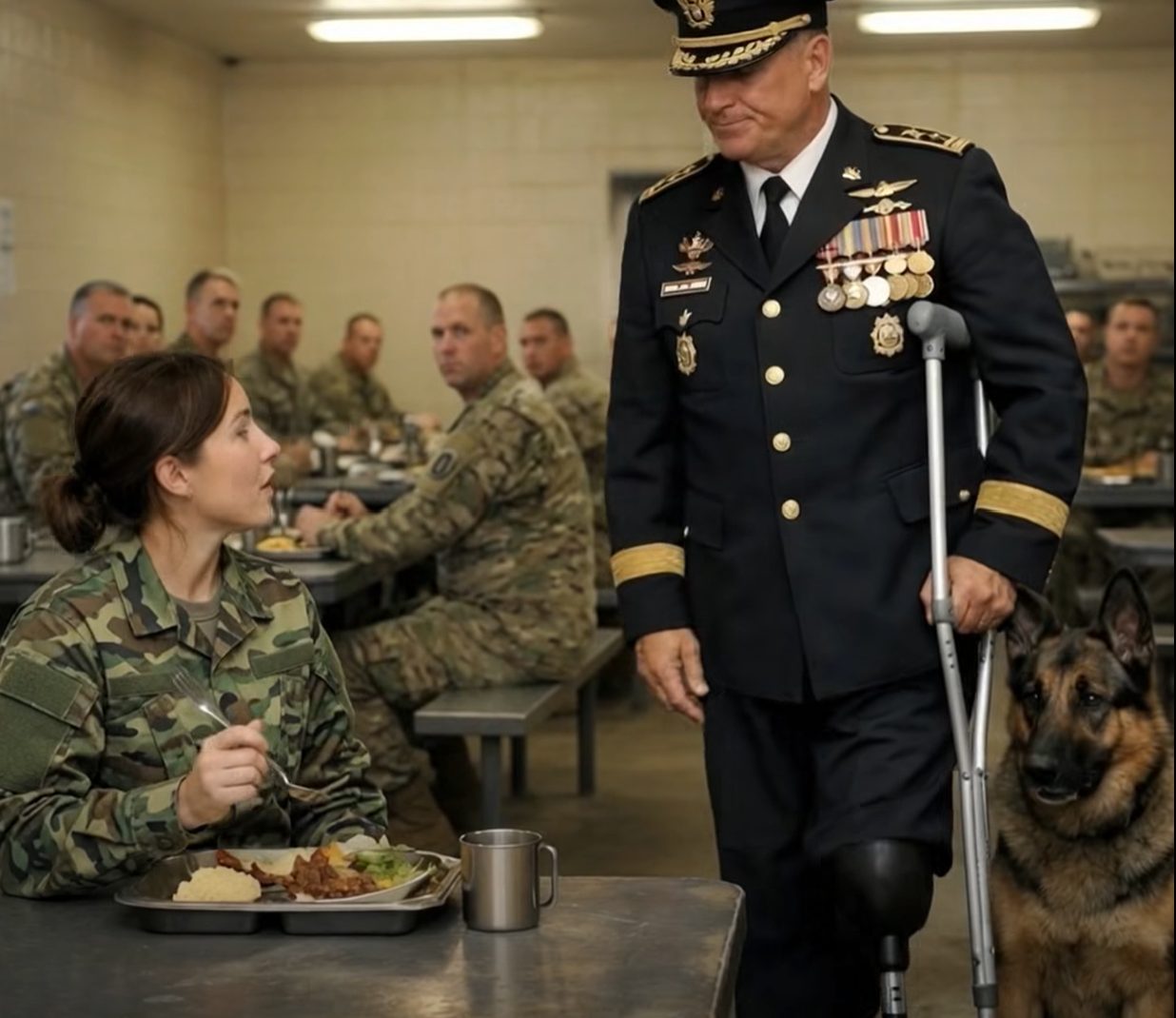
At 2:47 a.m., the aid station smelled of antiseptic, dried blood, and adrenaline.
The kind of smell that lingers after someone comes far too close to dying.
I sat on the concrete floor, shoulders against a cold cinderblock wall, exhaustion pressing into every muscle. My hands were stained crimson, the blood already drying into the creases of my skin.
None of it belonged to me.
It belonged to Private First Class Aaron Greer.
Twenty-three years old. Strong. Stubborn. The type of soldier who believed his body could survive anything if he pushed hard enough.
Tonight had proven otherwise.
Now he slept beneath a dim overhead lamp, one leg elevated on a field cot. Moments earlier, I had checked the pressure bandage on his thigh for the fourth time. The bleeding remained under control. The IV line flowed properly. His pulse beat steadily beneath my fingertips.
For the first time all night, I allowed myself to breathe.
Next to me lay Ranger.
His head rested on his paws, but his eyes remained open.
People always assumed working dogs slept like ordinary dogs.
Ranger didn’t.
He observed.
He listened.
He remembered.
Even in complete darkness, he could track every person in the room, recognize each scent, and distinguish between footsteps that carried confidence, exhaustion, or danger.
I reached back against the wall and listened to the sounds of Fort Bragg settling into another sleepless night.
A diesel engine rumbled somewhere in the distance.
Metal clanged once before silence swallowed it.
Boots crossed a hallway.
A radio crackled.
The base never truly slept. It simply changed shifts and kept moving.
Officially, Greer’s injury would later be described as a training accident.
A careless collision with a metal doorframe during a nighttime exercise.
Technically, that wasn’t a lie.
But it wasn’t the whole truth either.
The impact had torn deep into his thigh and opened a wound far worse than anyone initially realized. By the time someone found him and called for medical support, blood was pouring faster than it should have.
I had been pulled from my bunk just after midnight.
The treatment room wasn’t equipped for emergency surgery.
The supply cabinet looked as if it had been stocked by someone who had never seen a trauma patient in their life.
None of that mattered.
Eight minutes.
That was all the time available before Aaron Greer became a body instead of a patient.
Eight minutes to stop the bleeding.
Eight minutes to keep a young soldier alive.
Somehow, it had been enough.
I grabbed the small green notebook lying beside me and opened it.
Pulse stable. Bleeding controlled.
I wrote the words, then closed the cover.
Six weeks earlier, I had arrived at the installation in the back of a government transport van with two other corpsmen, several cases of medical equipment, and Ranger.
Military bases don’t welcome newcomers.
They absorb them.
Within hours, I’d been assigned a bunk, handed an identification badge, given a duty roster, and expected to move.
The following morning, I met Master Chief Wade Briggs.
Briggs looked like a man carved from old oak.
Forty-seven years old. Broad shoulders. Hard eyes. A face marked by years of responsibility and difficult decisions.
Nothing about him suggested comfort.
Everything about him suggested competence.
He shook my hand once.
Then he looked at Ranger.
Then back at me.
The expression on his face reminded me of someone inspecting a sealed crate and deciding whether the contents matched the label.
Men like Briggs trusted experience over paperwork.
Too many names on too many memorial walls had taught him that lesson.
Seven special operators sat inside the briefing room that morning.
Every one of them assessed me immediately.
Not because they were rude.
Because that was their job.
Female.
Twenty-six.
Navy medic.
Working dog handler.
Small frame.
Unknown capability.
The only person bold enough to say it aloud was Petty Officer First Class Kyle Stone.
“Standard medic rotation?” he asked.
Master Chief Briggs nodded.
“Her record speaks for itself.”
Stone leaned back slightly.
“Records don’t always survive reality.”
“No,” Briggs replied calmly. “They don’t.”
Then he continued the briefing.
I never reacted.
I simply wrote the date in my notebook and kept listening.
At my side, Ranger remained perfectly still.
At one point Stone glanced toward him.
Ranger returned the stare without moving a muscle.
Calm.
Unbothered.
Certain.
The kind of confidence that doesn’t require approval.
Three days later, Briggs led us on an eleven-mile conditioning run through pine forest and red clay trails.
Before we started, Stone joked that the medic might require medical evacuation before reaching the halfway point.
A few people laughed.
I adjusted my pack and began running.
By mile four, the terrain steepened.
By mile six, heat shimmered off the ground.
By mile eight, I noticed Stone checking over his shoulder.
I was still there.
Three strides behind him.
Steady.
Silent.
Unimpressed.
He never repeated the joke.
But that wasn’t the moment everything changed.
The moment that changed everything came on the ninth day.
And it started when Ranger suddenly stopped walking.
The Ninth Day
We were crossing the parade ground at 0615.
Just the two of us. Morning rounds, moving from the east barracks toward the aid station. The sun was barely up, orange light flat against the concrete. Ranger walked at my left side, leash slack, the way it always was when he wasn’t working. He didn’t need the tension. He knew where he was supposed to be.
Then he stopped.
Not the slow, distracted stop of a dog finding a smell. A hard stop. Four paws planted. Body rigid. Head up and angled toward the far end of the parade ground, toward the row of administrative buildings that ran along the western edge of the installation.
I stopped with him.
Didn’t speak. Didn’t pull the leash.
Waited.
Forty meters away, a man was walking alone. Dressed in physical training clothes, no rank visible, moving at a careful pace. One arm swung normally. The other was held slightly close to his body, the way people do when something hurts and they’ve decided not to admit it.
Ranger watched him.
The man hadn’t noticed us yet. He was looking down, somewhere between focused and somewhere else entirely.
Ranger took one step forward.
That was unusual. He didn’t approach strangers without a command.
I let him go.
The man looked up when he heard the paws on concrete. He stopped walking. His face was in his mid-fifties, close-cropped gray hair, a jaw that looked like it had made a lot of decisions. He glanced at Ranger, then at me, then back at Ranger.
Ranger sat down directly in front of him.
Not aggressive. Not playful.
Just present. The way he sometimes sat with patients in the aid station when they were trying not to cry.
The man stared at him for a moment. Something in his expression shifted. Not dramatically. Just a small thing, a loosening around the eyes.
“Yours?” he asked.
“Yes, sir.”
“What’s his name?”
“Ranger.”
He looked at Ranger for another few seconds. Then he crouched down, slowly, the arm held close to his body moving carefully, and he put one hand out, palm up.
Ranger sniffed it.
Then pressed his head into the man’s palm.
I had worked with Ranger for three years. I had seen him do that exact thing maybe four times.
The man stayed crouched for longer than felt casual. When he stood back up, he cleared his throat once and looked at me with a straightforward expression.
“Medic?”
“Corpsman, sir. Petty Officer Second Class Dara Pruitt.”
“What unit?”
I told him.
He nodded, like he already knew, or like it didn’t matter.
“You’re the one who kept Greer’s leg attached last night.”
It wasn’t a question.
“I was on call, sir.”
He looked back at Ranger, who was still sitting. Still watching him.
“Mind if I join you?” he said. “I was heading this direction anyway.”
I said that was fine.
We walked together toward the aid station. He didn’t introduce himself. I didn’t ask. On a base like this, if a man in PT clothes didn’t offer his name, you didn’t push. The rank would surface eventually. It always did.
What Ranger Already Knew
His name was Major General Carl Harwick.
I found out twenty minutes later when Sergeant First Class Deborah Moss nearly dropped her coffee mug when she saw him walk through the aid station door behind me.
Harwick didn’t acknowledge the reaction. He stood just inside the entrance and looked at the room the way a man looks at something he built a long time ago and hasn’t seen since.
“This the supply cabinet?” he asked, nodding toward the far wall.
“Yes, sir.”
He walked over and opened it.
Stood there for a moment, reading the contents.
Closed it.
“Who signed off on this inventory?”
Moss looked at me. I looked at Harwick.
“I don’t know, sir.”
“Find out.”
He said it without heat. Just information. A task, assigned.
Then he turned and looked at Greer, still asleep on the cot across the room. The leg elevated, the bandage clean, the IV bag three-quarters empty.
“How old?” Harwick asked.
“Twenty-three, sir.”
He was quiet for a few seconds.
“He know how close it was?”
“Not yet.”
Harwick nodded. He pulled a folding chair from against the wall, set it near the door, and sat down. Not at Greer’s bedside. Not in the way. Just in the room.
Ranger walked over and lay down at his feet.
Moss looked at me again, eyes wide.
Ranger had never done that with anyone except me and, once, a twelve-year-old kid we’d encountered during a humanitarian deployment in Djibouti. The kid had been sick for six days and too scared to let anyone near him. Ranger had lain down at his feet, and the kid had stopped fighting.
I didn’t say any of that.
I went back to my notes.
But I watched.
Harwick sat there for close to an hour. He didn’t speak much. He asked me two or three clinical questions about the treatment, listened to the answers, didn’t comment. At some point Greer stirred, and Harwick leaned forward slightly, elbows on knees, the way a person leans when they’re paying attention and not performing it.
Greer opened his eyes. Took in the room. Took in the man sitting near the door.
His face went through three expressions in about two seconds.
“Sir,” he managed.
“Relax, son. You’re not in trouble.” Harwick’s voice was flat and even. “You’re just alive.”
Greer blinked.
“Yes, sir.”
“Good.” Harwick stood, picked up the chair, put it back against the wall. “Stay that way.”
He looked at me.
“The supply cabinet. By end of week.”
“Yes, sir.”
He walked out.
Ranger watched him go.
What Stone Said After
Word moved fast on a base. It always did.
By 1100, Stone found me in the motor pool where I was helping swap out a battery on one of the aid vehicles. He leaned against the hood and crossed his arms.
“Harwick walked through your station this morning.”
“Yes.”
“Stayed an hour.”
“About that.”
Stone chewed on something for a second. Not gum. Just a thought he hadn’t finished yet.
“What’d he want?”
“To see Greer. And to look at the supply inventory.”
“That’s it?”
“That’s it.”
Stone looked at the ground. Then back at me.
“Harwick hasn’t set foot in a forward aid station in four years,” he said. “Not since his aide went through one on a stretcher and didn’t come back out.”
I didn’t know that.
I kept my face still.
Stone uncrossed his arms, pushed off the hood.
“Supply cabinet’s going to get fixed,” he said, like he was solving an equation.
“I know.”
He nodded once.
Walked away.
I went back to the battery.
2:47 a.m., Revisited
Now, sitting on the concrete floor with my back against the cinderblock wall, I turned the green notebook over in my hands.
Greer was breathing steadily. The IV bag needed changing in about forty minutes. Outside, the diesel engine that had been rumbling somewhere to the north finally cut off.
Ranger lifted his head.
I looked at the door.
Harwick stood in the frame. Still in PT clothes. It was almost three in the morning and he was still in PT clothes, which meant he hadn’t gone back to sleep after our walk that morning, or he’d gotten up again, or he’d never stopped moving.
He looked at Greer. Looked at the bandage. Looked at the IV bag.
Looked at me.
“Stable?”
“Yes, sir.”
He stood there for a moment. Not stepping in. Not leaving.
Ranger stood up.
Walked to the door.
Sat down next to Harwick’s left foot, the one on the side of the arm he kept holding close to his body.
Harwick looked down at him.
For a second, in the low light of the aid station, with the base quiet and Greer breathing and the IV dripping, the general looked like a man who was very tired and had been for a very long time.
He put his hand on Ranger’s head.
“Good dog,” he said.
He said it quietly. Not to me. Not to the room.
Just to Ranger.
Then he turned and walked back into the dark.
Ranger returned to his spot beside me, circled once, and lay back down. His eyes stayed open.
I wrote the time in my notebook.
Then I sat with the sound of the base breathing around us, and the soft drip of the IV, and the particular quiet that follows when something almost breaks and doesn’t.
—
If this one stayed with you, pass it along to someone who’d get it.
For more incredible stories, discover how a lieutenant made fun of me for saying my mom was a Navy SEAL – then she entered with 50 military dogs, or read about the time he slapped her lunch tray out of her hands like it was nothing, and you won’t believe what happened when my father locked me in a cabin at my grandfather’s funeral.



