The laughter started the moment she set her case on the table.
Not loud. Not cruel. Just that particular kind of quiet amusement that moves through a room in glances – the raised eyebrow, the half-smile, the deliberate look away. Sergeant Yara Vasek had seen it before. She’d learned to count it.
Seven. Seven people in that briefing room found something funny about her equipment.
She unlatched the case without hurrying.
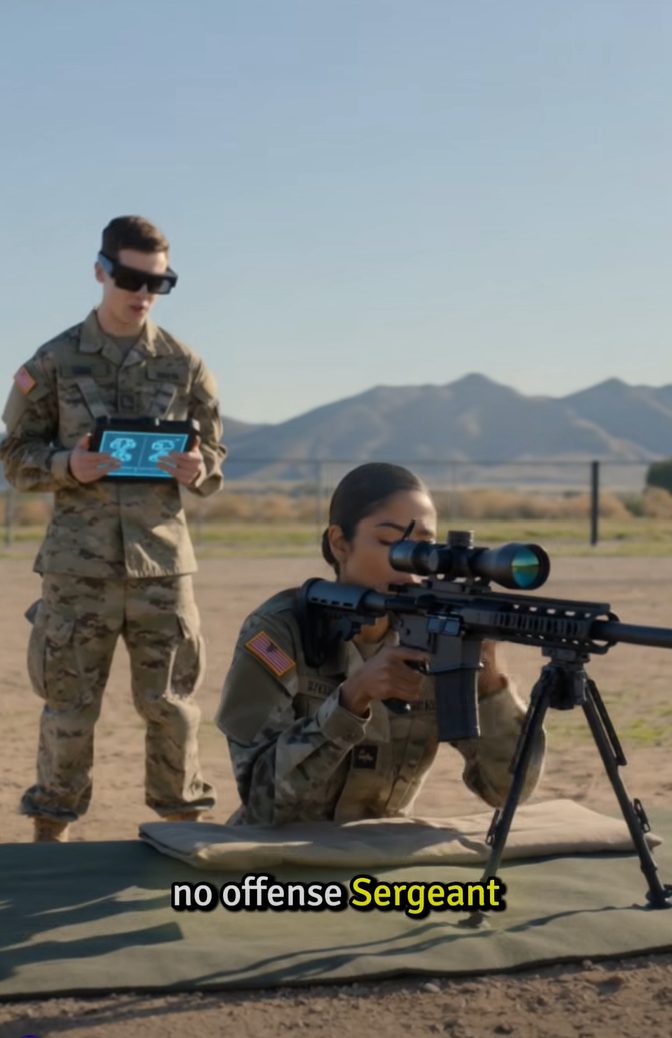
The rifle was clean. The stock was worn smooth in three specific places – her cheekbone, her right thumb, the heel of her palm – worn the way wood gets when it has been held through fear and cold and absolute stillness for years. The scope mounted above the barrel was a Leupold Mark 4, fixed 16-power, first focal plane. The reticle was hand-etched. The housing had a hairline crack along the left turret that she’d sealed with epoxy and never replaced, because replacing it would mean re-zeroing, and she did not re-zero what was already perfect.
It was, by the room’s estimation, a relic.
“That’s a fixed magnification scope,” said the man to her left. He had the tone of someone explaining something obvious to someone slow. “We’re running variable 5-25 on everything now. Better glass, better turrets, better – “
“I know what you’re running,” Yara said.
She lifted the rifle and checked the chamber. Old habit. The room watched her do it.
The man wasn’t finished. “At extended range, fixed mag limits your – “
“I know what it limits.”
She set the rifle down and looked at him directly, the way she’d learned to look at distances – without blinking, without adjusting, just finding the thing and holding it.
He stopped talking.
—
The briefing moved on. New unit integration. A joint evaluation exercise in the northern ranges. Performance metrics, equipment standards, chain of command. Yara listened and took no notes, because she remembered everything she needed to remember and wrote down nothing she didn’t want found.
At the back of the room, near the door, stood General Maren Solís.
Yara had not been told the general would be present. She suspected no one had. Solís had that quality – she appeared where things were about to matter, like weather.
She was not looking at the briefing officer. She was looking at the case on the table.
—
After the session, while the others moved toward the range to log their qualification scores, a young lieutenant paused beside Yara and nodded at the Leupold.
“Seriously though,” he said, not unkindly, “why not upgrade? The new variable glass would give you so much more flexibility at distance.”
Yara considered the question. She gave it more respect than it deserved, because he’d asked it without malice.
“A variable scope has moving parts,” she said. “Moving parts have tolerances. Tolerances drift.” She picked up the rifle. “At the distance I work, a tolerance that drifts one-tenth of one millimeter puts my shot two meters wide. Two meters wide means I go home having done nothing.” She paused. “Or worse.”
The lieutenant looked at the scope differently then. Not with admiration – not yet – but with the beginning of a question he hadn’t thought to ask before.
“What’s your longest confirmed?” he said.
Yara was already walking toward the door.
—
She didn’t answer him.
She didn’t need to.
Because at the back of the room, General Solís had opened her field tablet. Had pulled up the personnel file. Had found the operational record attached to Sergeant Yara Vasek’s name.
And now the general had gone very still.
The kind of still that Yara recognized.
The kind that comes just before – before the order, before the question, before the room changes and everyone in it has to recalibrate what they thought they knew.
4,200 meters.
The Eastern Mountains.
One shot. Wind at 34 kilometers per hour, gusting. Temperature: minus nineteen. The scope with the cracked turret housing. The fixed 16-power reticle, hand-etched, that everyone in this building had just finished laughing at.
The general looked up from the tablet.
Across the room, through the glass partition, her eyes found Yara.
And Yara – who had held her breath through worse – kept walking.
She already knew what came next.
What the Record Actually Said
The file was thirty-one pages.
Most personnel files at Yara’s level ran eight, maybe ten. The extra pages weren’t commendations. They weren’t citations. They were classified operational summaries, each one tagged with a location and a date and a single line of outcome text, and most of those lines were blacked out with the kind of ink that doesn’t come off under any light.
But page nineteen wasn’t blacked out.
Page nineteen was the Eastern Mountains report. It had survived declassification two years ago as part of a broader strategic review, and whoever had cleared it for partial release had apparently not understood what they were looking at. They’d left in the numbers. The coordinates. The environmental data logged by the forward team that had been pinned for eleven hours in a rock draw at 3,400 meters elevation while a second element worked to extract two intelligence officers who had no business being where they were.
The shot that ended the standoff was logged at 04:47 local time. Pre-dawn. No moon. Temperature minus nineteen Celsius, dropping. The wind reading came from a portable anemometer set up by Yara’s spotter, a man named Corporal Denes Farkas who had since left the service and gone back to running his family’s grain operation outside Debrecen. Farkas had called the wind at 34 kph with gusts to 41. He’d called the range at 4,180 meters and then corrected himself to 4,200 when he re-ran the laser.
He’d said, according to his own after-action statement, “That’s not possible.”
Yara had said nothing. She’d been in position for six hours by then. Her hands had stopped feeling like hands somewhere around hour three. She’d eaten one energy bar and drunk half a thermos of tea that had gone cold before she finished it. Her right eye was pressed against the rubber cup of the Leupold Mark 4, fixed 16-power, first focal plane, reticle hand-etched by a gunsmith in Bratislava named Tomás who’d been dead for four years and whose work Yara had never seen equaled.
She’d held for eleven minutes after Farkas gave her the range.
Eleven minutes of absolute stillness at minus nineteen, waiting for a gust to die, waiting for a particular quality of silence in the air that she couldn’t have explained to anyone who hadn’t felt it themselves.
Then she’d fired.
One round.
The standoff ended at 04:47.
The two intelligence officers were extracted by 06:15.
The General Doesn’t Smile at Much
Maren Solís had been a general for six years. Before that she’d been a colonel for eight, a major for five, and before any of that she’d been a young lieutenant who’d made a series of decisions in a drainage ditch outside a city she was not permitted to name in any document that might one day be read by someone without clearance, and those decisions had cost her two fingers on her left hand and earned her a decoration she kept in a shoebox under her bed because she didn’t like looking at it.
She did not impress easily.
She’d reviewed the file twice before the briefing. She’d seen Vasek’s name on the integration roster and pulled the record the night before, reading it in her quarters with a cup of coffee that went cold while she was on page seven. She’d gone back to page nineteen three times. Not because she didn’t understand it. Because she kept expecting to find the error.
There was no error.
So she’d come to the briefing room not to observe the integration session but to observe Yara Vasek. To see the person the file described. To check whether the file and the person matched, the way you check a map against the ground before you trust either one.
And she’d watched Yara set the case down. Watched the room react. Watched Yara count it, the way Solís herself had learned to count things, and then set the rifle on the table and check the chamber and look at the man who’d started talking and make him stop.
The general hadn’t smiled. She didn’t smile at much.
But something in her face had shifted, very slightly, the way a compass needle shifts when it finds north.
The Range
The joint evaluation ran for three days.
Day one was qualification: standard distances, standard targets, logged scores that would go into the integration assessment. Yara shot her qualification at 800 meters and scored a 98, which was not her best and not her worst and drew no particular attention because 98 at 800 was good but not remarkable for a unit-level sniper.
The man who’d spoken to her in the briefing room shot a 94. He had the new variable glass. He also had a spotter, a portable weather station, and a ballistic calculator that ran on a wrist-mounted tablet. He looked at Yara’s score and did the math and decided 98 versus 94 was not a meaningful gap given the difference in equipment.
He was not wrong about the math.
Day two was a field exercise: a moving element, urban-adjacent terrain, multiple target acquisition under time pressure. Yara moved through it the way she moved through everything, which was slowly and without any visible urgency, and the lieutenant who’d asked about her confirmed range found himself watching her more than the exercise itself, trying to figure out what she was doing differently. He couldn’t isolate it. She was just always in the right position before she needed to be, the way some people are always standing near the door before the meeting ends.
She scored a 96.
Day three was open distance. No cap on range. Targets set at intervals from 500 meters out to whatever the terrain allowed, which in the northern ranges was considerable. The evaluation team had set steel at 500, 800, 1200, 1600, and 2000 meters. There was a fifth target that wasn’t officially part of the evaluation, a 30-centimeter plate that a range technician named Borbála had placed at 2,800 meters as a joke, or as a dare, or as both. Nobody had hit it in the two years since she’d put it there. Most people didn’t try.
Yara hit it on her second round. The first had gone wide by about forty centimeters, which told her what she needed to know about the crosswind at that distance in this particular valley, and she’d adjusted and sent the second one and the steel had rung out across the range with a sound like a dropped pan.
The room went quiet.
Not the briefing-room quiet. A different kind.
What Solís Said
The general found her at the cleaning station that evening.
Yara was running a bore brush through the rifle in the particular rhythm she used, three strokes, reverse, three strokes, the way Tomás had told her to do it fifteen years ago when she’d first bought the rifle and brought it to his shop and he’d looked at her and said she was too young for this particular weapon. She’d been twenty-four. She hadn’t argued with him. She’d just waited until he handed it back.
“Vasek,” Solís said.
Yara didn’t look up. “General.”
Solís sat down across the table without being invited, which was her right. She set her field tablet face-down on the surface between them.
“Eastern Mountains,” she said. “Walk me through it.”
Yara ran another stroke through the bore. “It’s in the file.”
“I read the file. I want to hear the parts that aren’t.”
Yara considered that. She set the bore brush down and looked at the general directly, the same way she’d looked at the man in the briefing room, finding the thing and holding it.
“Farkas said four-two hundred,” she said. “I thought he was off. I ran my own calculation. Came out to four-one-ninety-five.”
“What did you shoot to?”
“Four-two hundred. Farkas was closer.”
Solís was quiet for a moment. “Eleven minutes between his range call and your shot.”
“Gusts were irregular. I needed a window.”
“At minus nineteen.”
“I was cold before that.”
The general picked up the tablet. She turned it over and looked at the screen, where the file was still open to page nineteen. Then she set it down again.
“The scope,” she said. “The crack in the housing.”
“Epoxy holds.”
“What if it doesn’t?”
Yara picked up the bore brush. “It hasn’t.”
Solís stood. She looked at the rifle the way you look at something that has done a thing you don’t fully believe. Then she looked at Yara.
“There’s an assessment next month,” she said. “Classified. Mountain terrain. I’m building the team now.”
She didn’t say anything else. She didn’t need to.
She walked out of the cleaning station and Yara listened to her footsteps go, and then she ran another three strokes through the bore and reversed and ran three more, and the rifle came out clean, the way it always did, the way she’d always brought it back.
What She Told the Lieutenant
He found her the next morning at the vehicle lot, loading her case into the back of a transport.
“2,800 meters,” he said. “Second round.”
“First was a read,” she said. “Second was the shot.”
He stood there with his hands in his jacket pockets. He was maybe twenty-six. He had the variable scope and the wrist tablet and everything the program had issued him, and he was good, genuinely good, and he knew enough to know he was still missing something he couldn’t name.
“The scope,” he said. “You really wouldn’t change it.”
Yara closed the transport hatch.
“Tomás built that reticle for my eye,” she said. “For the way I see at distance. The hash marks, the spacing, the subtension. He measured everything.” She picked up her kit bag. “He’s dead. There’s no one left who could build another one.”
The lieutenant thought about that.
“So it’s not just that you trust it,” he said.
“No.”
“It’s that it’s the only one.”
Yara looked at him. Something in her expression that wasn’t quite a smile but was adjacent to it, the way a cold morning is adjacent to warmth.
“Now you’re asking the right question,” she said.
She walked toward the transport and didn’t look back, and the lieutenant stood in the lot for a while after the vehicle left, working through something he’d have to think about for a long time before he understood it.
The scope with the cracked housing. The fixed glass. The hand-etched reticle from a dead man’s shop.
4,200 meters. Minus nineteen. One shot.
Not a relic.
A record.
—
If this one stayed with you, send it to someone who’d get it.
For more stories about characters who turn the tables, check out what happened when The General Asked If He Could Sit Down. Then Ranger Stood Up. or when A Lieutenant Called My Mom Fake in Front of 200 Students. Then the Rear Doors Opened.. You might also appreciate the tale of how She Was Standing in Spilled Coffee When They Walked In and Saw Her.