An “Old Crane Hand” Was Slapped in Front of the Whole Camp by a Spoiled Captain… But They Had NO IDEA Who Gavin Really Was 😱
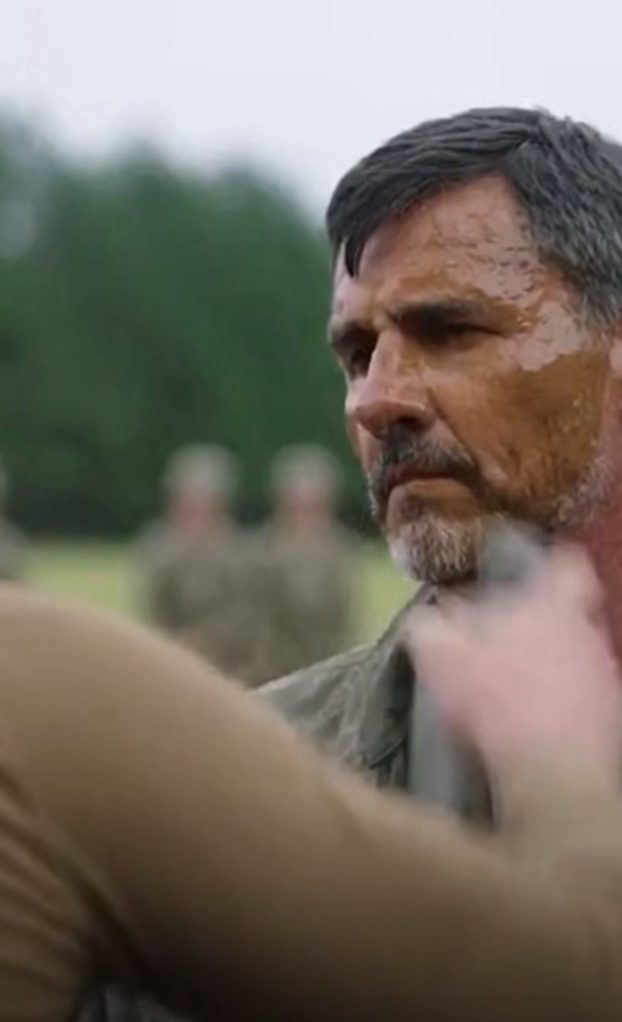
Captain Caleb threw muddy water in Gavin’s face in front of the entire training camp… then slapped him like he was some disposable laborer.
All because Gavin quietly said one sentence:
“Sir, if you pull from that angle, the radar truck will roll.”
The young crane soldiers were already panicking.
A multi-million-dollar radar vehicle was half-sunk in the mud pit, leaning hard to the left, its rear axle buried, its antenna mast shaking like it was about to snap.
Everyone could see it.
Everyone except Caleb.
He stood there in polished boots, clean gloves, and that smug little smile men get when their last name opens more doors than their work ever did.
“You think I need advice from a dead construction mule?” Caleb snapped.
Gavin wiped mud from his eye.
He didn’t yell.
He didn’t curse.
He just looked at the radar truck.
Then Caleb stepped closer.
“You’re here to carry chains,” he said. “Not give orders.”
A few soldiers looked away.
One young crane operator whispered, “Sir, Gavin’s right…”
Caleb turned on him too.
“You want to join him in the mud?”
Then he grabbed a canteen bucket, dumped muddy water across Gavin’s jacket, and slapped him so hard the whole field went quiet.
No one moved.
Gavin’s cheek turned red.
Mud dripped from his chin.
And then Gavin smiled.
Not angry.
Not embarrassed.
Almost… disappointed.
He reached into his old field coat and pulled out a sealed red authorization card.
Caleb laughed.
“What’s that? Your lunch ticket?”
Gavin didn’t answer.
He climbed into the heavy crane cab with one hand still wiping mud from his face.
The soldiers started shouting.
“Sir, that rig is unstable!”
“The boom angle is impossible!”
“You’ll flip the whole line!”
But Gavin touched the controls like a man playing a piano only he could hear.
The crane arm rose.
The cable tightened.
The radar truck stopped sinking.
Then, from the far end of the field, three black Army SUVs pulled up fast.
A major general stepped out.
Caleb’s smile vanished.
The general looked past the captain…
Straight at Gavin.
Then he shouted one word that made every soldier freeze.
The Word
“Chief.”
Not “Hey.” Not “Sergeant.” Not even his name.
Chief.
The way he said it wasn’t a greeting. It was a correction. Like a man walking into a room and finding the furniture rearranged by someone who had no business touching it.
General Roy Harwick was sixty-one years old and looked like a man who’d been built out of bad weather and worse decisions made by other people. His ribbons ran four rows. His boots had mud on them too, but his mud was from walking the south perimeter at 0500 that morning because he didn’t trust the drainage reports.
He crossed the field in about twelve strides.
Caleb straightened. “General, I can explain the recovery situation, we had a sinkhole develop under the – “
Harwick walked past him.
Didn’t even slow down.
He stopped at the base of the crane cab and looked up at Gavin, who was still working the controls with this terrible calm, the radar truck swinging up out of the mud now, water pouring off its undercarriage in brown sheets.
“You good?” Harwick called up.
“Almost,” Gavin said.
That was it. That was the whole conversation.
Caleb stood three feet away with his mouth slightly open, gloves still clean, and the slowly dawning look of a man who has just understood something too late.
What Nobody at Camp Whitmore Knew
Gavin Pruitt had arrived six weeks earlier in a dented F-250 with a cracked side mirror and a thermos that had seen better years. He’d checked in at the civilian contractor desk, signed the standard forms, and asked where he could get coffee.
The desk corporal had pointed him toward the mess hall.
Gavin had thanked him, gotten his coffee, and gone to look at the equipment yard.
Nobody had told the camp much about him. The paperwork said “technical advisor, heavy lift operations.” That was it. No rank listed. No service history attached. He carried a contractor badge clipped to his jacket, drank his coffee black, and showed up before most of the soldiers did every morning.
He was sixty-three. Broad through the shoulders but not tall. Gray at the temples and in his beard, which he kept short but not neat. His hands were the kind that made people look twice – thick across the knuckles, scarred along the right palm from something that had happened a long time ago in a place he didn’t talk about.
He spoke maybe a dozen words a day. When he did say something, it was specific. Useful. The kind of sentence that had been compressed down from about forty years of experience into the fewest possible syllables.
The young operators had liked him from the start, mostly because he never made them feel stupid for asking questions. He’d just show them. Climb up, adjust the angle, explain the load math in terms that actually made sense. Then climb back down and drink more coffee.
Caleb had decided he didn’t like Gavin around day three.
Caleb was twenty-nine. West Point. His father was a two-star who’d commanded this same training installation in the nineties. He had the rank, the posture, and the absolute unshakeable belief that experience was something you accumulated through authority, not through years.
He’d called Gavin “the mule” the first time in front of four junior soldiers, and they’d laughed because that’s what you did when a captain made a joke.
Gavin had heard it. Hadn’t reacted. Just kept checking the tension on a rigging cable.
The Mud Pit, Forty Minutes Before the SUVs
The AN/TPY-2 radar truck weighed sixty-four thousand pounds.
Gavin knew this the same way he knew his own boot size. It wasn’t a number he’d looked up. It was a number that lived in his hands.
The mud pit had formed overnight after a drainage pipe failed on the north berm. By 0630 the ground there looked stable. By 0900 it wasn’t. The radar truck had been in transit, routed across that section because the scheduled path had a crane blocking it, and the driver had felt the rear axle go soft and then go down and then go all the way down before he could do anything about it.
By the time Caleb arrived, the truck was tilted at eighteen degrees and still moving, slow and patient, the way heavy things sink.
Gavin had already walked the perimeter of the pit. He’d pushed a stick into the mud in four places, noted where it hit resistance and where it didn’t. He’d looked at the angle of the tilt, the position of the axle, the clearance on the antenna mast.
He’d done the math in his head.
The math said: don’t pull from the right. The mud was shallower on the left. Pull from the right and you’d rotate the chassis, drive the rear axle deeper, and when it caught on the buried concrete pipe edge that was definitely down there – and there was definitely a pipe edge down there, he could see the slight ridge in the surface – you’d flip the whole vehicle.
So he’d said so.
One sentence.
“Sir, if you pull from that angle, the radar truck will roll.”
And Caleb had made it a whole thing.
Twelve Seconds
The slap had happened fast and Gavin had felt it the way you feel a thing when you’ve been hit before – not with surprise, just with registration. His cheek went hot. The mud from the bucket was cold against his neck.
He’d stood there for a second.
The field was absolutely quiet. Forty-something soldiers and not one of them breathing right.
Gavin had thought about a lot of things in that second. He thought about 1987, Camp Carroll, South Korea, a captain not entirely unlike this one who’d made a similar kind of mistake and taken eleven months to understand it. He thought about a cable snap in Kuwait that had taken three fingers off a man named Delbert who’d been standing in exactly the wrong place because nobody had listened to the guy who knew where the wrong place was.
He thought about the radar truck.
Then he pulled the card.
The red authorization card was laminated, sealed in a clear pouch, and had a specific set of numbers printed on it that meant something very particular to anyone who knew what they were looking at. Caleb had not known what he was looking at.
Gavin had not expected him to.
He’d climbed into the cab.
The Crane
The rig was a Grove RT890E. Ninety-ton capacity, rough terrain. Gavin had operated this exact model in four countries and had opinions about its third-generation load management system that he’d once put in a written report that had gone to the manufacturer.
He settled into the seat.
The controls were familiar the way a steering wheel is familiar. You don’t think about them. Your hands just know.
He extended the boom at twenty-two degrees. Not the angle Caleb had ordered. Caleb’s angle would’ve torqued the frame. Twenty-two degrees put the lift vector directly over the truck’s center of gravity, which had shifted forward as the rear sank.
He set the hook.
He took tension.
Slow. The cable went from slack to taut to working load and Gavin watched the mud around the truck’s rear axle and waited for the moment – and there it was, a slight shudder, the ground releasing its grip – and he brought the boom up another three degrees and the truck came.
Not fast. Not dramatic. Just up.
Water and mud fell off it in chunks. The antenna mast swung once and steadied. The chassis leveled. Gavin moved the load left, away from the soft ground, and set it down on the gravel access road with about the same precision you’d use putting a glass on a coaster.
The whole operation took four minutes and forty seconds.
He’d done harder things before breakfast.
After
Harwick waited until the truck was down before he spoke to Caleb.
He didn’t raise his voice. That was the thing that seemed to bother Caleb most, later – the men would talk about it for weeks. Harwick just stood in front of him and explained, in a quiet and very complete way, exactly who Gavin Pruitt was.
Retired Chief Warrant Officer Five. Twenty-six years, Army Corps of Engineers. Recipient of two Meritorious Service Medals and one thing that Harwick mentioned by name that made two of the older NCOs standing nearby go very still.
He’d been brought in as a technical evaluator for the new crane operator certification program. The red card was a direct authorization from the installation commander. It meant Gavin could countermand any field order related to heavy lift operations if he assessed imminent risk to personnel or equipment.
Caleb had slapped the man who had authority over him in the one domain that mattered today.
Harwick let that sit for a moment.
Then he looked at Caleb’s clean gloves.
“Get those off,” he said.
Caleb looked down at his hands.
“Sir?”
“You’re going to help Specialist Darnell re-rig the truck for transport. Without the gloves. You’ll learn something.”
Caleb opened his mouth.
Closed it.
Took the gloves off.
Gavin climbed down from the cab. Harwick met him at the bottom and shook his hand, the one with the scar across the palm, and said something low that nobody else caught.
Gavin nodded.
He picked up his thermos from where he’d set it on the running board before he climbed up.
Took a sip.
Still warm.
He walked back toward the equipment yard without looking at Caleb once. The young operator who’d whispered Sir, Gavin’s right fell into step beside him after a few seconds, not saying anything, just walking.
Gavin didn’t say anything either.
There wasn’t anything to say.
The truck was out of the mud.
That was the job.
—
If this one hit different, pass it to someone who’s spent years being the smartest person in the room while someone louder took the credit.
For more incredible discoveries, you might be surprised to learn the secret that dentists don’t want you to know to remove tartar and whiten teeth in just 2 minutes, or how baking soda can make you look at least 15 years younger. And if you’re feeling adventurous, find out why you need to start boiling garlic in milk and drinking it once.