
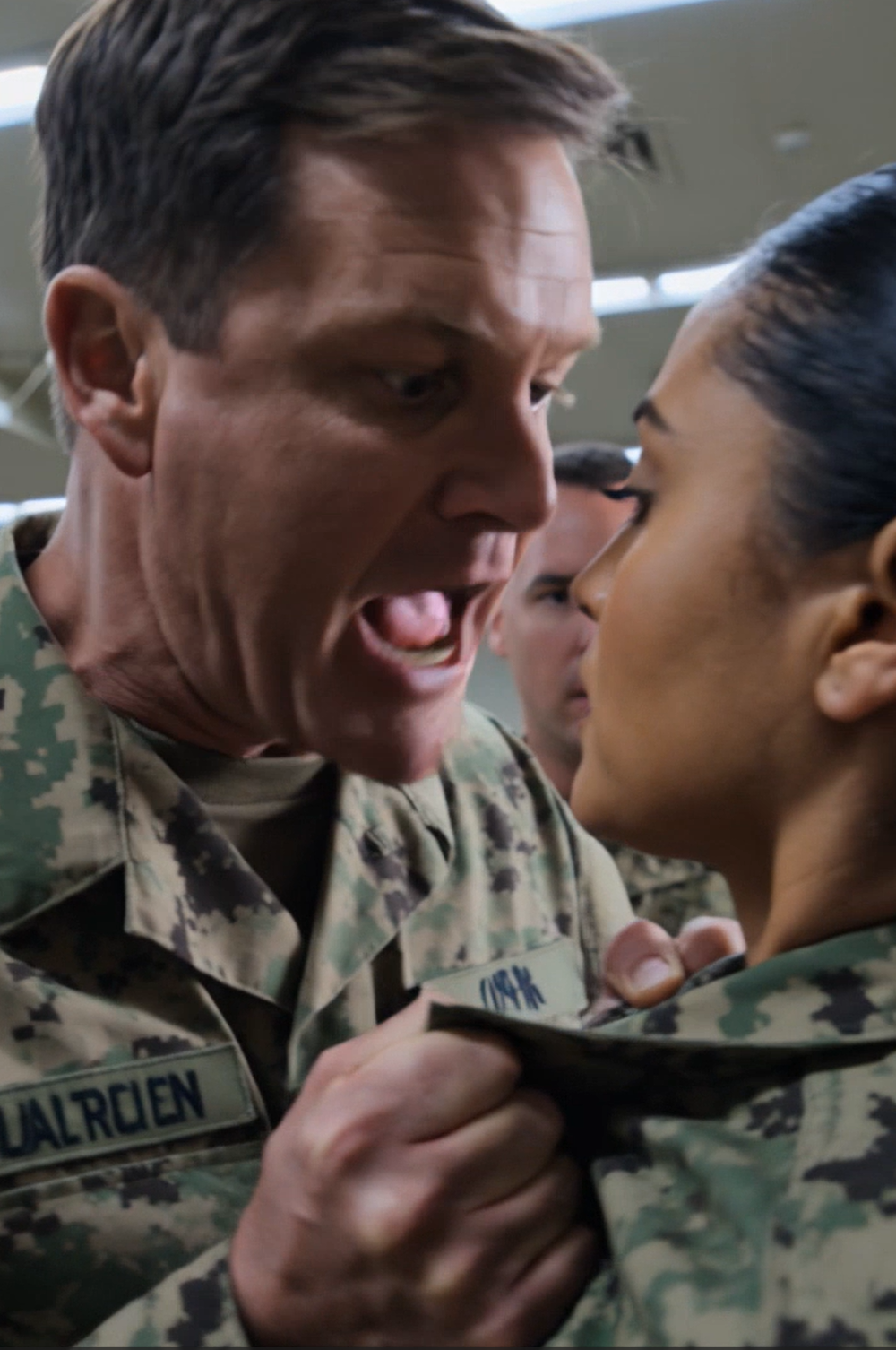
Captain Derek Webb’s voice cut through Camp Meridian’s mess hall like a blade. Trays froze midair. Dozens of Marines turned at once.
Staff Sergeant Jason Holt knew that tone. Cold. Cruel. The same tone Webb used three months ago when he made a nineteen-year-old private cry into his lunch tray. Nobody had stopped him then. Complaints always disappeared. “Lack of proof.” “Just discipline.” The chain of command always closed ranks around Webb.
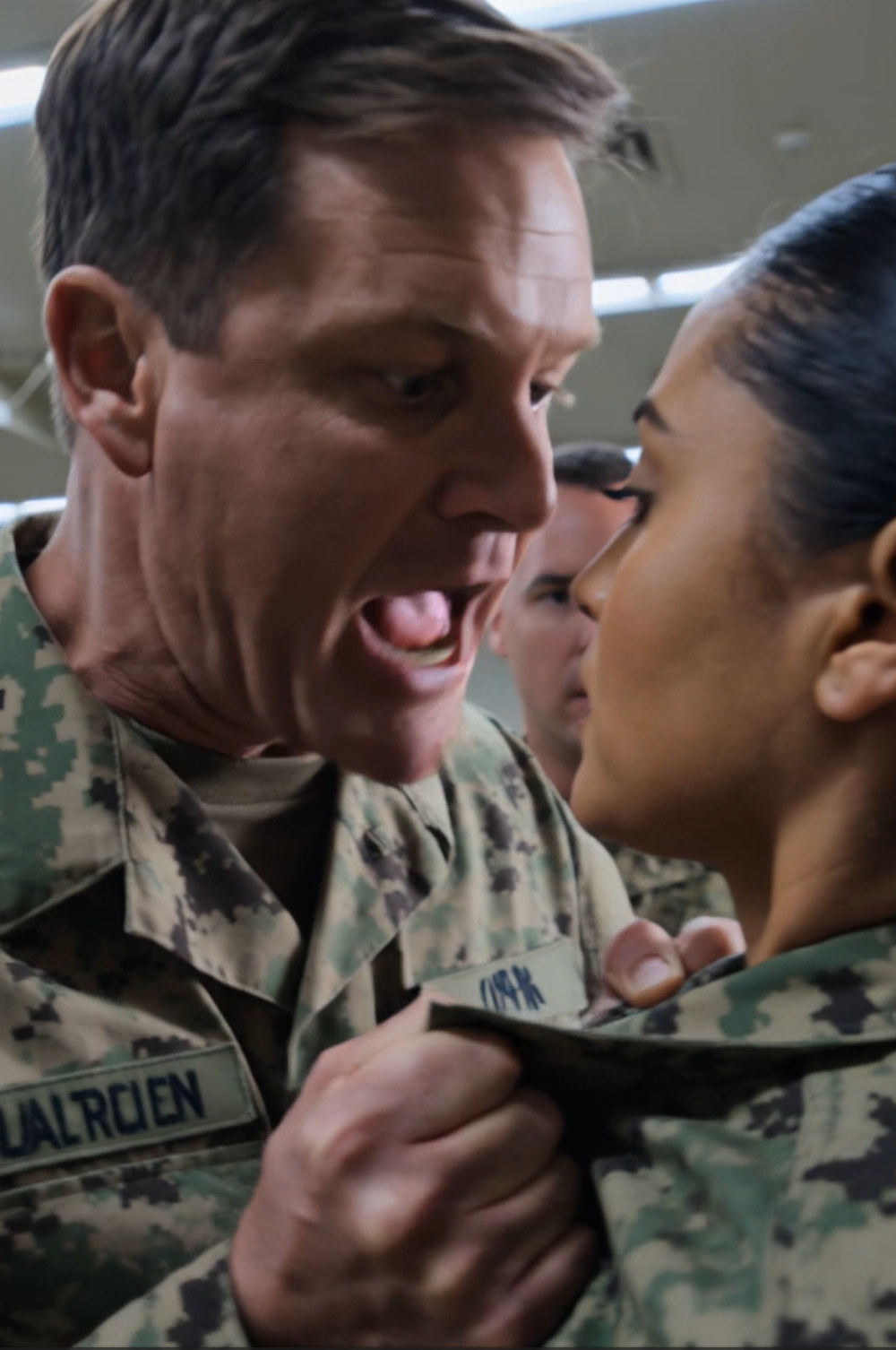
Now Webb had locked onto someone new.
She stood near the drink station. Young. Female. Camo jacket zipped to the collar. No rank visible. Holt didn’t recognize her – but something about her was off. Her posture was too clean. Too still. She wasn’t eating. She wasn’t waiting in line. She was watching the room like she was cataloging it.
Webb marched straight to her.
“Where’s your name tape?” he barked.
“Covered.”
A smirk. “Convenient. What unit?”
“Temporary assignment.”
He stepped into her space, voice rising so the whole hall could hear him perform.
“That doesn’t give you the right to disrespect authority, Marine.”
Her eyes didn’t move. “And it doesn’t give you the right to invent violations.”
The room went dead silent. Holt felt the hair on his arms stand up. Nobody talked to Webb like that. Nobody.
“Careful how you speak.”
“I am.”
Webb’s hand shot out and grabbed her sleeve. He yanked her forward hard enough that a tray clattered to the floor two tables down. Marines started rising out of their seats.
“Let her go, sir,” Holt heard himself say.
“Sit DOWN, Staff Sergeant.” Webb didn’t even look at him. He jabbed a finger an inch from her nose, spit flying. “You want to test me? I will end your career before this meal is over. I will have you scrubbing latrines in Twentynine Palms by Monday. Do you understand me?”
She didn’t blink.
Slowly – almost lazily – she reached up with her free hand and unzipped the top of her jacket. Just two inches. Just enough.
Webb’s eyes dropped to what was clipped underneath.
The color drained from his face so fast Holt thought the man might collapse right there. His hand released her sleeve like it had burned him. He took one step back. Then another.
She finally spoke, and her voice carried to every corner of that mess hall.
“Captain Webb. My name is Gunnery Sergeant Anya Sharma.”
Webb looked like he’d seen a ghost. His jaw worked, but no sound came out.
“This,” she said, tapping the gleaming gold badge pinned to the olive-drab shirt under her jacket, “is my authority. Inspector General’s Office.”
A collective gasp went through the room. Holt sagged back into his chair, his own heart pounding. The IG. They were the boogeymen. The auditors of the entire Marine Corps. They answered to no one but the Commandant.
Sharma’s voice dropped, but it lost none of its steel. “You just physically assaulted an investigating officer in front of two hundred witnesses.”
Webb swallowed hard, his face a pasty white. He looked around the room, at all the eyes now fixed on him not with fear, but with something new. Something cold.
“Gunnery Sergeant… I… I apologize,” he stammered, the words sounding like gravel in his throat. “I mistook you…”
“You mistook me for someone you could intimidate,” Sharma finished for him, her tone flat. “Someone without a voice. Someone you could abuse for sport.”
She took a small step forward, and Webb flinched, taking another step back. The power dynamic had flipped so completely it was dizzying.
“Staff Sergeant Holt,” she said, her eyes flicking over to him.
Holt straightened up, his own voice shaky. “Yes, Gunnery Sergeant?”
“Thank you for your intervention. It’s been noted.”
A simple acknowledgment, but it sent a wave of relief through him. He hadn’t just thrown his career away for nothing.
Sharma then addressed Captain Webb again. “My commander will be formally notified of this incident. You are to report to the base commander’s office immediately. Do not speak to anyone. Do not access your computer. Do not go to your quarters.”
She paused, letting the weight of her orders sink in. “Is that understood, Captain?”
“Yes… Gunnery Sergeant,” he whispered, his authority shattered. He turned, his shoulders slumped in defeat, and began the walk of shame out of the mess hall. He didn’t look at anyone.
The silence held for a moment longer before a low buzz of conversation started to fill the room. People were looking at Sharma with a mixture of awe and fear.
She zipped her jacket back up, concealing the badge. Her eyes scanned the room one last time, that same cataloging gaze from before. Then she walked over to Holt’s table.
“Mind if I sit, Staff Sergeant?”
“Not at all, Gunny.” He scrambled to make room.
She sat down, her movements calm and deliberate. She looked him in the eye. “That was a risky thing to do. Webb has a reputation.”
Holt shrugged, looking down at his half-eaten meal. “Couldn’t just sit there. It wasn’t right.”
“No, it wasn’t,” she agreed softly. “How long has it been going on?”
The question hung in the air. Holt hesitated. Snitching was a complicated thing. But this was the IG. This was different.
“Longer than I’ve been here,” Holt finally admitted. “He finds someone, a junior Marine usually, and just… breaks them down. For fun, I think.”
“Like Private First Class Miller a few months back?” Sharma asked.
Holt’s head snapped up. How did she know that name? Miller was the kid who had cried into his tray. He’d put in for a transfer a week later and was gone.
“You know about that?”
“I know a lot of things, Staff Sergeant,” she said. “My being here isn’t an accident. And what happened just now? That was just the opening act.”
She explained that her team had been on base for a week, quietly observing. They’d been compiling a file based on a series of anonymous complaints that had finally trickled up the right channels.
“Webb thought he was untouchable because he buried every complaint at the unit level,” she said. “He never imagined they’d find a way around him.”
Over the next few days, Camp Meridian was a different place. The air itself felt lighter. Captain Webb was gone, placed on administrative leave pending the full investigation.
Gunnery Sergeant Sharma’s work had just begun.
She called Holt to a small, sterile office in the administrative building. “I need your help, Jason,” she said, using his first name. “I need you to tell me everything. Off the record first, if you need. But I need to know what you’ve seen.”
So he told her. He told her about Miller. He told her about a Lance Corporal whose valid request for emergency leave to see his dying mother was denied by Webb, who claimed it was “a discipline issue.” The Marine’s mother passed away before his appeal could be processed.
He told her about another Marine, a woman, who was constantly passed over for promotions because Webb made crude jokes about her in front of promotion boards.
Each story Holt told was like lifting a stone, revealing something ugly underneath. Sharma listened without interruption, her expression unreadable but her eyes focused and intense.
When he was done, the room was quiet. “Thank you,” she said simply. “Now I need you to help me convince them to talk. They’re scared. They think this will blow over and he’ll be back.”
“He’s not coming back,” she added with absolute certainty.
Holt believed her. He spent the next week talking to his fellow Marines. He went to the motor pool, the barracks, the firing range. At first, they were hesitant. They’d been conditioned to fear retaliation.
But Holt’s courage in the mess hall had earned him a new kind of respect. He wasn’t an officer. He was one of them. And he had stood up when it counted.
Slowly, they began to open up. The Lance Corporal whose mother had passed away agreed to give a formal statement. The woman who’d been blocked from promotion came forward. So did PFC Miller, who was brought back to base to testify.
As Sharma dug deeper, she started to notice something strange. The bullying wasn’t random. It was targeted.
“It’s not just about power,” she told Holt during one of their late-night sessions in the makeshift office. “There’s a pattern here I can’t quite see yet.”
She pulled out a stack of maintenance and readiness reports for Webb’s company. “These reports are flawless. Too flawless. His company has the highest operational readiness score on the entire base.”
Holt frowned. “That can’t be right. We’ve had constant issues with our transport vehicles. I’ve personally filed three reports in the last six months about transmission failures.”
Sharma’s eyes lit up. She cross-referenced the dates. “Your reports. Webb denied them all. Citing ‘user error’.”
“That’s a lie,” Holt said, his anger rising. “Those transmissions are shot. It’s a miracle one hasn’t failed during a field op.”
Sharma pulled up another file. It was PFC Miller’s. “What does Miller do?”
“He’s a clerk. Basic paperwork, filing. Why?”
“Before he was a clerk, he was temporarily assigned to the motor pool to help with inventory,” Sharma said, her fingers flying across the keyboard. “He was the one who first flagged a discrepancy in the spare parts log. Two weeks later, Webb humiliated him in the mess hall.”
The pieces started clicking into place. This was the first twist. The bullying wasn’t the main crime; it was the cover-up.
Webb wasn’t just a sadist. He was a fraud.
He was falsifying readiness reports, pencil-whipping maintenance logs, and covering up serious equipment failures to make his unit look good on paper. It was a shortcut to commendations and a faster promotion.
And he used his authority and cruelty to silence anyone who got close to the truth. The Lance Corporal whose leave was denied? He worked in supply and had questioned a missing shipment of expensive navigation units.
The female Marine denied promotion? She was an expert comms technician who had pointed out that half their radios weren’t meeting standards.
“He was putting lives at risk,” Holt said, the realization dawning on him. “For a medal. For his career.”
“That’s the charge that will stick far more than bullying,” Sharma confirmed. “Conduct unbecoming, sure. But falsifying federal documents and knowingly endangering the lives of his Marines? That’s a court-martial.”
The investigation kicked into high gear. Sharma and her team seized every hard drive, every logbook, every piece of paper from Webb’s office. The flawless façade crumbled under scrutiny, revealing a deeply rotten foundation.
One evening, as the case against Webb was becoming undeniable, Holt asked Sharma a question that had been bothering him. “Why this unit? Why now? These complaints have been happening for years.”
Sharma leaned back in her chair, a tired but satisfied look on her face. “Because of a man named Marcus Thorne.”
The name didn’t ring a bell.
“He’s a retired Master Gunnery Sergeant,” she explained. “His son, Corporal Thorne, was in Webb’s company two years ago, before you got here.”
She continued the story. “There was a training accident. A vehicle rollover. Nothing too serious on the face of it, but Corporal Thorne sustained a career-ending back injury. The official report, signed by Webb, blamed it on driver error.”
Holt listened, completely engrossed.
“But Master Gunnery Sergeant Thorne didn’t buy it. He knew his son was a good driver. He also knew the Marine Corps. He started making quiet calls, using contacts he’d built over a thirty-year career. He talked to other Marines from the unit, guys who had since gotten out.”
This was the second twist, the one that felt like destiny.
“He found out about the faulty transmissions. He pieced together the truth long before we did. He knew Webb was cooking the books. He sent a detailed, private letter directly to the Inspector General himself. He didn’t make a complaint. He presented a case.”
Sharma smiled faintly. “An old Master Gunny has more power than a dozen Captains. He just knows how to use it quietly. My assignment wasn’t random. It came from the very top, with instructions to look into Captain Webb’s entire command culture, starting with the equipment logs.”
The public confrontation in the mess hall had just been an unexpected bonus, the final nail Webb hammered into his own coffin.
With irrefutable evidence of systematic fraud and endangerment, Captain Derek Webb was formally charged. The court-martial was swift. He was found guilty on all counts.
He was publicly stripped of his rank, his uniform disgraced. He was sentenced to military prison and given a dishonorable discharge. He lost his career, his reputation, and his freedom.
The aftermath on Camp Meridian was profound. A new Company Commander was brought in, a stoic, fair-minded Captain who made it his first order of business to hold an open-door meeting with all personnel.
Staff Sergeant Jason Holt received a Navy and Marine Corps Commendation Medal for his integrity and moral courage. It was presented to him in front of the whole battalion. But the real reward wasn’t the ribbon on his chest.
It was the change in the atmosphere. It was seeing junior Marines walk with their heads held high. It was the trust being rebuilt, day by day.
Months later, Holt was sitting in the same mess hall. The noise was different now. It was relaxed, full of laughter and easy conversation. The fear was gone.
He saw a familiar figure standing by the drink station. It was Gunnery Sergeant Anya Sharma, dressed in her sharp service uniform, clearly on her way to another assignment.
Their eyes met across the room. She gave him a short, crisp nod. A sign of profound respect between two people who, in their own ways, had held the line.
Holt nodded back, a small smile on his face.
He understood the lesson then, with perfect clarity. Leadership isn’t about the rank on your collar; it’s about the character in your heart. It’s about having the courage to speak up when something is wrong, even if your voice shakes.
One person, doing the right thing, can be enough to start an avalanche of justice. And in the end, integrity is a shield that no bully, no matter how powerful, can ever break.



