
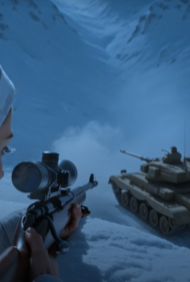
Nobody at Forward Operating Base Ridgeline knew what to do with the quiet woman who walked into the briefing room carrying a rifle that belonged in a museum.
She didn’t announce herself.
She didn’t ask for respect.
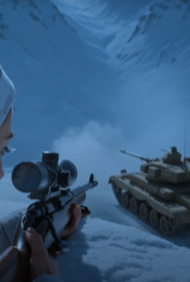
She just stood by the back wall with a duffel bag in one hand and an old wood-stock bolt action in the other, watching the room the way some people watch the sky before a storm breaks.
Colonel Nathan Briggs noticed the rifle before he noticed her.
The mission was already bad.
Seven armored vehicles had to cross Carara Valley in northern Alaska during a category three blizzard, hauling encrypted relay hardware and prototype targeting components so classified that even the men guarding them didn’t know what they were carrying.
Intelligence had warned that a hostile mechanized force might seal the valley exit before the convoy got through.
Then Briggs saw that rifle, and his face changed.
“You brought a wood-stock bolt action to a live convoy protection op?”
A few soldiers looked down, trying not to smile.
Others didn’t bother hiding it.
She never defended herself.
She didn’t explain the custom barrel, the rebuilt trigger, or the years she had spent learning that weapon until it became part of her own breathing.
When Briggs offered her a modern precision rifle from the armory, she looked at it once and said, “I’m keeping the antique.”
That only made the room colder.
Command had sent her, but the file attached to her name was almost empty.
No service history.
No biography.
No neat list of accomplishments to make anyone feel better about trusting a frozen mountain pass and a priceless convoy to a woman holding a rifle from 1940.
To the younger soldiers, she looked like a rumor in winter gear.
To Briggs, she looked like a liability.
Before she left base, a corporal asked if the rifle really worked in temperatures like this.
She answered in the same flat, steady tone she used for everything.
“The rifle is simple. Simple things survive. The shooter is the part that has to be precise.”
Fourteen hours later, nobody was laughing.
The convoy was deep in Carara Valley when the drone operator spotted five hostile vehicles pushing south through the storm to block the exit.
An IFV led the formation.
Two APCs and two light command vehicles followed.
Briggs ordered every vehicle to halt.
Engines idled in the dark.
Radios hissed.
Inside armored cabins, trained soldiers waited on a woman they couldn’t even see.
She was already above them.
For nearly two hours she had been lying on a frozen limestone shelf four hundred feet above the road, clipped to the mountain by a static line so the wind couldn’t tear her loose.
Her gloves were stiff.
Her clothes were damp from the climb.
The cold had gone past pain and settled into something heavier.
Quieter.
But she didn’t shiver.
Shivering meant movement.
Movement meant death.
Through her scope, the lead IFV sat one thousand four hundred twenty meters away, advancing through a blizzard at night.
Her rifle couldn’t pierce that armor.
Briggs knew it.
She knew it too.
But armor was never the whole story.
Every vehicle needed something to function.
A viewport.
A sight aperture.
An engine intake.
The room at Ridgeline had seen an antique.
She saw angles.
Distances.
Openings.
The first shot cracked across the valley and vanished into the storm.
For one long second, nothing happened.
Then the lead IFV drifted off line and rolled to a stop.
In the command vehicle, Briggs lowered his binoculars slowly.
“That is not the cold,” he said.
Eighty seconds later, the second vehicle died.
Then the third.
Then a command vehicle slid off the shoulder.
Then the last engine failed in the snow.
Five hostile vehicles down.
The road was open.
And that was when the real danger began.
Inside the lead IFV, the gunner was still alive.
While everyone else believed the vehicle was neutralized, he had been scanning the ridgeline with thermal optics, patient, methodical, hunting for the smallest betrayal of heat.
And at last he found it.
One patch of stone slightly warmer than the rock around it.
He found her.
The thirty millimeter cannon began turning toward the ridge.
She had two seconds.
One shot.
No second chance.
And what she did with that single bullet from a rifle built in 1940 is something Colonel Briggs still cannot explain to this day – but the photograph they pulled off the mountain the next morning showed exactly who she really was…
The thermal sight on the IFV was her only tell.
It was the eye that saw her, and she knew it was the one thing she could break.
She didn’t aim for the cannon.
She didn’t aim for the turret.
She centered her crosshairs on the small, dark lens of the thermal scope, the part that cost more than a new car.
One breath.
Out.
Her finger squeezed the trigger with a pressure so practiced it felt like an afterthought.
The rifle kicked hard against her shoulder.
The bullet, a custom-loaded round designed for stability in extreme cold, left the barrel and began its apathetic journey across the valley.
It didn’t explode.
It didn’t glow.
It simply flew, unseen, through the driving snow.
The thirty millimeter cannon swiveled another inch.
Then the bullet arrived.
For the gunner inside the IFV, the world of heat signatures and ghostly white figures simply vanished.
His display went black.
A tiny, star-shaped crack appeared on the external armored lens of his optics.
The machine was blind.
The cannon stopped moving.
On the limestone shelf, the woman ejected the spent brass casing, her movements slow and deliberate.
It tinkled against the rock and was swallowed by the snow.
She lay still for another full minute, listening to the wind.
Silence.
Over the radio, her voice was a faint whisper against the static.
“Threat neutralized. The road is clear for you.”
Colonel Briggs let out a breath he didn’t realize he’d been holding for three minutes.
“All vehicles,” he commanded, his voice tight with disbelief, “Proceed. Full speed.”
The convoy roared back to life, its headlights cutting through the blizzard as it raced past the five silent hulks on the side of the road.
They didn’t slow down.
An hour later, as the last of his vehicles cleared the valley, Briggs sent a two-man team to retrieve her.
“Find her,” he ordered. “Bring her back. And for God’s sake, be careful.”
The soldiers who climbed that ridge were hardened combat veterans.
They expected to find a phantom, a hardened operative built of ice and iron.
Instead, they found a woman unhooking herself from a safety line, her face pale and etched with exhaustion.
She was shivering now, the adrenaline finally leaving her system.
She handed them the rifle without a word.
One of the soldiers, a young sergeant, took it with a reverence he usually reserved for holy objects.
He looked at the worn stock, the simple bolt, the impossibly long barrel.
“Ma’am,” he started, then stopped, unsure what to say.
She just nodded, pulling her hood tighter around her face.
Back at FOB Ridgeline, the medics took over.
Hypothermia was setting in, but she was stable.
As they helped her out of her stiff, frozen gear, a small, waterproof pouch fell from an inner pocket.
The sergeant who had carried her rifle picked it up.
He handed it to Colonel Briggs, who had been waiting outside the medical bay like a nervous father.
Briggs opened the pouch.
Inside was a single, black-and-white photograph, yellowed with age but perfectly preserved.
It showed a young man in a World War II uniform, standing beside a jeep somewhere in the Ardennes forest.
He had a determined look in his eyes and a slight, confident smile.
In his hands, he was holding her rifle.
Or one exactly like it.
Briggs turned the photo over.
Faded ink on the back spelled out a name and a date.
‘Cpl. Alistair Finch. 1944.’
The name echoed in Briggs’s mind, dredging up a memory he hadn’t accessed in decades.
He dismissed his aide and went to his private quarters.
There, he unlocked a footlocker that contained his family’s history – old letters, medals, photographs.
He dug through a box of his grandfather’s correspondence.
His grandfather, Captain Thomas Briggs, had also served in the Ardennes.
He found it.
A letter dated January 1945, written to his grandmother back home.
His eyes scanned the cursive script, and the blood drained from his face.
“…we have a sniper attached to our unit,” his grandfather had written. “Corporal Finch. A strange man from the mountains, carries an old hunting rifle he refuses to part with. He thinks his old-world ways are superior to modern equipment. I warned him that his stubbornness would be a liability. The man is a risk.”
Briggs kept reading, his heart sinking with every word.
The letter detailed an engagement where Finch had recommended a flanking maneuver based on his “instincts.”
His grandfather, the young and arrogant Captain Briggs, had overruled him, opting for a direct, by-the-book assault.
The assault was a disaster.
They lost seven men.
In the after-action report, Captain Briggs had placed the blame squarely on Corporal Finch, citing his “unreliable methods” and “failure to integrate” as a source of confusion that led to the failed attack.
Finch was scapegoated.
His career was quietly ended.
He was sent home in disgrace, the official record forever tarnished by a lie.
Colonel Briggs sat back in his chair, the letter shaking in his hand.
The woman in the medical bay.
The antique rifle.
The name on the photograph.
It wasn’t a coincidence. It was a reckoning.
The next morning, he went to see her.
She was sitting up in a cot, drinking a cup of hot broth.
The rifle was leaning against the wall beside her.
Briggs didn’t enter as a Colonel.
He walked in as a man carrying the weight of his family’s history.
“Your file is empty,” he began, his voice soft. “May I ask your name?”
“Sera,” she said. “Sera Finch.”
Briggs nodded slowly.
He pulled out the letter and laid it on the small table between them.
She glanced at it but didn’t read it.
She already knew the story.
“Alistair Finch was my grandfather,” she said. “He taught me how to shoot. He taught me about the wind, the cold, and the way simple things survive.”
“Did he ever talk about the war?” Briggs asked.
“Never,” she replied. “He never spoke a single bad word about the Army. But I could see it in his eyes. He spent his whole life proving himself to a ghost.”
She looked at the rifle.
“He died last year. He left me this rifle and one request. He said the world had gotten complicated, full of things that blinked and beeped but had no soul. He asked me to show them that a steady hand and a clear eye were still worth something.”
Her empty file suddenly made perfect sense.
She hadn’t wanted her grandfather’s name to precede her.
She didn’t want charity or suspicion.
She wanted to be judged on her own merits, just as he never was.
Briggs finally understood the cold fury of the briefing room.
He had looked at her and seen a liability.
The same way his grandfather had.
History was repeating itself, only this time, the outcome was different.
“He wasn’t a liability, Ms. Finch,” Briggs said, his voice thick with emotion. “He was a hero. And so are you.”
He stood there for a long moment, the highest-ranking officer on the base, humbled by a quiet woman and her grandfather’s rifle.
“I am going to submit a full report of last night’s operation,” he continued. “And I am going to attach a formal request to the Department of the Army. I’m going to ask them to review your grandfather’s service record.”
Sera looked up, her calm expression finally breaking with a flicker of moisture in her eyes.
“I will ensure that Corporal Alistair Finch is posthumously awarded the commendation he earned seventy years ago,” Briggs vowed. “His name will be cleared. I promise you.”
She simply nodded, unable to speak.
A promise kept.
A debt repaid.
When Sera Finch left FOB Ridgeline two days later, the entire command staff was there to see her off.
There was no laughter.
There was only a deep, silent respect.
Colonel Briggs walked with her to the helicopter.
He looked at the old rifle in her hand, no longer seeing an antique, but a testament.
It was a symbol that true worth isn’t found in the latest technology or the fanciest gear.
It’s found in dedication. In honor. In the simple, profound act of keeping a promise.
It is a lesson about trusting the quiet experts, the ones who let their actions speak for them.
It teaches us that legacies of shame can be transformed into legacies of honor, sometimes by a single act of courage, a single impossible shot through a blizzard.



