
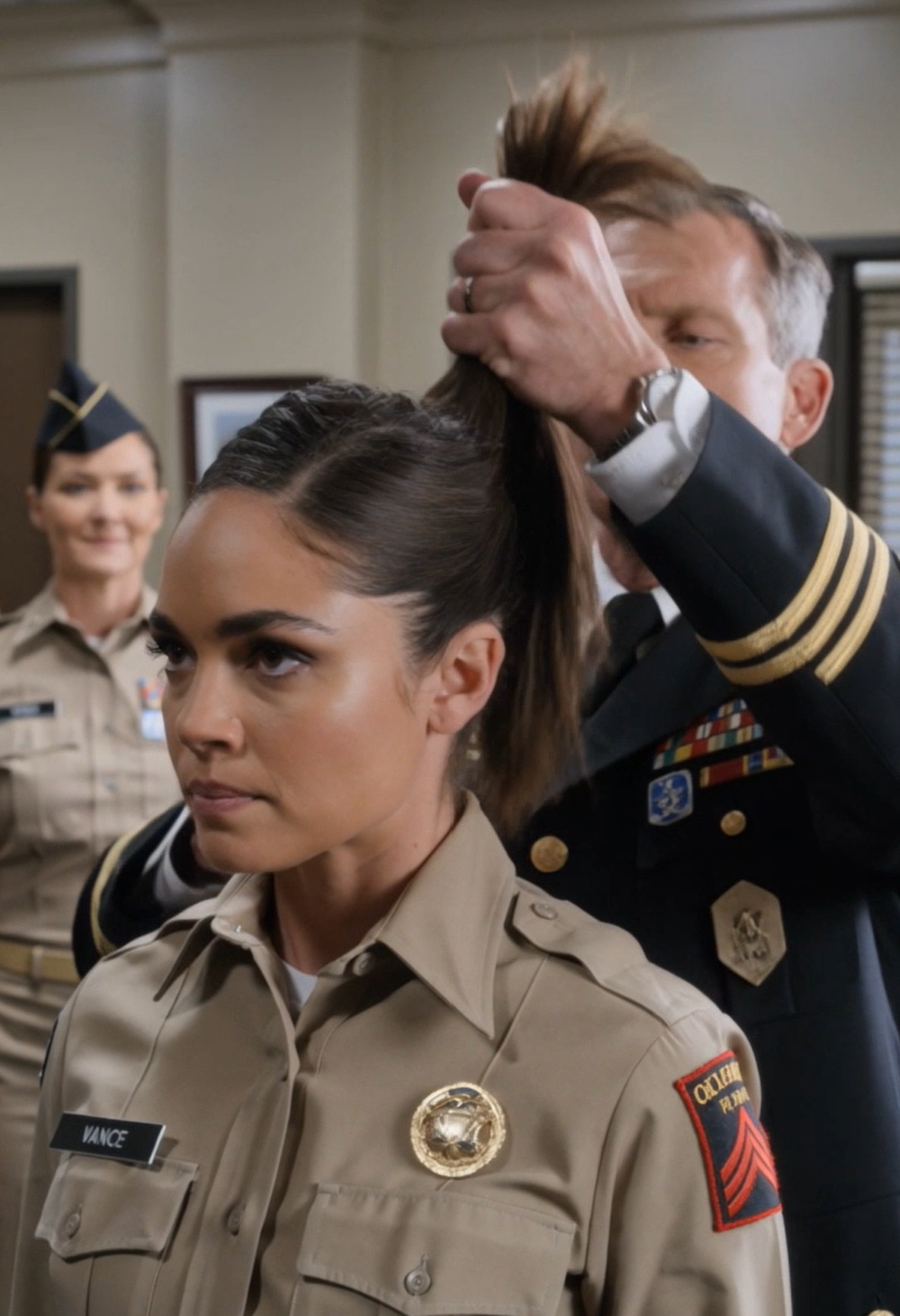
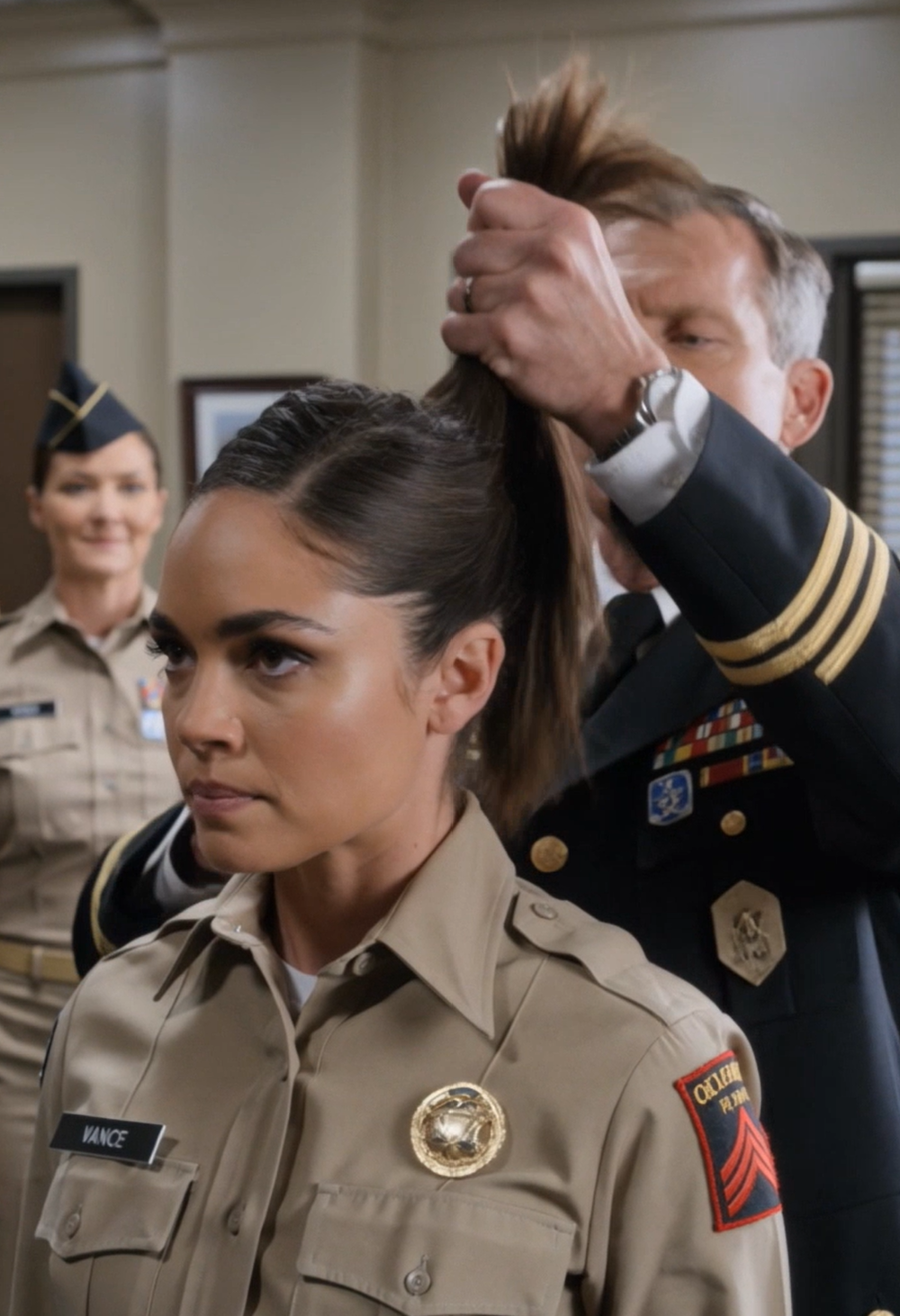
Tessa did not go to the barracks. She did not go to medical. She did not even touch the jagged ends of what used to be her hair.
She walked straight to the signal shop.
The night tech on duty, a kid named Bernard, looked up from his console and froze. He saw the uneven chop. He saw the look on her face. He started to stand.
“Sit down, Sergeant,” she said quietly. “And log out.”
“Ma’am?”
“Log out. Go get coffee. Take forty minutes.”
Bernard didn’t argue. He’d worked under Lieutenant Moran for eight months and had never heard her raise her voice. He didn’t need her to raise it now. He grabbed his cap and left.
Tessa sat down at the main terminal. She didn’t use her own credentials. She typed in a string of characters Bernard had never seen, and the screen blinked to a black command line none of the other techs knew existed.
At 00:23, the lights in the west corridor of the command building flickered.
At 00:24, every secure phone line on Fort Bradley went dead.
At 00:26, General Vance’s personal terminal – the one he bragged about, the one he used to monitor “his people” – rebooted on its own. When it came back up, it didn’t show the Army seal. It showed a single line of white text on a black screen:
AUTHORIZATION REVOKED. STAND BY.
Vance slammed his fist on the desk and grabbed his landline. Dead. He grabbed his cell. No signal. He yanked open his office door and bellowed for his aide. No one came.
Down in the signal shop, Tessa was already pulling up the second protocol.
Because what General Harold Vance did not know – what nobody on Fort Bradley knew, not even the base commander – was that Lieutenant Tessa Moran wasn’t actually assigned to the signal shop.
She was embedded there.
And the agency that placed her had a very specific clause about what was to happen if her cover was ever compromised by hostile action from inside the chain of command.
At 00:31, the front gate of Fort Bradley locked down. Not by base order. By something higher.
At 00:33, three black SUVs with no plates rolled through a side access road that, according to every official map, did not exist.
And at 00:34, as General Vance stood in the dark hallway of his own command building screaming for someone – anyone — to answer him, his office door clicked shut behind him on its own.
When he turned around, there was a man standing there in a charcoal suit, holding a folder with Vance’s name on it.
The man smiled politely and said, “General. We need to talk about the woman whose hair is on your carpet. Do you have any idea who you just…”
The man paused, flipping open the folder. He glanced down, then back up at Vance, his smile gone. “…who you just assaulted, General?”
Vance puffed out his chest, his fury overriding his confusion. “Assault? That was a disciplinary action! That was a lesson in military bearing for a subordinate who has been warned repeatedly!”
The man in the suit, whose name was Sterling, didn’t seem impressed. He took a small step forward, causing Vance to instinctively step back.
“Her hair was half an inch out of regulation, General. Our report states you measured it with a ruler from your desk. Is that correct?” Sterling’s voice was as calm as a frozen lake.
“It shows a lack of discipline!” Vance boomed, trying to regain control. “And I will not tolerate it on my post!”
“Your post?” Sterling raised an eyebrow. “Fort Bradley is under the command of Colonel Davies. You are a tenant here. The commanding officer of the 7th Signal Brigade.”
Vance’s face purpled. “I am a General in the United States Army! I will not be lectured by some civilian pencil-pusher!”
Sterling closed the folder with a soft snap. “I’m not a civilian. And you’re not a General anymore. Not really.”
He gestured to the dead phone on Vance’s desk. “As of twelve minutes ago, your command authority was suspended. As of right now, every order you try to give will be automatically routed to a null address.”
“This is an outrage! Who do you think you are?”
Sterling finally stepped into the single beam of moonlight cutting through the window. “I’m the man they send when a multi-billion dollar national security asset is compromised. Not by an enemy, General. But by the ego of one of its own.”
Down in the signal shop, Tessa wasn’t watching the security feeds of Vance’s office. She wasn’t interested in his downfall. She was working.
The lockdown protocol she initiated, codenamed ‘Iron Curtain,’ was designed for one purpose: to completely isolate Fort Bradley’s digital infrastructure from the outside world.
But as she ran her preliminary diagnostics, a chill went down her spine that had nothing to do with Vance.
It was an echo. A digital ghost.
Something had been inside their network. Recently.
It was faint, trying to cover its tracks, but to Tessa, it was like a muddy footprint on a clean white floor. The lockdown hadn’t just trapped Vance. It had trapped something else.
Or someone.
Her mission here wasn’t just to pose as a comms tech. She was an auditor. A hunter. Her real job was to test the security of America’s most critical military networks by trying to break them herself.
For eight months, she had found nothing but minor flaws and sloppy user habits, mostly stemming from General Vance’s insistence on using commercial-grade software on his personal terminal for “efficiency.”
He had created a dozen backdoors without even realizing it. All in the name of convenience.
Tessa’s fingers flew across the keyboard. She wasn’t an Army Lieutenant anymore. She was a different person entirely, a master architect moving through a world of pure data.
She found the point of entry. It was, as she suspected, Vance’s pet terminal.
The intruder had been subtle, siphoning tiny packets of data over weeks. Schedules. Logistics. Power grid schematics. Nothing top secret, but together, it painted a very clear picture of the base’s operations.
And then she saw what they were after.
The blueprints and operational codes for Project Chimera, a new drone swarm system being tested in the desert ranges near the fort. It was a revolutionary technology, and its loss would be catastrophic.
The protocol she had initiated wasn’t just about punishing a General. It had become a race against time.
The intruder was locked in with her. They knew it. And now, they were trying to smash their way out, taking the Chimera data with them.
Tessa needed help. Not a team of agents. She needed someone she could trust. Someone who knew the physical layout.
She keyed the intercom. “Bernard. Get back here. Now.”
A minute later, Bernard came jogging in, holding a lukewarm coffee. He stopped short when he saw the main screen, now a cascade of moving code.
“Ma’am? What’s going on? Is this because of the General?”
Tessa looked at him, her eyes sharp and clear. The humiliation from earlier was gone, replaced by an intensity he had never seen.
“No. It’s bigger than that. Sergeant, I need you to listen to me very carefully. My life and a significant piece of national security depend on it.”
Bernard straightened up, the coffee forgotten in his hand. “Yes, ma’am.”
“Go to server rack 77-B. It’s in the sublevel. There’s a red fiber optic cable connected to port 3. I need you to unplug it. Do not unplug anything else. Just that red cable.”
“Ma’am, that’s the main uplink for the meteorological data…”
“It’s not for meteorological data, Bernard. It’s a blind relay the intruder is trying to use to punch a hole through the firewall. I’m digitally rerouting them, trapping them in a loop. But I can’t sever the physical connection from here. I need you to be my hands. Can you do that?”
Bernard saw the truth in her face. This was real. More real than any drill he’d ever run.
“Yes, ma’am.”
“There’s one more thing,” Tessa said, her voice dropping lower. “The person who put that cable there might still be on this base. They might try to stop you. Your direct order is to unplug that cable. Do not engage anyone. Just pull the line and get back here. Understood?”
He nodded, his throat dry. “Understood.” He placed his coffee cup neatly on the edge of a desk and left at a run.
Meanwhile, in Vance’s office, Sterling was laying out the photographs.
“This is Lieutenant Moran’s graduation from MIT. Valedictorian. Triple major in network theory, cryptography, and applied mathematics.”
He laid down another. “This is her receiving a commendation from the Director of National Intelligence for stopping the ‘Scythe’ ransomware attack two years ago. Saved the entire Pacific Fleet’s logistics network.”
He laid down a third. “And this is a satellite photo from last year. It shows a small building in a foreign country vaporizing. She did that. With a laptop. From a coffee shop in Virginia.”
Vance stared, his face pale. “That’s not possible. She’s… she’s a communications tech.”
“She’s the single most valuable cyber warfare asset this country has, General,” Sterling said flatly. “Her designation is ‘asset-prime.’ Your entire career, your pension, your house—all of it combined is worth less to our nation than a single strand of her hair.”
Sterling leaned in. “The hair you just hacked off with a pair of office scissors and left on the floor.”
“When we embed an asset like Tessa, we have rules. The most important one is Rule One: the asset’s cover is absolute. No one, not even the base commander, can know who they are. Their safety depends on it.”
Sterling pointed at Vance. “You didn’t just compromise her cover. You physically assaulted her in front of fifty of your subordinates. You took our nation’s sharpest weapon and tried to break it over your knee because you didn’t like the way it was polished.”
Vance finally slumped into his chair, a broken man. “I… I didn’t know.”
“That’s the whole point, General,” Sterling said, his voice laced with cold fury. “You weren’t supposed to know. You were supposed to be a professional. A leader. Leaders don’t humiliate their soldiers. Bullies do. And your bullying has put this entire installation, and the project within it, at risk.”
At that moment, an alarm klaxon began to blare from the sublevels.
Bernard was halfway down the corridor to the server farm when he heard footsteps.
He ducked behind a bank of generators as two men in maintenance uniforms hurried past, speaking in a hushed, urgent language he didn’t recognize. They weren’t base maintenance. He’d never seen them before.
They were headed for the server racks.
His heart pounded. Tessa’s warning echoed in his ears. ‘The person who put that cable there…’
He had a choice. Follow his orders and run back to the signal shop, or complete the mission. Tessa was counting on him.
He took a deep breath, slipped off his boots, and continued in his socks, silent as a shadow.
He peeked around the corner. The two men were at rack 77-B. One was desperately trying to pull a hard drive while the other was typing furiously on a small, handheld device. They were trying to escape.
Bernard saw the glowing red fiber optic cable. Port 3. His target.
He couldn’t get to it without them seeing him. He looked around. On the wall was a fire suppression handle. A big, red lever. The sign said: HALON GAS RELEASE. WARNING: EVACUATE AREA IMMEDIATELY.
He remembered his training. Halon wasn’t lethal, but it would suck the oxygen out of the room and force an immediate evacuation.
He didn’t hesitate. He ran, grabbed the handle with both hands, and pulled.
A deafening horn blasted, and vents in the ceiling began to hiss. The two men spun around, their eyes wide with panic as they saw him. They gave up on the server and ran for the emergency exit.
Bernard held his breath, rushed to the rack, found the red cable, and yanked. It came free with a soft click.
Mission accomplished. He turned and sprinted back the way he came, his lungs burning.
In the signal shop, Tessa saw the connection die. The intruder’s digital escape route vanished. She immediately erected a final wall, boxing them in a data prison with no doors.
It was over. She had them. And she had their digital signature. She knew who they were.
A moment later, Bernard stumbled in, gasping for air. “Ma’am. Cable is pulled. Encountered two hostiles. Activated the fire suppression to create a diversion.”
Tessa looked up from her screen, and for the first time that night, she smiled. It was a small, tired, but genuine smile.
“Good work, Sergeant. You did very good work.”
An hour later, the sun was beginning to rise. The black SUVs were gone. So were the two rogue maintenance workers, now in custody.
General Vance was gone, too. He wasn’t arrested. Sterling had offered him a choice. He could face a court-martial for assault, dereliction of duty, and compromising national security, which would strip him of his rank and pension and land him in prison.
Or he could sign his immediate, unconditional resignation for “personal health reasons,” effective immediately. He would keep his pension, but his name would be wiped from every active military roster. He would simply cease to exist, professionally. It was a mercy he didn’t deserve.
He had taken the deal.
Sterling stood with Tessa near the window of the now-quiet signal shop. A team from her agency was busy cleaning up her digital battlefield and restoring the base to normal. Bernard had been sent to the mess hall for the biggest breakfast he could eat, with strict orders to say nothing.
Tessa was holding a small pair of scissors, carefully evening out the disastrous haircut. It was shorter than she liked, but it was neat. Disciplined.
“We’ve identified the intrusion,” Sterling said quietly. “A foreign intelligence service. Your work tonight prevented a strategic disaster. The Director sends his personal thanks.”
Tessa just nodded, concentrating on a stray lock of hair.
“We’re pulling you out, of course,” Sterling continued. “There’s a promotion waiting. A corner office in Langley. You’ll be heading up your own department. No more undercover work. No more arrogant generals with scissors.”
Tessa paused. She looked at her reflection in the dark monitor. She saw her new, short hair. She thought of Bernard, a scared-stiff but brave kid who followed a crazy order because he trusted his superior. She thought of all the other Bernards on this base and others, doing their jobs, wanting to be led, not belittled.
“No, thank you,” she said softly.
Sterling looked surprised. “I don’t understand.”
“That office in Langley… it’s for people who think in terms of assets and protocols,” Tessa said, putting the scissors down. “I was reminded tonight that we’re not just assets. We’re people.”
She turned to face him. “Vance’s problem wasn’t just that he was a bully. It was that he saw his soldiers as tools. He demanded discipline but didn’t inspire it. He broke things he didn’t understand.”
“I want to stay,” she said. “Not forever. But for a while longer.”
“Here?” Sterling was incredulous. “As Lieutenant Moran?”
“Yes. Colonel Davies is a good man. He’ll be taking full command now. With Vance gone, this place needs leaders, not just commanders. I want to train these kids. I want to teach Bernard what I know. I want to build a team that’s so good, so secure, that you’ll never have to send someone like me here again.”
She looked Sterling in the eye. “The best way to secure a network isn’t with firewalls and lockdowns. It’s with the people who guard it. My job isn’t done here.”
Sterling was silent for a long time. He looked at this brilliant, quiet woman who had turned down a top job to stay in the trenches and mentor a young sergeant. He finally understood the difference between power and strength.
“I’ll make the arrangements,” he said, a newfound respect in his voice. “Your cover remains. But from now on… your recommendations carry the weight of my office. You build your team, Lieutenant.”
Tessa nodded. “Thank you.”
True leadership isn’t about the rank on your collar or the volume of your voice. It’s not about public displays of power or humiliating those you perceive as beneath you. True leadership is quiet. It’s competent. It’s about seeing the potential in others and building them up, not tearing them down. It’s about earning respect through your actions, not demanding it with your title. General Vance thought discipline was about the length of someone’s hair. Tessa Moran knew it was about the quality of their character. And in the end, character is the only thing that holds.



