I had the privilege to witness a poignant moment at the Vietnam Veterans Memorial this morning. It was one of those crisp days, where the air feels almost sacred, and the silence wraps around you like a comforting blanket.
In the midst of this tranquility stood an elderly gentleman, probably in his 80s. Clad in a faded windbreaker, he was engrossed in his thoughts, tracing a name on the somber, black granite wall. He seemed miles away, absorbed in memories, unaware of the newcomers approaching.
Three young men, cadets from West Point, marched purposefully up to him, their uniforms meticulously pressed. One of them, the tallest, carried an air of arrogance that was hard to miss as he jeered, “Find your name there, old-timer?”
The veteran remained still, his focus unwavering on the wall before him.
“I asked you a question,” continued the cadet, with a tone that dripped with condescension. “What was your call sign, old man? Or were you one of those who sat out the war at home?”

The heaviness of the silence that followed was perceptible. The old man finally shifted, pulling his hand away from the wall, and turned his gaze to meet the cadet’s eyes. They were not angry, but profoundly knowing.
“I’m exactly where I belong,” he rasped softly.
The cadet chuckled dismissively. “This place is reserved for heroes, not those seeking a photo op. It’s called stolen valor,” he said, loud enough for the gathering crowd to hear.
People nearby started recording the encounter on their phones. Emboldened, the cadet signaled a Park Police officer to intervene.
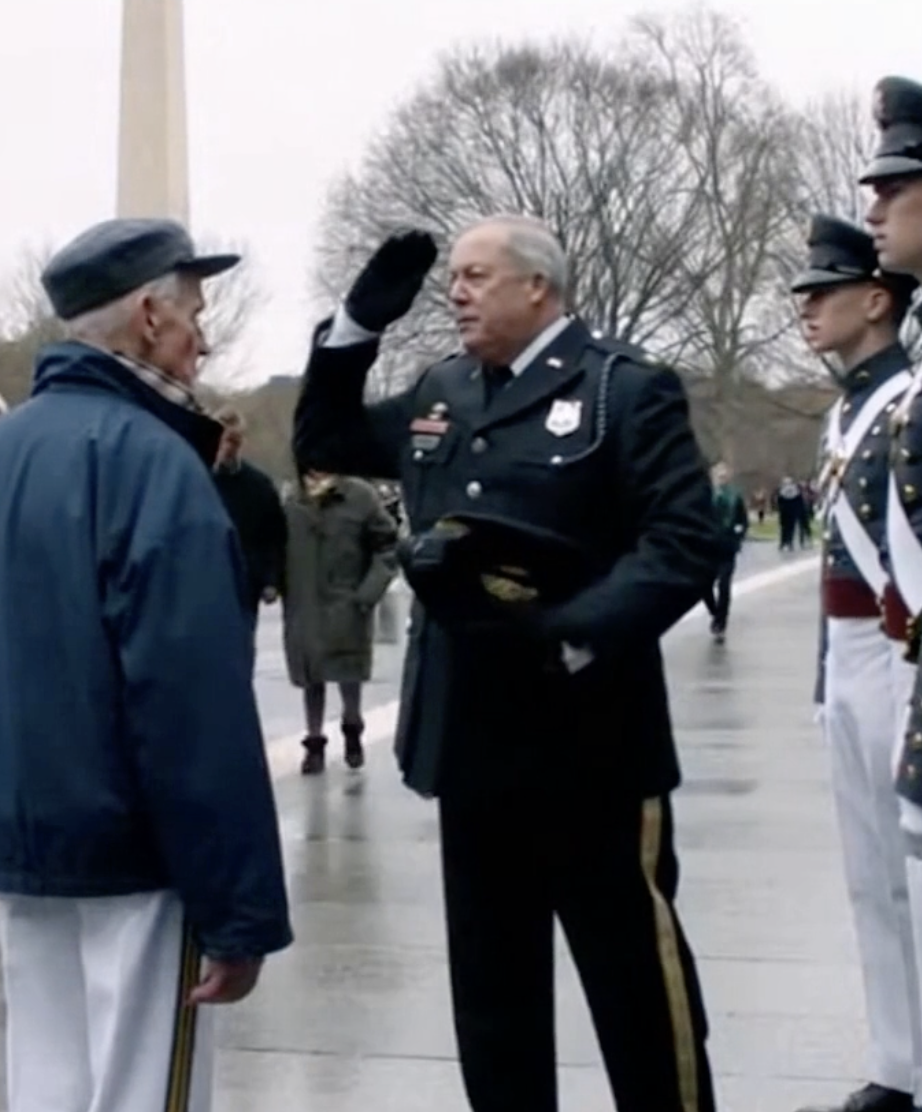
Things took a dramatic turn when a sleek black sedan pulled up with a screech. Out stepped a two-star Army General, his presence commanding instant respect. Ignoring the crowd, his attention was entirely on the veteran.
He approached, saluting sharply and addressing the veteran with reverence, “Spectre, it’s an honor, sir.”
The cadet paled visibly, realization dawning upon him that he had crossed a line he couldn’t have imagined.
The General introduced him as Arthur and offered him a nod, “At ease, David,” Arthur murmured. “You’re kicking up quite a fuss.”
“The disturbance,” General Miller said with a crisp edge, “was caused by my future officers here.” He directed a steady gaze at the cadets, the contrast between their pale faces and stiff postures stark.
“Cadet, what’s your name?” the General demanded, calm with underlying intensity.
“Cadet Rollins, sir,” came the shaky response.

The General gestured toward his car. “Cadet Rollins, you and your companions have exactly thirty seconds to be seated in my car. End of discussion.”
Turning to the officer, the General reassured, “Officer, thank you for your service. We’ll handle this matter within military jurisdiction.”
Arthur watched impassively as the General sighed, “Join me, sir? There’s a valuable lesson to impart here.”
With a weary nod, Arthur agreed, and the drive that followed was imbued with a solemn silence, the gravity of the earlier moment hanging heavy.
We arrived at Fort Myer, at a building that seemed almost historic with its weathered presence, reminiscent of times long past. Inside, the atmosphere was filled with the scent of worn books and polished wood.
General Miller wasted no time, addressing the cadets who stood rigid before his sturdy oak desk, their demeanor one of abject realization.
“Cadet Rollins,” the General queried, his voice rich with sternness, “are you familiar with MACV-SOG?”
“Yes, sir,” Rollins stammered. “The Military Assistance Command, Vietnam—Studies and Observations Group, a secretive unit of the Vietnam War.”
“Correct, but books don’t capture the magnitude,” the General elaborated. “They moved in shadows, missions denied by official records. They were phantoms—fighting in places unimagined, their courage lost in the silence of denial by their own government.”
“If captured, they were disavowed. If killed, unrecognized. Yet, history remembers the legend—Spectre, leader of Recon Team Idaho.” He pointed emphatically at Arthur, emphasizing, “You’re standing before the man himself.”
The cadet’s response was disbelief colored with respect as the room settled into contemplative silence.
“You wear a uniform of honor,” General Miller continued, a controlled fury under his words, “and you insult a man synonymous with valor.”
“This man,” he continued, gesturing towards Arthur, “led a three-day mission through enemy lines—saving lives while hunted by battalions. Listed MIA, presumed dead, Arthur walked out of jungles alone.”

Arthur shifted uncomfortably. “David,” he interjected softly, but the General pressed on.
“My father’s name stands at that wall,” he stated, a profound connection in his voice. “Sergeant Frank Miller died during one of these impossible missions—a Green Beret downed in a ’68 monsoon—a mission Arthur’s team undertook despite insane odds.”
“His body returned because of Spectre’s unwavering rule: Bring everyone home, alive or not.”
Facing Rollins closely, the General revealed, “Arthur’s team rescued my father, giving me a chance to honor his memory.”
The weight of his words was palpable. “So, Cadet, don’t question his presence at that wall.”
He paused purposefully. “Yet, there’s another reason you’re here, Cadet,” the General continued, with a softer but no less impactful tone.
Drawing from his desk, he produced a picture from another era—a jungle scene, soldiers caught in critical roles, Arthur a force at the center. “Study it closely,” he instructed Rollins.
Recognition jolted through Rollins as he scanned the photo—a face in the group awakening memories whispered yet unheard.
“Captain Thomas Rollins,” murmured the General, “Your grandfather. His place secured by Spectre and his men.”
The revelation settled like a leaden weight, sending Rollins reeling.

“I was told he was a supply officer,” Rollins faltered. “He never spoke of combat.”
Arthur’s words were gentle, soothing the rawness of truth. “The scars we carry from battle aren’t tales to burden family,” he explained. “Your grandfather was courageous, aiding in strikes that protected us. He chose silence about the burdens he carried.”
Arthur stepped forward, smaller than the cadet yet emanating a deep inner strength. “Thomas Rollins was a good man, son,” Arthur continued, “brave and worthy of your memory, uncontrolled by the harshest day.”
The young cadet broke, emotions overwhelming. The facade of arrogance shattered, and he wept.
“I’m deeply sorry, sir,” he cried, “I never knew, never understood.”
Arthur rested a comforting hand upon him. “I know,” he reassured. “You’ve learned perspective today. Pride often blinds us to truth.”

Withdrawing his touch, Arthur emphasized the truth of legacy—“Your grandfather’s silence was for you to pave a path unburdened, to hold pride in uniform as humility, never arrogance.”
Observing this exchange, the General’s demeanor softened, acknowledging the crucial lessons of the day.
“Cadet Rollins,” the General said finally, with authority tempered by empathy, “You will contribute to preserving these stories by dedicating your weekends to ensuring the Army’s historical memory remains polished and honored. Write what humbled you today, the true constituent of leadership.”
Taking his dismissal, Rollins departed, humility newly forged.

With the cadets gone, the General turned back to Arthur, apologizing softly, “I regret your enduring that disrespect.”
Arthur shook his head, forgiving. “He’s but a young spirit, David. Today, he glimpsed truth. That’s of greater worth than my wounded pride.”
Looking out the window, Arthur reflected, “Some wars, we bear on the inside, others, outwardly. The wisdom is honoring both.”
As we departed, Arthur lingered on a photo—a young Lieutenant Miller with Sergeant Frank Miller, Arthur’s solemn reflection on remembrance.
In his quiet dignity, the veteran carried a past marked with untold stories, content with remembering those no longer spoken by the world but never forgotten by his heart.
The morning’s lesson has left an indelible mark on me. True heroism, I’ve realized, often lies silent, exemplifying humility through simple acts of commemoration. It resides quietly within those ordinary among us, whose unseen bravery shapes the world profoundly.