“I’m sorry, but we paid for a high-class experience,” a woman muttered, casting a disapproving look. “And his hat is… well, it’s just sad.”
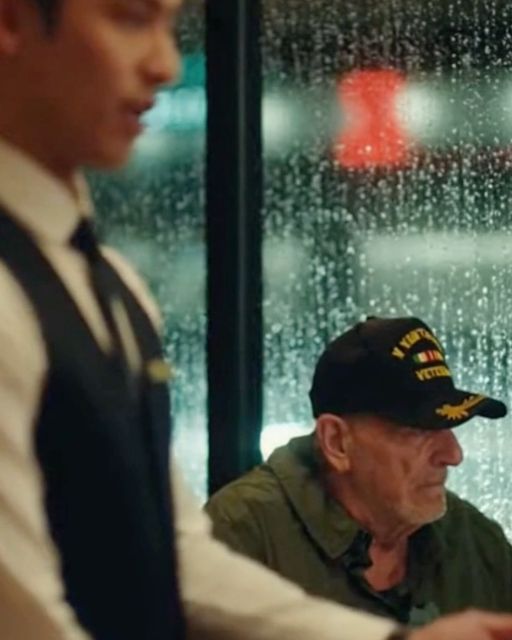
She pointed to an elderly man by the window, alone with his coffee, wearing a simple “Vietnam Veteran” cap. The rain drummed against the glass as he looked out, lost in his thoughts.
My husband and I were celebrating our anniversary at a chic new restaurant. The couple next to us seemed dissatisfied with everything, and now the quiet veteran had caught their attention.
“Manager, please,” the woman’s companion called over. “Can you seat that gentleman somewhere less visible? He’s spoiling the ambience.”
The young manager glanced at the old man and back at the couple. I braced for a response.
“I’m sorry, sir,” the manager replied gently.
“What do you mean, you can’t?” the man demanded. “Isn’t the customer always right?”
Gathering his composure, the manager looked directly at the man. “This entire venue is booked for the night under one name.”
He gestured to the veteran. “That gentleman over there made the reservation. This building’s deed lists his name—Arthur Gable. He’s paid for every single table this evening.”
Surprise flickered in the man’s eyes. His earlier confidence faltered.
His wife, named Penelope, scoffed. “That’s impossible. How could he possibly…”
“Indeed, it’s true,” the manager, Daniel, confirmed kindly. “Mr. Gable bought this block a decade ago and leased the restaurant with one unique stipulation.”
Daniel glanced back at the veteran, still staring peacefully at the rain, untouched by the tension.
“He asked that on this night each year, the restaurant be solely for him and his guests. No questions asked.”
The man, Richard, looked bewildered, his authority slipping away, unable to reconcile the veteran with the owner of the building.
“You see, sir,” Daniel continued warmly, “you’re sharing in his hospitality today.”
The dining room fell silent. My husband took my hand, mirroring the surprise and reverence we all felt.
Richard’s demeanor shifted from indignation to paleness. Words eluded him.
Penelope, however, gathered herself to speak. “This is highly incorrect. Why weren’t we told this at booking?”
“Mr. Gable preferred to keep things simple,” repeated Daniel with patience. “He wished for us to maintain our usual operations. Tonight, he said he wanted to enjoy the view before anyone else arrived.”
The room held its breath.
Just then, the main door opened, ushering in a refreshing breeze. A young woman entered, gently guiding a small boy of about five, clutching a handmade card. Their neat simplicity contrasted with the venue.
The young woman scanned the room, broke into a radiant smile when she saw the old man at the window.
“Arthur!” she called brightly, warmth in her voice.
The veteran turned, his tired features softening with affection. A small wave followed.
They approached him, the boy offering the card with pride. Arthur accepted it with a grace that spoke volumes, reading it with care before tucking it into his pocket with a pat.
Richard and Penelope watched, discomfort and disbelief clear on their faces. Their carefully crafted evening was unravelling.
Two men entered next, one in a wheelchair, both sporting a military insignia. They greeted Arthur with the camaraderie of old friends.
Soon, more guests arrived.
An elderly woman, supported by a teen with vivid pink hair, was among the next.
The kitchen’s chef even made an appearance to pay tribute.
A family of four, their laughter filling the air, joined in too.
The expected “high-class” guests were conspicuously absent. These were regular, everyday people.
The space, once so impressively vast, now buzzed with warmth and conversation. A real community was taking shape.
My husband leaned in. “This is, hands down, the best anniversary dinner ever.”
I held his hand in agreement, savoring the unique moment.
Daniel approached us quietly. “I hope the disruption wasn’t too upsetting,” he said.
“Not at all,” I assured him. “Thank you for everything.”
His tired smile widened. “Mr. Gable is the kindest boss I’ve known in my years here.”
Daniel shifted his attention to Richard and Penelope. “Would you prefer a quieter seat? Perhaps a corner table?”
The irony was felt by all. A move to a less observable spot was now offered to them.
Richard declined, seeming utterly defeated, perhaps for the first time understanding his lack of authority.
Arthur continued, not as a man of influence but as a friend among friends, moving from table to table, sharing in their stories, listening intently.
He nodded as a boy showed him something on a phone, shared a quiet conversation with the veteran in the wheelchair.
Soon my curiosity won over. As Arthur neared, I found my voice.
“Sir?” I called gently.
He turned kindly. “Yes?”
“I’m sorry for intruding. My husband and I are celebrating our anniversary here. What you’re doing is wonderful.”
A slow, warm smile appeared. “It’s not about me. It’s them who make it all worthwhile.”
He looked around, a profound peace in his eyes. “This restaurant was my wife’s dream. She always believed it should be a place of welcome over prestige.”
His voice softened. “Today would have been her birthday.”
Understanding dawned. This wasn’t about flaunting wealth. It was a tribute—profound and beautiful.
“These people here,” Arthur motioned round, “they are family in one way or another. We’ve shared kindness.”
He gestured to the young woman with the boy. “We helped Sarah when she needed a fresh start. She’s now a nurse.”
The men in uniform, he called “brothers,” bound by shared history and support.
“And Maria,” he chuckled, his eyes on the pink-haired teen. “She volunteers at the VA hospital. A heart of gold.”
He connected each story, weaving a tapestry of genuine care.
“Eleanor always said real wealth lies in good deeds,” Arthur reflected. “This party is her doing. I only send invites.”
With that, he moved to join an elderly woman, her tale evoking his laughter.
We finished our meal in thoughtful silence, aware we had witnessed a legacy of love.
As the evening approached its twilight, a soft tune set the room alight with laughter and conversation.
Richard and Penelope remained, picking at their dishes, their eyes darting around as though caught in a tableau for which they’d misunderstood the script.
And then, another unexpected turn emerged.
A sharply dressed man approached Arthur, his briefcase and posture commanding respect.
His brief exchange with Arthur, briefcase in hand, drew toward Richard and Penelope’s table.
Richard stood abruptly, almost upset at his seating.
“Mr. Harrison,” Richard stammered, unease evident. “What a surprise!”
“As is seeing you, Richard,” Mr. Harrison returned coolly, withholding customary niceties.
“A wrap-up meeting brings me here,” Mr. Harrison noted, gesturing to Arthur. “The community changes project, finalized.”
I recalled Richard bragging earlier of a grand contract he’d claimed to nearly secure.
“Oh, yes!” Richard retorted with bravado, “My submission—sure to impress.”
Mr. Harrison inspected Richard and Penelope before glancing at Arthur’s distinct hat on the table.
“Presentation is key,” Mr. Harrison stated. “Yet our board prefers partnerships aligning with—respect, humility, community.”
A pause. “Arthur Gable leads that board.”
Richard’s face reflected horror once again. He had not only belittled here tonight but done so in front of someone critical to his success.
Mr. Harrison nodded slightly. “Another bid won our preference. Good night.”
With that, Mr. Harrison left, leaving Richard shattered, exposed.
Brief, silent, their departure was swift, leaving behind only the memory of their misjudgment.
As Arthur rose, he didn’t demand silence or attention. His unassuming presence naturally hushed the room.
“Thank you, everyone, for honoring Eleanor,” he said, emotions heavy in his voice. “Her wish for a room of good people, a family.”
Raising his glass, he toasted, “To Eleanor.”
The response was unanimous. “To Eleanor.”
After covering our bill and leaving a thoughtful tip, chosen with gratitude for a unique evening, we began to exit.
A glance back revealed Arthur, not just the veteran of service but also of heart and character, engaging warmly with those he cherished.
Outside, rain continued its gentle dance, yet somehow the world seemed to bask in newfound warmth. The evening profoundly taught that appearances deceive. That real richness—respect, dignity, and kindness—cannot be purchased or reserved. It’s earned and freely given through simple yet profound acts of grace.