Dawn. Formation. Breath like smoke. I locked my knees and stared past General Holt’s shoulder at nothing. One loose strand. That’s all it took.
He circled me like I’d set the barracks on fire. “You think you’re above protocol?” His voice hit my spine like ice water.
“No, sir.” My mouth was dry sand.
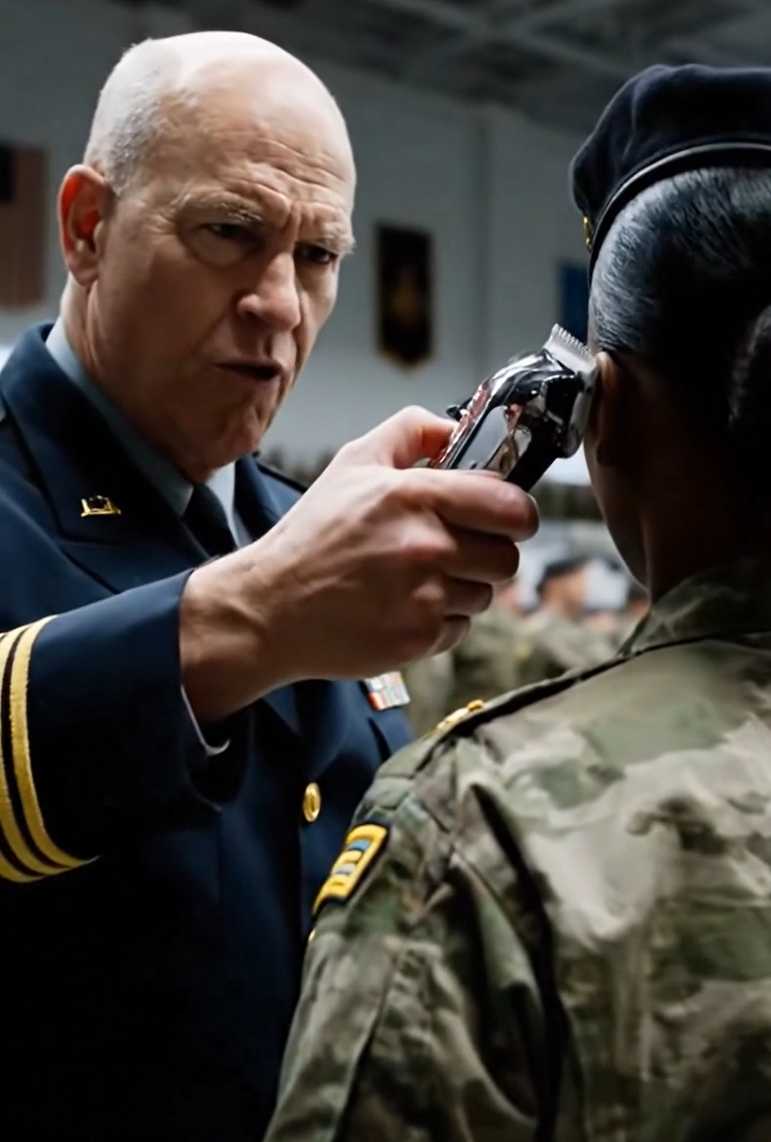
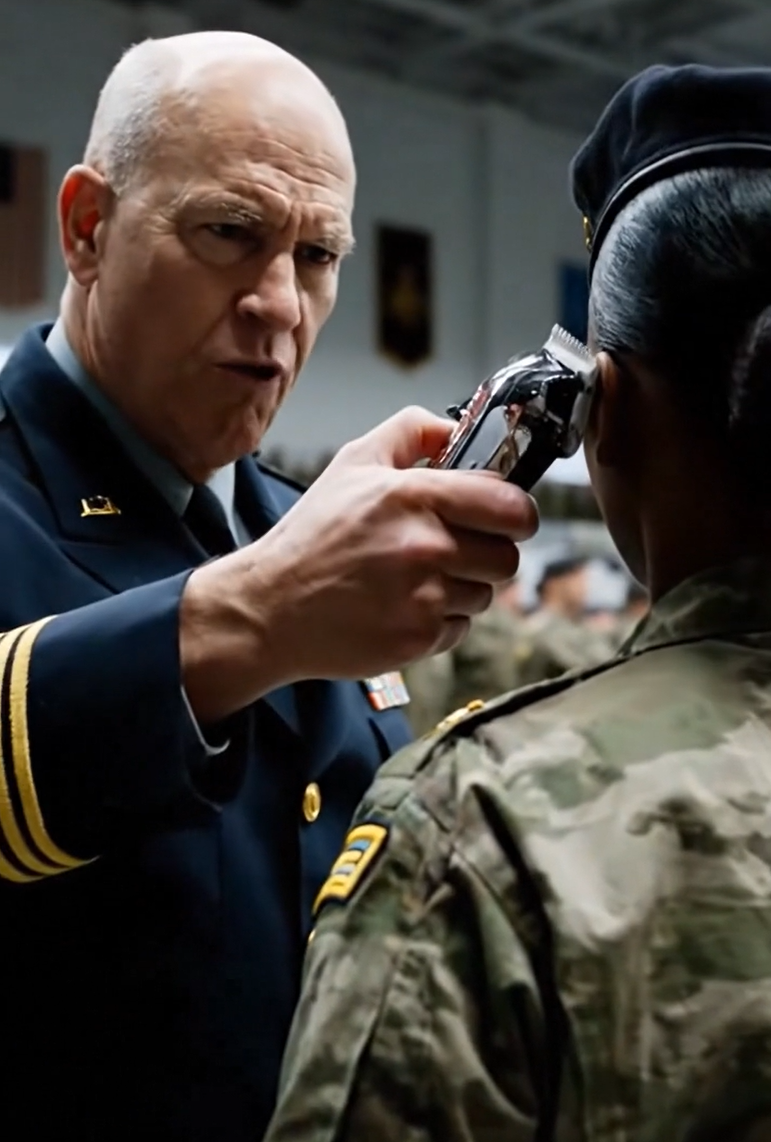
He didn’t lecture. He grabbed a pair of utility scissors from a gear bag and yanked my braid. My stomach flipped. The metal felt cold against my neck.
Snip.
The sound cracked through the line. My braid dropped to the gravel. I felt the back of my head go light, air rushing where weight used to be. I didn’t blink. Couldn’t. Two hundred soldiers watched. Nobody moved.
“That,” he said, dropping the scissors, “is what happens when you think regulations don’t apply to you.”
My hands trembled. Not from fear. From rage I couldn’t show.
I’d worn that braid for eight years. Through basic training. Through two deployments. Through my daughter’s birth – I’d braided my hair the morning I flew out, thinking of her tiny face. That braid meant something. He knew it meant something.
He walked away. I stood there, scalp burning, feeling the uneven edges where he’d cut too close. Sergeant Martinez wouldn’t meet my eyes. Private Chen’s jaw was clenched so tight I thought his teeth might crack.
The formation broke. I went to the bathroom and saw myself in the mirror – one side shorter, rough and jagged, like he’d used the scissors as a weapon instead of a tool. Because he had.
The person staring back at me looked violated. Hacked at. I touched the raw ends of my hair, the strands stiff and uneven. For a moment, all the air left my lungs.
Then the rage came back, cold and sharp. This wasn’t about a strand of hair. This was about him making an example of me. This was about power.
I walked back to the barracks, my head held high. I could feel the stares. I could hear the whispers stop as I approached.
Sergeant Martinez caught up to me by the lockers. He still wouldn’t look directly at me.
“Miller,” he said, his voice low. “What he did… it wasn’t regulation. It wasn’t right.”
I just nodded. I didn’t have the words yet.
He hesitated. “Be careful,” was all he added, before walking away.
It was a warning and an apology, all in one. He was telling me that he knew I was going to do something, and that the system was built to protect men like Holt, not soldiers like me.
Later that evening, as I sat on my bunk staring at a blank incident report form, Private Chen found me. She was barely twenty, fresh out of advanced training, and she looked terrified.
She held out her phone. “I have it,” she whispered. “I have the whole thing.”
I looked at her, confused. “What?”
“I was in the back row,” she explained, her words rushing out. “I saw him grab the scissors. I just… I started recording. I don’t know why.”
My heart hammered against my ribs. “Let me see.”
She played the video. It was exactly as I remembered, but worse. You could see the smirk on his face as he held up my braid. You could hear the collective intake of breath from the unit. You could see the absolute stillness of two hundred soldiers forced to watch their superior humiliate one of their own.
You could see him smile as he let it drop.
The video ended. Chen looked at me, her eyes wide. “What do you want me to do with it?”
I thought about my career. About the risk. A private filing a complaint against a General. I would be a target for the rest of my service. They could make my life a living hell.
Then I thought about my daughter. What would I tell her if she asked me what I did when a powerful man tried to break me?
I looked at the young private in front of me, who had risked just as much by filming it.
“Send it to the Inspector General’s office,” I said, my voice steady for the first time all day. “Don’t attach your name. Just send the file.”
She nodded, a look of profound relief on her face. “Okay.”
That night, I filed the report. Just the facts. No emotion. Just what happened, when it happened, who saw it.
By Wednesday, the Army’s legal team was involved. By Friday, every news outlet was asking questions. By Monday, General Holt was on administrative leave pending investigation.
The first interview was with a JAG captain who looked exhausted. He asked me questions that felt like traps.
“Did you provoke the General in any way?”
“No, sir.”
“Has your hair been out of regulation before?”
“No, sir.”
“Is it possible you’re misinterpreting an attempt to enforce discipline?”
I looked him dead in the eye. “Is there a regulation that allows a commanding officer to physically assault a subordinate with a pair of scissors, sir?”
His posture changed after that.
The next day, the video landed on his desk. I wasn’t in the room, but I heard about it. I heard the investigation went from a “he said, she said” inquiry to a full-blown criminal case in a matter of hours.
The story spread. An 8-year-old girl saw the photos online and asked her mom why that man was “being mean to the lady soldier.” Teachers started talking about it. Veterans’ groups issued statements. The hashtag trended for six days.
What General Holt didn’t know was that Private Sarah Chen – the one whose jaw was clenched—had filmed everything on her phone. The angle was perfect. You could see his face. You could see the scissors. You could see the braid falling. You could see him smile.
She’d sent it to the Army’s Inspector General without telling anyone.
Two weeks later, I got called to the commander’s office. General Holt had resigned. Not fired. Resigned. Which meant pension. Which meant he was trying to get ahead of a court-martial conviction.
The colonel sat across from me, his hands folded. “Private, what you did took courage. Not the way you took it—the way you reported it. You could have let it go. You could have transferred. You could have gotten out.”
“Sir, I’m not leaving.”
He nodded. “I know.”
He told me the video was the reason the case had moved so fast. An anonymous submission, he said, winking slightly. We both knew. The whole unit knew. Private Chen was treated with a new kind of respect after that. She’d had our backs.
What happened next was the part nobody expected. The Army launched a full review of Holt’s command. Turns out, there were fourteen other incidents. Fourteen.
A female lieutenant he’d passed over for promotion while hiring her male subordinate. A sergeant he’d transferred for “attitude problems” after she filed a sexual harassment complaint. A master sergeant he’d publicly berated for her pregnancy.
They came forward. All of them.
One of them, Lieutenant Davies, found me in the mess hall. She was sharp, professional, and had eyes that looked like they’d seen too much.
“Miller,” she said, sitting across from me. “I’m Davies. I wanted to thank you.”
I was taken aback. “For what, ma’am?”
“For lighting the match,” she said with a wry smile. “Some of us have been carrying kindling for years, waiting for a spark.”
She told me her story. How Holt had sabotaged her command evaluation, calling her “too emotional for leadership” after she’d questioned one of his logistical plans. He’d given the promotion to a man with half her experience.
“He doesn’t just hate women,” Davies explained. “He hates competent women. He can’t stand anyone who isn’t intimidated by his rank.”
Her story made my blood run cold. My haircut was just the tip of the iceberg. It was the most visible thing he’d done, but the invisible damage was so much worse.
We started talking. A small group of us. The women from Holt’s past. We shared our stories in quiet corners, building a case file of his character that was more damning than any single video.
The investigation uncovered a pattern of abuse that stretched back a decade.
By the time the investigation closed, General Holt faced a dishonorable discharge recommendation, loss of pension, and potential criminal charges.
Then came the twist that sealed his fate. It came from Sergeant Martinez.
He requested a formal interview with the investigators. He told them he had served as Holt’s aide about fifteen years prior. He remembered Holt as a hard man, but not a cruel one. Not at first.
Martinez explained that Holt lived in the shadow of his father, a legendary command sergeant major from the Vietnam era. His father was a man of unimpeachable honor, known for being tough but fair.
“The General… he always tried to be his dad,” Martinez told them. “But he only understood the ‘tough’ part. He never understood the ‘fair’ part.”
Then Martinez dropped the bombshell.
“Those scissors,” he said, his voice heavy. “I recognized them. They belonged to his father. They were in a memorial case in his office for years.”
The scissors he had used to cut my hair weren’t just some random tool from a gear bag. They were a piece of his own family’s honored military history. He had taken a symbol of his father’s legacy of integrity and used it as a weapon for a petty, cruel act of humiliation.
When the investigators presented this fact, it broke something in the case. It wasn’t just an assault anymore. It was a desecration. It showed a profound sickness in his character, a contempt for the very values he claimed to be enforcing.
That detail leaked. The story was no longer just about a bully General. It was about a man who had corrupted his own heritage.
The day before his hearing, he called me. I don’t know how he got my number.
“I was teaching you discipline,” he said. His voice was different. Smaller. It was the voice of a man who had lost everything and was trying to rewrite the story in his own head.
“No, you weren’t,” I said, my own voice calm. “You were being a bully. And you got caught.”
I hung up.
My hair grew back. Uneven at first, then I had it cut properly—short, practical, strong. I went to a civilian salon off-post. The woman who cut it didn’t know my story.
“A fresh start,” she’d said, smiling, as she swept away the shorn locks. It felt like that.
I made corporal six months later. The citation mentioned my integrity and character. Not my hair. Not what happened to it.
But everybody knew.
At my promotion ceremony, standing there in dress uniform with the new rank on my sleeve, I saw General Holt’s name in the roster of disgraced officers. Permanently.
Lieutenant Davies was there. She was Captain Davies now. She pinned my new rank on my collar herself.
“This is what real strength looks like, Corporal,” she whispered, her eyes shining with pride.
Private Chen was there too, standing in the back, beaming. She’d shown a different kind of courage, the quiet kind that changes the world from the shadows.
My daughter, eight years old now, was in the front row. She ran up and hugged my legs after the ceremony was over.
She looked up at me and asked me why my hair was short. I knelt down to her level.
“Because I choose it,” I told her.
That was the truth he never understood. He thought he could take something from me, mark me with his power. But he couldn’t touch who I was.
The braid had been a connection to my past, a symbol of my journey. It represented the young woman who joined the army, who became a mother, who served her country.
But my new hair, the hair I chose, was a symbol of my future. It was a statement that my strength doesn’t come from what I can endure in silence. It comes from my voice. It comes from standing up, not just for myself, but for everyone who has been told to stay quiet.
Discipline, I realized, isn’t about fear or humiliation. True discipline is the courage to hold yourself, and those around you, to a higher standard of decency and respect. It’s the integrity to do the right thing, especially when it’s hard.
That was the lesson General Holt, in all his years of service, had never managed to learn. But it was a lesson he taught me, and one I would carry with me forever.