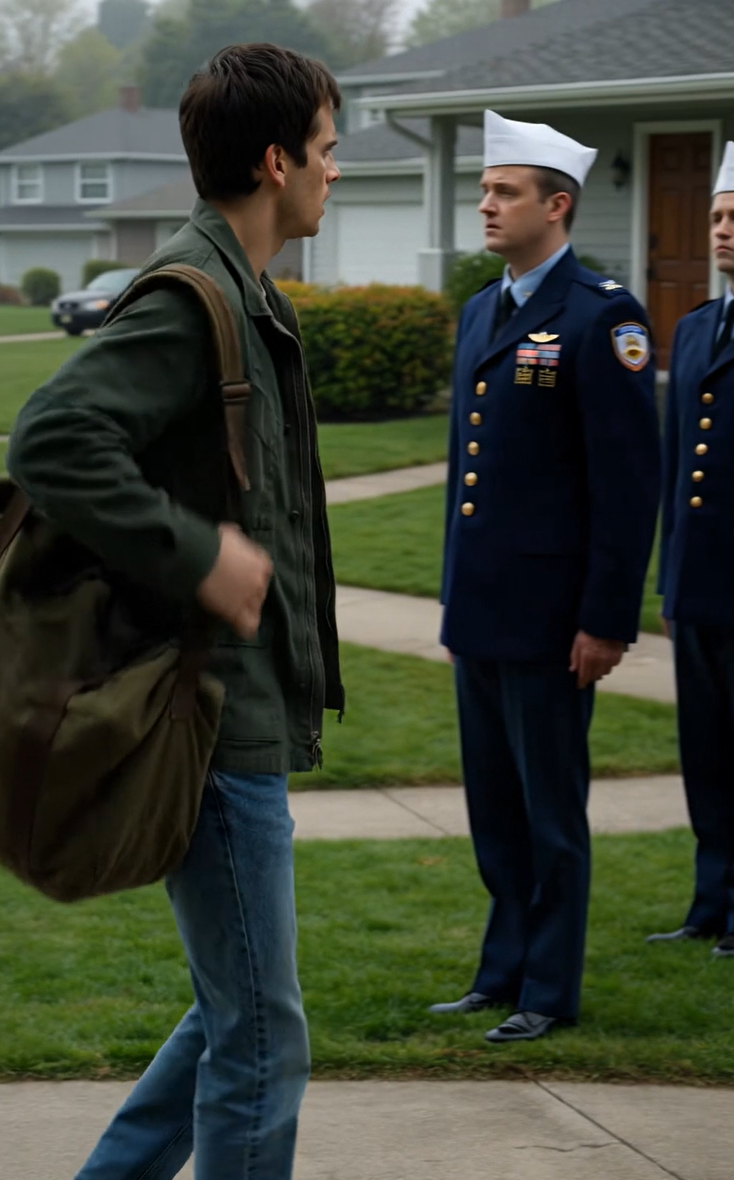
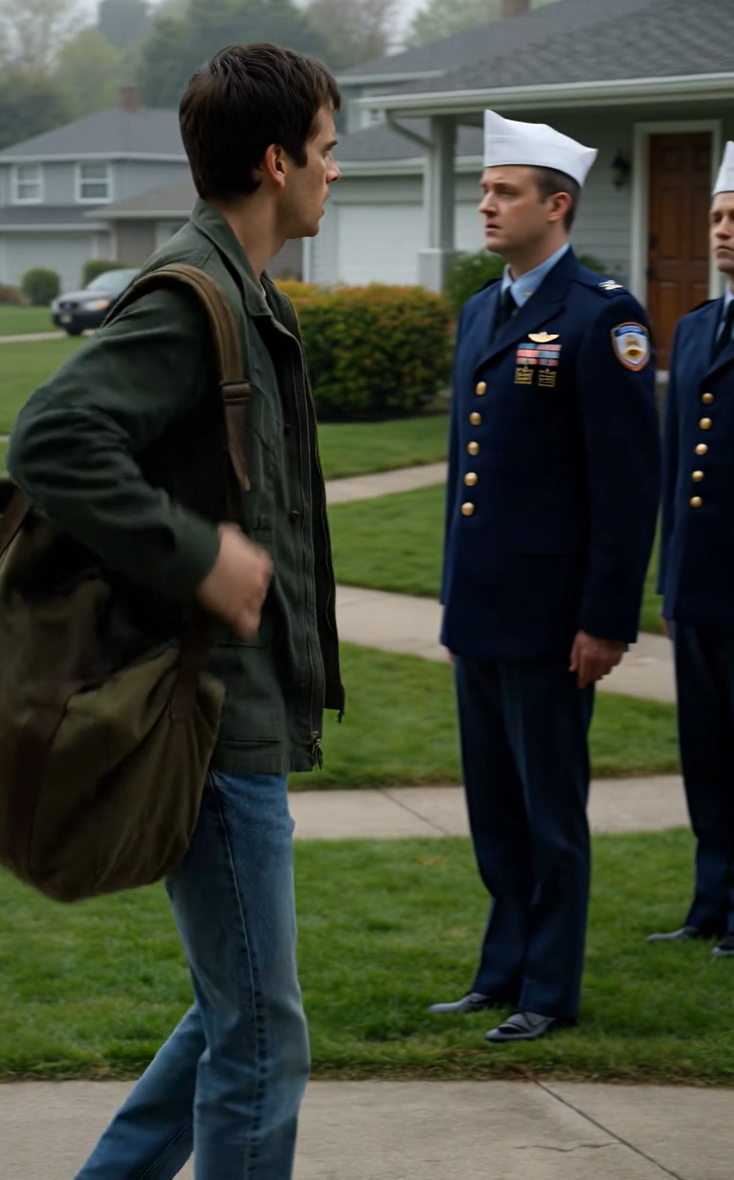
After 17 months in the sand, I didn’t call. I wanted to see Kara’s face when I walked through the door. I wanted the surprise.
I turned the corner onto our street and my legs stopped working. My duffel bag hit the pavement with a thud.
There were three black government cars in my driveway. Ten men in full dress blues stood in rigid formation on my lawn. The silence on the street was so heavy it felt like it was choking me.
Our front door was open. I could see people inside. Dark suits. Crying.
My hands shook as I picked up my bag. Each step toward the house felt like walking through concrete. The soldiers saw me first. One of them, a captain with silver hair, went pale. His mouth opened but no sound came out.
“Sir?” I managed. My voice cracked.
He turned to the others. “Fall back. Now.”
They scattered like someone had pulled a fire alarm. Car doors slammed. Engines started. Within seconds, half of them were gone.
I walked past where they’d been standing. There were fresh footprints in the grass. A folded flag sat on our porch swing.
Inside, I heard Kara’s voice. She was thanking someone. Her words were hollow, automatic. The way you sound when you’ve been crying for days.
I stepped through the door.
The living room was full of people. Neighbors. Kara’s parents. My brother Mike. Everyone was wearing black.
Kara stood in the center of it all, holding a box. A small wooden box with an eagle carved on top.
She looked up.
The box fell from her hands and shattered on the hardwood floor.
“No.” She stumbled backward. “No. No. No.”
Her mother screamed. Someone’s glass of water hit the carpet.
“Kara – ” I started.
“You’re dead.” Her face was white. “They told me you were dead.”
Mike grabbed my arm so hard it hurt. “Jesus Christ. Jesus Christ, Danny.”
I looked at the broken box. At the photos on the mantle – my photos, surrounded by candles. At the memorial card on the coffee table with my name and dates.
“What the hell is happening?” My voice didn’t sound like mine.
The captain from outside burst through the door, his phone pressed to his ear. “I need confirmation on Sergeant Daniel Morrison. Now. Right goddamn now.”
Kara was shaking. Her knees buckled and her father caught her.
“Ma’am,” the captain said, still on the phone. “Ma’am, I need you to stay calm. There’s been – ” He looked at me. His face was gray. “There’s been some kind of mistake.”
“A mistake?” Kara’s voice was rising. “You came to my door four days ago. You handed me a flag. You said he was gone. You said—” She couldn’t finish.
Mike’s grip on my arm tightened. “Who did they bury, Danny?”
The captain’s phone kept ringing. “I don’t—the records say—” He looked at me again. “Sir, I need to see your tags.”
I pulled them from under my shirt with numb fingers. He read them. His face went from gray to green.
“Oh God.” He turned away, pressing the phone harder to his ear. “We need immediate verification. Body identification. Chain of command. Someone screwed up and I need to know—”
“WHO DID YOU BURY?” Kara screamed it.
The room fell silent.
I looked at the memorial card again. My name. My photo. But the date of death was wrong by three days. And the location listed wasn’t where I’d been stationed.
My stomach dropped.
“Thompson,” I whispered. “Marcus Thompson.”
The captain stopped mid-sentence.
“He looked like me. We joked about it. Same height, same build, same—” My voice failed. “He borrowed my jacket. The one with my name sewn in. He said his was at the laundry and—”
Kara’s face crumpled. “So you’re alive. You’re here. You’re—”
“Ma’am.” The captain’s voice was barely audible. “I need to make some calls. There’s been a catastrophic error in—”
The phone in his hand started buzzing. He looked at the screen. His whole body went rigid.
“Sir,” a voice crackled through the speaker, loud enough for us all to hear. “We have a situation. The body we recovered had Morrison’s tags and jacket, but the fingerprints—”
The captain’s eyes met mine.
“—the fingerprints match Sergeant Marcus Thompson. Dental records confirm. But sir, there’s something else. Something on the body. We found—”
The phone went to speaker mode. The voice dropped lower.
“The gunshot wound wasn’t from enemy fire. Entry angle is wrong. And there was a note in his boot.”
Kara grabbed my hand. Her fingers were ice cold.
The voice continued, and what it said next turned my living room from a place of mistaken grief into the scene of a crime.
“The note just has two words, sir. ‘Ask Sterling’.”
Captain Hayes snapped the phone shut so fast it made a crack. His eyes were wide, darting from me to Kara to my brother.
“That call was on a secure channel. None of you heard that,” he said, but his voice lacked conviction.
“Ask Sterling?” Mike repeated, stepping forward. “Colonel Sterling? Your commanding officer?”
“That information is classified,” Hayes snapped. He was a man drowning, and he was grabbing at regulations like they were a life raft.
I felt a cold dread wash over me. Colonel Sterling. He was the one who personally approved my early leave. He’d clapped me on the shoulder, told me I’d earned it. He’d looked me right in the eye.
“Marcus,” I said, the memories coming back in a painful rush. “The last few weeks, he was on edge. He worked in the supply depot. He kept talking about inventory logs, about how things didn’t add up.”
My own words hung in the air. Things didn’t add up.
“He said they were shipping out more ordnance than we were getting in. That whole containers were just… vanishing from the books.”
Kara squeezed my hand. “Danny, what does this mean?”
“I don’t know,” I lied. But I was starting to. I was starting to see the ugly shape of it.
Captain Hayes looked like he was going to be sick. He was a good soldier, a man who followed the chain of command, and his chain was leading him somewhere terrible.
“Sergeant Morrison,” he said, his voice regaining a bit of its formal steel. “You need to come with me. We need to debrief you at the base. It’s a matter of national security.”
Kara stepped in front of me. After four days of believing she was a widow, she had a fire in her eyes I’d never seen before.
“He’s not going anywhere,” she said, her voice low and dangerous. “You people declared him dead. You brought a flag to my door. You have no authority in this house.”
The guests, our friends and neighbors, were starting to back away, whispering, sensing the shift in the air. The funeral was over. Something else was beginning.
“This is an order, ma’am,” Hayes said, but he was looking at me.
“And you can take your order and leave,” Mike said, standing beside Kara. “He’s not going anywhere until someone tells us why a kid who looked like my brother died with his jacket on from a bullet that wasn’t enemy fire.”
Hayes’s face was a mask of conflict. He knew protocol. He also knew he was standing in a room full of civilians who had just heard something they shouldn’t have. He made a decision.
“I’ll have two men stationed outside,” he said, his voice dropping. “For your protection. Don’t leave the house. Don’t talk to anyone. I’ll be back.”
He turned and left. The remaining government cars peeled away, leaving just one sedan with two silent men inside parked at the curb.
The quiet in our house was different now. It wasn’t the quiet of mourning. It was the quiet of fear.
Kara’s parents ushered the last of the guests out. They hugged me, their faces a mixture of relief and confusion, and promised to call.
Then it was just the three of us. Me, Kara, and Mike.
“Sterling,” I said again, tasting the name like poison. “Marcus was scared of him. He told me Sterling was always watching him, always asking about the depot.”
Mike went to the window and peered through the blinds at the car outside. “For our protection? Or to make sure we don’t go anywhere?”
“Both,” I said. My mind was racing, trying to put the pieces together. Marcus borrows my jacket. My name is on it. I go on leave, approved by Sterling. Marcus is found dead, shot in the back, misidentified as me.
It was supposed to be me.
The realization hit me so hard I had to sit down. That bullet was meant for me.
“They thought you were Marcus,” Kara whispered, her face pale. “They thought he was you. That’s why he was—”
“They wanted me dead,” I finished. “Because of what Marcus was telling me. They must have thought he’d told me everything.”
“So what did he tell you?” Mike asked, turning from the window.
“Just fragments. Missing rockets. Falsified logs signed by Sterling himself. He said he’d found the original paperwork, hidden away. He said it was his proof.”
We spent the next few hours in a hushed, frantic state. Kara made coffee that we barely touched. Mike paced the floor. I sat on the couch, my own memorial card staring up at me from the coffee table.
My “death” had been their perfect solution. With me gone, the only person Marcus was talking to would be silenced. And with Marcus dead, the source of the leak was plugged. They just got the bodies mixed up.
“We can’t trust anyone,” I said. “If Sterling is in charge, we can’t go to the military police. We can’t even trust that captain, Hayes.”
“So what do we do?” Kara asked. She sat beside me, putting her head on my shoulder. It was the first moment of peace I’d had, the first time it felt real that I was home, that she was here. But it was tainted with danger.
“Marcus said he had proof,” I murmured, my thoughts drifting back to the dust and heat of the base. “The original paperwork. He was so paranoid. He wouldn’t have kept it on him. He wouldn’t have kept it on the base.”
I remembered a conversation, a week before I left. Marcus had been talking about his sister, about sending her a package.
“His sister,” I said, sitting up straight. “He has a sister in Chicago. He told me he was sending her a ‘late birthday present’.”
Mike pulled out his phone. “What’s her name?”
“I don’t know,” I said, my heart sinking. “He just called her Beth.”
It was a long shot, but it was all we had. Mike, who worked in data analysis, sat at our dining room table, his fingers flying across his laptop. He searched military family registries, social media, anything he could think of.
Two hours later, he found her. Elizabeth Thompson. A teacher.
“Okay,” Mike said, his face grim. “We have a plan. We can’t call her. Our phones are probably being monitored. We can’t email. We have to get to Chicago.”
“What about the guys outside?” Kara asked.
“We create a diversion,” I said, a plan forming in my mind. “And we don’t take our car.”
That night, under the cover of darkness, Mike called his friend, a pizza delivery driver. Ten minutes later, a beat-up sedan pulled into our driveway. The driver got out, went to the front door, and pretended to have the wrong address. While the two government agents were distracted by the headlights and the confused driver, Kara and I slipped out the back, through our neighbor’s yard, and into Mike’s car parked two streets over.
The drive to Chicago was silent and tense. Every pair of headlights in the rearview mirror made my heart pound. I was a ghost, a dead man driving through the night to solve his own murder.
We found Elizabeth Thompson’s apartment building on a quiet, tree-lined street. It felt a world away from the nightmare we were in.
We told her everything. She was a smaller, softer version of Marcus, with the same kind, intelligent eyes. She cried when we told her for certain that he was gone, but she listened with a fierce resolve.
“A package?” she said, her brow furrowed. “Yes, he sent me a box. About a week ago. He told me not to open it. He said it was just some old books he wanted me to hold onto for him.”
She went to a closet and pulled out a small, heavy cardboard box.
My hands trembled as I sliced open the tape. Inside, nestled among old paperbacks, was a thick manila envelope.
I pulled out the contents. They were shipping manifests. The original, carbon-copy pages. And at the bottom of every single one was Colonel Sterling’s signature, clear as day. Dozens of them. They detailed shipments of Stinger missiles, C-4, and high-caliber rifles to a holding company I’d never heard of. It was an illegal, off-the-books arms deal.
Marcus hadn’t just found a discrepancy. He’d uncovered a massive betrayal.
“He died for this,” I whispered, looking at the papers. “He died trying to do the right thing.”
Elizabeth’s hand went to her mouth. “That note. ‘Ask Sterling’. It wasn’t a question. It was the answer. He was telling you who killed him.”
The second twist wasn’t in the plot; it was in my gut. I had respected Colonel Sterling. He was a decorated officer, a man we all looked up to. The betrayal felt personal, deep, and sickening. He hadn’t just tried to have me killed; he’d murdered one of his own men to cover his tracks.
We knew we couldn’t go back. Returning to my house was a death sentence. We were fugitives in our own lives.
“There’s one person,” I said, an idea sparking. “A journalist. Richard Cole. He did an exposé on military contractors a few years back. He’s relentless. He can’t be bought.”
Mike found his contact information. I made the call from a burner phone we’d bought on the way. I didn’t give my name. I just told him I had proof of treason at the highest levels of command. We agreed to meet.
The meeting took place in a crowded public library. It felt safer to be surrounded by people. Richard Cole was older than I expected, with tired eyes that had seen too much.
I laid the manifests on the table between us. I told him the whole story. The funeral. The mix-up. The note in Marcus’s boot.
He looked at the papers, then at me. “If this is real,” he said softly, “it will bring down a lot of people.”
“It’s real,” I said. “And a good man is dead because of it.”
Cole took the documents. He promised to protect us. We spent the next two days in a motel, watching the news, waiting.
Then, it broke. The story was everywhere. “Treason in the Ranks: Colonel Sterling Accused of Arms Trafficking.” The manifests were plastered across the screen. My “resurrection” was the unbelievable human element that made the story impossible to ignore.
The fallout was immediate and spectacular. Colonel Sterling was taken into custody. An internal investigation was launched. And Captain Hayes, the man who had been sent to my funeral, came forward. He confirmed the phone call, the note, everything. He chose his conscience over his career.
A week later, we were finally able to go home. The government agents were gone. The street was quiet.
The military held a second funeral. This one was for Sergeant Marcus Thompson. He was buried with full honors, awarded a medal for valor. I stood with his sister, Elizabeth, as they handed her the folded flag. This time, it went to the right family.
Kara and I had to rebuild our lives from the rubble of my death. It wasn’t easy. There were nightmares. There were days I’d look in the mirror and not recognize the man looking back. But we had each other.
The experience changed me. It taught me that heroes aren’t always the ones with the most medals. Sometimes, they’re the quiet ones who work in supply depots, the ones who see something wrong and refuse to look away, no matter the cost. Marcus Thompson was a hero. He died so the truth could live.
My return from the dead gave his death meaning. It allowed his final, desperate message to be heard. In a strange, karmic twist, the man they tried to silence became the very instrument of their downfall. Life has a funny way of balancing the books. It reminds you that the truth, no matter how deep you bury it, will always, eventually, find its way to the light.