
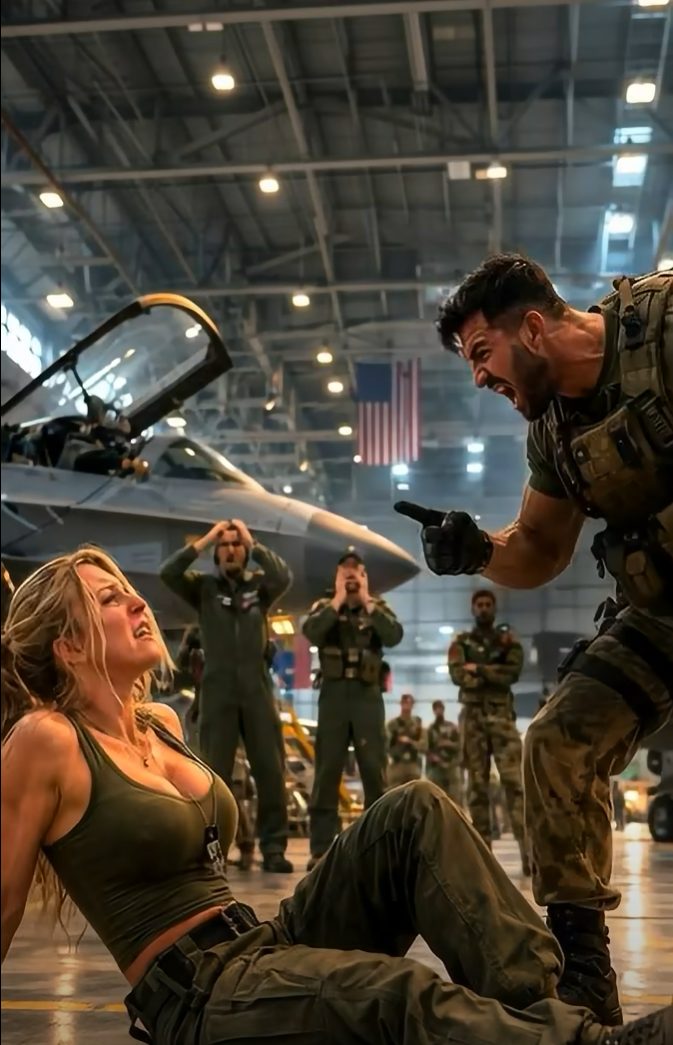
Hangar 9 was the kind of place where every sound carried authority. Hydraulic carts rattled across polished concrete, technicians spoke in clipped code, and a row of armed security personnel stood near the sealed testing bay as if they were guarding a crown jewel. In a way, they were. Inside the bay rested the XR-12 Specter, an experimental hypersonic fighter built around a classified propulsion system that had already consumed years of money, politics, and careers.
Dr. Elena Voss stood beneath its left intake, studying diagnostic data on a rugged tablet while manually checking a sensor housing with a torque tool. In plain coveralls, with her dark hair tied back and safety glasses slipping down her nose, she looked less like the architect of one of the most advanced airframes in the country and more like a quiet systems librarian no one bothered to notice.
Then Major Damon Cross arrived.
He came in with two younger pilots and the swagger of a man who had been praised too often and corrected too rarely. Damon was the program’s star test pilot – fast, decorated, handsome, and fully convinced that instinct could outrun engineering. When he saw Elena kneeling near the landing strut, he slowed just long enough to sneer.
“Who let the archive clerk onto my flight line?”
A few of the younger pilots laughed. Elena rose calmly and told him not to touch the aircraft until calibration was finished. Damon brushed past her shoulder hard enough to knock her sideways into a tool cart. Metal clattered across the floor. Several technicians froze, but no one stepped in.
Elena steadied herself and looked straight at him. “The inertial dampening array is misaligned by one-thousandth of a micron. If you push beyond Mach 4 before it’s corrected, the resonance spike will hit the cockpit. You’ll black out in under three seconds.”
Damon gave a humorless smile. “I trust flight hours more than decimal points.”
He started toward the ladder.
Before he could climb, the hangar doors on the far side opened and Brigadier General Nathan Voss entered with program officials and two civilian observers. His timing silenced the room instantly. Without acknowledging Damon’s protest, he ordered the pilot away from the aircraft and redirected everyone to the simulator chamber for the day’s qualification event: Needle Thread, the project’s most difficult high-speed scenario, a compression-corridor run no pilot had ever completed cleanly.
Damon welcomed the challenge. In front of everyone, he strapped into the simulator, smirked at Elena through the canopy glass, and launched.
For the first minute, he looked brilliant. Then came the bottleneck segment. The vibration profile shifted. Warning tones stacked. The digital Specter began to shudder exactly where Elena had said it would. Damon fought the controls, overcorrected, lost orientation, and slammed the simulated aircraft into the canyon wall in a burst of red across every screen.
The room fell dead silent.
Then General Voss turned – not to Damon, not to the senior pilots, but to Elena.
“Your turn, Doctor.”
Damon stared at him in disbelief. The younger pilots looked confused. Elena set down her tablet, walked toward the simulator without a trace of triumph, and placed one hand on the cockpit rail.
No one in that room was prepared for what was about to happen next.
Because the woman Damon had mocked in front of the entire hangar was not there to take notes.
She was there because the aircraft existed in the first place.
And within minutes, both Damon’s career and the entire culture of the program were about to crack wide open….
What Damon Didn’t Know About the Woman He Shoved
The XR-12 Specter had been Elena’s idea. Not the program. Not the contract. The actual physics.
She’d written the propulsion theory in 2019 as a thirty-four-page internal paper for the Advanced Systems Group at Edwards, the kind of document that gets passed around quietly, then suddenly appears in a classified briefing with other people’s names on the cover. That had happened too. She’d watched a colonel present her compression-corridor model to a room full of generals and take seventeen minutes of questions without once mentioning her name. She’d been sitting in the third row.
She didn’t make a scene. She went back to her desk and kept working.
That was Elena’s particular quality – the patience that looked like invisibility. She’d grown up in Tucson, daughter of a machinist and a math teacher, and she’d learned early that the people who shouted in rooms rarely understood what the rooms were built on. She had a doctorate in aerospace propulsion from Caltech and a second one, unfinished, in computational fluid dynamics that she’d quietly abandoned when the Specter project went live and ate her entire life.
She was thirty-nine years old.
She’d been working on this aircraft for six years.
Damon Cross had been attached to the program for eleven weeks.
He was a genuinely exceptional pilot. Nobody disputed that. Three combat deployments, two commendations, an emergency landing on a carrier deck in the South China Sea that was still being taught in training programs. He had the kind of reflexes that made other pilots slightly envious and the kind of face that made program directors feel comfortable putting him in front of cameras.
He also had the habit – common in men who’ve been exceptional at one hard thing – of assuming the habit transferred. That being good at flying made him good at understanding flight. That the aircraft existed to serve his instincts rather than the other way around.
He’d walked into Hangar 9 eleven weeks ago and immediately started calling it his flight line.
Nobody had corrected him.
Until now.
The Simulator
Elena climbed in without ceremony. She adjusted the seat, checked the restraint fittings herself rather than waiting for the tech, and put her hands on the controls the way someone picks up a tool they’ve used ten thousand times.
Because she had. Not in the simulator. In the design software. In the fluid models. In the stress analysis that had consumed six months of her life when the original airframe kept cracking at the compression seam. She knew what the Specter felt like before it existed. She’d built its nervous system out of equations.
She put on the helmet. The display lit up.
Damon was still standing near the back wall, arms crossed. One of the younger pilots, a lieutenant named Garret Fitch, leaned over and whispered something. Damon didn’t respond. He was watching Elena with the focused attention of a man who badly needed her to fail.
The simulation launched.
Needle Thread started easy. Always did. A broad corridor at Mach 2.8, plenty of margin, the kind of entry that made pilots feel comfortable right before the canyon walls closed in. Elena flew it flat and clean, no unnecessary corrections, no showing off. She was reading the aircraft, not performing.
At the two-minute mark, the corridor began to compress.
Mach 3.4. The walls on either side of the digital canyon started coming in at seven-degree angles, and the ceiling dropped, and the turbulence profile shifted from smooth to what engineers called “corrugated” – a layered oscillation that had killed the previous simulation record holder at exactly this point. You couldn’t muscle through it. You had to read the wave pattern and find the frequency that let the aircraft ride it rather than fight it.
Damon had fought it.
Elena waited. Three seconds. Four. The aircraft shuddered once, hard, and she let it. Didn’t correct. Didn’t grab for the stick. Just let the shudder pass through and found the other side of it.
Then she flew.
The screens showed Mach 4.1 through the bottleneck. The compression spike that had knocked Damon out registered on the instruments – it was real, it was there – but at the angle she’d threaded the corridor, it hit the airframe’s lateral surface instead of the cockpit, exactly as the design intended when the dampening array was properly calibrated.
One-thousandth of a micron.
She came out the other side of the canyon clean, bled off speed in a controlled arc, and brought the simulated Specter to rest at the designated exit point.
Total run time: four minutes, eleven seconds.
Damon’s run had lasted two minutes, forty seconds.
The room was very quiet.
General Voss uncapped a pen and wrote something in his notebook. The two civilian observers were both leaning forward. One of them, a woman from the procurement office named Carol Briggs, had her hand over her mouth.
Elena pulled off the helmet. Her hair had come half out of its tie. She didn’t fix it.
What Happened in the Debrief
The debrief was supposed to be a standard post-simulation review. It became something else.
General Voss ran it himself, which was unusual. He sat at the head of the table in Conference Room C, and he went through the run data point by point, and every time he referenced a design decision – the dampening array, the compression-corridor geometry, the cockpit resonance threshold – he looked at Elena and said “your work” or “your model” or, once, simply “hers.”
Damon sat three seats down and said almost nothing.
At one point, Voss pulled up the original propulsion paper from 2019. The one with other people’s names on the cover. He put it on the screen and read the acknowledgments section, which was two lines long and mentioned Elena as a “contributing analyst.”
He let that sit for a moment.
“Dr. Voss,” he said, “for the record. Who wrote this paper?”
“I did.”
“All of it?”
“The propulsion model, the corridor geometry, and the resonance analysis. Yes.”
Voss nodded slowly. He looked at the program director, a civilian named Bob Healy who had gone the color of old paper. “Bob, I want a full authorship review of every document in this program going back to 2019. On my desk by Friday.”
Bob said “yes, sir” very quietly.
Then Voss turned to Damon.
He didn’t raise his voice. Generals of a certain type don’t need to. He said: “Major Cross. You made physical contact with a civilian program lead during an active calibration procedure. You disregarded a direct safety warning from the aircraft’s designer. And you flew a Mach 4-plus simulation with an uncorrected dampening error you were explicitly told about.”
Damon opened his mouth.
Voss kept going. “You want to tell me which of those three things you’d like to defend first?”
Damon closed his mouth.
The debrief ended twenty minutes later. Damon left the room without looking at Elena. Garret Fitch, the younger pilot who’d been whispering to him during the simulation, held the door and gave Elena a look she couldn’t quite read. Not quite an apology. Not quite admiration. Something in between, from someone who was only now recalculating.
She’d seen that look before.
After
They grounded Damon from the Specter program that afternoon. Pending review, officially. The kind of pending review that, in practice, means permanently.
He wasn’t drummed out of the Air Force. He had too many commendations for that, and the institution has its own inertia. He was reassigned to a training command in Nevada, which is where decorated pilots go when someone needs them to stop being visible. He didn’t fight it. Maybe he understood what had happened. Maybe he just understood that the aircraft had already exposed him, the way Elena said it would.
She never spoke to him directly again.
The authorship review that General Voss ordered took three weeks and produced a forty-page report that was, by all accounts, deeply uncomfortable reading for several senior people in the program. Two names were removed from the 2019 paper’s cover and replaced with one. Corrections were filed with the program’s official record.
Elena’s name appeared at the top.
She was at her workbench in Hangar 9 when Carol Briggs from the procurement office walked over and showed her the corrected document on a tablet. Elena looked at it for a moment. Her name. Her work. Her aircraft.
She handed the tablet back.
“The forward sensor cluster still needs recalibration,” she said. “The left intake’s reading two degrees off ambient.”
Carol looked at her. “That’s it? That’s all you have to say?”
Elena picked up her torque tool. “I’ve been saying it for six years. I’m used to it.”
She went back to work.
The Specter’s first real flight test was scheduled for March. Elena would be in the control room for every second of it, watching data streams that only she fully understood, in the plain coveralls, with her hair tied back, looking like someone no one needed to notice.
The aircraft would know who built it.
That had always been enough.
—
If this one got under your skin, pass it to someone who needs to read it.
For more tales of unexpected power and quiet strength, check out how My Corner Booth at Anchor Point Wasn’t Empty – It Was a Trap or the story of The Woman They Grabbed in the Parking Lot Wasn’t Who Anyone Thought She Was. And don’t miss the time I Had No Rank on My Sleeve. The Monitor Knew My Name.



