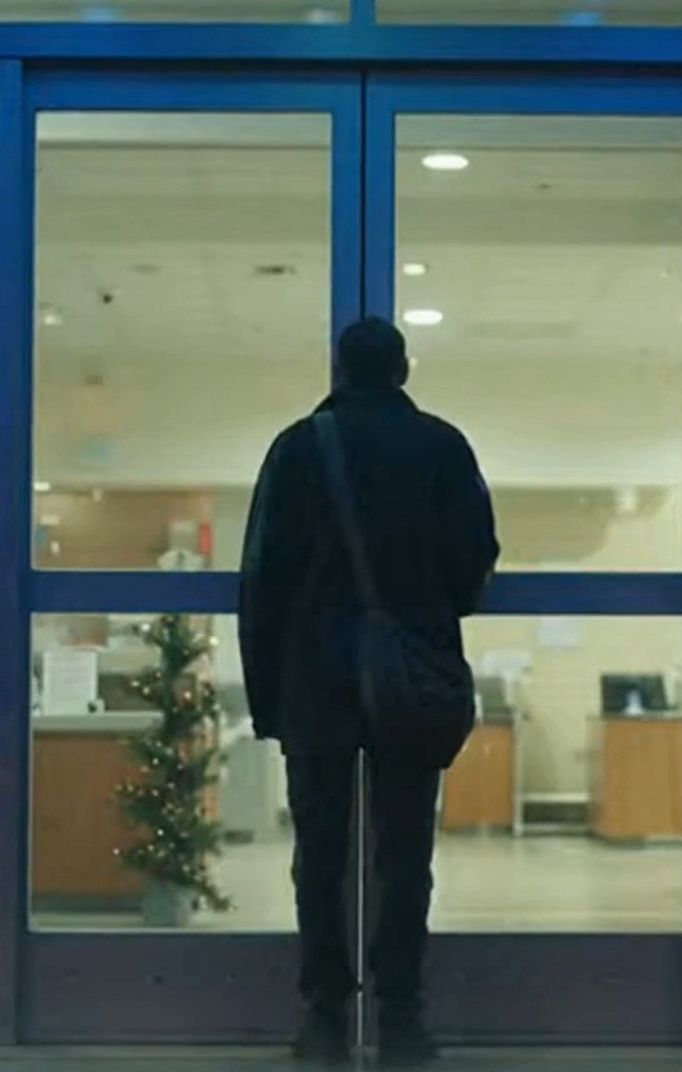
The rain had been falling for three days straight when Robert Miller finally made it to the VA hospital entrance. His boots were soaked through, the cardboard insoles disintegrated hours ago, and his Army jacket – the only thing he’d kept from his service – hung heavy with water.
He’d walked eleven miles from the underpass where he’d been sleeping. Eleven miles with a cough that wouldn’t quit and a fever that made the city lights blur like watercolors.
The automatic doors didn’t open for him. He stood there, swaying, watching families walk past. A woman pulled her daughter closer. A man in scrubs looked right through him.
“Sir, you can’t stand here.” A security guard appeared. Young kid, maybe twenty-two. “You’re blocking the entrance.”
“I just need…” Robert’s voice cracked. When was the last time he’d spoken to anyone? Tuesday? “I just need to see a doctor. I’m a veteran. I served – “
“The clinic’s closed for the day. Come back tomorrow.”
“Please.” The word felt foreign in his mouth. Forty years ago, he’d never begged for anything. Forty years ago, he’d carried wounded men through jungle heat. “I don’t think I can make it until tomorrow.”
The guard’s radio crackled. He stepped back, annoyed. “Look, there’s a shelter on Fifth Street. They got beds.”
Robert’s knees buckled.
The concrete was cold against his cheek. He could hear voices above him—alarmed now, calling for help. His vision tunneled. Through the haze, he saw his sleeve had ridden up, exposing the faded ink on his forearm. The eagle. The date. The unit number that meant nothing to anyone anymore.
Running footsteps. Someone in a white coat pushing through the crowd.
“Get him inside! Now!” A woman’s voice, sharp with authority.
Hands lifted him onto a gurney. Fluorescent lights streamed past overhead. The woman doctor was barking orders—IV, chest X-ray, core temperature—but then she stopped. Her hand grabbed his arm.
“Wait.” Her voice changed. Softer now. Almost breaking. “Wait.”
She was staring at his tattoo. The eagle. The date. The unit number.
Robert tried to focus on her face. She was maybe sixty, silver hair pulled back, reading glasses hanging from a chain around her chain. And on her left hand, a ring he recognized. A simple gold band with a small sapphire.
His wife had had the same ring. The one he’d bought in Saigon. The one he’d slipped on Sarah’s finger in 1972, right before his second tour.
The doctor’s hands were trembling now.
“Dad?” Her voice cracked. “Daddy?”
The last time he’d seen his daughter, she’d been fourteen years old, standing in the driveway as he drove away to get help for demons that had no name back then. He’d written letters. They’d come back unopened. He’d called. The number had changed. Eventually, he’d stopped trying. Eventually, the bottle had won.
Forty-one years.
She was crying now, this stranger in a white coat, this doctor who’d saved countless lives, this woman who’d grown up without him.
“I looked for you,” she whispered. “I looked for you everywhere.”
The security guard stood frozen in the doorway. Nurses had stopped mid-step. The waiting room had gone silent.
Robert opened his mouth to speak, to apologize, to explain, to beg forgiveness for four decades of absence and silence and shame. But before he could form the words, his daughter—his little girl, his Elizabeth—pressed her forehead to his chest and said the three words he’d never expected to hear again:
“I found you.”
His heart monitor beeped steadily as she lifted her head, tears streaming down her face, and reached for his chart. Her hand hesitated over the line marked “Emergency Contact.”
“I need to call someone,” she said, her voice barely a whisper. “Dad, there’s something you need to know about—”
The door burst open. A young man in his twenties rushed in, out of breath, still wearing his medical school ID badge. He had Robert’s eyes. Robert’s jaw. Robert’s hands.
Elizabeth turned to face him, and the young man’s gaze landed on the old veteran in the bed.
“Grandpa?” The word hung in the air. “Mom, is that…”
Robert’s world tilted again, but this time it wasn’t the fever. He stared at the young man, at the ghost of his own youth staring back at him. A grandson. He had a grandson.
Elizabeth wiped her eyes with the back of her sleeve, her composure as a doctor fighting a losing battle with the emotions of a daughter. “Daniel, this is… this is your grandfather. Robert.”
Daniel took a hesitant step forward, his eyes wide with a mix of shock and something else Robert couldn’t decipher. Pity? Disbelief?
“I don’t understand,” Daniel said, looking from his mother to the gaunt, weathered man on the gurney. “I thought he was… gone.”
The word hung in the air, a polite substitute for the truth they had all believed. Dead.
“I thought so too,” Elizabeth admitted, her voice thick. She placed a hand on Daniel’s shoulder, a grounding gesture for them both. “I was wrong.”
Robert felt a fresh wave of shame wash over him. His grandson’s first image of him was this: a broken, sick, homeless man. A failure. He tried to pull his arm away, to hide the tattoo that had brought them all crashing together.
But Elizabeth’s grip was firm. “Don’t,” she said softly. “Don’t you dare hide from us now.”
Nurses began to move again, their professional instincts kicking in. They wheeled him into a private room, a quiet space away from the chaos of the ER. Daniel followed, never taking his eyes off Robert.
Once Robert was settled, a nurse gently cleaned the grime from his face and hands. Elizabeth took over, checking his vitals herself, her touch both clinical and profoundly personal.
“You have severe pneumonia,” she said, her doctor-voice a thin shield. “And you’re badly malnourished. We’re going to get you on strong antibiotics and nutrients.”
Robert just nodded, unable to speak past the lump in his throat.
Daniel pulled up a chair and sat by the bed. “Mom told me about you. She told me you were a hero in the war.”
The word “hero” felt like a punch to the gut. “I wasn’t a hero,” Robert rasped. “Heroes come home and stay.”
A heavy silence filled the room. It was Daniel who broke it.
“She never gave up on you,” he said quietly. “Every few years, she’d hire a new private investigator. She’d search the VA databases. She always said she just had a feeling.”
Elizabeth came to stand beside her son. “I had to know what happened. And your grandmother… she never stopped believing you were out there somewhere.”
Robert’s head snapped up. His heart hammered against his ribs. “Sarah? Your mother… she’s…?” He couldn’t finish the sentence. He’d assumed she remarried, moved on, or worse. The guilt of it had been his constant companion.
“She’s alive,” Elizabeth said, and her expression softened with a deep, complicated sadness. This was what she’d been trying to tell him. “She’s alive, Dad.”
Relief was a tidal wave, so powerful it almost knocked the breath from his lungs. Sarah was alive. The one pure, good thing in his life was still in the world.
“Where is she?” he asked, his voice urgent. “I need to see her. I need to tell her I’m sorry.”
Elizabeth took a deep breath. “It’s not that simple. She has Alzheimer’s. She’s been in a memory care facility for the last five years.”
The hope that had flared so brightly in his chest flickered and dimmed. Alzheimer’s.
“Some days are good,” Elizabeth continued, seeing the devastation on his face. “Some days she remembers me, she remembers her childhood. She even remembers the war.”
“Does she remember me?” The question was a whisper.
“She asks for you,” Elizabeth said, her eyes welling up again. “On her good days, she asks when Sergeant Miller is coming home from his tour. She’s been waiting for you, Dad. All this time, she’s been waiting.”
The weight of forty-one years came crashing down on Robert. He hadn’t just abandoned his daughter. He had abandoned his wife, the woman who was still, in the fragmented corners of her mind, waiting for him to walk through the door.
He closed his eyes, and the sterile hospital room faded away. He was back in that dusty driveway in 1974, Elizabeth’s tear-streaked face in the rearview mirror. He was going to a facility, a place for vets with “battle fatigue.” He’d promised he’d be back in a month.
But the demons were louder than his promises. The things he’d seen, the things he’d done… they followed him out of the jungle and into his dreams. The treatment didn’t work. The shame was a physical thing, a monster on his back. How could he return to his perfect family when he was so broken, so dirty inside?
He started drinking to quiet the noise. The drinking led to lost jobs. Lost jobs led to arguments. One day, he packed a bag, convinced they would be better off without him poisoning their lives. He thought it would be temporary. But days turned into weeks, weeks into years, and the chasm between the man he was and the man they deserved grew too wide to cross.
“I… I thought you’d be better off,” he finally managed to say, the words tasting like ash. “I was no good for anyone.”
“That wasn’t your decision to make!” Elizabeth’s voice was sharp with decades of pent-up anger and hurt. “You didn’t give us a choice. You just vanished.”
“I’m sorry,” he wept, the words he’d rehearsed in his mind a million times finally being spoken. “I am so, so sorry.”
Daniel placed a hand on his grandfather’s arm. It was a simple touch, but it felt like an anchor. “Mom,” Daniel said gently. “He’s here now.”
Elizabeth’s shoulders sagged. She nodded, the anger receding, replaced by a profound exhaustion. She pulled another chair close, and for the next hour, they sat in the quiet of the hospital room, a broken family taking the first tentative steps toward putting the pieces back together.
Later that evening, the young security guard who had told Robert to leave knocked softly on the door. His name was Thomas. His face was pale, and he was wringing his hands.
“Dr. Miller?” he said to Elizabeth. “Can I have a word?”
She stepped into the hallway. “If this is about what happened at the entrance—”
“It is,” he interrupted, his voice trembling slightly. “I’m so sorry. I had no idea. I was just following procedure.”
“He was a veteran in clear medical distress,” Elizabeth said, her tone icy. “Procedure should have been to get him help, not send him to a shelter.”
“I know. You’re right. There’s no excuse,” Thomas said, looking at the floor. “But there’s something else. My supervisor told me the patient’s name. Robert Miller.”
Elizabeth just stared at him, waiting.
“My grandfather served in Vietnam,” Thomas continued. “He was in the 101st Airborne. He passed away a few years ago, but he used to tell stories. He had this one story about being pinned down in the A Shau Valley. His whole platoon was in trouble.”
Thomas looked up, his eyes meeting Elizabeth’s.
“He said a sergeant named Miller, a guy everyone called ‘Rock,’ ran through open fire three times to pull wounded men back to the line. My grandfather was one of them. Sergeant Miller saved his life.”
Elizabeth felt the air leave her lungs. “My father’s nickname in the Army… it was Rock.”
Thomas nodded, a tear tracing a path down his cheek. “I turned away the man who saved my grandfather’s life. I told him to go sleep in the rain.”
The next day, Robert was feeling stronger. The antibiotics were fighting the infection, and the food, simple hospital broth and bread, felt like a feast. Daniel had stayed with him through the night, dozing in the uncomfortable chair.
He’d asked Robert questions. Not about why he left, but about his life. What was his favorite color? Did he like baseball? What was Grandma Sarah like when she was young?
Robert answered them all, his rusty voice growing stronger with each memory he shared. He spoke of Sarah’s laugh, how it sounded like wind chimes. He talked about teaching a five-year-old Elizabeth to ride a bike. Small, simple moments of a life he had forfeited.
When Elizabeth arrived that afternoon, she brought a bag of new clothes—soft sweatpants, a warm sweater, and a real pair of shoes. She also brought a photo album.
She sat on the edge of his bed and opened it to the first page. There was Robert, young and proud in his uniform, his arm around a smiling Sarah. He looked like a different person, full of hope and certainty.
They went through the pages slowly. Elizabeth’s high school graduation. Her wedding day, a photo of her being walked down the aisle by an empty space that should have been filled by him. The birth of Daniel. Holidays. Birthdays. An entire life he had missed.
It was painful, a catalog of his failures. But it was also a gift. He was seeing the woman his daughter had become, the man his grandson was.
A few days later, Robert was discharged from the hospital. Not to the street, but to Elizabeth’s home. He walked out of the automatic doors that had refused to open for him just days before, flanked by his daughter and grandson. Thomas, the young security guard, was there. He just nodded at Robert, a look of profound respect and apology in his eyes. Robert nodded back.
The trip to Elizabeth’s house was surreal. Quiet suburbs, green lawns, kids riding bikes. It was the world he had left behind.
The final piece of his journey, the one he dreaded and yearned for in equal measure, was to see Sarah.
Elizabeth drove him to the memory care facility the following week. He was clean, shaved, and wearing the new clothes she’d bought him. He looked in the rearview mirror and saw a stranger. An old man with his daughter’s eyes.
The facility was bright and clean, but it smelled of antiseptic and regret.
“Are you ready?” Elizabeth asked at the door to the common room.
Robert could only nod.
Sarah was sitting in a comfortable armchair by a window, looking out at a garden. Her hair was snow-white, her face lined with a gentle grace. She didn’t look at them as they approached.
“Mom,” Elizabeth said softly, kneeling beside her chair. “I’ve brought someone to see you.”
Sarah turned her head slowly. Her blue eyes, a bit cloudy now, scanned Elizabeth’s face with faint recognition. Then they moved to Robert.
There was nothing. Just a polite, vacant gaze.
Robert’s heart sank. He was too late. The woman he loved was gone, and this gentle stranger was all that was left.
He knelt beside Elizabeth, his old knees protesting. He took Sarah’s frail, spotted hand in his. It felt small and delicate.
“Sarah,” he said, his voice cracking. “It’s me. It’s Robert. I’m home.”
She looked at him, a flicker of confusion in her eyes. “Robert?” she repeated, the name an echo. “My Robert is fighting overseas. He’s a sergeant.”
“I was,” Robert said, tears blurring his vision. “But the war is over, Sarah. It’s been over for a long, long time. I’m home now. I’m so sorry it took me so long.”
He brought her hand to his lips and kissed her knuckles, just as he had done a lifetime ago. He began to hum, a tuneless, quiet melody. It was the song she’d always loved, the one they’d danced to at their wedding.
Sarah’s gaze sharpened. Her eyes focused on his face, truly seeing him for the first time. Her hand tightened in his. A slow, beautiful smile spread across her face, erasing the years and the confusion.
“You came back,” she whispered, her voice a fragile thing. “I knew you would.”
He hadn’t fixed the past. He couldn’t erase the forty-one years of pain and absence. But in that moment, none of it mattered. He was no longer a ghost or a failure. He was just a man who had finally found his way home.
Robert didn’t get a miracle cure for his past, and Sarah’s memory remained a fragile, shifting thing. But his life found a new purpose. Every day, he went to see her. Some days, she knew him as her husband. Other days, he was just a kind man who held her hand and told her stories about a brave sergeant who loved a girl with eyes the color of the sky. He became a grandfather to Daniel, teaching him how to fix a leaky faucet and telling him the stories about his service that he’d never been able to tell anyone else. He found peace not in forgetting his past, but in building a future, one small, precious day at a time.
The deepest wounds are often the ones no one can see, carried silently for years. But the story of Robert Miller is a quiet reminder that it is never too late. It’s never too late to be found, to ask for forgiveness, or to come home. The road back may be long and paved with regret, but the journey is always worth taking, because love, in its purest form, has a memory all its own.