
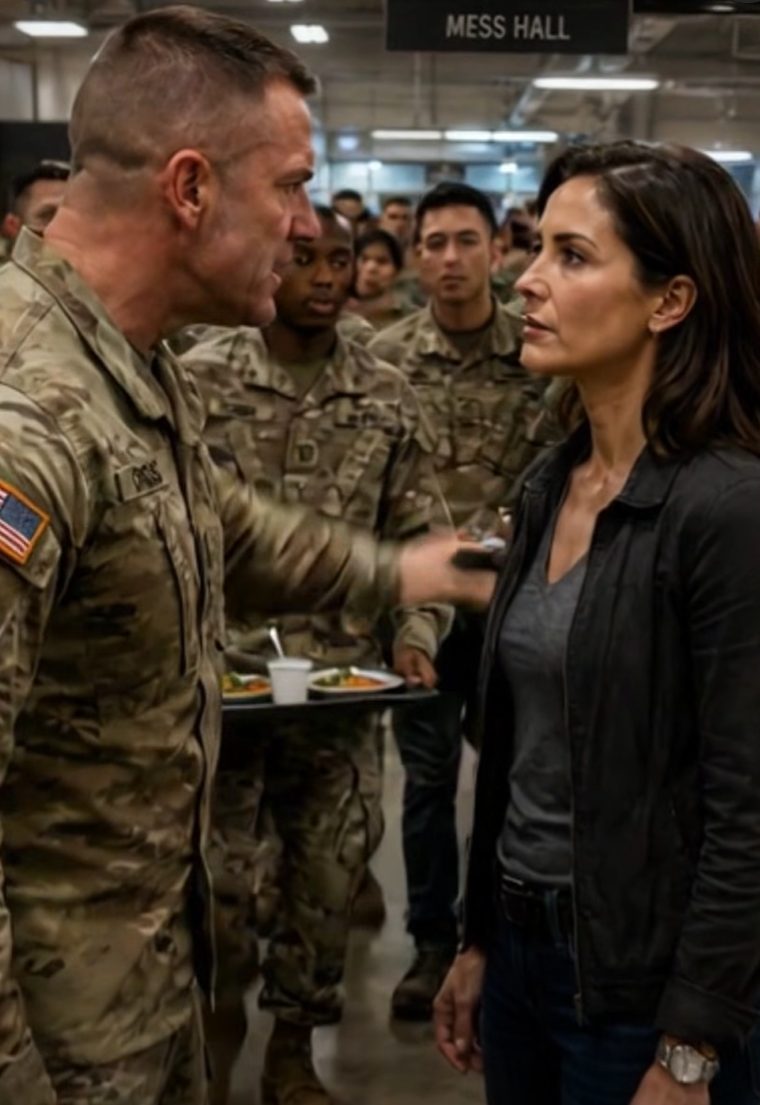
No one in the mess hall noticed the woman at first – and that was exactly why everything that followed hit like a grenade.
By 6:10 that morning, Rock Ridge Training Facility was already fully alive. Boots dragged over concrete in tired, rhythmic bursts. Metal trays slammed against rails. Voices overlapped in the dull, familiar hum of people running on too little sleep and too much routine. Nothing about the morning felt unusual. It was another day, another line, another chance for someone higher up the chain to remind everyone else where they stood.
And no one embodied that system more completely than Sergeant First Class Damian Cross.
Cross was known across the base for one thing: discipline. Not the inspiring kind that earned respect naturally, but the cold, punishing version that made people straighten their backs the second he appeared. His uniform was always perfect. His commands were always sharp. His patience was famously nonexistent. To some, he was efficient. To many more, he was brutal in ways he didn’t need to be.
In the center of the serving line, he stood like a gatekeeper, watching every movement with narrowed eyes, making sure no rule – spoken or unspoken – was broken under his watch.
That was when the woman stepped forward.
She looked completely out of place, at least at first glance. No uniform. No insignia. No polished boots. Just civilian clothes: a dark jacket, jeans, and an expression so calm it somehow made her stand out even more. She wasn’t loud. She wasn’t demanding attention. If anything, she carried herself with a quiet ease that didn’t match the tension of the room.
To the soldiers nearby, she was just one thing: someone who didn’t belong.
Cross spotted her instantly.
“Hold it,” he barked, stepping in front of her before she could reach the counter.
The command cracked through the cafeteria noise like a rifle shot. Conversations slowed. A few heads turned. Several soldiers lowered their eyes to their trays, pretending not to watch.
“This line is for active personnel,” Cross said, each word clipped and hard.
The woman stopped. She looked at him, not startled, not embarrassed – just steady.
For a moment, she said nothing.
That silence only seemed to irritate him more.
Around them, the room subtly shifted. People sensed something unfolding, though no one could yet tell exactly what. The kitchen staff froze behind the counter. A private near the drink station stopped mid-pour. Even the usual clatter of silverware seemed to fade under the weight of what was quickly becoming a scene.
The woman still didn’t move.
Cross took another step forward, invading her space with the full force of his authority. “You heard me. Move aside.”
A lesser person might have apologized. Might have backed away. Might have explained themselves in a rush just to ease the tension. But she didn’t do any of that. She simply remained where she was, composed, unreadable, as if she had seen men like him a thousand times before and knew exactly how they worked.
That unsettled him more than open defiance would have.
“You think the rules don’t apply to you?” he snapped, louder now, making sure the room heard it. “Because around here, everybody answers to someone.”
A few soldiers exchanged glances. Nobody spoke.
Then, in one sharp movement born from irritation, ego, and the certainty that no one would dare challenge him, Damian Cross shoved her away from the line.
Gasps cut through the room.
The woman staggered half a step – but did not fall.
And then, for the first time, her face changed.
Not with fear. Not with anger.
With recognition.
She slowly reached into her jacket.
Someone near the back whispered, “Oh no…”
Cross straightened, ready to keep going, still certain he controlled the moment.
But the instant she pulled out what was inside and lifted her eyes to meet his, the entire mess hall seemed to stop breathing.
Because in that second, every person in the room realized the same horrifying truth at once – Damian Cross had just laid hands on the one person on that base who outranked every single one of them.
What She Pulled Out
It was a credential wallet. Black. Small. Worn at the corners in the way things get worn when they’ve been carried for a long time.
She flipped it open.
The ID inside had a photograph, a name, and a title. The title is what made the room go cold.
General. Two stars.
Not a retired general. Not a consultant. Not some civilian liaison with a fancy job description that nobody really understood. A sitting, active-duty, two-star general named Patricia Holt, currently assigned to the Pentagon’s Readiness and Training Division, who had driven four hours from D.C. that morning specifically to conduct an unannounced inspection of Rock Ridge.
Unannounced. That was the word that would haunt Cross for the rest of his career.
She’d done it on purpose. The civilian clothes, the quiet entry, the lack of escort. She’d walked in through the main gate with a single aide who’d been told to hang back. She wanted to see the facility raw, before anyone had a chance to polish it. Before the flags got straightened and the coffee got fresh and the sergeants remembered to smile.
She’d been watching Cross for four minutes before he ever noticed her.
And she’d seen everything.
What Cross Did Next
To his credit – and it is the only credit he gets in this story – he didn’t try to talk his way out of it.
Some men would have. Some men would have launched into an explanation, cited regulations, claimed he hadn’t seen the ID clearly, done the verbal equivalent of throwing spaghetti at a wall and hoping something stuck. Cross wasn’t that kind of man. Whatever else he was, he wasn’t a liar.
He stood there for a long three seconds. Jaw tight. Eyes fixed on the credential.
Then he snapped to attention so hard his heels cracked together.
“Ma’am.” His voice came out flat and stripped of everything that had been in it thirty seconds ago. “Sergeant First Class Damian Cross. I – “
“I know who you are,” she said. Not cold. Not theatrical. Just a statement.
She closed the wallet and slid it back into her jacket. Then she picked up a tray from the stack at the end of the counter, moved past him without another word, and got herself a cup of coffee and two pieces of toast.
She sat down at an empty table near the window.
Cross remained at attention.
Nobody told him to stand down.
For about forty-five seconds, nobody in the room did anything at all.
The Aide Nobody Noticed
His name was Corporal Dennis Pruitt, and he’d been standing near the entrance the whole time, nursing a cup of bad coffee and trying to look like he wasn’t watching.
He was twenty-three. He’d been General Holt’s aide for eleven months. In that time he’d watched her walk into three other facilities unannounced, and each time something like this had happened – not the physical part, that was new, that was worse – but the part where someone with too much local authority and too little self-awareness decided she was a problem to be managed.
He’d learned not to intervene. She didn’t want him to. She’d told him directly, the first week: If someone gives me trouble, you let it run. I need to see what runs.
So he’d let it run.
He watched Cross shove her. He watched her catch her balance. He watched her pull the credential. And then he quietly set down his coffee, pulled out his phone, and sent a single text to the general’s chief of staff back in D.C.
It happened again. Worse this time. Physical contact.
The reply came back in forty seconds.
Document everything.
Pruitt already was.
What the Room Did
The soldiers in that mess hall were not stupid people. They were tired, underpaid, and operating on institutional autopilot, but they weren’t stupid. The second the credential came out, the math was obvious to all of them.
The question was what to do with that math.
A staff sergeant named Greg Farrow, who’d been sitting three tables back and had watched the whole thing from start to finish, later said it felt like watching a car accident in slow motion. You could see it coming. You could see every second of it. And there was nothing you did, because doing something would have meant admitting you’d seen Cross operate this way before and never said a word.
That was the part nobody wanted to sit with.
Cross hadn’t invented his behavior that morning. He’d been running the mess hall line the same way for two years. Everyone knew it. The way he talked to junior enlisted. The way he used his size and his rank to compress people into smaller versions of themselves. The shove was new, yeah. But the dynamic that produced it wasn’t.
Farrow pushed his eggs around his plate for a while and didn’t eat any of them.
At the table near the window, General Holt ate her toast and drank her coffee and watched the room with the same expression she’d walked in with.
Calm. Patient. Paying attention.
The Inspection
It lasted six hours.
Holt moved through Rock Ridge methodically, Pruitt two steps behind her with a notepad and a tablet. She talked to people. Not the officers first, the way these things usually went. She started with a group of privates doing equipment maintenance in the south bay. Then a pair of cooks on break behind the kitchen. Then three women from signals who’d been at the facility for eighteen months and hadn’t been formally evaluated once.
She had a way of asking questions that didn’t feel like questions. More like she was just curious. More like she had time, which she didn’t, but she made it feel that way.
By noon, she’d filled two pages of handwritten notes and Pruitt had logged fourteen separate observations on his tablet.
Cross had been relieved of his duties pending review by 9 a.m. A major named Steph Kowalski had been pulled in to cover the rest of his shift. Kowalski was quiet and competent and had the kind of face that suggested she’d been waiting for this particular morning for a while.
She didn’t say that. But her face said it.
What Happened to Cross
The official outcome took three weeks.
Formal reprimand. Reduction in responsibilities. Mandatory review board. The physical contact with a superior officer was the headline charge, but the board didn’t stop there. Once they started looking, they found a pattern that eleven people had documented in personal journals, text messages, and one formal complaint that had somehow died in a filing system nobody could fully account for.
Cross didn’t lose his rank. That surprised some people. It shouldn’t have. The military’s relationship with accountability is complicated, and one incident – even a bad one, even a witnessed one – rarely ends a career outright. What it does is mark it. Redirect it. Make certain doors close quietly and permanently.
He was reassigned to a logistics coordination role at a depot in Kentucky. Administrative. No command authority over personnel. A desk, a computer, and a job that required him to talk to spreadsheets instead of people.
Whether that counts as justice depends on who you ask.
The privates in the south bay probably had one answer. Farrow, still pushing eggs around a plate in his memory, probably had another.
What She Left Behind
Before General Holt left Rock Ridge that afternoon, she did one thing nobody expected.
She went back to the mess hall.
It was nearly empty by then. The lunch service was winding down. A couple of soldiers lingered over coffee. A kid who couldn’t have been more than nineteen was mopping the floor in long, slow arcs near the drink station.
Holt walked to the counter, got a second cup of coffee, and sat down again at the same table by the window.
Pruitt stood near the door, giving her space.
She sat there for maybe ten minutes. Just drinking coffee and looking out the window at the training yard, where a group of soldiers was running drills in the gray November light.
Nobody bothered her. Nobody pretended not to notice her, either, which was different from the morning. In the morning she’d been invisible because she looked like she didn’t belong. Now she was visible in a way that had nothing to do with the credential in her jacket.
She finished the coffee. Set the cup down.
Stood up, put on her jacket, and walked out.
The kid with the mop watched her go. He’d been there that morning. He’d seen the whole thing from behind the drink station, frozen mid-pour.
He went back to mopping.
Outside, the drills kept going. Boots on concrete. Commands cutting through cold air. The facility running exactly the way it was supposed to run, or close enough that the difference would take a long time to measure.
But something had shifted. You could feel it even if you couldn’t name it. The way a room feels different after a window gets opened, even after the window gets closed again.
The air had changed.
—
If this one got under your skin, pass it to someone who needs to read it.
If you’re looking for more incredible stories, you won’t want to miss “The Old Man in the Faded Jacket Stepped to the Line and I Stopped Breathing” for a tale that silenced Fort Bragg, or “She Asked “May I Take A Turn?” – The SEALs Went Quiet” to see how an unexpected visitor left the SEALs speechless. And for another jaw-dropping moment, check out “She Was Just an Analyst. Then She Said the Number.”



