
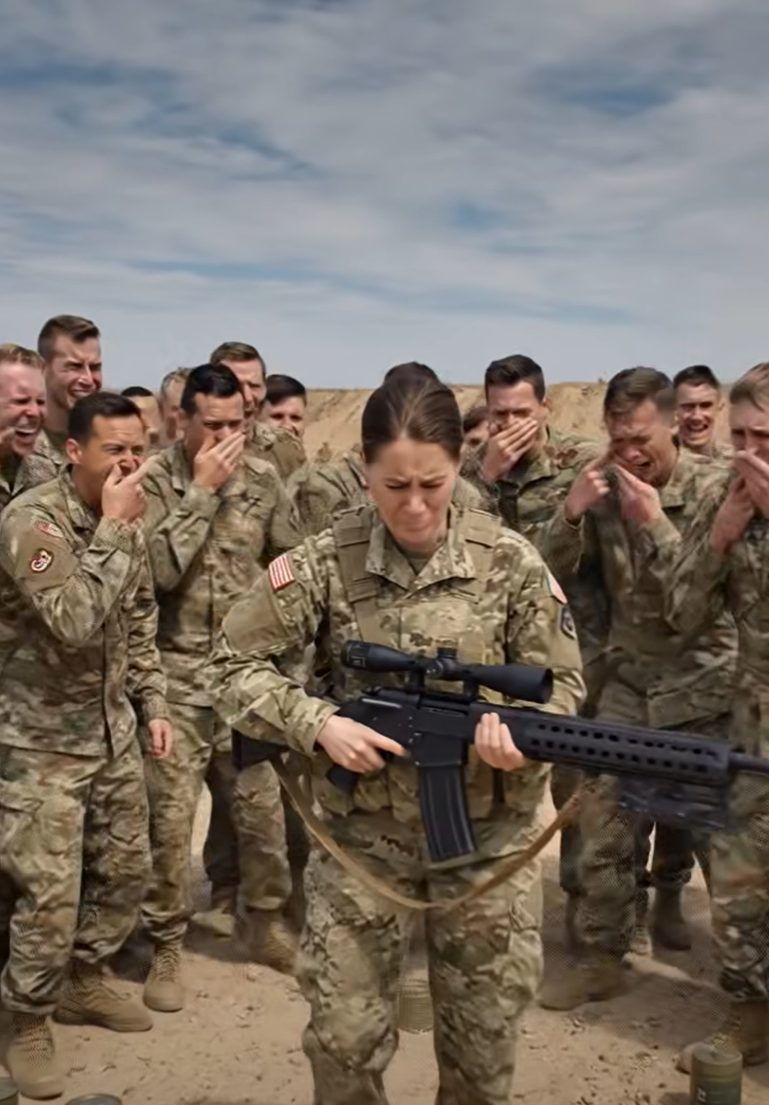
The phrase Shaking Female Officer had already spread across Redstone Desert Training Base like wildfire long before sunrise fully broke over the Nevada horizon. Soldiers whispered it between barracks corridors, mess hall tables, and weapon storage rooms, each version slightly more dramatic than the last. Some said she was a former battlefield legend returning after years of silence. Others insisted she had been reassigned following a psychological collapse during a classified overseas mission that officially never existed. Nobody actually knew the truth, but that uncertainty made her arrival even more entertaining for those who survived on routine boredom and military gossip.
By the time the sniper qualification event officially began, nearly the entire range had filled with spectators. Rows of soldiers leaned against sandbags and ammo crates under the scorching desert sun while instructors adjusted scopes and wind meters with practiced precision. Heat shimmered over the valley like a moving veil, bending the distant targets into unstable shapes. The air smelled of gun oil, dry dust, and something closer to appetite.
At Lane Seven stood Major Evelyn Carter.
She did not look like what the soldiers expected.
No aggressive posture. No commanding presence. Just a quiet woman standing slightly too still, one hand resting beside a long black sniper rifle already mounted on the firing mat – fingers not quite touching the grip, hovering above it the way a person hovers above something that once burned them.
And that rifle was not standard issue.
Even from a distance, experienced marksmen recognized it immediately. The weapon had been modified well beyond regulation limits: reinforced recoil system, tightened trigger response, unstable long-range calibration designed for extreme punishment testing. It was the kind of rifle nobody volunteered to use unless someone wanted to break confidence publicly and leave no fingerprints doing it.
Colonel Adrian Blackwell had chosen it personally.
He stood behind her with a composed expression that made no effort to conceal his intent.
“Major Carter has requested operational requalification following extended absence from field service,” he announced to the entire range, his voice carrying easily across the desert silence. “At Redstone Base, we do not adjust our standards for sentiment.”
A ripple of laughter moved through the crowd immediately.
One young sergeant leaned toward the soldier beside him.
“She looks like she hasn’t held a rifle in years.”
The other smirked. “This is going to be painful to watch.”
Evelyn did not respond. Did not turn. Did not acknowledge them.
She knelt slowly onto the firing mat, dust rising around her knees as she positioned herself behind the rifle. Her jaw was set. Her breathing was controlled in the deliberate way that only people who have had to deliberately control it ever learn.
And then the laughter grew louder.
“Look at her hands.”
“She’s already shaking.”
“Why would command even approve this?”
She looked up then – not toward Blackwell, not toward the targets, but directly at the sergeant who had spoken first. He was young, maybe twenty-three, with the easy confidence of someone who had never been asked to carry anything heavier than his own ego. He met her eyes and held them just long enough to smirk again before looking away.
She held her gaze on the empty space he left behind for a moment longer than necessary.
Then she looked back at the rifle.
Her fingers settled onto the grip.
Colonel Blackwell stepped closer, lowering his voice just enough to reach her ears.
“You can still stop,” he said. “No shame in accepting you’re not what you used to be.”
Evelyn said nothing. Her right hand had stilled completely against the stock. Whatever had been trembling a moment ago had gone somewhere else – somewhere quieter, somewhere deeper – the way a fire pulls inward just before it catches.
Nobody on the range noticed the black SUV that had turned off the main access road forty seconds earlier.
Nobody noticed it park.
Nobody noticed the door open.
Not yet.
What Nobody on That Range Knew About Her
I need to back up. Because if you only have what happened on the firing line, you’re missing most of it.
Evelyn Carter had been gone from active field service for fourteen months. The official record listed it as a medical leave, administrative category, nothing specific. That’s the kind of language the Army uses when the real explanation would require clearances most colonels don’t hold.
What actually happened – what I pieced together later from two sources who would only talk off the record – was this.
Eighteen months ago, she had been embedded with a small advisory unit operating in a region the Pentagon was officially not operating in. Her team had been compromised. Three men didn’t come back. She did, but only because she’d spent eleven hours in a drainage channel in temperatures that dropped to single digits, directing a rescue extraction via a radio with a cracked casing held together with electrical tape she’d found in her jacket pocket.
Nobody shot a rifle during those eleven hours. Not her. Not anyone.
But before that. Before the channel and the cold and the tape.
Evelyn Carter had been, by any measurable standard, one of the top five precision marksmen the Army had produced in a decade. Not top five women. Top five, full stop. She’d qualified on seven platforms. She’d trained snipers in two countries. She had a citation sitting in a file somewhere that described a 1,400-meter shot under wind conditions that the range officer had initially called impossible and then quietly revised his assessment of after he watched the footage four times.
Blackwell knew this.
That’s the part that mattered. He knew exactly who she was, and he’d chosen the modified rifle anyway. He’d chosen the public venue. He’d chosen the audience. He’d done all of it deliberately, which meant this wasn’t hazing. It was something with more calculation behind it. More patience.
I’m not going to speculate about why. But I know what he wanted to happen.
He wanted her to fail in front of everyone, and he wanted it on record, and he wanted the laughter to be the last sound associated with her name at Redstone.
The First Shot
She didn’t rush.
That was the first thing that surprised people. The crowd had settled into a kind of pre-emptive amusement, the way people look right before they expect someone to trip. Relaxed. Ready to react.
Evelyn took forty-three seconds before she fired.
Forty-three seconds is a long time on a public range with two hundred people watching. It’s long enough for someone to cough. For someone else to mutter something. For Blackwell to shift his weight from one foot to the other and check his watch with a performance of boredom so deliberate it was almost theatrical.
She exhaled.
The shot broke.
The target – 800 meters, first position – registered a hit. Center mass. The scoring system beeped once, a flat electronic tone that carried across the range without drama.
Silence.
Not the silence of awe. Not yet. The silence of recalibration, of people who’d been leaning forward to laugh suddenly not quite sure what posture to hold.
The young sergeant – the one she’d looked at – stopped smiling. Not because he was impressed. Just because the script had gone slightly off and he hadn’t gotten new lines yet.
Evelyn cycled the bolt.
Second shot. 900 meters, crosswind at roughly twelve miles per hour from the northwest. The modified calibration on the rifle should have pushed the round left by a margin that would pull it outside the scoring zone. She’d compensated, though nobody watching could see how or when she’d made that calculation. The round hit inside the ring.
Another flat beep.
Blackwell’s expression hadn’t changed. He was good at that.
Third shot. 1,000 meters.
This one took her fifty-eight seconds. She shifted her position twice, barely perceptibly, adjusting something about the angle of her left elbow. The crowd had gone fully quiet by now, not out of respect but out of the particular attention people give to something they’ve stopped being sure about.
The shot broke.
Hit.
And then – from somewhere in the back, near the sandbag wall – a voice. One of the older sergeants, a guy named Pruitt who’d been at Redstone for six years and had the kind of face that had stopped being surprised by most things.
“Huh,” he said.
Just that. Just huh. But the way he said it meant something.
The SUV
The vehicle had parked near the range’s northern access gate, which put it about sixty meters from where Blackwell was standing. Military plates. Tinted rear windows. A driver who stayed behind the wheel.
The passenger door opened first.
An aide stepped out – young, pressed uniform, clipboard – and then held the door for the man behind him.
General Raymond Holt was sixty-one years old and built like someone who had decided a long time ago that retirement was for other people. He had four stars. He had operated in positions that didn’t appear on public-facing org charts. He had, fourteen months ago, personally signed the emergency extraction order that had gotten Evelyn Carter out of that drainage channel.
He was not supposed to be at Redstone today.
His calendar, according to the aide who later told someone who later told me, had shown him in Washington for a Joint Chiefs briefing that had been quietly rescheduled two days prior.
He walked toward the range without hurrying. The aide followed. Nobody else came out of the SUV.
The first person to notice him was a corporal near the range entrance who snapped to attention so fast she nearly knocked over a water bottle. Then the next soldier saw her do it. Then the next.
The reaction moved through the crowd the way a wave moves – not all at once, but in sequence, person by person, each one catching the expression of the person beside them and following it to its source.
Blackwell turned last.
The Mood Across the Base
There is a specific kind of quiet that happens when a four-star general walks onto a base without warning and the base commander has not been notified. It is not the quiet of respect. It is the quiet of everyone doing rapid, private math.
Blackwell went rigid. Not at attention – he was too experienced for that kind of visible reaction – but something in his posture changed. The performance of ease drained out of him, and what was left underneath it was less comfortable.
Holt didn’t look at him.
He walked to the edge of the firing area and stopped about ten feet behind Evelyn’s position. She was between shots, cycling the bolt, and she had not turned. Whether she knew he was there, I honestly couldn’t tell you.
Holt watched.
Nobody spoke.
Evelyn fired the fourth shot. 1,100 meters. The modified rifle kicked hard – harder than regulation, the recoil system doing exactly what it had been built to do – and she absorbed it without any visible disruption to her position. The target registered. Inside the ring.
Holt crossed his arms.
One of the junior officers near Blackwell made the mistake of starting to say something, some comment he’d probably been building for the last two minutes, and Blackwell cut him off with a single look that required no words.
Evelyn fired the fifth shot.
And the sixth.
When the final scoring tone sounded – a different tone from the individual hits, a longer one that signaled the end of the qualification sequence – the range officer read the score twice before he announced it. Not because he doubted the number. Because he wanted to be sure he was saying it correctly.
She had scored higher on the modified rifle, under those conditions, than the base record for standard issue.
After
Holt walked up to her while she was still on the mat, clearing the weapon. She looked up. He looked down. There was a conversation that lasted about ninety seconds, and the only people close enough to hear it were the range officer and Blackwell, and neither of them has talked about it in specific terms.
What I know is this.
Blackwell requested a transfer to a different assignment three weeks later. It was approved. He is currently stationed somewhere in the Pacific Northwest in a role that involves a lot of administrative oversight and very few public range events.
The young sergeant – the one with the smirk and the easy confidence – found himself reassigned to a different training unit within the month. Pruitt, the older one who had said huh, got quietly moved into a senior instructor role.
Evelyn Carter returned to active field service with a full operational clearance. No probationary period. No modified assessment track. Full clearance, standard assignment, no asterisk.
I don’t know if she knows how much of it Holt had already known before he pulled into that parking lot. I don’t know if she cared. She’d spent forty-three seconds and then fifty-eight seconds and then various other intervals of quiet, careful time doing the only thing that had ever actually mattered to her argument.
She’d shot the rifle.
The rifle they’d handed her to embarrass her.
And she’d shot it better than anyone at that base had ever shot anything.
The rest of it – the laughter, the smirk, the colonel’s composed expression – that had all been noise. And she’d known, somewhere in the part of her that had survived eleven hours in a drainage channel with electrical tape and a broken radio, that noise was the one thing a good shot doesn’t hear.
—
If this one got to you, pass it along to someone who needs to see it today.
If you’re looking for more gripping military tales, you might find yourself engrossed in I Watched This Man Die in Afghanistan. He Was Aiming at Me From a Rooftop., or perhaps the intense moment when My Squad Leader Pushed Me Into a Ditch Without Knowing Who My Father Was catches your eye, and don’t miss the unforgettable story of My Opponent Outweighed Me by Ninety Pounds. The Whole Base Was Watching..



