
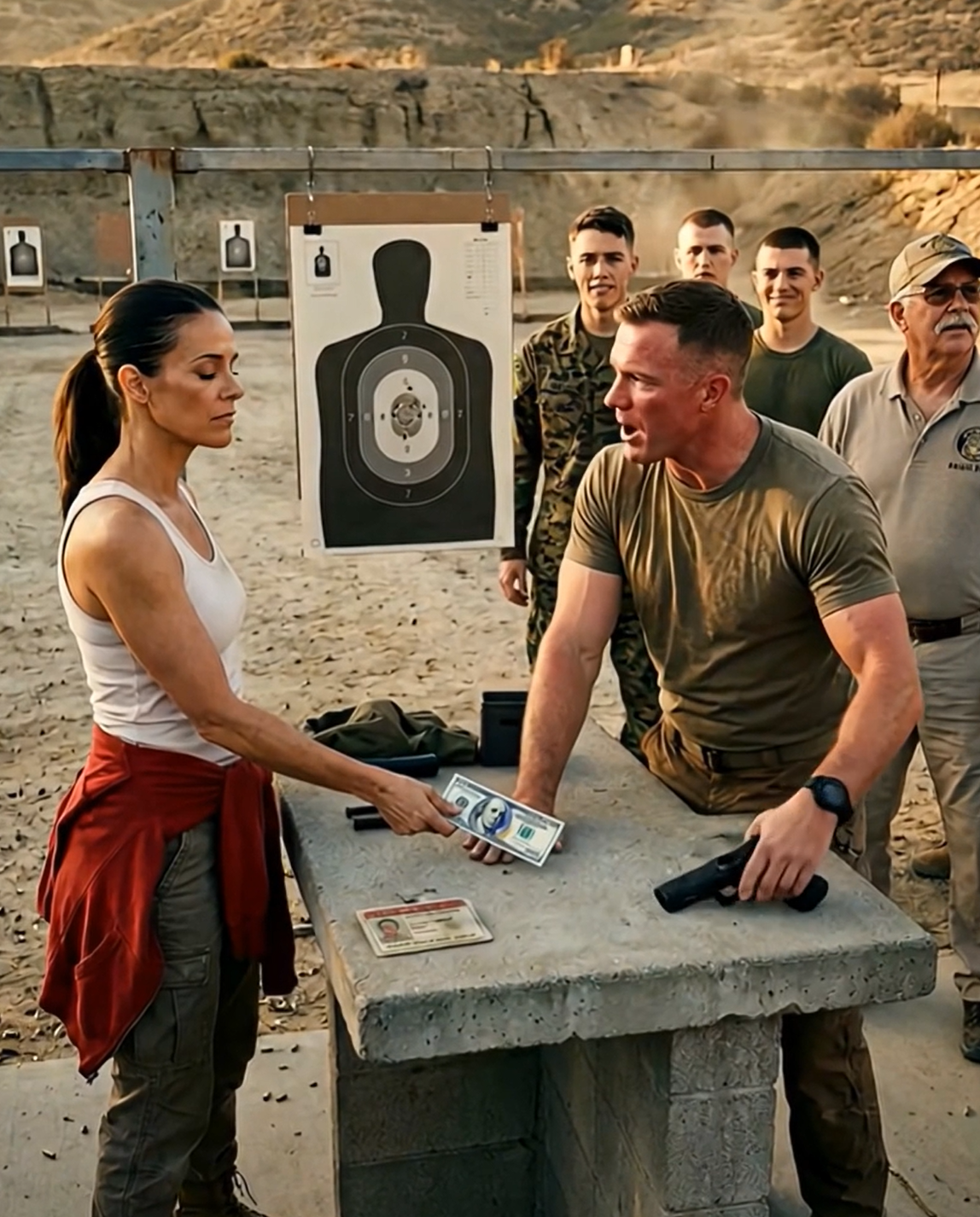
Sergeant Michael Ducker pushed the hundred-dollar bill across the shooting bench and called me “sweetheart.”
His buddies laughed behind him.
Five rounds. Four seconds. Twenty-five yards. Easy money, he said.
I arrived at the Oceanside range at 4:38 p.m. on three hours of sleep. Rental Glock 19. White tank top. Red jacket knotted around my waist. Scuffed boots. Hair pulled back tight.
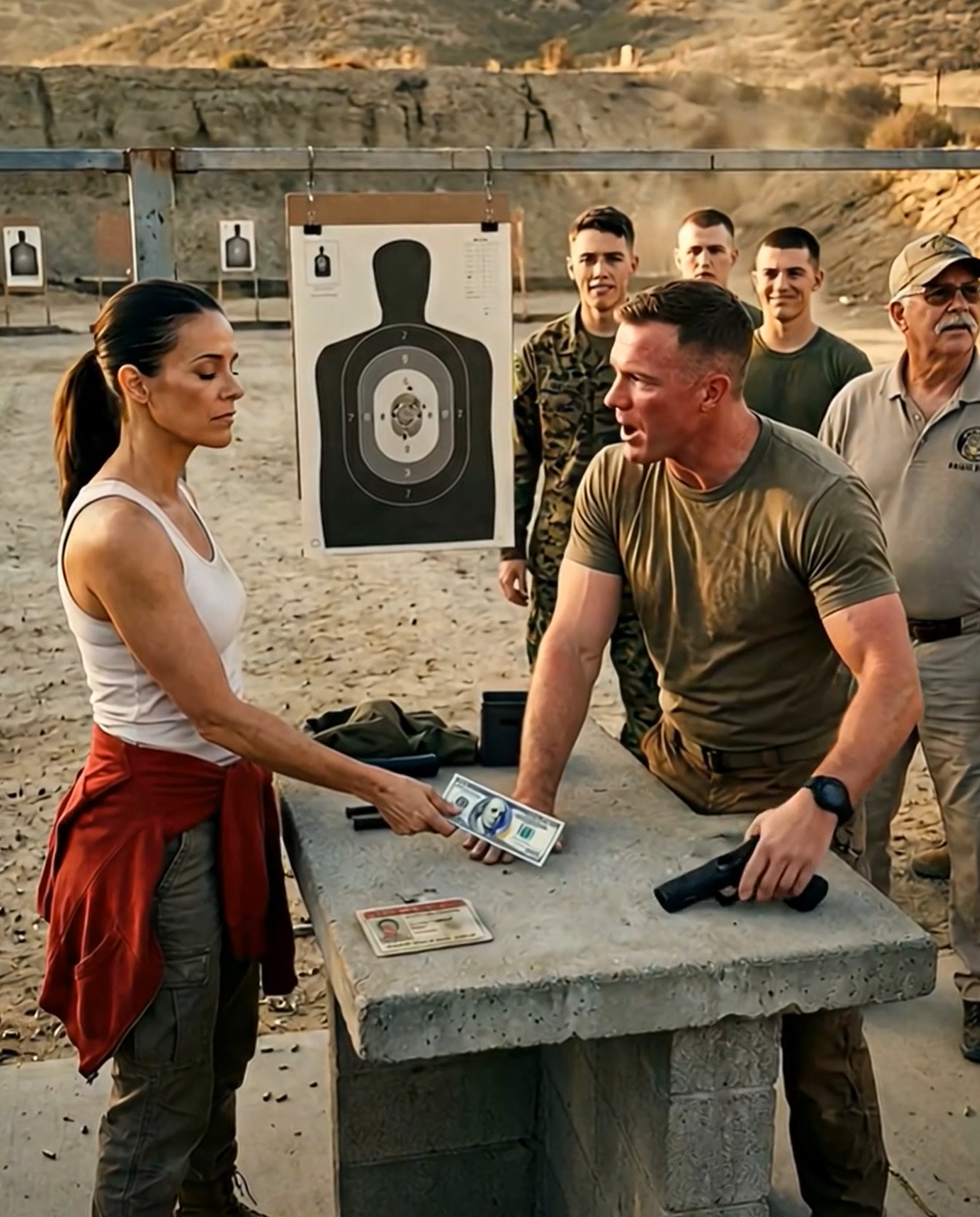
I looked like a woman killing a few hours on a weekend.
That was the first thing they got wrong.
Ducker looked like a recruiting poster come to life. Clean haircut. Hard jaw. Four younger Marines stood behind him, pretending this wasn’t their entertainment for the day.
One laughed openly. One tried to cover it. One wore that polite little smile people get right before they say something stupid.
The youngest didn’t say a word.
Early twenties. Lean. Motionless. His eyes never once landed on my face.
They stayed locked on my thumbs while I loaded the magazine.
That told me everything.
“I’ve been watching you,” Ducker said. “You seem… pretty at home here.”
I pressed another round into the magazine. “That your professional assessment?”
The Marines behind him howled. His smile tightened, then sharpened.
“Sergeant Michael Ducker. Marksmanship instructor. MCRD San Diego.”
I glanced up for half a second. “Congratulations.”
Someone behind him choked on a laugh.
He raised the bill. “Five targets. Five rounds. Four seconds. Cold. You win, it’s yours. You lose, you’re buying drinks tonight.”
There’s a certain moment when someone builds a version of you in his head and decides it’s the truth.
Civilian. Beginner. Weekend class, maybe.
I’d met that version of me before. In bars. At ranges. In a dusty alley overseas, where a lieutenant once told me not to worry about wind calls.
He didn’t last very long.
I locked the magazine in. “What’s the time limit?”
“Four seconds. Cold.”
By 4:51, a crowd had formed. The range officer slowed as he walked past. Conversations died. That strange pressure settled over the lanes – the kind right before someone is about to be embarrassed.
Ducker stepped up first, enjoying every second.
The youngest Marine had stopped smiling completely.
Still watching my hands.
People who actually understand shooting don’t watch your face. They watch your hands before the shot matters.
Ducker raised his pistol, then glanced back at me, waiting for me to flinch.
I didn’t.
I set my red jacket down on the bench, reached into the inside pocket, and laid a worn ID card next to the hundred-dollar bill.
The range officer saw it first.
He froze.
The youngest Marine saw it next. His whole body went rigid. The color drained out of his face like someone had pulled a plug.
Ducker didn’t see it at all.
He only heard the range officer’s voice, low and very careful:
“Sergeant… you may want to rethink this.”
Ducker smirked without turning around. “Why?”
That’s when the youngest Marine finally spoke. Just three words, barely above a whisper – but loud enough that every Marine behind Ducker went pale.
“Sir… that’s Valkyrie.”
The name hung in the air, heavier than gunpowder smoke.
It wasn’t my given name. It was a name I earned in sand and sweat, a name whispered in after-action reports and training manuals.
Ducker’s smirk dissolved. He turned slowly, his eyes finally falling on the ID card.
It wasn’t a driver’s license.
It was a retired Department of Defense identification. Gunnery Sergeant Ava Vance. On the right, a list of qualifications that took up more space than my photo.
The hundred-dollar bill Ducker had placed so confidently on the edge of the bench fluttered in the breeze and fell to the concrete floor with a soft, pathetic whisper.
No one moved to pick it up.
The bravado drained out of Ducker’s face, replaced by a chalky white panic. His posture, once a perfect picture of military bearing, seemed to collapse inward.
“Ma’am,” he stammered, his voice cracking. “I… I didn’t…”
I just looked at him. I didn’t need to say anything. The silence was doing the work for me.
The youngest Marine, the one who had spoken my callsign, took a half-step forward, his eyes wide with something between fear and awe.
“It’s really you,” he breathed.
I gave a small, almost imperceptible nod. My focus wasn’t on them anymore. It was on the target downrange.
“Four seconds,” I said, my voice quiet but cutting through the tension. “That was the bet.”
Ducker looked like he wanted the floor to swallow him whole. “Ma’am, you don’t have to.”
“A deal’s a deal, Sergeant.”
I picked up the Glock. It felt cold and unfamiliar, a rental tool. But a tool is a tool.
I didn’t take a classic shooter’s stance. I didn’t need to. I stood relaxed, feet shoulder-width apart, body angled slightly toward the target.
My mind went quiet. The chatter of the range, the embarrassed shuffling of the Marines, Ducker’s ragged breathing – it all faded away into a dull hum.
There was only me, the weapon, and the target.
I raised the pistol. It was one smooth, fluid motion. No wasted energy, no hesitation. The sights aligned themselves as if by magnetic force.
My breathing slowed to a single, controlled cycle. Inhale.
The range officer, finally shaking himself out of his stupor, hit the timer.
The beep was the only thing I heard.
Exhale.
The first shot broke before the sound of the timer had fully faded. Crack.
The slide cycled, the brass casing ejecting in a golden arc.
Crack.
My trigger finger moved with a learned, subconscious rhythm. Press, reset. Press, reset.
Crack.
My support hand wasn’t just holding the gun steady; it was managing the recoil, driving the sights back onto the target before my brain had even registered the previous shot.
Crack.
The crowd that had gathered to watch a woman get humiliated was now watching a masterclass. Each shot built on the last, a violent symphony of precision.
Crack.
The fifth and final shot felt exactly the same as the first. The gun fell silent.
I lowered the pistol, placed it safely on the bench, and dropped the empty magazine.
The whole thing couldn’t have taken more than two heartbeats.
The range officer stared at his stopwatch, his mouth hanging open.
“Two point one seven seconds,” he whispered, like he was announcing a miracle.
No one spoke. The only sound was the faint ringing in my ears.
I walked over to the control panel and pressed the button to retrieve the target. The paper silhouette glided toward us on its cable, swaying slightly.
From twenty-five yards away, it looked like I had missed completely. The paper was clean, except for a single, dark hole in the center of the chest.
As it drew closer, the truth became apparent.
It wasn’t one hole.
It was five. All five bullets had passed through the exact same space, creating one ragged, quarter-sized puncture in the paper.
Ducker stared at it, his face a mask of disbelief and profound respect. He looked from the target, to my hands, and then finally, to my eyes.
“Ma’am,” he said, and the word was full of everything he couldn’t say. Apology. Awe. Humiliation.
I just nodded.
I turned my attention to the youngest Marine. He was still standing there, ramrod straight. I could see the name tape on his uniform now. Miller.
“How did you know, Private Miller?” I asked, my voice softer now.
He swallowed hard. “Gunnery Sergeant Hartman at Parris Island, ma’am. He… he was one of your students. He taught us from your playbook.”
I felt a ghost of a smile touch my lips. Hartman. He was a good kid. A great Marine.
“He used to say, ‘You can tell everything you need to know about a shooter by their hands before they ever touch the gun,’” Miller recited, like he was quoting scripture. “He said Valkyrie’s hands were so efficient, she could chamber a round and check her watch in the same motion.”
“He was exaggerating,” I said, but the memory warmed me.
“No, ma’am,” Miller insisted. “He said you were the standard. The one they told stories about but were never allowed to mention by name in reports. The ghost in the machine.”
I looked at this kid, so young, so full of earnest belief, and saw a chain stretching back through time. From me, to Hartman, to him. A legacy.
Ducker finally moved. He bent down, picked up the hundred-dollar bill from the floor, and smoothed it out carefully. He held it out to me.
“Ma’am. I was out of line. This is yours.”
I looked at the money, then back at him. I saw the shame in his eyes. He wasn’t a bad Marine, just a young and arrogant one. The Corps has a way of sanding down those rough edges. Today was just his turn at the grinder.
I didn’t take the bill.
“Keep it, Sergeant,” I said. “Put it in the beer fund for your men. They earned it for having to put up with you.”
The other Marines, who had been holding their breath, let out a collective sigh of relief. A few of them even cracked a smile.
Ducker nodded, his throat tight with emotion. “Aye, Ma’am.”
Then, I looked back at Private Miller. The name had been nagging at me since I first saw it. Miller.
There was something familiar about his face, too. The set of his jaw. The color of his eyes.
“Miller,” I said slowly. “Your father… he wouldn’t happen to be from Ohio, would he? A town called North Ridgeville?”
The kid’s eyes went wide. Utter shock radiated from him. “Yes, ma’am. How could you possibly know that?”
And just like that, the entire day snapped into focus. The reason I was here. The pull I felt to come to this specific range, on this specific day. It wasn’t a coincidence at all.
It was a promise.
“Your father was Sergeant Thomas Miller,” I stated. It wasn’t a question.
Tears welled in the young Marine’s eyes. He nodded, unable to speak.
“We called him ‘Pops,’” I said, the nickname feeling strange and wonderful on my tongue after so many years. “He was my spotter. 2nd Battalion, 7th Marines.”
The air left the room. Ducker and his men looked between me and Miller, finally understanding that they had stumbled into something far more significant than a petty shooting bet.
“He… he never talked much about his service, ma’am,” Miller whispered. “He just told me he served with the best.”
I reached out and put a hand on his shoulder. The fabric of his uniform was stiff and new. “He didn’t just serve with me, kid. He saved my life.”
The memory was as clear as yesterday. A firefight in a sun-baked maze of streets. The wrong turn, the ambush. The lieutenant who didn’t listen to wind calls was already down. My own position was compromised.
Then, out of the smoke and chaos, there was Pops. Laying down suppressing fire, shouting coordinates, dragging me out of the line of fire when a round clipped my leg. He never wavered.
“He took a piece of shrapnel that was meant for me,” I said, my voice thick. “Right before we shipped home, he made me promise him something.”
I paused, gathering myself.
“He said, ‘Ava, if my boy ever decides to be a damn fool and follow in my footsteps, promise me you’ll look him up. Make sure he’s okay.’”
Miller was openly crying now, but he stood his ground, proud and straight.
“I’ve been keeping loose tabs on you since you enlisted, Private,” I confessed. “I knew your unit was stationed here. I just… I didn’t know how to approach you. I figured I’d hang around the places a young Marine might be.”
It was the truth, but not the whole truth. The whole truth was that I was scared. Scared to see the boy his father talked about with such love and hope. Scared to be a reminder of a man he lost too soon.
“Your father was the bravest man I ever knew,” I said, locking eyes with him. “He would be so damn proud of you.”
At that, his composure finally broke. A single sob escaped his lips.
Ducker, to his credit, stepped forward. He put a hand on Miller’s other shoulder.
“Let’s get you some water, Marine,” he said gently. He looked at me, his eyes full of a new, hard-earned humility. “Ma’am. Thank you.”
It wasn’t just for the shooting lesson. It was for everything.
I spent the next hour sitting with Private Thomas Miller Jr. I told him stories about his dad. Not the war stories, but the funny ones. The way his dad could sleep through anything, the terrible jokes he told, the way he always had a stash of candy bars to share.
I filled in the gaps of the man he only knew as ‘Dad’ with the man I knew as ‘Pops,’ my brother in arms.
When it was time to go, I took the target paper—the one with the single, five-shot hole—and I wrote on it.
“To Private Miller. Your father was a hero. Be as good a man as he was. – Gunnery Sergeant Ava Vance.”
I handed it to him. “Don’t ever let anyone tell you who you are,” I said, glancing over at Ducker, who had the good sense to look ashamed. “You know. And you come from the best.”
Ducker approached me one last time as I was packing up my jacket.
“Ma’am,” he started. “I don’t know what to say.”
“Then don’t say anything,” I cut him off, but without malice. “Just be a better Sergeant tomorrow than you were today. Your men deserve it.”
He nodded crisply. “Ma’am. It would be an honor if… if you’d let me buy you that drink. Or coffee. I’d just like to listen.”
I thought about it for a second. I saw the genuine desire to learn in his eyes.
“Some other time, Sergeant,” I said. “Tonight, my first drink is with the son of a friend.”
I walked out of the range, leaving behind a humbled Marksmanship Instructor, four wide-eyed young Marines, and a hundred-dollar bill that had bought a lesson far more valuable than pride.
Driving away, I realized the target I came here for wasn’t made of paper.
It was about connecting a thread from a past promise to a present reality. It was about seeing a father’s legacy alive and well in his son’s earnest eyes.
Sometimes, the most important shots we take in life don’t involve a trigger at all. They are the shots we take on people—to believe in them, to guide them, and to honor the memory of those who stood beside us.
That is a legacy worth fighting for.



