A Bet at the Range
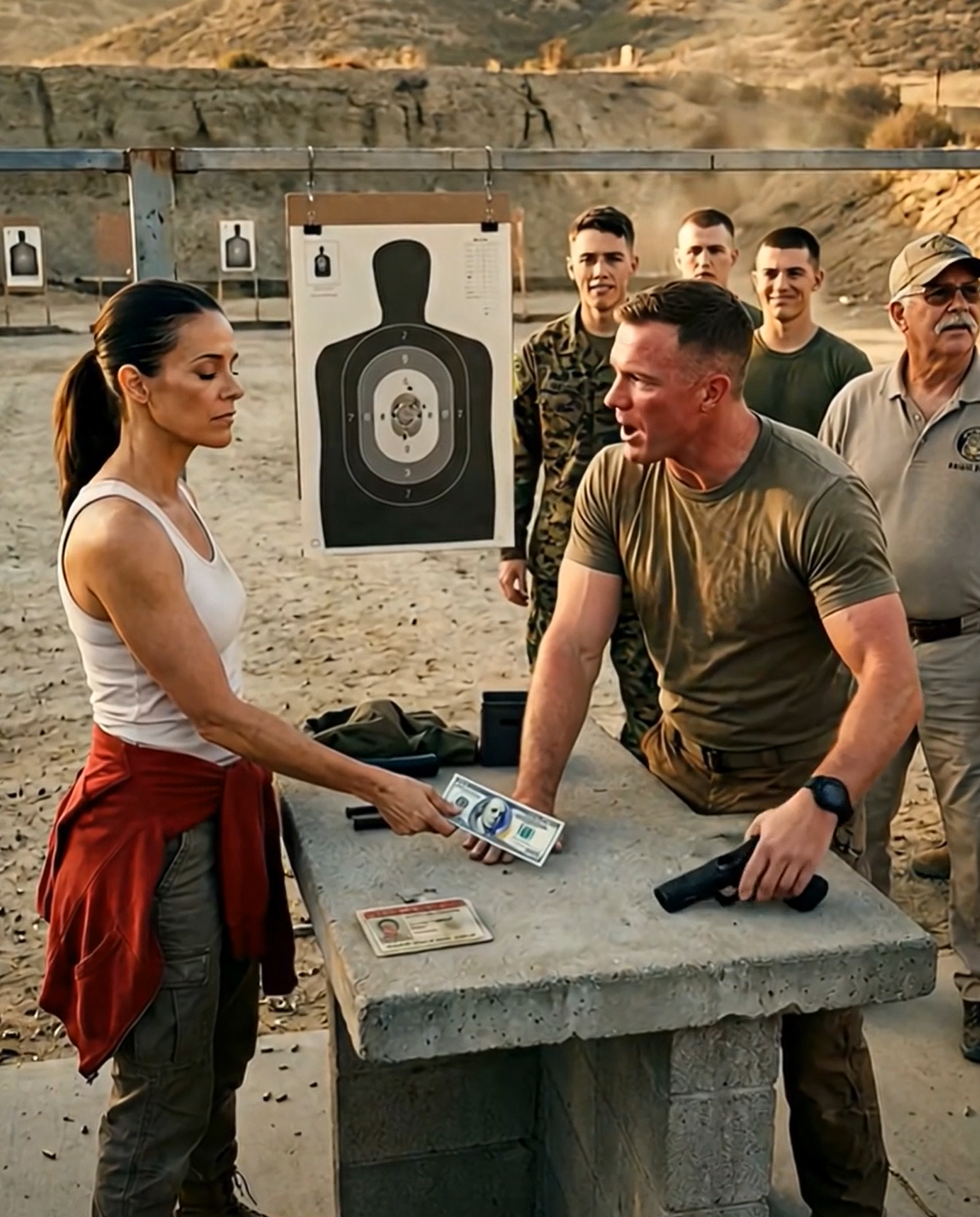
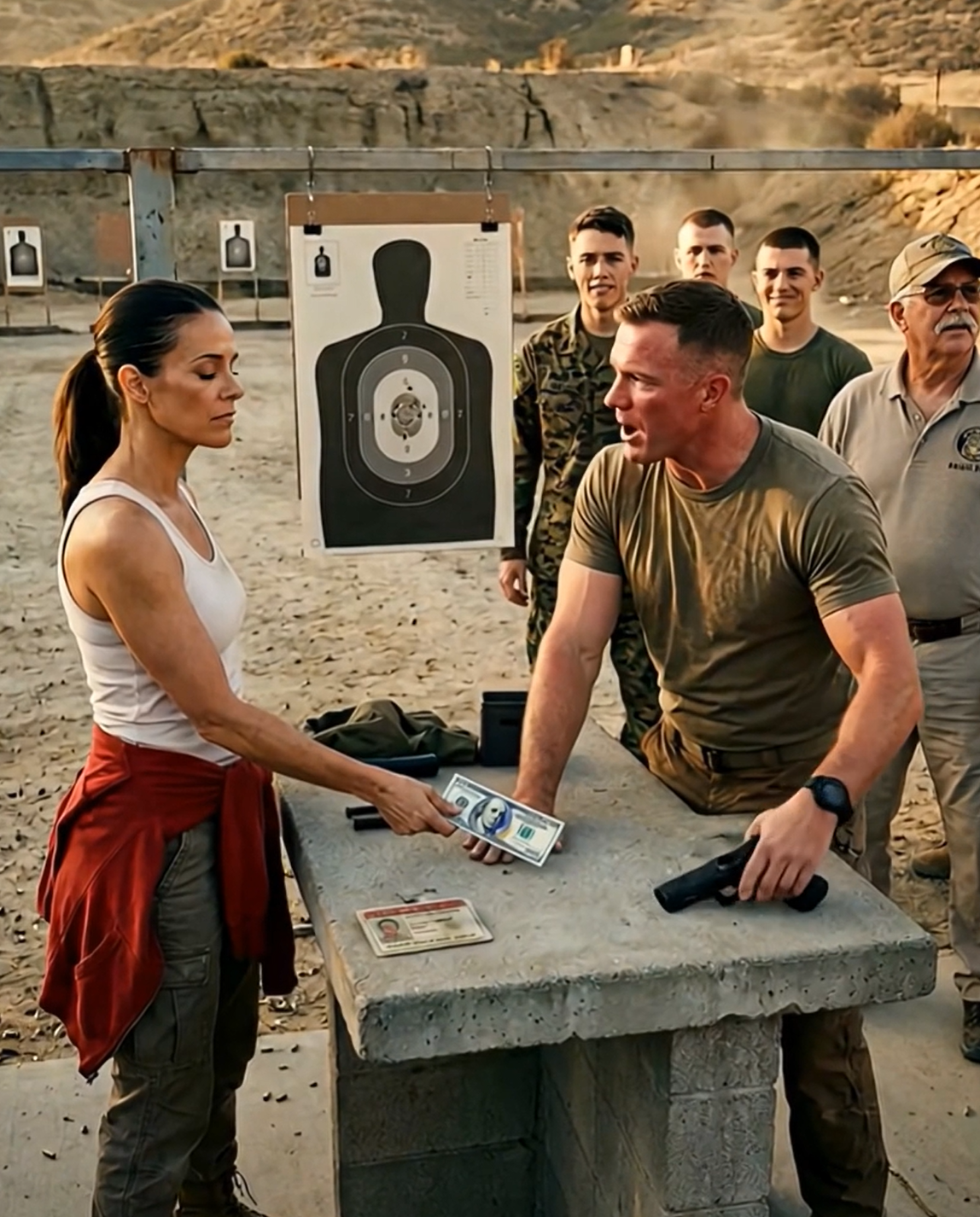
Sergeant Michael Ducker slid a crisp hundred-dollar bill across the shooting bench and, with a half-smile meant to sting, called me “sweetheart.” His buddies behind him laughed, the kind of laughter men use to test the water and see how far they can push.
Five rounds. Four seconds. Twenty-five yards. Easy money, he said. He sounded absolutely sure of himself, like he’d made this little wager a hundred times and won ninety-nine of them.

I had arrived at the Oceanside range at 4:38 in the afternoon, running on three hours of sleep. I rented a Glock 19 at the counter. White tank top. Red jacket tied at the waist. Scuffed boots that had known more than one kind of dust. Hair pulled back tight, out of the way, the way habit and years of training taught me to do it.
Nothing about me announced anything special. If you had glanced my way, you might have thought I was just there to pass a little time and clear my head.
That was the first thing they got wrong. I didn’t look dangerous. I didn’t look like I had anything to prove. But looks can turn a person into the wrong story if you’re not careful.
Ducker stood in front of me like a recruiting poster come to life. Fresh haircut. Strong jaw. Confidence in every line of his posture. Four younger Marines clustered behind him, each one pretending, in his own way, that this wasn’t the afternoon’s entertainment.
One laughed out loud. One tried to hide it. One wore a polite little smile that shows up right before people say something they’ll regret. The youngest one didn’t say a word. He was lean, still as a fence post, and his eyes, oddly enough, never once met mine.
They watched my thumbs while I loaded the magazine. Not my face. Not my stance. My hands.
That told me everything I needed to know about the quiet one.
“I’ve been watching you,” Ducker said, chest out a little. “You seem… pretty at home here.”
“That your professional assessment?” I asked, seating another round with a familiar push.
His friends howled. His smile tightened and then seemed to sharpen, as if he’d just slipped on his instructor’s hat.
“Sergeant Michael Ducker. Marksmanship instructor. MCRD San Diego.” He offered the title the way a man offers a business card.
“Congratulations,” I said, glancing up for half a second, then back to the work of my hands.
Someone behind him choked on a laugh. I could feel the air thicken with expectation, the way it does when a room leans forward to see what happens next.
Ducker raised the bill. “Five targets. Five rounds. Four seconds. Cold. You win, it’s yours. You lose, you’re buying drinks tonight.”
The Picture People Paint For You
There’s a certain moment when a stranger paints a portrait of you in his head and decides it’s true. It’s tidy. It’s simple. It lets him relax into what he already believes.
Civilian. Beginner. Maybe a weekend class or two. Someone who shoots for social media and not much else.
I’d met that version of me before. In bars, at ranges, and once in a hot, narrow alley overseas where a brand-new lieutenant told me not to worry about wind calls.
He didn’t last long in that job.
I locked the magazine into the Glock with a gentle, certain click. “What’s the time limit?” I asked, meeting Ducker’s eyes as if I hadn’t heard him the first time.
“Four seconds,” he said. “Cold.” He liked the sound of his own certainty.
By 4:51, a small crowd had formed. The range officer slowed as he walked past, then stopped. Conversations nearby fizzled out and drifted away. The air settled into that strange quiet that shows up right before someone is about to learn a hard lesson.
Ducker stepped to the line first, riding the attention like a tall wave. His youngest Marine had completely stopped smiling. He was still watching my hands.
People who truly understand shooting don’t study your face in the moments before it matters. They watch your hands. The hands give you away—how you check, how you load, how you touch the slide, how your fingers find the frame. The hands tell the truth.
Ducker lifted his pistol and then, for show, flicked a look over his shoulder to see if I would flinch.
I didn’t.
I set my red jacket on the bench, reached into the inside pocket, and laid a worn identification card down next to that hundred-dollar bill.
The range officer saw it first. He froze, his jaw going tight as if someone had told him to hold still or else.
The youngest Marine saw it next. In an instant he went rigid, the color draining out of his face as if someone had pulled a plug.
Ducker didn’t see it at all.
He only heard the range officer, who spoke slowly and very carefully. “Sergeant… you may want to rethink this.”
“Why?” Ducker didn’t turn around. His voice was confident, but the edges of it had dulled just a little.
That’s when the quiet Marine gave us all three words, barely above a whisper, but they carried like a church bell.
“Sir… that’s Valkyrie.”
A Name Earned, Not Given
The name hung in the air heavier than gunpowder smoke. Not my given name. The one I earned the hard way—in sand and sweat and long nights. A name whispered in after-action reports and passed quietly from instructor to instructor. The kind of name that doesn’t need a last name next to it.
Ducker’s smirk dissolved. He turned slowly. His eyes fell to the card I had placed on the bench, and the shape of his world changed.
It wasn’t a driver’s license. It was a retired Department of Defense identification card. Gunnery Sergeant Ava Vance. On the right-hand side, a column of qualifications that took up more space than my photo.
The hundred-dollar bill he’d placed so confidently at the edge of the bench fluttered, slid off, and fell to the concrete with a soft little whisper. No one moved to pick it up.
Color drained from Ducker’s face. His posture—perfect minutes ago—folded in on itself. “Ma’am,” he stammered. “I… I didn’t…”
I looked at him. I didn’t need to say a word. Silence, used well, can be a better teacher than a speech.
The youngest Marine, the one who knew the call sign, took a half-step forward, eyes wide with something between awe and fear. “It’s really you,” he breathed.
I gave him a small nod. My attention was already moving downrange to the target.
“Four seconds,” I said, softly but clearly. “That was the bet.”
Ducker swallowed. “Ma’am, you don’t have to.”
“A deal’s a deal, Sergeant.”
Four Seconds Starts Now
I picked up the Glock. It was cold and unfamiliar, the way a rental always is. But a tool is a tool, and a job is a job.
I didn’t bother with a picture-perfect stance. I didn’t need to. I set my feet shoulder-width apart, my body lightly angled toward the target, every muscle except the ones I needed loose and ready.
My mind went quiet. The background noise of the range, the shifting boots of the Marines behind me, the ragged breathing of a man reconsidering his life choices—everything softened to a distant hum.
There was only the triangle that mattered: me, the weapon, the target.
I raised the pistol in one smooth motion. No wasted energy. No hesitation. The front sight rose and settled as if pulled by a magnet to the notch it belonged in.
I took a single controlled breath in.
The range officer came back to himself, thumbed the timer, and the sharp electronic beep sliced the air.
Exhale.
Crack.
The slide cycled; brass arced away in a neat flash of gold.
Crack.
My trigger finger moved in a rhythm drilled so deeply it didn’t need thought. Press, reset. Press, reset.
Crack.
My support hand did more than hold the gun. It managed the recoil and drove the sights back to the exact same spot before my conscious mind could name what had just happened.
Crack.
To the folks who’d gathered to watch a stranger get embarrassed, the scene shifted into something else entirely. Not a show. A lesson. Not arrogance. Mastery.
Crack.
The fifth shot matched the first—same sight picture, same press, same result.
I lowered the pistol, set it safely on the bench, and dropped the empty magazine. The stillness afterward felt like the pause after a prayer.
The range officer stared at his stopwatch as if he’d never seen numbers before. “Two point one seven seconds,” he whispered, like he was careful not to scare a miracle.
What The Paper Showed
No one said a word. Even the ringing in my ears felt respectful.
I sent the target back with a press of the button. The cable hummed; the silhouette swung slightly as it came closer. From twenty-five yards out it looked like I had missed everything. The paper seemed clean except for a single dark mark in the middle of the chest.
Then the truth reached us.
It wasn’t one hole. It just looked like one. All five rounds had passed through the same space, chewing a ragged, quarter-sized opening where the heart would be on a person.
Ducker’s face shifted from disbelief to something like humility. He looked at the target, then at my hands, and then finally met my eyes. “Ma’am,” he said, and that one word carried apology, respect, and the sharp edge of a lesson learned too late.
I nodded. There was nothing to add. The paper had spoken.
The Quiet Marine Speaks Up
I turned to the youngest Marine. He stood ramrod straight, the way new uniforms and fresh resolve make people stand. The tape on his chest read Miller.
“How did you know, Private Miller?” I asked, my voice softer now.
He swallowed. “Gunnery Sergeant Hartman at Parris Island, ma’am. He… he was one of your students. He taught us from your playbook.”
A smile tugged at the corner of my mouth before I could stop it. Hartman had been a good kid. A good Marine.
“He used to say, ‘You can tell everything you need to know about a shooter by their hands before they ever touch the gun,’” Miller went on, careful with each word. “He said Valkyrie’s hands were so efficient, she could chamber a round and check her watch in the same motion.”
“He was exaggerating,” I said, though the memory warmed me right through the ribs.
“No, ma’am,” Miller said, shaking his head. “He said you were the standard. The one they told stories about but never wrote down. The ghost in the machine.”
I looked at this young man—so sure and so earnest—and felt a line stretching back: from him, to Hartman, to me, and even farther to those who had trained me. That’s how knowledge travels in this world, hand to hand.
Respect Earned, Not Demanded
Ducker finally moved. He bent to the floor, picked up the hundred-dollar bill, and smoothed it flat between his fingers. He held it out to me as if it weighed more than paper.
“Ma’am. I was out of line. This is yours.”
I looked at the money, then at his face. He wasn’t a bad Marine. He was a young one who had let his confidence outrun his judgment. The Corps knows how to sand those edges down. Today was just his turn at the grinder.
“Keep it, Sergeant,” I said. “Put it in the beer fund for your men. They earned it for having to put up with you.”
Behind him, shoulders lowered, air released. A few smiles appeared. Relief can be a powerful teacher too.
“Aye, Ma’am,” he said, voice tight.
A Name That Meant More
I looked back at Private Miller. His name had been tugging at me like a loose thread. There was something familiar in his face too—the set of his jaw, the color of his eyes.
“Miller,” I said slowly. “Your father… he wouldn’t happen to be from Ohio, would he? A town called North Ridgeville?”
His eyes widened in shock. “Yes, ma’am. How could you possibly know that?”
And just like that, the entire day snapped into focus. The time. The place. The pull to come to this very range on this very afternoon. It wasn’t coincidence.
It was a promise.
“Your father was Sergeant Thomas Miller,” I said. Not a question. A fact.
Tears welled. He nodded, unable to form a word.
“We called him ‘Pops,’” I said, tasting the old nickname like something sweet and rare. “He was my spotter. Second Battalion, Seventh Marines.”
All around us, the other Marines finally understood they had stepped into something much bigger than a range bet.
“He… he never talked much about his service, ma’am,” Miller whispered. “He just told me he served with the best.”
I put my hand on his shoulder. His uniform was new and stiff with pride. “He didn’t just serve with me, kid. He saved my life.”
The memory opened like a door. A sun-baked maze of streets. A wrong turn. An ambush that started too fast to stop. The lieutenant who wouldn’t listen about the wind had already gone down. My position was blown. Then there was Pops—steady as sunrise—laying down fire, shouting clean coordinates, dragging me out when a round clipped my leg.
“He took a piece of shrapnel meant for me,” I said, my voice low. “Right before we shipped home, he made me promise him something.”
I paused to find my balance in the story.
“He said, ‘Ava, if my boy ever decides to be a damn fool and follow in my footsteps, promise me you’ll look him up. Make sure he’s okay.’”
Miller was crying now, but he stood straight, a young man trying to hold both grief and pride in the same pair of hands.
“I’ve been keeping loose tabs on you since you enlisted,” I admitted. “I knew your unit was here. I just didn’t know how to walk up and say hello. I figured I’d linger where a young Marine might spend his off-hours and trust that the right moment would show up.”
The whole truth was simpler and harder: I had been scared. Scared to stand in front of the boy a good man loved and see his father’s face. Scared to be a reminder of loss.
“Your father was the bravest man I ever knew,” I said, meeting his eyes. “He would be so proud of you.”
His breath hitched. A single sob broke free.
To his credit, Ducker stepped close and put a steady hand on Miller’s other shoulder. “Let’s get you some water, Marine,” he said, gently. Then he looked at me, humility clear in his eyes. “Ma’am. Thank you.”
Stories That Fill The Gaps
I spent the next hour with Private Thomas Miller Jr., filling in the spaces he didn’t know how to name. Not the firefights—that kind of story has its time and place. The other things. How his dad could sleep anywhere, anytime. The bad jokes that somehow never got old. The secret candy bars he always had around when someone needed a lift.
I offered him the man I knew—Pops, my brother in arms—so he could hold that picture alongside the one he had grown up with, Dad.
When it was time to go, I took the target with the single, five-shot hole and wrote across the top.
“To Private Miller. Your father was a hero. Be as good a man as he was. – Gunnery Sergeant Ava Vance.”
I handed it to him. “Don’t ever let anyone tell you who you are,” I said, letting my eyes slide to Ducker and back again. “You know. And you come from the best.”
Ducker approached as I folded my jacket into the crook of my arm. “Ma’am,” he began, searching for the right words. “I don’t know what to say.”
“Then don’t,” I said, not unkindly. “Be a better Sergeant tomorrow than you were today. Your men deserve that.”
He nodded, the lesson landing where it needed to. “Ma’am. It would be an honor if… if you’d let me buy you that drink. Or coffee. I’d just like to listen.”
I considered him. The desire to learn was real. That counts for a lot.
“Some other time, Sergeant,” I said. “Tonight, my first drink is with the son of a friend.”
The Target I Came For
I walked out into the fading afternoon light, leaving behind a humbled marksmanship instructor, four wide-eyed young Marines, and a hundred-dollar bill that had paid for a lesson worth far more than pride.
Driving away, I realized the target I’d come for wasn’t made of paper. It was a thread running from a promise in a hot, dusty past to a young man standing at a clean shooting lane in the present. It was the proof that a father’s legacy can live steady and bright in a son’s eyes.
In our lives, the most important shots don’t always involve a trigger. Sometimes they’re the chances we take on people. The decision to believe in them, to guide them, to honor the ones who stood by us when things were hardest. Those are the shots that matter long after the paper is thrown away.
That is a legacy worth fighting for.