A Quiet Bar, A Harsh Lesson
The rain worked its way down the windowpanes in thin, steady lines, the kind that make time feel slower. Inside the small neighborhood bar, the air was calm and still. A jukebox had been playing an old song, the kind that usually loosens shoulders, but it cut off mid-verse as if it, too, sensed a change coming. No one had touched it. It simply went silent.
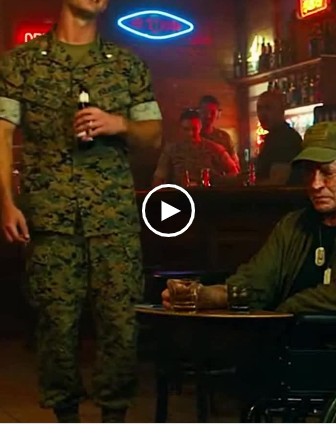
Moments earlier, a young Marine had mouthed off. His joke had landed on the wrong target, a veteran in a wheelchair who looked like he had outlived more storms than the kid had seen sunrises. The words hung there, ugly and unnecessary, and the room felt them like a chill. Then the door opened, and a senior officer stepped in wearing a dark coat slick with rain. He moved with the careful steadiness of a man who knows how much weight words can carry.
“Clear the room,” the general said, voice calm and hard at the same time. Chairs scraped. Boots shifted. Nobody argued. In a matter of seconds, the shuffle settled into silence. The young Marine did not look up or apologize. He simply stared down, trapped by the knowledge that he had crossed a line he did not fully understand.
When the door finally clicked shut again, only three people remained in the bar: the general, the bartender named Rick, and the older man in the wheelchair—the one some regulars called a ghost because nobody believed the things people whispered about him could be true. Some of the whispers were right. Most were not. All of them were dangerous.
The general put a steady hand on the back of a chair as if he needed it to stay grounded. His coat was dotted with rain, and his face was sober. “We need to talk,” he said, his eyes never leaving the older man.
The veteran nodded toward the chair, and the general sat down. The wood creaked like an old floorboard. Outside, the rain tapped the glass with the rhythm of an impatient clock. Rick poured a fresh bourbon, placed it in front of the older man, then set another in front of the general even though it hadn’t been requested. Rick knew when to speak and when to stay quiet. This was the time for quiet.
Two Old Soldiers Face the Past
The general did not touch his drink. He leaned forward, elbows planted on the worn table, and spoke in a voice that suggested there was a lot riding on the answer. “You were supposed to be dead.”
The man in the wheelchair, the one some once called Reaper One, met the general’s gaze without blinking. “I was,” he said. “In every way that counts.”
The general studied him closely, the way you look at a photograph in dim light and try to recognize the face of a friend you have not seen in years. A lot sits behind a look like that—battlefields, lost hours, lost brothers, and a long list of secrets.
“Two months ago we heard someone was digging,” the general continued quietly. “A journalist, or someone smart enough to pretend to be one, started piecing together parts of Operation Black Echo. They have names, photographs, and even old coordinates. Yours is at the top.”
Rick let out a soft whistle and watched the grain of the counter instead of the men at the table. Reaper One took a drink. His hand was steady.
“Tell me you didn’t come back just to sit in the open and wait for trouble,” the general said, the words tight. “If your name goes public—if even a hint of what happened that night sees daylight—it won’t be just you they come for.”
Reaper One held his eyes. “I didn’t come back to hide,” he said. “I came back to finish it.”
The general’s expression shifted with that single line. “Finish what?”
“Whoever’s digging isn’t just chasing a story,” the older man said. “They’re trying to bring something back to life.”
The room felt different then. Even the air seemed heavier. Rick looked up now, his face a shade paler. The word for what the older man meant was simple, but it took a moment to say it out loud.
“The file was locked under Omega clearance,” the general muttered, more to himself than anyone. “Destroyed on paper. Sealed. Buried.”
“So was I,” Reaper One said, voice low.
He opened a small black pouch tucked along the side of his wheelchair and placed something on the table. It wasn’t big, but it carried weight. A polished bullet casing hit the wood with a soft, final sound. Carved into its base were two numbers: 11 and 23.
The general went still. “That can’t be right.”
“They’re code dates,” the older man told him. “Eleven targets. Twenty-three days. Someone is rebuilding the schedule.”
“So you believe the project is being rebuilt,” the general said, not as a question but as a bitter confirmation.
Reaper One nodded. “Not believe. Know. And they aren’t whispering. They want people like us to notice. It’s bait, and it’s a signal.”
A Promise Made in Plain Sight
The general finally picked up his glass and took a measured sip, buying himself a second to think. “You know you can’t disappear again,” he said. “You’re exposed now.”
“I’m not running,” the older man replied, his tone the calm of a storm that has already decided its path. “I’m hunting.”
Rick took one step back from the table, as if an old instinct he had left behind years ago had just stood up again. This wasn’t a night for bar talk. The room had transformed without anyone moving a chair. The old mission feeling was back, and you could taste it like metal on the tongue.
“If you’re going to hunt,” the general said, “you’ll need your team.”
“Most are gone,” Reaper One said. “Some vanished and never came up again. One of them is pretending to be insane in Leavenworth just to stay off the board.”
The general shut his eyes for a heartbeat. “Ghost 6.”
The older man gave a short nod. “I need him.”
The general hesitated. “That’s a big door to open.”
“He remembers the kill switch protocols,” Reaper One said. “If the node goes live again, they can wake sleepers inside any office from Langley to Langford.” He paused, then added in plain words, “That means they can turn good people into unaware weapons, even inside places that are supposed to be secure.”
The general watched the casing with the numbers carved in it. “Are you sure you’re not seeing threats where there aren’t any?”
Reaper One tapped the casing twice with the flat of his finger. “Paranoia is why I’m still breathing.”
Viper Walks In From the Rain
The door opened again, just a slim crack at first. A woman stepped in, soaked through, a duffel over one shoulder. She took in the room like someone who had learned to count exits as naturally as counting breaths. Her gaze was quick, sharp, and certain.
“Didn’t think you’d start without me,” she said, closing the door behind her.
Reaper One didn’t flinch. “Hello, Viper.”
She walked to the table and dropped the duffel with a thump, unzipping it just enough to show the tangle inside—gear, files, and the kind of tools you never talk about in daylight if you can help it.
Rick pursed his lips. “This isn’t that kind of bar anymore.”
Viper offered a quick grin that didn’t quite reach her eyes. “It is tonight.”
The general rose slowly, as if to get a better read on the size of the wave heading their way. “You two together means this is worse than I thought.”
Reaper One looked toward the dusty television mounted over the back shelf. “It’s already started.”
As if on cue, the TV flickered to life without anyone touching the remote. Static gave way to a breaking news banner. The anchor’s voice was calm in the trained way that keeps fear from spreading too fast.
“We’re following reports of another blackout affecting multiple defense networks across the eastern seaboard,” the anchor said. “Officials deny cyberterrorism, but sources say the intrusion resembles the 2006 Langley breach—an event long believed to be internal.”
The general’s jaw tightened. “That breach was scrubbed clean. Your signature was erased.”
“They’re using my prints,” Reaper One said. “Not my fingers. My pattern. The way I move through a system. Everyone has a rhythm, even in code.”
Viper slid a small thumb drive on the table with a firm tap. “They’re using all of ours.”
The room exhaled into quiet. Then Reaper One moved with a speed that surprised anyone who had forgotten what experience looks like. He rolled to the back counter, pulled the old laptop Rick used for the jukebox updates, and plugged in the drive. The screen woke slowly, like a tired eye that didn’t want to open. Then file names began to appear. Old operation logs. Encrypted timelines. Names marked years ago as KIA—killed in action—now showed a different word beside them.
ACTIVE.
Rick’s hand found the edge of the bar. “Oh my God,” he whispered.
The general pulled a chair back to the table and sat again, this time less like a superior officer and more like a man facing down a storm he knew might take roofs and lives with it.
Not a Dig. A Resurrection.
“This isn’t someone poking around for a headline,” the general said slowly. “This is a resurrection.”
Reaper One scrolled through the names and watched the map icon in the corner pulse with a cold, steady beat. “And someone is playing God.”
There was a long pause, the kind that lets a room settle into what it knows it has to accept. The general broke it, his voice steady again. “Then it’s time we play Devil.”
No one argued. Viper turned slightly and began speaking quietly into an earpiece. Rick reached forward and locked the bar’s front door without waiting to be told. The ordinary place where folks used to argue about ball games and listen to old songs had just taken on a new purpose. It was dusty. It was dated. But purpose has a way of cutting straight through that.
“Where do we start?” the general asked.
Reaper One enlarged the pulsing map. Several dots brightened, then one pulsed stronger than the rest. He steadied the cursor over the nearest blinking name. “We start with the closest name marked active. Bravo Seven.”
“He’s dead,” the general said reflexively.
Reaper One watched the corner of the screen where a small graph rose and fell. “Then tell me why I can see his heart rate.”
The Map Points West
They leaned in. The image pulled back to show a facility in Utah. Underground. The readouts were simple and cold. Heart rate. Temperature. Movement. There is something chilling about seeing life measured like that—just numbers, no face attached.
Viper glanced at the data and spoke in the even tone of someone who has delivered difficult news too many times. “They’re using medical labs as holding pens,” she said. “They’re testing how fast they can turn a mind back on after years in the dark. Measuring reaction times. Seeing how much control they can take and how long they can hold it.”
The general swore softly. “Soldiers who don’t sleep, don’t question, and don’t remember. They move, they complete, and then they forget.”
Reaper One looked at the file labels and the too-familiar pathways inside them. “Worse than that,” he said. “They’re using our memories.”
Viper and the general both turned toward him.
“They cloned the old protocols,” Reaper One continued. “If they have the switches, they have our debriefs. Our training movements. Our instincts that got wired into procedure. Bravo Seven won’t hesitate to put a bullet in me, because from the inside, he’ll think he is me.”
The general’s breath came out like he had just been punched. “Jesus.”
Rick found his voice. “What happens if he finds you first?”
Reaper One’s mouth bent into the hint of a smile, not unkind, but firm. “Then I remind him who wrote the book.”
Gearing Up and Getting Real
The general stood, picked up the casing with the carved numbers, and closed his fist around it. “You’ll need authorization, transport, and enough gear to get you in and out again.”
“I’ve got Viper,” Reaper One said simply.
“You’ll need more,” the general replied.
As if the night had been waiting for its cue, the door opened once more. A big man stepped inside, carrying himself with the taller kind of limp that tells a story without words. Ink ran from his neck down his hand, an old pledge wound into skin: Semper Fidelis. Always faithful.
“Heard the old ghost was thirsty,” he said, walking in with a familiar ease.
Viper grinned, this time with warmth behind it. “Grizzly. Thought you were dead.”
“I was,” he said, clapping a heavy hand on Reaper One’s shoulder. “But someone started poking graves.”
Reaper One nodded once. “Good to see you, brother.”
The general pulled out his phone. No code names now. No layers. Just a voice with the kind of authority that still opens doors. “This is General Monroe,” he said into the receiver. “Reactivate Protocol Echo Sierra. Effective immediately. And I need access to Leavenworth in the next hour. Ghost 6 is going home.” He ended the call and looked back at Reaper One. “What do we call this?”
Reaper One turned to the old laptop, watching as more dots woke on the map like embers in a dark field. “We call it the reckoning.”
A New Kind of Battlefield
The words were plain, but they carried the full weight of what everyone in that room understood. The neighborhood bar wasn’t a bar anymore. It was a staging ground. The people inside it weren’t passersby or customers. They were names on a page that had never fully been closed.
Rick moved quietly behind the counter and took a breath like he was steadying himself. He knew enough to know you don’t have to stand on a battlefield to be part of a fight. Sometimes your job is to hand over an old power cord, find a clean towel, or make sure the back door really is locked. Purpose shows up in all kinds of clothes.
Viper was already issuing directions in low tones. Grizzly pulled a chair across the floor and sat where he could see both the laptop screen and the door. The general stood with the casing in his palm, rolling it once as if he could still feel the old timetable written there.
Reaper One took one more look at the drive, then at the names that had switched from past to present as if time could be edited with a keystroke. He had been called a ghost. He had lived like one for years. But a person isn’t a ghost just because the world can’t find them. A person becomes a ghost when the past refuses to let them go. Tonight, the past had walked in from the rain and sat down at the table.
“We start with Utah,” Reaper One said. “We go quiet. We learn who is running their board. We cut their power. We take Bravo Seven without putting him down if we can help it. If he’s still in there, we bring him back.”
“And if he isn’t?” the general asked, not because he wanted to hear the answer, but because he had to know if the line in the sand had been drawn.
Reaper One didn’t blink. “Then we make sure he can’t be used again.”
Viper met his eyes, firm and steady. “We do the job clean.”
Grizzly shifted, the old tattoo moving with the muscle of his forearm. “Always.”
The general slid the casing back across the table. “You’ll have what you need by the time you hit the highway. Leavenworth will stall me, but not for long. Ghost 6 will be waiting when you get where you’re going next.”
Rick poured coffee without asking and set the cups down. “On the house,” he said. “And if the jukebox starts up again on its own, I’m unplugging it.”
For the first time that night, the room exhaled a thin thread of humor. It didn’t change anything, but it lightened the load enough to lift shoulders a fraction higher.
Reaper One took a sip of coffee and felt the heat steady his hands. He wasn’t young anymore. None of them were. But age has its own kind of strength. You learn what to fear and what not to. You learn which promises you can keep and which ones you wish you had never made. And you learn how to walk back into a room and do what needs doing, even when you swore you were done.
The Ghosts Wake Up
“We move in thirty,” Viper said softly.
“Make it twenty,” Reaper One replied.
The rain outside lifted its steady tapping and shifted into a gentler patter. The streetlights hummed. Somewhere a car passed, slow, unaware of the storm gathering in a quiet bar on a quiet block.
They all felt it in their bones. This wasn’t nostalgia, and it wasn’t a retelling of old war stories meant to impress or punish a kid who had said the wrong thing out loud. This was the present coming to collect a debt from the past. It was the start of something that would require steady hands, clear minds, and the kind of loyalty that doesn’t change just because the years do.
The general stood, squared his shoulders, and offered a simple nod. “Bring him back if you can,” he said. “Bring them all back if there’s anything left to bring. And if there isn’t, end it.”
Reaper One looked at the faces around him—Viper, sharp and certain; Grizzly, solid as a wall; Rick, steady in his quiet way; and the general, carrying responsibility like armor. He gave a single nod in return. “We will.”
They checked the room one last time. Not for show. For habit. For respect. For the men and women whose names had flickered from gone to active. For the ones who had paved the way and the ones who had gotten lost along it.
Then they moved. Not fast. Not slow. Just right. The way people do when the path is clear, even if the road ahead is dark.
The neighborhood bar stayed behind them, but it didn’t return to what it had been. Not yet. Not tonight. It would wait, patient, and hold in its walls the echo of a promise. Outside, the rain kept time. Inside, the empty room held the last words spoken before the door opened and the night took them.
It’s a battlefield now.
And the ghosts?
They’re awake.