
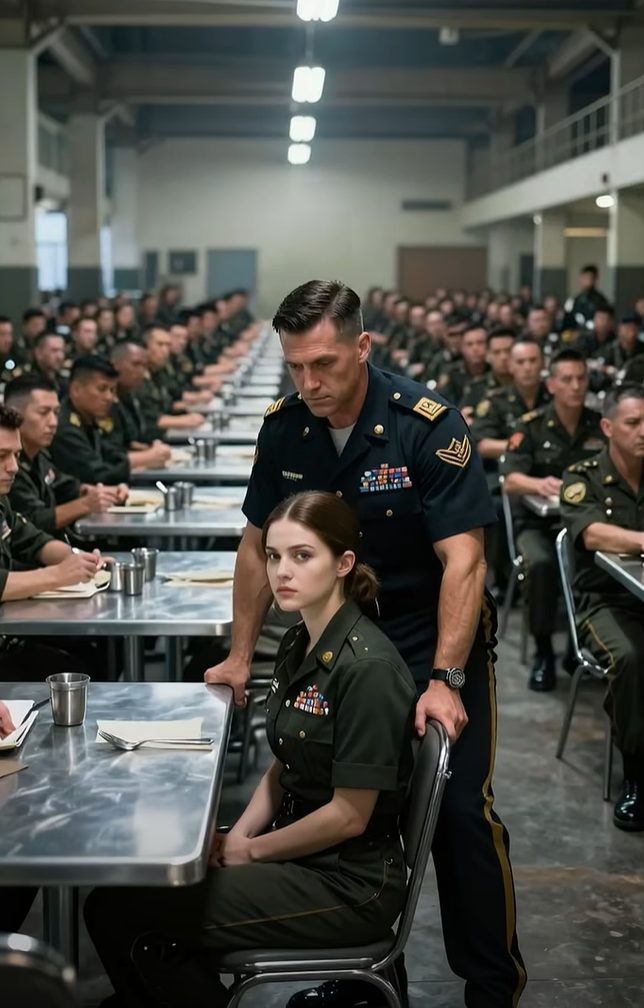
The silence at Joint Base Pearl Harbor-Hickam did not simply fall – it crushed. It was the kind of heavy, pressurized stillness that exists only in the presence of a man who can end a career with a single signature, and Fleet Admiral Jonathan Drake was precisely that man. To the three hundred officers and enlisted personnel in the dining hall, Drake was more than a ranking officer; he was a natural disaster in a white dress uniform, and everyone in the room had learned to read the weather.
He had been making his customary circuit of the hall – a ritual the staff called the Promenade, never to his face – pausing at tables with the performative warmth of a man who had rehearsed human decency. When he stopped behind the woman in the olive flight suit, the gesture looked almost collegial. A hand rested on the back of her chair. A lean forward, as though to share something private and benevolent. To anyone watching from across the room, it might have read as mentorship.
It was not mentorship.
The woman did not turn her head. She did not have to. Her right hand, which had been curled loosely around a coffee mug, went very still – the particular stillness of something that has made a decision.
“Touch me again, Admiral.” Her voice was barely above a murmur, calibrated precisely so that only the nearest tables could hear. “And you’ll finally understand who really commands this base.”
The air around her had become a localized field of high voltage. Drake straightened slowly, his hand withdrawing by a fraction – not retreating, he would have told himself, simply reassessing the terrain. His ego was as vast as the Pacific Fleet he commanded, but somewhere beneath it, older and more animal, lived an instinct for genuine threat. That instinct was awake now, sending heat up the back of his neck.
He had not survived thirty-eight years of naval politics by ignoring that instinct.
What he did not know – what no one in the dining hall could have known – was that the woman’s flight suit bore no name tape by design. That the coffee mug she had not released contained grounds she had not yet drunk, because she had been trained, long ago and in a program whose budget existed in no public ledger, to never fully occupy any room she might need to leave quickly. That three weeks earlier, in a building with no listed address in a city she was not supposed to have visited, she had watched a man with more institutional power than Drake sign a document that made her, functionally, invisible to the chain of command he believed he sat atop.
Drake leaned down until his mouth was level with her ear, his voice dropping to a frequency designed to intimidate without witnesses.
“You have five seconds,” he said, “to tell me who you are and why you’re in my dining hall. Before I have you removed – and believe me, Commander, whatever you think you know, I have buried careers for far less theater than this.”
The woman finally turned her head. Just enough. Her eyes, when they found his, held no anger – which was somehow worse than anger. They held the calm, specific patience of someone who had already seen how this ended.
“I know you have,” she said. “That’s exactly why I’m here.”
The Woman Without a Name Tape
Her name was Karen Pruitt.
Not that Drake knew that. Not that it would have meant anything to him if he had, which was precisely the point of the last four years of her life.
She’d come up through naval aviation the long way – Pensacola in the mid-nineties, two deployments on the Kitty Hawk, a third that she couldn’t discuss in any unclassified setting. She’d been good. Better than good, if you asked the men who’d flown alongside her, though most of them had learned not to say so too loudly around Drake’s people. The Pacific Fleet had a culture, and the culture had a ceiling, and the ceiling had Drake’s handprints all over it.
She’d watched it happen to three women before her. Four if you counted Renee Holloway, who technically resigned voluntarily but whose resignation letter had been drafted in a JAG office at two in the morning after a meeting with Drake’s chief of staff that she’d never described in detail to anyone, including Karen.
Renee had been Karen’s closest friend for eleven years. She was currently teaching high school physics in Tucson, Arizona, and she didn’t talk about the Navy.
So Karen had understood, by the time her own career reached the altitude where Drake’s attention became an occupational hazard, that the institution was not going to protect her. The institution had never protected anyone Drake decided to notice. The institution, in fact, had developed a sophisticated bureaucratic immune system that treated accountability as the pathogen.
What the institution had not counted on was that Karen had spent the previous eighteen months being recruited by people who operated entirely outside of it.
The Program With No Budget Line
She couldn’t tell you the official name of the office. Partly because it changed every fiscal year. Partly because the version she’d been read into didn’t have an official name, just a room number in a building on the third floor of a structure that Google Maps showed as a parking garage.
What she could tell you was that the man who recruited her was named Gary. Just Gary. He wore a brown cardigan and carried a thermos of terrible coffee and had the specific energy of a retired high school vice principal who had, at some point in his unremarkable life, personally ended the careers of eleven senior military officers and one sitting congressman.
Gary had found her after the second incident with Drake.
The first incident she’d documented herself – date, time, witnesses, the exact words, the exact hand placement. She’d put it in a folder and given a copy to her JAG contact and kept one in a safety deposit box in Honolulu and emailed one to a personal account she accessed from a laptop that had never touched a government network.
The second incident, three months later, she’d done all of that again. Plus one additional step. She’d sent a copy to an address Gary had given her, through a mutual contact, at a dinner party she’d attended in Arlington the previous November. The dinner party had been unremarkable except for the fact that every person there had been, at some point, told by someone in uniform that their problem didn’t rise to the level of official concern.
Gary called her six days after she sent the folder.
“We’ve been watching Drake for two years,” he said, without introduction, on a Tuesday afternoon. “You’re not the first. You’re the thirteenth.”
She’d sat with that number for a moment.
“What happens to thirteen?” she asked.
“That depends,” Gary said, “on whether thirteen is willing to be in a very specific room, on a very specific day, and say a very specific thing.”
What She Already Knew
The thing about Drake was that he was careful. Careful in the way that men with thirty-eight years of practice are careful, which is to say he had never once left a clean evidentiary line between himself and the damage he caused. His chief of staff handled the paper. His flag aide handled the conversations. Drake himself dealt only in implication, in proximity, in the particular pressure of his physical presence in a room.
He’d been investigated twice. Both times the investigations had concluded with findings that were, in the official language, “insufficient to substantiate.” Both times, the investigators had been rotated to assignments that were technically lateral but practically career-ending. Both times, the women who’d filed the original complaints had left the service within eighteen months.
The Navy had a word for what Drake did. Several words, actually, scattered across various policy documents and training modules and the laminated cards they handed you at indoctrination. What the Navy did not have was a mechanism for applying those words to a man who had personally approved the fitness reports of half the people who would have needed to act on them.
Karen knew all of this because Gary had given her a file. Not a thin file.
She’d read it over two evenings in a hotel room in San Diego, drinking bad vending machine coffee, and by the end of the second evening she’d understood that Drake’s career was not a series of isolated incidents. It was a system. Deliberate, maintained, evolved over decades. The same patterns in Yokosuka in 2003 as in Bahrain in 2009 as in Pearl Harbor now. Different women. Same architecture.
The file also contained something else. Something Gary had flagged with a single yellow sticky note that said, in his cramped handwriting: This is why you’re the one.
It was a memo. Internal. Dated fourteen months ago. Drake’s signature at the bottom.
She’d read it three times before she understood what she was looking at.
The Dining Hall, Continued
Drake was still leaning over her. He had not moved. The men at the nearest tables had found things to study in their food.
“Why you’re here,” he repeated, and his voice had shifted slightly. Still controlled. But the register had changed. A half-step lower. The voice he used when he was deciding something.
Karen set down the coffee mug. Slowly. Both hands flat on the table.
“Fourteen months ago,” she said, “you signed a memo recommending the discontinuation of the joint harassment reporting protocol. The one that would have created an independent review board outside the chain of command.” She kept her voice the same volume. Conversational. “You cited budgetary concerns. You CC’d four people. Three of them are currently serving on the promotion board for O-6.”
Drake’s face did not move. That was the tell. A man with nothing to hide would have frowned, would have searched his memory, would have produced some version of confusion. Drake’s face went flat and still, the way a surface goes still when everything underneath it stops.
“The fourth person you CC’d,” Karen continued, “retired eight months ago and is currently cooperating with an inquiry that doesn’t appear anywhere in your threat model. Because it isn’t military. And because the man running it drinks terrible coffee and wears a brown cardigan and has been doing this since before you made O-5.”
She picked up the coffee mug again.
“You asked who I am.” She finally looked up at him directly, the full look, nothing held back. “I’m the woman who’s been sitting in your dining hall for six weeks eating your food and watching you run your Promenade. And I’m the woman who, forty minutes from now, is going to walk into a conference room on the second floor of this building and brief four people on everything in that file. Including the memo. Including today.”
Drake straightened. All the way up. His hand had been on the back of her chair this entire time; he removed it now, and the removal was careful, deliberate, the movement of a man recalibrating in real time.
“You have no authority,” he said.
“No,” Karen agreed. “I don’t.”
She stood up. Picked up a manila folder that had been sitting face-down on the table beside her tray, a folder so ordinary and unremarkable that no one in the room had clocked it.
“But the people I’m briefing do.”
What Happened After
The conference room was on the second floor, as she’d said. The four people in it were not in uniform. Two of them she’d met before, briefly, at Gary’s instruction. The other two she was meeting for the first time, and one of them, a woman in her sixties named Barbara, had a legal pad in front of her that was already half-covered in handwriting before Karen sat down.
The briefing took two hours and twenty minutes.
Drake did not appear. He was, at that moment, in his office, and his flag aide was outside the door turning away every appointment on his calendar, and his chief of staff had not answered two calls.
The inquiry that followed was not fast. Nothing real ever is. It took eleven months, and there were three moments during those eleven months when Karen was certain it was going to collapse, when the institutional immune system was going to do what it had always done and metabolize the threat and return to baseline.
It did not collapse.
The memo was the thing. Gary had been right about that. The memo wasn’t just evidence of Drake’s conduct; it was evidence of his strategy, his deliberate effort to dismantle the one mechanism that might have stopped him years earlier. That turned a harassment case into something with a different legal character entirely. Something that the people in the conference room, and the people above them, could not route around.
Drake retired. The announcement used the word “distinguished.” His fitness reports for the last decade were placed under review. The promotion board for O-6 was paused and then reconstituted with different members.
Renee Holloway, in Tucson, got a call. Karen doesn’t know exactly what was said on that call. Renee hasn’t talked about it. But she did, six months later, send Karen a photograph. The two of them, grinning, standing in front of a rental car somewhere in New Mexico on a road trip that had no particular destination.
Karen kept it on her phone. Not framed anywhere. Not posted anywhere.
Just there, in her camera roll, between a screenshot of a boarding pass and a blurry photo of a sunset she’d meant to delete.
Some things you keep where only you can find them.
—
If this one stayed with you, pass it on to someone who’d get it.



