
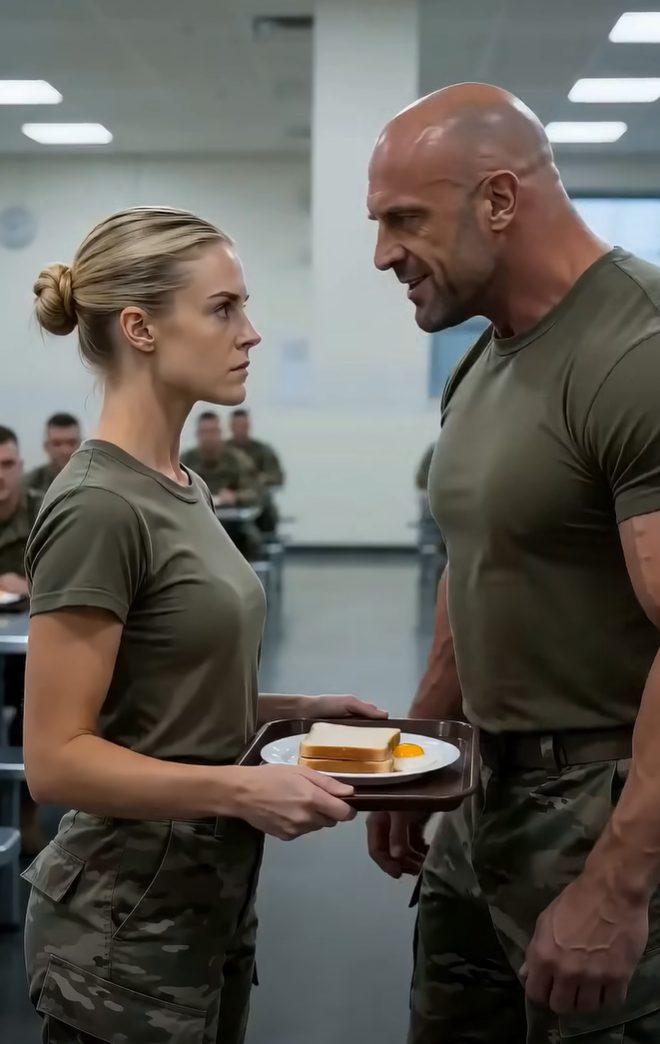
The mess hall smelled like burnt coffee and reconstituted eggs.
Fluorescent lights hummed overhead, bleaching everything the same institutional white.
Dozens of recruits sat shoulder to shoulder, eating the exact same breakfast.
Two slices of bread. One fried egg.
No exceptions. No favorites.
At the center of the room stood the only woman in the unit.
Blonde hair pulled into a military bun. Tray held level. Eyes forward.
She looked like she hadn’t slept in three days.
She walked like it didn’t matter.
Then the Commander stepped into her path.
The room didn’t go quiet all at once. It went quiet the way a fire goes out – one corner, then another, until there was nothing left.
Everyone knew what was coming.
He was the kind of man who filled a doorframe without trying. Bald head. A bodybuilder’s frame gone slightly to ego. He didn’t raise his voice to intimidate people. He didn’t need to.
He stepped forward until his shadow swallowed her tray.
“You really think you belong here?” he asked. Almost gentle.
Several recruits smirked into their food.
She didn’t answer. Didn’t shift her weight. Didn’t give him a single millimeter.
Don’t react, she told herself. That’s what he’s selling tickets to.
He leaned in until his face was inches from hers.
“This place isn’t built for people like you.”
Laughter rippled from somewhere behind her. One voice, then several.
“She doesn’t even fit in.”
“This is gonna be good.”
Phones appeared beneath tables like they’d been waiting.
The Commander stepped aside with a grin that had nothing friendly in it.
She kept walking. Tray steady. Posture straight. Giving them absolutely nothing.
Then his arm swung hard into the bottom of her tray.
The plastic cracked upward. The plate hit the floor and shattered. Egg slid across the tile. Bread scattered under boots.
The crash rang through the mess hall like a starting gun.
And the room erupted.
Cheering. Clapping on tables. A few recruits actually stood up, like they’d just watched a knockout. The Commander threw his head back and laughed the loudest of all.
She didn’t look down.
Not at the plate. Not at the food around her boots. Not at a single face in the room.
She stood exactly where she was. Arms at her sides. Eyes level. Still.
The laughter peaked.
Then it started to thin.
Because the longer she stood there – ten seconds, fifteen, twenty – the more the room seemed to turn on itself. One recruit dropped his eyes. Then another. The clapping stopped first, then the cheering, until the only sound left was the Commander’s laughter fading into something that no longer had any company.
She still hadn’t moved.
And slowly, without anyone deciding to, the mess hall understood what it had actually just witnessed – not a humiliation, but an attempt at one. The difference was becoming harder to ignore by the second.
That’s when the door at the far end of the hall opened.
Boots on concrete. Measured. Unhurried.
The recruits nearest the entrance turned first. Then the ones behind them. A ripple of straightening spines moved through the room like a current.
The Commander’s laughter stopped.
He turned around.
And whatever he saw in the doorway wiped the grin completely off his face.
Who Just Walked In
Colonel Doris Hatch had forty-one years of service behind her.
She didn’t look it, exactly. She looked like someone’s aunt – the kind who sends birthday cards on time and keeps hard candy in her purse. Medium height. Reading glasses on a chain. Hair gone mostly silver, cut short and practical.
But every person in that room with more than six weeks of training knew who she was.
She’d done two tours before the Commander had graduated high school. She’d been one of four women in her entire training class, and the other three had washed out by week three. Not because they couldn’t cut it. Because the system, in those days, was specifically designed to make sure they didn’t.
She’d cut it anyway.
She walked into the mess hall the way she walked everywhere – like the building had been put there for her convenience – and she took in the scene in about two seconds flat. The shattered plate. The egg on the tile. The woman standing in the middle of it, still holding her empty tray. The Commander, standing three feet away, already composing his face into something neutral.
He didn’t get there fast enough.
Colonel Hatch had seen that particular expression before. The one men wore right after they’d done something they knew was wrong and were now calculating how to frame it.
She’d been watching that calculation her entire career.
What She Didn’t Say
She didn’t speak immediately.
That was the thing about Hatch – she let silence do the heavy lifting. She crossed the mess hall at the same unhurried pace, and the recruits who’d been half-standing sat back down, and the ones with phones under the table put them in their pockets, and the whole room kind of held its breath and waited.
She stopped next to the woman with the empty tray.
Looked down at the broken plate.
Looked at the Commander.
He opened his mouth.
“Colonel Hatch, I was just – “
“I know what you were just,” she said.
Quiet. Flat. The kind of flat that isn’t calm, it’s just all the heat compressed down to a point.
She looked at him for another three seconds. He was a big man. She was not a big woman. It didn’t seem to matter.
Then she turned to the woman beside her and said, “Get another tray.”
That was it. No speech. No dressing-down in front of the room. No dramatic moment of vindication. Just: get another tray. Like the whole thing was an administrative inconvenience that had already been dealt with.
The woman – her name was Corporal Sandra Pruitt, twenty-six years old, nine weeks into a program that had been trying to spit her out since day one – set her empty tray on the nearest table and walked to the serving line.
Her hands were steady.
Nobody said a word.
What Happened After
The Commander was removed from his post fourteen days later.
Not because of the tray. Or not just because of the tray – the incident had been filmed on three different phones, and those clips had made their way up the chain of command faster than he’d expected, which was to say at all. But the investigation that followed turned up other things. A pattern, documented over two years. Complaints that had been filed and quietly buried. Recruits who’d left the program and, when asked later, had said they’d been pressured to say nothing.
He didn’t go quietly. He told people it was politics. He told people Hatch had a grudge. He told anyone who’d listen that Pruitt had provoked him, which was a claim so thin you could see through it, and which collapsed the moment anyone watched the footage.
Pruitt didn’t watch the footage. She’d been there.
She finished the program six weeks later. Second in her class. She didn’t make a big deal out of it. She picked up her certification, shook the hands she needed to shake, and went where she was assigned.
A reporter tried to interview her twice. She declined both times.
Her mother called when the story started circulating online. Asked if she was okay.
“I’m fine, Mom.”
“You should have thrown the tray back at him.”
Sandra laughed. First real laugh in about three weeks. “That’s not how it works.”
“It’s how it should work.”
What She Actually Thought, Standing There
Here’s the thing nobody asks about.
The twenty seconds she stood in the middle of that mess hall, surrounded by people laughing at her, egg on the floor at her feet – she wasn’t thinking about dignity. She wasn’t thinking about being strong or proving a point or what any of it would look like later.
She was thinking about her father.
Specifically, she was thinking about the morning she was twelve years old and her father had driven her to a swim meet three towns over, and she’d come in last in her heat, and she’d cried in the parking lot, and he’d stood next to her and waited until she was done and then said: You don’t have to win. You have to finish.
She’d thought it was a stupid thing to say at the time.
She’d finished every race since.
Standing in the mess hall, she wasn’t composing herself. She wasn’t performing composure. She was just waiting for the next thing she had to do, the same way she always had. Her hands were cold. Her jaw ached from keeping it still. The fluorescent light directly above her had a flicker she hadn’t noticed before, a tiny irregular pulse, and she’d been staring at it for so long she’d started counting the intervals between blinks.
That’s what those twenty seconds actually were.
Not a statement. Not a moment.
Just a woman, counting the flickers in a bad light, waiting for whatever came next.
What She Keeps
She still has the tray.
Not the broken plate – that stayed on the floor, got swept up by whoever drew kitchen duty that morning. But the tray itself, the plastic one that took the hit and didn’t crack, got handed back to her by a recruit she didn’t know when she came back from the serving line with her second breakfast.
She doesn’t know why she took it home. She doesn’t know why she kept it. It sits on a shelf in her apartment in a city she’s not allowed to name, next to a photo of her father and a coffee mug she’s had since college.
People who come to her apartment don’t ask about it. It’s just a plain gray mess hall tray. Nothing to look at.
She knows what it is.
Her father died the winter before she started the program. Heart attack, fast, which her mother said was a mercy and which Sandra is still deciding about. He never knew she’d applied. She’d been going to tell him when she got in.
She tells herself he’d have thought the tray thing was funny.
He probably would have.
You don’t have to win, he’d have said. You just have to finish.
She’s still finishing.
—
If this one stayed with you, pass it along to someone who needs it today.



