
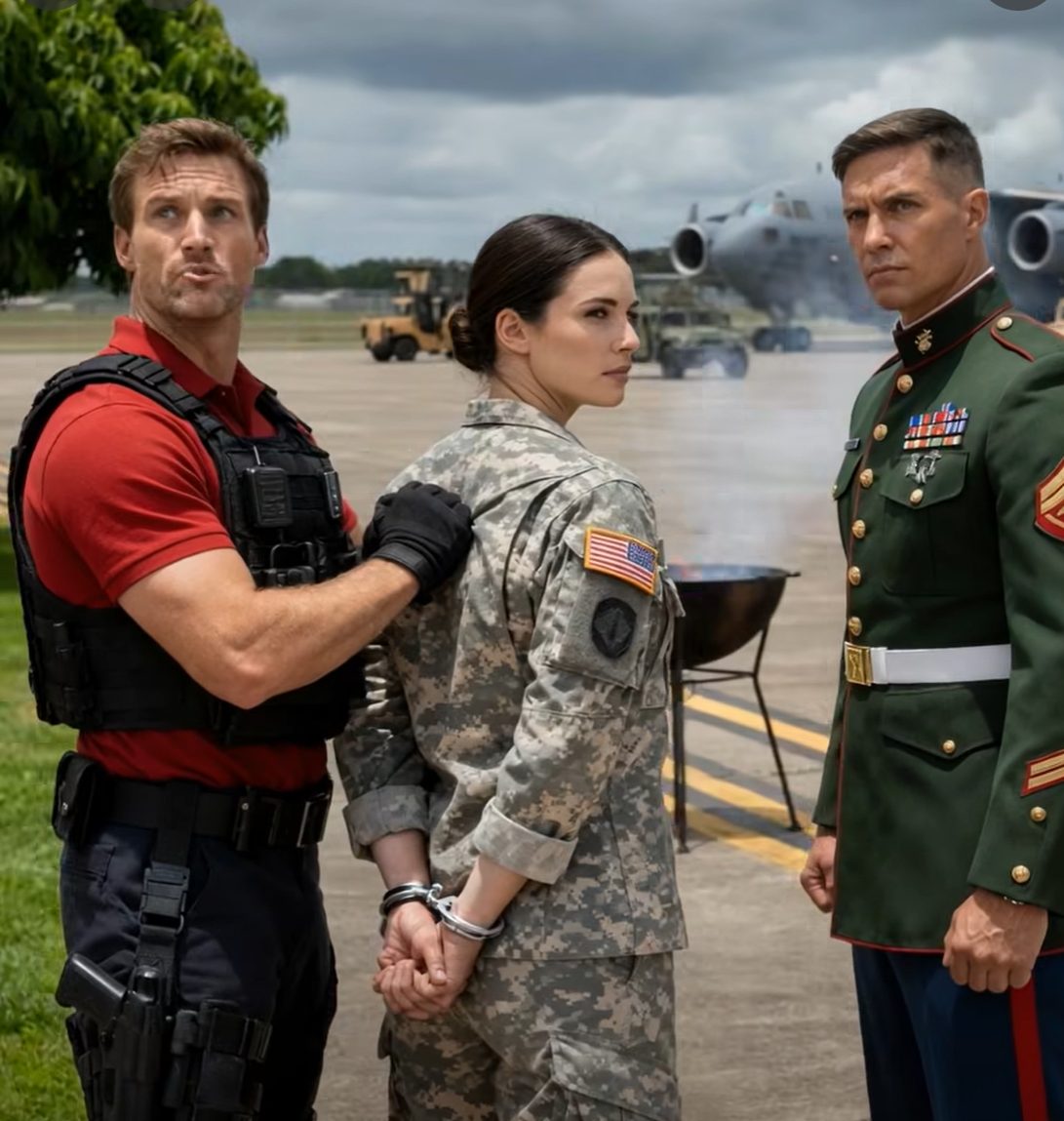
My cousin arrested me in front of my entire family with barbecue sauce on his shirt and my grandmother’s potato salad still on my paper plate.
He shoved my face toward the picnic table and hissed, “Let’s see who respects you now, Evelyn.”
Three seconds later, a black government SUV rolled up the gravel driveway, and a sergeant in dress uniform stepped out like he had walked straight through thunder.
He looked past the shocked cousins.
Past my mother’s pale face.
Past the sheriff’s deputy gripping my wrists too tightly.
Then he saluted me.
“General Klein,” he said. “We’re here.”
The whole backyard went silent except for the cicadas screaming in the Georgia heat.
My cousin Tyler’s hand loosened around the cuffs.
Just a little.
Not enough.
His fingers were damp.
I could feel him calculating behind me, trying to decide whether this was a prank, a mistake, or the end of the little kingdom he had built around our family’s fear.
I didn’t move.
I didn’t raise my voice.
I didn’t cry.
I just turned my head enough to look at him over my shoulder.
“Tyler,” I said quietly, “you’re going to want to take these off before he asks twice.”
He laughed.
It came out wrong.
Too sharp.
Too high.
Behind him, Uncle Rob lowered his beer can.
Aunt Marlene stopped fanning herself with a paper plate.
My mother, Denise Klein, stood by the porch steps with one hand pressed flat against her chest, wearing the same expression she had worn the day I left for basic training at seventeen.
Disappointment dressed up as concern.
She mouthed my name.
Not because she was worried.
Because she was afraid I might embarrass her again.
That had always been her favorite word for me.
Embarrassing.
I embarrassed her when I enlisted instead of taking the receptionist job at her dental office.
I embarrassed her when I came home with a limp and refused to explain why.
I embarrassed her when I bought a house instead of moving back into her basement after my divorce.
I embarrassed her by being quiet.
I embarrassed her by not begging.
I embarrassed her most of all by surviving things she had told everyone were just “attention-seeking stories.”
For fifteen years, my family called me dramatic.
For fifteen years, my family called me cold.
For fifteen years, my family called me useless.
For fifteen years, my family used my silence like a shovel and buried me alive with it.
But silence is not surrender.
Sometimes silence is a locked door.
Sometimes silence is a loaded file.
Sometimes silence is a woman counting every lie until the room is full enough to burn.
Tyler tightened the cuffs again.
“Cute,” he said. “Real cute. Which one of your army buddies did you call to play dress-up?”
The sergeant’s jaw moved once.
Only once.
He was tall, broad-shouldered, with ribbons squared perfectly across his chest and a face carved into discipline. His name was Marcus Reed. Sergeant First Class Marcus Reed. I had seen him drag two wounded men through burning debris outside Mosul with one working arm and a broken cheekbone.
He was not a man who enjoyed being called a costume.
He took one step forward.
Tyler drew himself up like the badge on his chest made him bulletproof.
“This is an active arrest,” Tyler snapped. “You need to stay back.”
Marcus looked at me.
Not at Tyler.
At me.
His eyes asked one question.
Do you want me to intervene?
I gave the smallest shake of my head.
Not yet.
Because the whole family was watching.
And for once, I wanted them to see the shape of the knife before I took it away.
The BBQ had started at noon.
By three, the grass was flattened from kids running in circles, the folding chairs had sunk into the soft ground, and smoke from Uncle Rob’s ribs hung low beneath the pecan trees.
The Klein family did Memorial Day big.
The Kingdom Tyler Built
Every family has one. A person who got just enough authority to become a problem.
Tyler Klein was thirty-nine years old. He had been a Pritchard County sheriff’s deputy for eleven years. He drove his patrol car to family functions even when he was off-duty. He kept the badge clipped to his belt at church. He had opinions about how women should carry themselves, how men should shake hands, and how the military was “fine for people who couldn’t get into college.”
He’d said that last one to my face in 2003, the week before I shipped to Fort Jackson.
I was seventeen. He was twenty-five. He said it at Grandma Loretta’s kitchen table while she was in the other room, which was how Tyler operated. Loud enough to land. Quiet enough to deny.
I didn’t answer him then. I just picked up my duffel bag and walked out the door.
He took my silence as shame. He’d been taking it as shame ever since.
That was the foundation of the kingdom: the idea that I had nothing to say because there was nothing to say. That the quiet woman who came back from deployments looking thinner and harder and less interested in family gossip had been broken by something and hadn’t the dignity to admit it. Tyler had told that story so many times that most of the family believed it. My mother believed it. Uncle Rob half-believed it. Even my cousin Patrice, who was the closest thing I had to a friend in that yard, had said once, gently, that maybe I should “open up more.”
What nobody knew, because I had not told them, was that I couldn’t open up more. Not about any of it. Not yet. There were clearances involved. There were non-disclosure agreements. There were things I had done and seen and ordered that would not appear in any newspaper for another twenty years, if ever.
The silence wasn’t damage.
It was protocol.
But Tyler had built eleven years of dominance on his interpretation of it, and today, Memorial Day, with the whole family assembled and three beers in him before two o’clock, he had decided to make it permanent.
What Started It
I should have left when he started in on the car.
I drive a black Suburban. Government plates, which I’m permitted to keep on a personal vehicle under certain conditions. Tyler clocked it the second I pulled in, and I watched him do the math wrong in real time.
“Who’d you borrow that from?” he called across the yard.
“It’s mine.”
“Sure it is.”
That was it. That was the whole conversation. But it sat in him wrong, because Tyler’s truck was a 2019 F-150 with a cracked taillight and a payment plan, and he’d spent the last decade being the most impressive Klein at every gathering.
An hour later he found me by the cooler and told me I had “an attitude problem.”
I said I didn’t have an attitude. I said I was just standing by the cooler.
He said I knew what he meant.
I said I didn’t.
He said I’d always thought I was better than everyone.
I said I didn’t think that.
He said then why wouldn’t I ever talk about what I did over there.
I said some things aren’t mine to talk about.
His eyes went flat. That specific flat. The one that comes right before a man decides to prove something.
“You know what I think?” he said. “I think you were a secretary. I think you filed papers for fifteen years and now you’re embarrassed about it and you dress it up in mystery so nobody asks too many questions.”
I looked at him for a moment.
Then I picked up my paper plate of potato salad and walked toward the picnic table.
He followed me. I heard him tell Uncle Rob I was “doing it again.” I heard Rob grunt in response. I sat down. I ate a forkful of potato salad.
That’s when Tyler came up behind me, grabbed my arm, and told me he was detaining me for “suspicious vehicle registration” and “failure to identify.”
Both of which were false. Both of which he knew were false.
But the family was watching. And Tyler needed them to keep watching him the right way.
Sergeant Reed Does Not Wait Forever
Marcus hadn’t moved from beside the SUV.
He was standing with his hands clasped behind his back in parade rest, which to a civilian looks like patience. To anyone who’s served, it looks like a man choosing not to do something he’s very capable of doing.
There were two other men in the vehicle. I could see them through the tinted glass. They had not gotten out. They would not unless I indicated.
Tyler still had the cuffs on me. He was talking. Something about jurisdiction and how Marcus needed to produce credentials and how this was a lawful county matter. His voice had taken on the specific register of a man who has realized he’s in over his head but cannot stop swimming forward.
My Aunt Marlene had put down her paper plate entirely. She was staring at Marcus’s ribbons. She’d been an Army wife for six years before Uncle Dennis died, so she knew what she was looking at. I watched her do the count. I watched her face change.
“Tyler,” she said.
He didn’t hear her.
“Tyler.” Louder.
“Marlene, I’m handling something – “
“Boy,” she said, “you look at that man’s chest and you tell me what you see.”
Silence. Tyler looked. He didn’t know what he was seeing, not exactly, but he knew it was a lot. More than he’d expected.
Marcus spoke again. Same volume as before. Unhurried.
“Deputy Klein. I’m going to ask you one time to release the General. After that, I’m going to make a phone call that will end your career before the holiday weekend is over. That’s not a threat. That’s a schedule.”
Tyler laughed again. Same broken sound as before.
But his hands had stopped moving.
What Was in the Folder
Here is the thing about spending fifteen years being called nobody.
You document everything.
Not out of spite. Out of habit. The military trains it into you: log it, file it, date it, keep copies. I had applied that habit to my civilian life the same way I applied it to everything else. Methodically. Without drama.
The folder in my Suburban’s center console was three inches thick.
It held my DD-214. My promotion orders, every one of them. My security clearance documentation, the version I was permitted to carry. Two commendation letters, one of which had the Secretary of Defense’s signature on it. A copy of the federal statute that made what Tyler had just done a crime. And a personal letter from a general officer that I had never shown anyone, not once, because I hadn’t needed to.
Until today.
Marcus walked to the vehicle. He came back with the folder. He set it on the picnic table next to my paper plate, open to the first page.
My mother leaned forward.
She read my name. My rank. My dates of service. The list of assignments, most of them redacted but the shape of them visible, the way a body is visible under a sheet.
Her hand was still on her chest.
But her face had changed.
Not into pride. I want to be honest about that. My mother’s face did not flood with pride the way it does in the version of this story where everything resolves clean. What crossed her face was something more complicated and less flattering. Something that looked, if I had to name it, like the specific shame of realizing you have been wrong about something for a very long time and that everyone in the yard had just watched you be wrong about it.
She sat down in one of the folding chairs.
She didn’t say anything.
Tyler Takes the Cuffs Off
He did it himself. I’ll give him that.
He didn’t wait for Marcus to ask twice. He found the key in his pocket, unlocked the cuffs, and stepped back. His face was doing several things at once. His mouth was working toward something that might have been an apology or might have been another angle of attack; I genuinely couldn’t tell which way it would break.
I rubbed my wrists. Picked up my fork. Finished the potato salad.
“The vehicle registration,” I said, “is current. You can call the DMV if you want confirmation. The number’s on the plate.”
Tyler said nothing.
“The failure to identify charge,” I said, “doesn’t apply because I gave you my name when you asked. You have that on your body camera, assuming it was on. If it wasn’t on, that’s a separate issue you’ll want to address before Monday.”
Marcus was standing three feet away, not looking at Tyler, which was somehow worse than if he had been.
Uncle Rob set his beer can down on the cooler. It was the quietest sound in the world.
“Evelyn,” Aunt Marlene said, “do you want more potato salad, honey?”
And that was it. That was the sound of the kingdom coming down. Not a crash. Not a speech. Just Marlene asking about potato salad in a voice that meant she was choosing a side and had already chosen it and was done with the whole business.
I said yes. I said I’d love some more.
Marcus stayed for forty minutes. He had business nearby, genuinely, which was why the timing had worked out the way it did. He ate two of Uncle Rob’s ribs and told Grandma Loretta her lemonade was the best he’d had in Georgia, which made her laugh in a way I hadn’t heard in years.
Tyler left before the fireworks. Drove his patrol car down the gravel driveway and didn’t say goodbye to anyone.
I stayed until dark.
I sat in a folding chair next to Aunt Marlene and watched the kids catch fireflies in the field behind the fence, and I ate a second paper plate of food, and nobody called me dramatic or cold or useless or embarrassing.
Not once.
My mother came and sat beside me around eight o’clock. She didn’t say much. She said she hadn’t known. I said I was aware she hadn’t known. She said she wished she had. I said I understood that.
We watched the fireflies for a while.
It wasn’t forgiveness. Not yet. Maybe not ever, completely. But it was two women sitting in folding chairs in Georgia in the dark, and that was more than we’d managed in a long time.
I drove home at nine-thirty. The Suburban’s headlights swept across the empty driveway where Tyler’s truck had been.
I turned onto the county road.
The cicadas were still going.
—
If this one hit somewhere real, pass it to someone who needs it.
If you’re looking for more wild tales, you won’t want to miss when My Sergeant Cut Off My Hair at 3 a.m. to Destroy Me at Inspection or the chilling story of I Was Reaching for My ID When He Pulled the Trigger. And for something truly mysterious, discover why She Pounded the Chapel Glass With Bloody Fists and Nobody Would Tell Me Why.



