🛩️ I hid my father’s classified secret inside this rusted Warthog for twenty years, but today the dead system finally woke up…
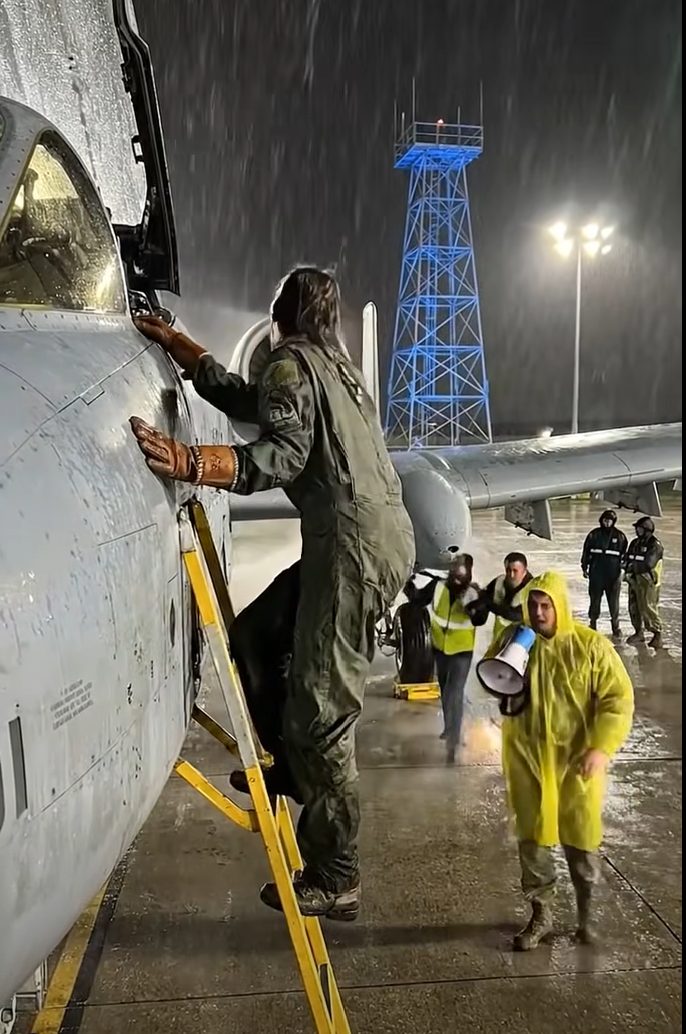
The cockpit smelled of old grease, ionized air, and the faint, copper tang of her own adrenaline.
Kelly didn’t look at the radar. She didn’t need to. The shrill, rhythmic chirp-chirp-chirp of a Search-and-Track spike was vibrating through the soles of her flight boots. Somewhere above the shimmering heat haze of the Mojave, a pair of F-16s were painting her matte-gray skin with invisible lasers.
“November 3814 Charlie, you are in breach of restricted airspace,” the radio barked. The voice was young, clipped, and heavy with the boredom of someone who had never seen a real dogfight. “Comply immediately or you will be shadowed to the perimeter. How’s the weather down there in 1974, Ma’am?”
Kelly didn’t key the mic. Her thumb hovered over the cool plastic of the throttle, feeling the familiar, notched resistance. She leaned into the turn, the A-10 responding not with a snap, but with a heavy, gravitational groan. To her left, the canyon wall was a blur of sun-bleached sandstone, so close she could see the individual fractures in the rock.
The stick pulsed against her palm – a rhythmic tremor, like a heartbeat made of hydraulic fluid.
Suddenly, a silver flash cut across her canopy. The lead F-16 dropped from the sun, its polished fuselage reflecting the desert floor like a chrome blade. It leveled off barely twenty feet from her wingtip. The pilot pulled his oxygen mask away for a split second, a smirk visible even through the distance. He gave a mocking two-finger salute, then banked away, his engine wash tossing the Warthog like a leaf in a gale.
Kelly gripped the controls, her knuckles white inside the worn leather of her father’s gloves. She felt the stitch on her left wrist bite into her skin.
“Lead to Tower,” the pilot’s voice crackled, leaking into her frequency. “Visual confirms it’s a museum piece. A-10, tail number 880914. Looks like she’s held together with spit and prayer. We’ll walk this brick to the fence.”
Kelly’s gaze shifted to the dashboard. Beneath a layer of fine desert dust, a small, recessed light – one she had never managed to fix in three years of restoration – suddenly flickered. It wasn’t green or red. It was a low, steady amber.
The IFFF (Identification Friend or Foe) display, an analog relic, began to whir. The numbers didn’t cycle through civilian codes. They began to spin backward, clicking like a geiger counter reaching a hot zone.
8-8-0-9-1-4.
The cockpit temperature seemed to drop ten degrees. The “brick” didn’t just fly; it hummed. A deep, sub-vocal frequency resonated through the seat, a sound Kelly hadn’t heard since she was six years old, sitting on her father’s lap in a darkened hangar.
“Lead, this is Tower,” a new voice broke over the comms. The boredom was gone. In its place was a cold, sharp vacuum of silence. “Lead, break formation. Move to five thousand feet immediately. Do not – repeat, do NOT – engage that aircraft.”
“Tower? It’s just a civilian mod, what’s the – “
“Get clear, Lieutenant!” the voice roared. “You’re not shadowing a civilian. You’re standing next to a ghost.”
Kelly looked down at her father’s flight notes, taped to her thigh. The ink seemed darker, the slanted block letters suddenly legible in the harsh light. She reached out and flipped a switch she had been told was dead for twenty years.
The A-10 didn’t scream. It exhaled.
On the radar screen of the F-16 above, the gray dot of the Warthog didn’t just vanish. It split into three, then merged into a symbol the pilot had only seen in classified historical briefings. A crown. The Monarch.
Kelly keyed the mic, her voice a low, steady rasp that cut through the static. “Tower, this is 880914. I’m not lost. I’m exactly where I’m supposed to be.”
As she leveled the wings, she noticed a detail the F-16 pilots had missed. On the floor of the cockpit, rolling out from under the seat with the force of the turn, was a single, spent 30mm shell casing – stamped with a date that hadn’t happened yet.
What Her Father Left Behind
The shell casing wasn’t the first thing she’d found that didn’t make sense.
That honor went to a logbook, spiral-bound, its cover so water-damaged the original color was anybody’s guess. She’d pulled it from the avionics bay three years ago, wedged behind a relay panel that hadn’t been touched since the aircraft was decommissioned. Her father’s handwriting was all over it. Columns of numbers, compass headings, fuel burn calculations. Normal enough. But on the last page, in handwriting that pressed harder than the rest, was a single line.
She’ll know when. Don’t explain it. Just let her fly.
Her father, Col. Warren Dale Pruitt, USAF retired, had died on a Tuesday in November, 2003. Pancreatic cancer. Went fast. He’d had six weeks from diagnosis to a flag-folded over a casket at Edwards, and in those six weeks he’d said almost nothing useful. He talked about her mother a lot. He talked about fishing. He did not talk about the aircraft he’d spent eleven years of his career flying, modifying, and apparently hiding things inside of.
Kelly had been twenty-four when he died. She was forty-four now.
Twenty years is a long time to carry something you can’t name.
The Restoration Nobody Believed In
She’d bought 880914 at a government surplus auction in 2021 for $31,000. That was less than some people spend on kitchen renovations, and the aircraft was in roughly comparable shape to a kitchen that had been through a flood, a fire, and a decade of neglect. The Pima Air Museum had passed on it. A private collector in Scottsdale had made an offer and then withdrawn it after inspection. The airframe was structurally sound, the assessor said, but the avionics were a write-off. Half the systems were stripped. The other half were so modified from factory spec that getting them certified would be an exercise in bureaucratic futility.
Kelly bought it anyway.
Her brother, Dennis, thought she’d lost her mind. He said so at Thanksgiving, over turkey, in front of their respective families. “You’re a flight instructor at a regional airfield in Barstow,” he said. Not unkindly, but not kindly either. “What exactly is the plan here?”
She didn’t have one. That was the plan.
She rented hangar space from a guy named Floyd Cobb at a private strip twenty miles east of Victorville. Floyd was seventy-one, had a left knee that predicted rain better than the NWS, and had spent his career as a crew chief on A-7s. He thought the Warthog was the ugliest aircraft ever built by human hands, which he said was a compliment. He helped her on weekends. He never asked about the logbook.
Three years of weekends. Hands cracked from hydraulic fluid and cold desert mornings. A second mortgage she didn’t tell Dennis about. New seals, rebuilt actuators, two replacement tires, one argument with an FAA examiner named Brent who had the energy of a man who had never once in his life been surprised by anything.
The IFF transponder she’d left alone. It was original equipment, late-70s hardware, and every diagnostic she ran said it was dead. No signal in, no signal out. She’d ordered a replacement twice and twice talked herself out of installing it. Something about the original unit felt wrong to disturb. Not wrong like broken. Wrong like deliberate.
She should have listened to that feeling sooner.
The Morning of the Flight
She’d filed a VFR flight plan. Straightforward. A shakedown loop, twenty miles out and back, staying well below and west of the restricted corridor that ran along the military range boundary. She’d done the preflight in the dark because she always did, because that’s what her father had taught her. You trust what you checked, not what you remember.
Floyd had watched from a folding chair with a thermos of bad coffee. He’d given her a thumbs-up when the engines lit. Both of them. The TF34s spinning up with that low, building howl that she felt in her back teeth.
She’d been airborne eleven minutes when the first F-16 appeared.
She hadn’t crossed the boundary. She was certain of that. Her GPS track was clean, her heading solid. But the restricted corridor at Edwards had a funny history of shifting on short notice, and apparently someone with a radar screen and a short temper had decided 880914 was in the wrong place.
The young pilot’s voice. The boredom in it. How’s the weather down there in 1974, Ma’am.
And then the amber light.
What the Numbers Mean
8-8-0-9-1-4.
She’d known that sequence her whole life. It was on her father’s old squadron coffee mug, the one that sat on his desk until the day he died. She’d assumed it was a unit number, a mission code, something routine. He’d never explained it. She’d never thought to ask.
The IFF display cycling through it backward, clicking like something waking up from a long sleep – that was not routine.
The frequency the unit settled on wasn’t in any civilian band she’d ever encountered. It wasn’t in the military bands she had documentation for either. Floyd had a friend, a retired signals intelligence guy named Phil Garrett, who’d spent thirty years at Fort Meade doing things he described only as listening. When Kelly had described the frequency to Phil over the phone six weeks later, Phil had gone quiet for long enough that she’d checked to see if the call had dropped.
“Where did you hear that number?” Phil said finally.
“From a piece of hardware in an aircraft I own.”
Another pause. “What’s the tail number on that aircraft?”
She told him.
“Jesus,” Phil said. And then: “Don’t fly it again until I make some calls.”
She flew it again the next Saturday. She’s not sure why. Maybe because her father’s note said let her fly, not ask permission first.
The Symbol on the Radar
The Monarch designation wasn’t something Kelly had ever heard of. She learned about it afterward, pieced together from things Phil said and didn’t say, from a heavily redacted document that arrived in her email from an address that no longer existed when she tried to reply, and from one conversation with a retired two-star general named Barbara Holt who’d agreed to meet her at a diner outside Palmdale and had spent most of the meal watching the parking lot.
The short version, as best Kelly could reconstruct it: during a period roughly spanning 1979 to 1991, a small number of A-10 airframes were modified under a program that officially did not exist. The modifications weren’t weapons systems. They were communications and identification systems. The aircraft were intended to function as airborne relay nodes for a command-and-control network that was itself classified above top secret. The idea was that if the primary command structure was destroyed – nuclear scenario, specifically – these aircraft could authenticate surviving commanders and relay orders through a frequency architecture that couldn’t be jammed or spoofed by existing Soviet technology.
The program was shelved. The aircraft were decommissioned and scattered. Most of the modifications were stripped out before the planes went to surplus or museums.
Most.
Her father had flown 880914 for nine years. He’d been part of the program. And when the decommissioning order came down, something about the way it came down had made him trust the process less than he trusted the aircraft.
So he’d left the hardware in place. Buried it under dead relays and civilian-spec overlays. Waited.
For what, Kelly still wasn’t entirely sure.
Barbara Holt, watching the parking lot, had said: “He was waiting to see if anyone would come looking. Nobody did. So he left it for you.”
“Why me?”
Holt had looked at her then. Direct. “Because you’re the only one who’d restore it without selling the avionics for parts. He knew that about you. He said so.”
Kelly had ordered coffee she didn’t drink.
“He said it to whom?” she asked.
Holt hadn’t answered that.
The Shell Casing
The date stamped on the casing was fourteen months in the future.
She’d picked it up off the cockpit floor with two fingers, like it might be hot. Turned it over. The headstamp was military spec, 30mm PGU-14/B. The date format was standard. The date itself was not possible.
Floyd, when she showed it to him back at the hangar, had held it under a work light for a long time.
“Could be a misprint,” he said. He didn’t sound like he believed that.
She didn’t either.
She put it in the same lockbox where she kept the logbook. She put the lockbox in her truck. She drove home on the 58 with the windows down and the radio off, the Mojave going dark around her, the first stars coming up over the ridgeline to the east.
She thought about her father. The way he’d smelled – jet fuel and Old Spice, a combination she’d never encountered on another human being. The way he’d let her sit in cockpits she wasn’t supposed to be in, his hand on the back of her neck, not gripping, just resting there. Present.
She thought about the amber light. The way it had come on like it had been waiting for exactly this altitude, this heading, this specific Tuesday in October.
She thought about the tower operator’s voice. You’re not shadowing a civilian. You’re standing next to a ghost.
She didn’t feel like a ghost.
She felt like someone who had just gotten a message that had been in transit for twenty years, and she was only now working out what it said.
The shell casing sat in the lockbox. The date on it wasn’t a misprint and it wasn’t a mystery she could solve tonight. But it was hers. The same way the aircraft was hers, the same way the logbook was hers, the same way the frequency and the amber light and the symbol on some lieutenant’s radar screen were hers.
Her father had built her a key.
She was still figuring out the door.
—
If this one got under your skin, pass it to someone who’d understand why.
For more incredible stories from behind the front lines, you might enjoy reading how She Was Never Just Another Soldier. The Truth Behind Her Aim Would Change Everything or the time She Set Down a Military ID and the Sergeant’s Smile Never Fully Recovered. And if you’re curious about surprising hidden talents, check out My Instructor Said “Sure, Give It a Shot” – He Didn’t Know I Used to Do It for Real.