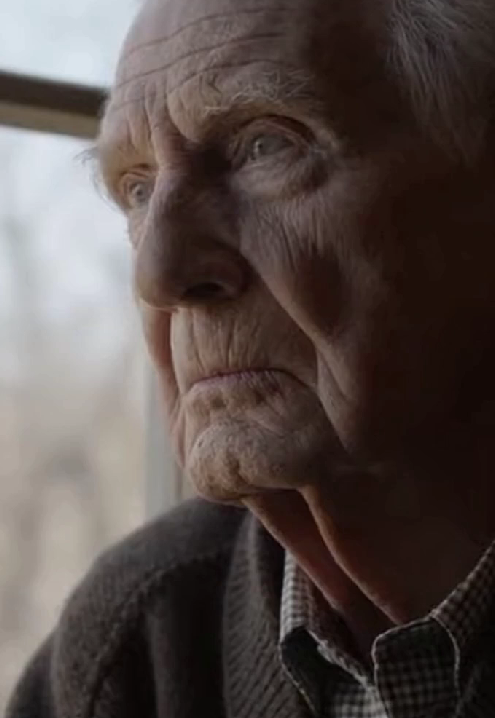
My grandpa Rodney never talked about the war. Not once. When we’d ask, he’d just stare out the window and say, “Some things stay buried, kiddo.”
He passed last March. Ninety-one years old. Quiet as the day I was born.
My mom handed me a garbage bag of his stuff. “Take what you want. The rest goes to Goodwill.”
I almost didn’t open it.
Inside was his old Army jacket. The olive drab was faded to almost gray, the patches barely hanging on. It smelled like him – Old Spice and motor oil. I held it up and something crinkled.
There was weight in the lining. Something stitched inside, near the left breast pocket, right over the heart.
I grabbed a seam ripper from my wife Janelle’s sewing kit. My hands were shaking and I didn’t even know why.
I pulled out a small oilcloth pouch, folded tight.
Inside were three things:
A photograph of a woman I had never seen. She was young, dark-haired, holding an infant. On the back, in my grandfather’s handwriting: “Forgive me.”
A military transfer order dated 1953, stamped CLASSIFIED, with my grandfather’s name – but a different rank. A rank far higher than the “supply clerk” he always claimed to be.
And a birth certificate.
The child’s name on it was my father’s name.
But the mother listed wasn’t my grandmother.
It was the woman in the photo.
I called my mom immediately. She picked up on the first ring, like she’d been waiting.
“Mom,” I said. “Who is the woman in Grandpa’s jacket?”
The line went dead silent. Then I heard her crying.
“He told me you’d find it one day,” she whispered. “Your father doesn’t know. He can never know. Because that woman isn’t just some stranger. She’s…”
Her voice broke into a sob.
“…she was your grandmother Eleanor’s best friend.”
The floor seemed to tilt beneath my feet. I sank onto the edge of my bed, the jacket and its secrets spread out beside me.
“Her name was Annelise,” my mom continued, her voice thick with old pain. “They grew up together. Inseparable.”
“She had an affair with Grandpa?” I asked, the words tasting like ash.
“It was after the war,” she said, rushing the words out. “He was stationed in Germany for a while. That’s where it happened.”
I looked at the transfer order. Berlin, 1953. My father was born in 1954.
“Annelise couldn’t handle it,” Mom said. “She was overwhelmed. She gave the baby to Rodney and Eleanor to raise as their own, and then she just… disappeared.”
“She abandoned my father?”
“She was young, sweetheart. And it was a different time. Your grandparents gave your father a life. A good one. They loved him.”
“But it was all a lie.”
“It was a protection,” she insisted. “A secret to keep him from getting hurt. You can’t tell him, Daniel. You can’t. It would destroy him.”
We hung up, and the silence in my house was deafening. I looked at the face of my father, a man I thought I knew, and realized I didn’t know him at all.
His whole life was built on a foundation I had just ripped open with a seam ripper.
That night, I couldn’t sleep. I laid next to Janelle, staring at the ceiling.
“What is it?” she mumbled, half-asleep.
I told her everything. Every word my mother said. I showed her the photo, the certificate.
She sat up, wide awake, and held the picture of Annelise. “She has your dad’s eyes.”
It was true. The same deep-set, kind eyes stared back at me from the faded photograph.
“Your mom is right about one thing,” Janelle said softly. “This would shatter him.”
“But doesn’t he deserve to know the truth, Janelle? His own mother.”
“What truth?” she asked, her voice gentle but firm. “The truth that his biological mother abandoned him and the woman who raised him, who kissed his scraped knees and read him bedtime stories, was living a lie? What good comes from that?”
She had a point. My grandmother Eleanor had been the warmest person I’d ever known. Her house always smelled like cinnamon and yeast rolls. She was the definition of “home.”
How could she have lived with such a secret? How could she look at her best friend’s child every day and pretend he was her own?
The next few days were a blur. I went to work, I came home, I ate dinner. But my mind was a million miles away, back in post-war Germany.
I kept coming back to the transfer order. “CLASSIFIED.” And the rank. Captain. Grandpa always said he was a corporal, a guy who counted blankets and boots.
It didn’t add up.
Late one night, fueled by coffee and a gnawing need for answers, I started digging. I went to online military archives, ancestry websites. I typed in “Rodney Miller, Captain, Berlin, 1953.”
Most of it was dead ends. Redacted files. But then I found a forum for veterans who served in occupied Germany.
I made a post, vague at first. “Looking for anyone who knew Captain Rodney Miller, Berlin sector, 1953-1954.”
For two weeks, nothing. I started to believe my mom’s story was the only one I would ever get. Maybe it was for the best.
Then I got an email.
The sender’s name was Arthur. He was eighty-nine, living in a retirement community in Arizona.
“I knew Rod Miller,” the email read. “He wasn’t a supply clerk. That was his cover. He was one of the quiet ones. The spooks. Counterintelligence. He saved my life.”
My heart hammered against my ribs.
I called the number Arthur provided. His voice was raspy, but his memory was sharp as a tack.
“Your grandfather was a ghost,” Arthur said. “He worked out of a tiny office, but he was running a network of informants. It was a dangerous time. The Soviets were grabbing people off the street, scientists mostly.”
I thought of my dad, a brilliant engineer who always credited his parents for fostering his love of science.
“I don’t understand,” I said. “My family thinks he had an affair there.”
Arthur laughed, a dry, rattling sound. “Rodney? With a woman? He was married to one person and one person only: your grandmother, Eleanor. He wrote to her every single day. We used to tease him about it.”
The story my mother told me was crumbling.
“There was a woman, though,” Arthur added, his tone shifting. “A German woman. Annelise. Her husband was a physicist, a brilliant man named Klaus. The Soviets wanted him badly.”
My breath caught in my throat.
“Rodney was tasked with getting them out,” Arthur explained. “It was an exfiltration. A dangerous one. He got Annelise and the baby across the line, but… Klaus didn’t make it. There was a confrontation at the checkpoint.”
“What happened to her?” I whispered.
“We put her on a transport to the States. Gave her a new identity, some money. It was part of the deal to protect her and the boy. After that, I don’t know. The file was sealed tight. Rodney never spoke of it again.”
I thanked Arthur, my mind reeling. I hung up the phone and just sat there, in the dark.
It wasn’t a story of betrayal. It was a story of sacrifice.
My grandfather wasn’t an adulterer. He was a hero. And my grandmother Eleanor wasn’t a woman scorned; she was his partner in an act of incredible compassion.
They had saved a life. My father’s life.
The note on the back of the photo, “Forgive me,” wasn’t an apology for an affair. It was my grandfather asking Annelise to forgive him for the life he couldn’t save, and for taking her son, even if it was to protect him.
I had to find her.
Using the name Arthur gave me, Annelise Schmidt, I started a new search. It was a common name, but I had a timeframe and the fact that she would have immigrated around 1954.
It took another month of dead ends before I found a naturalization record from 1960. Annelise Schmidt had become Anna Stevens. She had settled in a small town in rural Wisconsin.
I didn’t tell my mom. I didn’t even tell Janelle what I planned to do. I just told them I needed a few days to clear my head.
I drove for ten hours, the old oilcloth pouch on the passenger seat beside me.
The address led me to a small, neat bungalow with a garden full of rose bushes. I sat in my car for a long time, my courage failing me. What if she didn’t want to be found?
Finally, I got out and walked up the stone path.
The woman who answered the door was small and frail, with wisps of white hair and the same kind, deep-set eyes from the photograph.
“Can I help you?” she asked, her voice soft with a faint German accent.
I couldn’t find the right words, so I just held out the old, creased photograph.
She took it, her hand trembling. Her eyes filled with tears as she looked at the image of her younger self holding her baby boy.
“David,” she whispered. “My David.”
She looked up at me. “You have his eyes.”
We sat in her quiet living room, surrounded by books and photographs of a life I knew nothing about. She told me everything.
She spoke of her husband, Klaus, with a love that was still raw after seventy years. She described the fear of living in a divided city, the constant threat of being taken.
“Rodney and Eleanor were angels,” she said, clutching a teacup. “They promised Klaus they would keep us safe. When he was… gone… I was lost. I had nothing. I was a target.”
She explained the plan they made. She would go to America under a new name, and they would raise David as their own, away from anyone who might be looking for Klaus’s son.
“It was the hardest thing I have ever done,” she wept. “To give away my child. But it was the only way to keep him alive. Rodney sent me a letter and a picture every year on his birthday, until Eleanor passed away. Then they stopped. I respected their silence. I never wanted to disrupt the life they had given him.”
She had lived a quiet life. She became a librarian. She never remarried. She never had any other children. She had spent a lifetime loving her son from a distance.
I stayed for two days, listening to her stories, sharing photos of my father, of her grandchildren she never knew she had. It was both heartbreaking and beautiful.
When I left, she hugged me tightly. “Thank you,” she said. “For not letting the story stay buried.”
The drive home was different. My heart wasn’t heavy with a secret anymore. It was full.
I went straight to my parents’ house. I found my dad in the garage, tinkering with his old lawnmower, and my mom reading on the porch.
I asked them to sit down.
“Mom,” I said gently. “The story you told me… it wasn’t the whole truth, was it?”
She looked down at her hands, her shoulders slumping in relief. “No,” she whispered. “It wasn’t. It was the story Rodney and Eleanor told me to tell. The one they thought was simpler. Less dangerous.”
Then, I told them. I told them about Captain Rodney Miller of Counterintelligence. I told them about Klaus and the escape from Berlin. I told them about the promise my grandparents made, and the sacrifice Annelise made.
I told them that their entire family was built not on a shameful secret, but on a heroic act of love and protection.
My father was silent for a long time, just staring at his hands. I thought I had broken him, just as my mother had feared.
But when he looked up, there were tears in his eyes, but he was smiling.
“So I’m not the son of a supply clerk,” he said, his voice thick with emotion. “I’m the son of a physicist and a brave woman… and I was raised by two heroes.”
He looked at my mom, and then at me. “My whole life, I’ve felt… complete. They gave me that. They all did.”
The next day, we made a call.
I dialed the number, my hand shaking more than it did when I opened the jacket’s lining.
I handed the phone to my father.
“Hello?” he said, his voice unsteady.
And for the first time in seventy years, my father heard the voice of his mother.
That old Army jacket hangs in my study now. It’s no longer a reminder of a family secret or a painful past. It’s a testament to the fact that some things shouldn’t stay buried. It represents a different kind of love story – one of courage, sacrifice, and the quiet, unseen promises that hold a family together. The truth didn’t tear us apart. It stitched us together, stronger than before, with a legacy far richer than any of us had ever imagined. Family, I learned, isn’t just about the blood you share, but about the love you’re willing to give, and the incredible lengths people will go to protect it.