“That shot wasn’t luck. And you know exactly why.”
The words slipped out of someone’s mouth before anyone on the range could breathe again.
For a moment, the Nevada desert went completely still. No laughter. No boots scraping gravel. No cheap jokes floating behind my back. Just heat trembling over the sand and a steel target ringing somewhere nearly two miles away like it had exposed a secret no one was ready to hear.
I lowered the rifle slowly.
Across from me, Mark Dalton’s smile had disappeared.
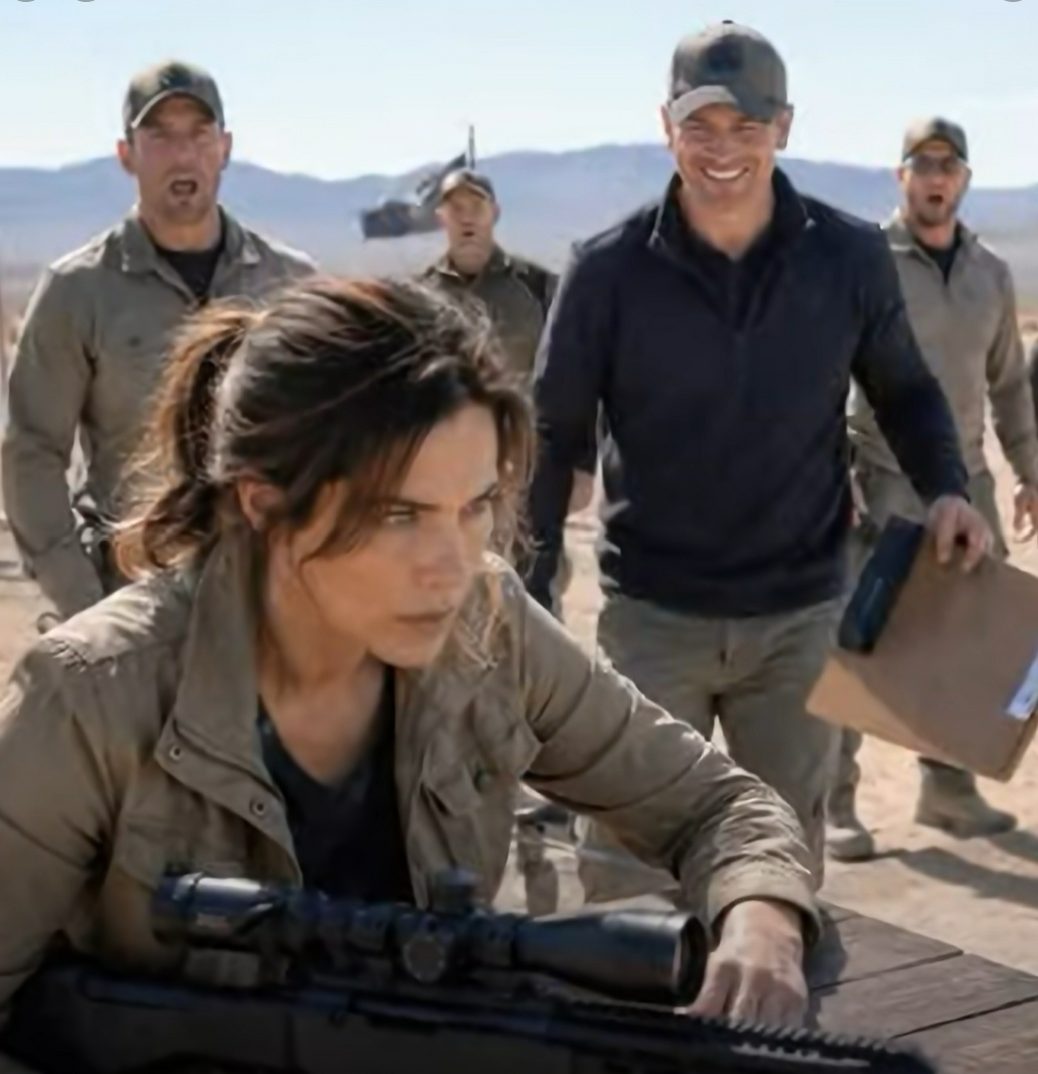
Only a few seconds earlier, he had been laughing with the others, pushing the sniper rifle into my hands like he was handing a toy to someone who didn’t understand the weight of it.
“Come on, Emily,” he had said, his voice loud enough for everyone to enjoy. “Just hold it. Don’t worry, nobody expects you to hit anything.”
A few men chuckled behind him.
I had heard that kind of laugh before.
Not the sound itself, maybe, but the shape of it. The easy cruelty. The confidence of people who believe they already know who you are.
To them, I was just Dr. Emily Carter, the civilian ballistics consultant flown in to review long-range data for a private defense demonstration. I wore plain range clothes, no patches, no medals, no stories hanging from my chest. I looked like someone who lived behind laptops, wind charts, and calculation tables.
That was the version of me they were comfortable with.
So when Mark shoved the rifle into my arms, the others leaned in like they were about to watch a harmless little humiliation.
The rifle settled against my palms.
Heavy. Cold. Familiar.
Something old moved quietly inside me.
The desert stretched in front of us, endless and white-hot beneath the Nevada sun. Far downrange, at 2,950 meters, the steel plate shimmered in the heat haze until it barely looked real. It wasn’t a target from where we stood. It was a rumor. A gray breath behind boiling air.
“She probably can’t even see it,” one of the men muttered.
“Total waste of ammo,” another said.
I didn’t turn around.
I never wasted energy on men who needed a crowd before they felt brave.
I brought the rifle closer, checked the scope, and felt the range change around me. Wind flags flickered along the valley in uneven little jerks. Left to right near the first marker. Dead pause near the second. A hard push past the ridge. Subtle drop where the ground dipped.
Most people saw fabric moving.
I saw a conversation.
My finger rested outside the trigger guard while I adjusted elevation. I made the correction slowly, not because I needed extra time, but because my hands remembered the rhythm better than my mind wanted to admit.
Inhale.
Exhale.
Hold.
The voices behind me softened.
Then stopped.
Maybe they noticed something in my posture. Maybe they saw the way my shoulders settled, the way the rifle no longer looked awkward in my hands. Maybe Mark, for the first time, understood that the joke had already started turning against him.
“Emily,” he said, quieter now. “You don’t have to actually – “
Click.
The shot tore through the valley like thunder cracking open stone.
The recoil pressed into me, clean and controlled. The echo rolled away across the desert, bouncing off distant ridges until even the sound seemed to lose confidence.
Then came the waiting.
At that distance, time becomes cruel.
Half a second.
One second.
Two.
Someone behind me gave a nervous little breath, the kind people make when they want to laugh but suddenly aren’t sure they’re allowed to.
Then – Clang.
The sound came back sharp and delayed, cutting through the heat like a verdict.
A direct hit.
No one moved.
The man with the clipboard dropped it into the dust. Papers slid across the gravel, but he didn’t bend to pick them up. Mark’s jaw had gone tight, his eyes locked on the far end of the range as if staring harder could undo what had just happened.
“That’s…” someone whispered. “That’s impossible.”
I lifted my cheek from the stock and looked at them.
Their faces had changed completely.
The amusement was gone. So was the arrogance. In its place was something smaller. Something colder. Suspicion. Confusion. A little fear.
Mark stared at me like he had finally noticed a door in a wall he thought was solid.
“Where did you learn to shoot like that?” he asked.
The question landed harder than the rifle had.
I felt every eye turn toward me.
The desert wind slid over the back of my neck, hot and dry, carrying dust against my skin. I could have laughed it off. I could have shrugged and blamed math, luck, instinct, anything simple enough for them to swallow.
But my hands were still on the rifle.
And the past was no longer staying buried.
Because men like Mark always thought skill had to announce itself before it mattered. They thought silence meant weakness. They thought a woman who didn’t explain herself had nothing worth hiding.
They were wrong.
I set the rifle down on the bench with care, but the sound of metal touching wood made two of them flinch.
Mark took one step closer.
“Emily,” he said again, and this time my name sounded different in his mouth. Less mocking. More cautious. “Who are you?”
I looked past him, past the staff, past the heat-warped range, toward the target still swinging faintly in the distance.
For years, I had built a life around not answering that question.
Then a black SUV rolled slowly up behind the firing line.
No one spoke as the driver’s door opened.
A man in a dark uniform stepped out holding a sealed folder against his chest. His eyes found mine immediately, and the look on his face told me the one thing I had been praying wasn’t true.
He hadn’t come by accident.
He knew exactly where to find me.
And when he said my old name, every person on that range turned to stare.
The Name I Buried
The name he used wasn’t Emily.
It wasn’t Carter either.
It was the name on a file that was supposed to be classified at a level most people in that circle didn’t have clearance to sneeze near. A name attached to a program that officially concluded in 2013, when the unit was disbanded and its members were quietly redistributed into civilian life with new credentials, new histories, and a very clear understanding of what “quiet” meant going forward.
I had been quiet for eleven years.
Eleven years of Dr. Emily Carter. The academic papers. The consulting contracts. The careful, bloodless work of reviewing other people’s field data from behind a desk in Reno. I was good at it, genuinely. The math was real. The credentials were real. The woman who showed up to conferences and argued about external ballistics over bad hotel coffee, she was real too, mostly.
But the name he said on that range was the one my team had used.
The one my spotter, a big, quiet Georgian named Doyle, had called me every morning for four years when we were working jobs in places that didn’t make it onto any public map.
The man in the dark uniform walked toward me with the folder and I didn’t move. My feet felt bolted to the gravel. The sun was directly overhead, no shadow, nowhere to disappear into.
Mark Dalton was still standing six feet away, and I could see him cycling through it. The shot. The name. The SUV. He was a contractor, well-connected, not stupid. He was already doing arithmetic.
“Dr. Carter,” the uniformed man said, and then corrected himself. “We need a moment.”
The others peeled back without being asked. Something about the way he carried himself made the air around him feel like a restricted area.
Mark didn’t peel back.
He held his ground, jaw set, looking at me like I owed him something. An explanation, maybe. Or an apology for making him look small in front of his own people.
I looked at him until he stepped aside.
What Was in the Folder
His name was Garrett. I didn’t know him, but I knew the agency he worked for the way you know a bad neighborhood: by reputation, by the specific flavor of its trouble, by what it tended to want from people like me.
We walked thirty yards from the group, far enough that the wind swallowed our voices.
He opened the folder.
Inside was a photograph. Grainy, long-lens, taken from altitude. A man standing outside what looked like a transit facility somewhere flat and brown. Eastern Europe or Central Asia, hard to say. The man’s face was circled in red marker, old-fashioned, like someone had printed the photo and drawn on it by hand.
I knew the face.
My chest did something I didn’t have a word for.
“When was this taken?” I asked.
“Six weeks ago,” Garrett said.
“That’s not possible.”
“We know.”
The man in the photograph was named Petrov. Not his real name, the name we’d had for him. A broker. Someone who moved things, people sometimes, information mostly, across borders that didn’t officially exist. We had tracked him for eight months in 2011. We had been twenty-four hours from a resolution in Bishkek when the program got pulled, the mission got scrubbed, and I got handed a new name and a plane ticket to Nevada.
Petrov had walked away clean.
He’d been walking away clean ever since, apparently.
“Why me?” I said. “You have active personnel. You have people who are current, who haven’t been sitting in a consulting office for a decade.”
Garrett looked at the folder, then at me.
“He requested you specifically,” he said.
I stopped.
“What?”
“He made contact through a back channel two months ago. He said he’d talk to one person.” Garrett paused. “He used your old name.”
What Doyle Told Me Once
There was a night in Tajikistan, 2010, late October, cold enough that the scope kept fogging on the exhale. Doyle and I had been in position for nine hours waiting on a window that kept not opening. We were both running on bad instant coffee and worse sleep, and somewhere around hour seven, Doyle started talking the way people do when they need the sound of a human voice more than they need silence.
He said the thing that kept him up wasn’t the shots he’d taken.
It was the ones that got called off.
“You do all that work,” he said, “all that tracking, all that patience, and then somebody in a room you’ve never been in makes a phone call, and you just pack up and go home. And the guy’s still out there. Still doing it. And you know he is. And there’s nothing.”
He didn’t finish the sentence.
He didn’t need to.
I had thought about Petrov more times than I’d ever told anyone. Not obsessively. Not like some festering thing. Just the occasional intrusion, the way a name surfaces when you’re almost asleep. The knowledge that a loose end existed, that it had a face, that it was somewhere continuing to be a loose end.
And now here was Garrett telling me that loose end had pulled my thread.
Deliberately.
The Part I Didn’t Tell Garrett
I said I needed twenty-four hours.
He said I had twelve.
I drove back to Reno in my own car, a gray Civic with 90,000 miles on it and a cracked dashboard I’d never gotten around to fixing. The AC barely worked. I drove with the windows down and the hot air coming in off the desert and I didn’t turn on the radio.
Mark Dalton had watched me leave. I’d felt it. He’d wanted to say something, I could see it on his face, but he’d held off. Smart enough to know he’d already lost whatever he’d been playing at.
Back in my apartment, I sat at the kitchen table for a long time.
The apartment was small and extremely tidy. One shelf of books, all technical. A coffee maker I used twice a day. A succulent on the windowsill that had survived four years on minimal attention. The life of someone who had deliberately kept the surface area of their existence small.
There was a lockbox in the closet under a stack of winter gear I hadn’t touched since February.
I didn’t open it.
Not yet.
I thought about Doyle instead. We hadn’t spoken in three years, not since a brief, awkward phone call after his mother died, when neither of us had known what to say and had eventually just said goodbye. He was somewhere in Montana now, I thought. Or Wyoming. Somewhere with enough land that the nearest neighbor wasn’t visible from the porch.
I thought about what he’d said in Tajikistan.
And the ones that got called off.
Petrov had killed four people in the time since Bishkek. That was in the folder. Garrett had included it deliberately, I was sure, the way you include a thing you know will do the work for you.
I went to the closet.
Opened the lockbox.
Inside was a phone, an old one, charged and ready out of habit, a habit I’d kept without ever asking myself why. A set of credentials that were technically expired but probably still had ghosts in the right systems. And a photograph, small, worn soft at the corners from handling.
Me and Doyle, somewhere in the mountains. Both of us squinting into the sun. Both of us younger by a decade and a half and not yet aware of how long things would stay unfinished.
I put the photograph in my jacket pocket.
Then I picked up the phone and called the number Garrett had written on the inside cover of the folder.
“I’ll need Doyle,” I said when he answered.
A pause.
“He already said yes,” Garrett told me. “He’s been waiting for your call.”
The Range, Later
I went back to the range before I left Reno.
Early morning, before anyone else arrived. The sun was just up, orange and flat, and the desert smelled like dust and something faintly mineral underneath.
The steel target was still there at 2,950 meters, barely visible in the early light.
I stood at the bench where I’d stood the day before and looked at it for a while.
Mark’s rifle was gone, locked up somewhere. I hadn’t brought one. I’d just come to stand there.
The thing about a shot like that isn’t the math, though people always want it to be the math. The math is the easy part. The math is what you do before your hands get involved. The hard part is the moment between the exhale and the trigger, the moment where you’re not doing anything, just waiting for the body to be still enough.
That stillness had never really left me.
I’d just been pointing it at spreadsheets for eleven years.
I touched the bench with two fingers.
Then I walked back to my car, and I drove toward whatever came next.
—
If this one got under your skin, pass it along to someone who’d feel it too.
If you’re looking for more stories about unexpected twists and turns, you might enjoy reading about how one tattoo made an entire military base go silent or the tale of her return from the grave. And for another dose of someone standing their ground, check out how she told a Lieutenant Colonel he wouldn’t have three seconds.