
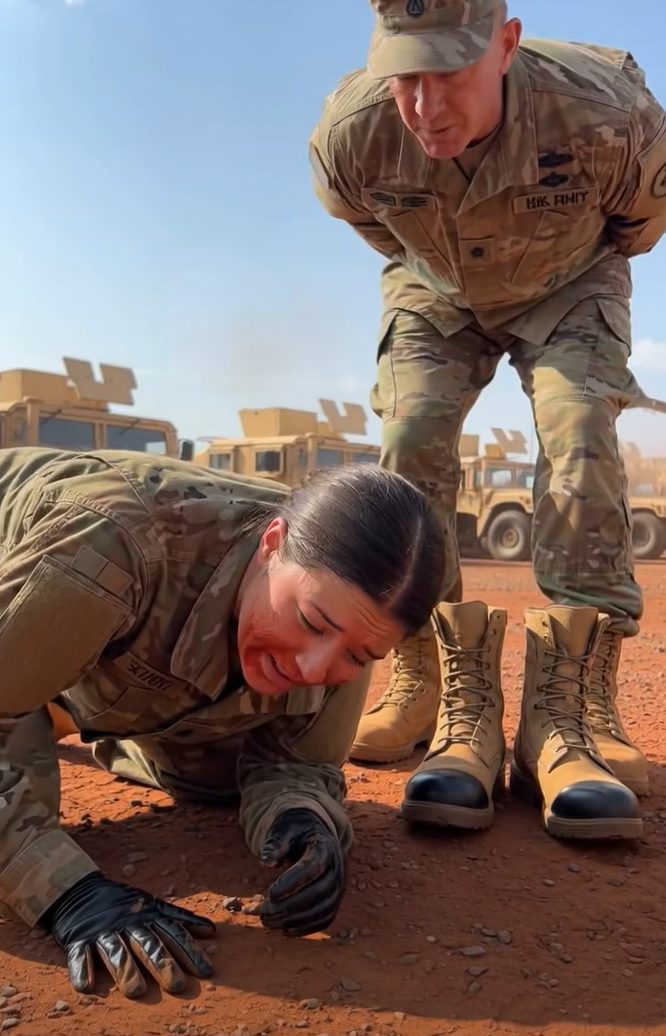
I was picking my own teeth out of the Georgia red clay when Sergeant Mark Hensely leaned down and whispered that I was a mistake the Army was about to correct.
The taste of copper and diesel oil flooded my mouth. My lungs burned, desperately trying to pull in the thick, humid air of Fort Moore.
It was August. The kind of oppressive Southern heat that doesn’t just make you sweat; it actively tries to crush you.
“You’re pathetic, Vance,” Hensely hissed, his voice perfectly modulated so only I could hear it over the roar of the idling Humvees. “A fragile little girl playing dress-up in her daddy’s boots. You are going to wash out, and I am going to make sure you cry when you do.”
I didn’t cry. Not then. I just stared at the perfectly polished toe of his combat boot, inches from my bleeding nose.
Sergeant First Class Mark Hensely was the golden boy of the 3rd Brigade Combat Team. He was the man commanders pointed to when they talked about military excellence.
His uniform was never wrinkled, even after a twelve-hour field exercise. His physical fitness test scores were maxed out. He had the sharp jawline and cold, unblinking eyes of an absolute apex predator.
And he had decided, from the moment I arrived at the motor pool three months ago, that I did not belong in his Army.
I am Specialist Elena Vance. Twenty-two years old. Five-foot-four on a good day, with grease permanently embedded under my fingernails.
I joined the military as a heavy-wheel mechanic for two reasons: to pay for my younger sister’s medical bills back in Detroit, and to chase the ghost of my father, a Ranger who died in the Korengal Valley when I was ten.
My dad used to say the Army was a meritocracy. He promised me that if you worked hard, bled for your squad, and kept your integrity, you would earn your place.
He never warned me about men like Hensely.
“Get up, Vance!” Hensely barked, suddenly standing tall and projecting his voice so the rest of the platoon could hear. “Stop milking a little trip and fall! We have a convoy leaving in twenty mikes and your vehicle is still leaking transmission fluid!”
It wasn’t a trip and fall. We had been doing a rapid tire-change drill on a two-and-a-half-ton truck. I was struggling with the pneumatic lug wrench – the air compressor was faulty – and Hensely had “accidentally” kicked the jack stand.
The heavy steel axle had slammed down, the wrench had kicked back, and the heavy metal handle had caught me square in the jaw, throwing me to the ground.
He did it on purpose. I knew it. He knew it. But there were no cameras in the back lot of the motor pool, and his word was gospel.
A hand grabbed the back of my tactical vest and hauled me upward. It was PFC Jackson Tyler.
Jackson was a skinny, nervous kid from rural Ohio who looked like a strong gust of wind would blow him away. He was nineteen, joined to escape a dead-end town, and suffered from crippling anxiety that he tried to hide behind a sarcastic sense of humor.
Jackson’s hands were shaking as he steadied me. He was terrified of Hensely. We all were.
“You good, El?” Jackson muttered, his eyes darting toward Hensely. Jackson’s right hand was instinctively reaching for his pocket, where he kept a vintage, beat-up Zippo lighter. He didn’t smoke. He just flipped the lid open and closed when he was having a panic attack. It was his anchor.
“I’m fine,” I lied, spitting a small glob of blood into the dirt. I wiped my mouth with the back of my grease-stained glove.
“Tyler!” Hensely snapped. “Are you her mother? Get back to your bay!”
Jackson flinched, the color draining from his face. “Yes, Sergeant,” he stammered, hurrying away.
I walked back to the Humvee. My jaw throbbed with a dull, vicious ache. Every time I clamped my teeth together, a sharp pain shot up into my ear.
I slid underneath the vehicle, the hot asphalt radiating heat through my uniform. I stared at the transmission pan. It was leaking, alright. But not because I had done a poor job installing the gasket yesterday.
Someone had taken a flathead screwdriver and deliberately scored the edge of the metal seal.
My blood ran cold. This wasn’t just hazing anymore. This was sabotage.
I lay there in the stifling heat, the smell of JP-8 jet fuel and old sweat thick in my nose, realizing the terrifying reality of my situation.
Hensely was intentionally damaging military equipment just to make me look incompetent. He was willing to compromise the safety of a convoy – vehicles that carry soldiers at fifty miles an hour down public highways – just to build a paper trail of my failures.
“Vance!” Hensely’s boots appeared in my line of sight beneath the truck. “Status!”
“The seal is broken, Sergeant,” I said, sliding out from under the chassis. I stood up, refusing to break eye contact. “It looks like it was gouged.”
Hensely’s eyes narrowed. The charming, perfect soldier mask slipped for just a fraction of a second, revealing the sheer malice underneath.
“Are you making excuses for your sloppy maintenance, Specialist?” he asked, stepping into my personal space. The scent of his expensive cologne mixed sickeningly with the motor pool smells.
“I installed it perfectly yesterday. You signed off on it,” I said, keeping my voice steady, though my heart was hammering against my ribs.
“I signed off on it assuming my mechanic wasn’t completely useless,” he countered smoothly. “Write it up. Replace it. And since you’re so slow, you’re pulling overnight guard duty at the arms room tonight. Maybe sleep deprivation will teach you attention to detail.”
He turned and walked away before I could respond.
I spent the next three hours pulling the transmission pan, cleaning the gouged metal, and installing a new seal. My jaw swelled, turning a mottled purple and blue.
Around 1400 hours, Captain Sarah Jenkins walked through the motor pool.
Captain Jenkins was our Company Commander. She was twenty-eight, a West Point graduate, and fiercely intelligent. She had a reputation for being fair but brutally overworked.
Rumor had it her husband back in Texas had just filed for divorce because she spent eighty hours a week at the company headquarters. She lived on black coffee and adrenaline.
You could always tell when Captain Jenkins was stressed because she carried a broken blue ink pen in her right hand, constantly clicking the button at the top.
Click-click. Click-click.
I watched from beneath the hood of a truck as she approached Hensely.
“Sergeant Hensely,” she said, her tone clipped. “Are we green for the convoy tomorrow? Battalion is breathing down my neck about readiness rates.”
Hensely smiled. It was a terrifyingly genuine-looking smile. “One hundred percent, Ma’am. My squad is locked in. We had a minor hiccup with one of the transmissions – Specialist Vance made a rookie mistake on a gasket seal – but I caught it during my final inspections. We’re correcting it now.”
Click-click. Click-click.
“Good catch, Sergeant,” Captain Jenkins sighed, rubbing her temples. “Keep an eye on her. I can’t afford broken vehicles on the highway. I don’t have the bandwidth for a safety investigation.”
“You can count on me, Ma’am. I’ll make sure Vance gets the training she needs. Even if I have to work her into the ground to do it.”
Captain Jenkins nodded, entirely blind to the reality of what was happening. She trusted the spreadsheet. She trusted the man who kept her metrics in the green.
I wanted to scream. I wanted to march up to her, show her my bruised jaw, and tell her about the screwdriver marks on the transmission pan.
But I knew what would happen. Hensely was a senior non-commissioned officer with ten years of perfect evaluations. I was a brand-new E-4 mechanic. It would be my word against his. He would claim I hit my face with the wrench due to my own negligence, and that I was making up wild accusations to cover for my bad mechanical work.
I would be labeled a problem soldier. I would be transferred, or worse, kicked out with an Other Than Honorable discharge.
If I lost this job, I lost my sister’s health insurance. I would fail my family. I would fail my father’s memory.
I swallowed the anger. I swallowed the injustice. It felt like swallowing broken glass.
That night, the arms room was freezing. The air conditioning was cranked to fifty-five degrees to keep the weapons from rusting in the humidity.
I sat at the metal desk, a thick field jacket wrapped around my shoulders, staring blankly at the security logbook.
The silence of the building was deafening, broken only by the occasional hum of the vending machine down the hall.
My jaw throbbed in time with my heartbeat. Every time I closed my eyes, I saw Hensely’s smug face. I heard his voice telling me I was a mistake.
Around 0200, the heavy metal door to the hallway creaked open.
I immediately sat up, reaching for my radio.
It was Jackson. He was wearing his gray physical training uniform, looking exhausted. He held two Styrofoam cups of terrible dining facility coffee.
“Hey,” he whispered, glancing nervously down the dark hallway before slipping inside.
“Jackson? What are you doing here? You’re supposed to be in the barracks. If Hensely catches you out past curfew…”
“Hensely is at his house off-post,” Jackson said, handing me a cup. “I couldn’t sleep. My roommate is snoring like a chainsaw, and… well, I was worried about you.”
I took the coffee. It was lukewarm and tasted like burned dirt, but it was the best thing I’d ever drank.
“I’m fine,” I said again, the default military response to pain.
Jackson sat in the plastic chair across from the desk. He pulled out his Zippo lighter. Clink. Clack. Clink. Clack. He opened and closed the metal lid, staring at the floor.
“He’s going to get you kicked out, El,” Jackson said quietly. “Or he’s going to get you killed in the motor pool. That jack stand… I saw him kick it.”
I froze, the coffee cup halfway to my lips. “You saw him?”
Jackson nodded, his shoulders slumped. “I was carrying oil filters from the supply cage. I saw him look around, step forward, and kick the release lever on the stand. Then he acted like it was an accident.”
“Jackson, you have to tell Captain Jenkins.”
The metal lighter slipped from his hands and clattered onto the linoleum floor. Jackson looked up at me, and I saw raw, unfiltered terror in his eyes.
“I can’t,” he whispered, his voice cracking. “El, I can’t. He knows about my mom. He knows she’s sick, and he knows I lied about my medical history to get in. I had severe asthma as a kid. If they find out, it’s fraudulent enlistment. I’ll get a dishonorable discharge. He told me if I ever cross him, he’ll make a phone call to the recruiting command and ruin my life.”
My chest tightened. Hensely wasn’t just a bully. He was a predator. He found the weak spots in the people under him and exploited them for absolute control.
He was using Jackson’s fear against him. He was using my need to survive against me.
“I’m sorry, El,” Jackson choked out, tears welling in his eyes. “I’m a coward. I want to help you, but I can’t.”
I reached across the desk and grabbed his shaking hand.
“Listen to me, Jackson,” I said softly, but with a firmness that surprised even me. “You are not a coward. You’re surviving. We’re all just trying to survive him.”
“How?” he asked, looking at my bruised face. “He’s untouchable.”
I leaned back in the chair, staring at the racks of M4 rifles secured behind the steel grating of the arms room.
My dad’s voice echoed in my head. If you’re outgunned, you don’t charge the hill. You flank the enemy. You find the supply line and you cut it.
Hensely’s power came from his pristine reputation. He was the golden boy because his vehicles never broke down (officially), his squad never failed (on paper), and his maintenance logs were perfect.
But I had seen the gouged transmission pan. I knew he was faking the perfection.
If he was willing to sabotage a vehicle to get me in trouble, what else was he doing? How many corners was he cutting to keep Captain Jenkins’s spreadsheets in the green?
“He’s not untouchable,” I said slowly, a cold, hard resolve settling in my stomach. The pain in my jaw suddenly didn’t matter anymore.
“What are you going to do?” Jackson asked, his eyes wide.
“I’m going to do my job,” I said. “I’m a mechanic. My job is to find what’s broken, take it apart, and expose the damage.”
Jackson swallowed hard. “If he catches you digging into his stuff…”
“He thinks I’m a fragile little girl playing dress-up,” I said, a dark smile pulling at my bruised cheek. “He thinks I’m too stupid and too scared to fight back.”
I took a sip of the terrible coffee.
“Starting tomorrow, I am going to become the quietest, most obedient soldier in this platoon. I’m going to let him yell. I’m going to let him push me around. Because while he’s busy inflating his own ego, I’m going to tear apart every single maintenance log, every parts requisition form, and every dispatch sheet he has ever signed.”
I looked at Jackson, the fire of absolute determination burning away the exhaustion in my mind.
“I am going to find his paper trail, Jackson. And when I do, I’m not going to punch him. I’m going to annihilate his entire career.”
The Quiet Part
Jackson left around 0330, the hallway swallowing him back up into the dark.
I sat alone with the logbook and the hum of the vending machine and my swollen jaw, and I made myself think clearly for the first time since I’d hit the ground.
Paper. Everything in the Army was paper.
Every vehicle that left the motor pool had a DA Form 5988-E attached to it. Equipment Maintenance and Inspection Worksheet. Every fault, every repair, every part pulled from supply, every signature. The paper trail of a motor pool was a complete record of everything that happened to every vehicle. Who signed off. When. What they said was fixed.
Hensely signed off on a lot.
He was the senior mechanic supervisor. His initials were on every final inspection before a vehicle rolled out of the bay. If he was cutting corners, if he was signing off on work that wasn’t done, or logging parts that were never actually replaced, it would be right there. In ink.
The Army doesn’t throw away maintenance records. They go into the unit files, stacked in gray metal cabinets in the back of the motor pool admin office.
I had legitimate access to those files. I was a mechanic in the unit. I pulled records for reference all the time.
Nobody would notice me pulling old dispatch packets. Not at first.
I started the next morning at 0600, forty minutes before the rest of the platoon arrived.
Grease and Numbers
I told the overnight CQ runner I’d forgotten my headphones in the admin office and needed to grab them before PT formation. He barely looked up from his phone.
Inside the office, I went straight to the gray cabinets against the far wall. I pulled the 2022 maintenance packets first, working backward six months from the current date.
I wasn’t sure what I was looking for. That was the honest truth. I just knew that a man willing to score a transmission seal with a screwdriver wasn’t suddenly careful everywhere else.
I found the first one about forty minutes in.
A Humvee that had been dispatched for a 200-mile convoy run in March. The 5988-E showed the front differential had been serviced and the fluid replaced. Hensely’s initials were on the sign-off line.
I knew that vehicle. I had personally worked on it two weeks after that convoy. The differential fluid had come out black and gritty, burned completely through, the kind of degradation that takes months of neglect. Not two weeks.
I pulled out my phone and photographed the form.
I found three more like it over the next two weeks. Small things. An oil change that, based on the mileage logs, had been signed off 800 miles before it was actually due. A brake inspection cleared on a vehicle that I had personally found with metal-on-metal rear pads six days later. A tire rotation logged on a truck that still had the original asymmetric wear pattern when I checked it the following month.
None of it was dramatic. None of it was a smoking gun by itself.
But it was consistent. It was a pattern. And in the Army, a pattern in maintenance records isn’t just a paperwork problem. It’s a safety violation. It’s a commander’s inquiry. It’s potentially criminal negligence if a vehicle goes down on a highway and someone gets hurt.
Jackson found me in the break room one evening, eleven days into it. He sat across from me with his coffee, and I slid my phone across the table without a word.
He scrolled through the photos slowly. His face went very still.
“El,” he said quietly. “This is a lot.”
“I know.”
“He’s going to destroy you if he finds out you’ve been pulling these.”
“I know that too.”
Jackson set the phone down. He opened and closed the Zippo twice, fast. “What’s the play?”
I’d been thinking about that for eleven days. Going to Captain Jenkins directly was still too risky. She trusted Hensely. She was overworked and running on fumes, and her first instinct would be to protect the metrics that were keeping Battalion off her back. Hensely would have a counter-explanation for every single discrepancy, and I’d come out looking like a disgruntled soldier manufacturing grievances.
I needed someone who had no stake in protecting the motor pool’s readiness numbers. Someone whose job it was to find exactly this kind of problem.
“The Inspector General’s office,” I said.
Jackson blinked. “That’s going over the entire chain of command.”
“Yes.”
“If this goes wrong – “
“Jackson.” I looked at him. “He kicked a jack stand out from under a truck with my head three feet from the axle. I’m done playing within the lines he drew.”
The Form I Filed at 0730 on a Tuesday
The IG complaint form took me two hours to fill out.
I documented everything. The jack stand incident, with the date and approximate time. The gouged transmission seal, with photos I’d taken on my phone before I replaced it. The maintenance record discrepancies, with form numbers, vehicle bumper numbers, and dates. I cross-referenced the mileage logs against the service records to show the math didn’t add up.
I also documented the pattern of targeted harassment. The guard duties. The public humiliations. The overnight assignments stacked on top of each other. I had kept a log in a notes app on my phone since week two, because my dad had also told me: if you’re going to fight someone with rank, you better have receipts.
I submitted it through the secure online portal at 0730 on a Tuesday morning, sitting in my car in the parking lot of the PX with the engine running and the AC on full blast.
Then I drove to PT formation and did not say a word to anyone.
What Happened After
The IG investigation was quiet. That’s the thing nobody tells you. You don’t see it happening. You just go to work every day and act normal and wonder if you’ve destroyed your own career for nothing.
Hensely kept at it. Two more guard duties in the following three weeks. A counseling statement for “failure to maintain equipment standards” that was so vague it could have applied to literally anyone. I signed it, added a rebuttal statement citing the specific maintenance actions I had performed and the dates they were logged, and kept my mouth shut.
Six weeks after I filed, two people in civilian clothes showed up at the motor pool and asked to see the maintenance records going back eighteen months. They had credentials. They spoke with Captain Jenkins privately for about forty minutes.
I watched from underneath a truck, and I kept my face completely neutral.
Captain Jenkins came out of that meeting with the clicking pen going double-time. She didn’t look at Hensely. She looked at the floor.
That was the first moment I let myself believe it might actually work.
Two weeks after that, Hensely was placed on administrative reassignment pending investigation. He showed up one morning, got called into the First Sergeant’s office, and by noon his desk in the NCO room was empty.
Nobody told us officially. Nobody had to.
The Last Thing
The counseling statement he’d written on me was withdrawn as part of the investigation findings. Three other soldiers, two of them women, one a young specialist named Darnell Pruitt who’d been in the unit eight months longer than me, came forward once the investigation opened. Darnell had a list of his own. Longer than mine.
I never saw Hensely again after that Tuesday morning.
Captain Jenkins pulled me aside about a month later, in the motor pool office, the door closed. She looked tired in a different way than she usually did. Not overworked tired. Something else.
“Vance,” she said. Then she stopped. Clicked the pen twice. “I should have seen it.”
I didn’t say anything.
“I’m sorry I didn’t.”
I thought about my dad. About what he said the Army was supposed to be. About whether this counted.
“Thank you, Ma’am,” I said.
She nodded once and walked out.
Jackson got his coffee the next morning from the dining facility, sat across from me at 0630, and set the Zippo on the table between us. He didn’t open it once the whole time we sat there.
That was how I knew we were going to be okay.
—
If this hit you, pass it on. Someone out there needs to know the paper trail is worth keeping.
If you’re looking for more wild true stories, read about the manager who dumped a bucket of water on an employee or the janitor who knew a secret. And for a tale that will send shivers down your spine, check out what happened when they arrested a dead woman.



