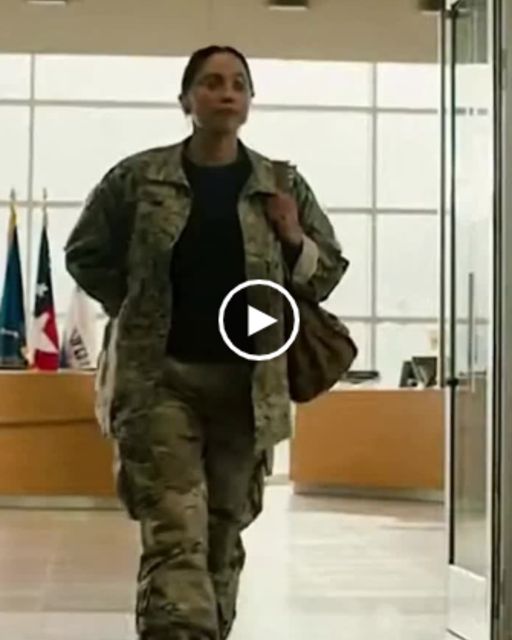
I was hanging around in the lobby of the Texas base with a cup of coffee in my hand, just before drill when she walked in. Her uniform was a bit worn, and her boots showed signs of many hard days on the field—a contractor ready for medic training, or so it seemed.
The young lieutenant, fresh from ROTC with a perfectly pressed uniform, scanned her from top to bottom and sternly said, “Ma’am, that uniform isn’t authorized. Please remove it.”
Unfazed, she simply nodded, calm and collected, and began to unzip her jacket. Her past experiences, the dust storms, the rotor wash—none of it was mentioned.
The room fell silent as the jacket came off. Underneath lay her story: battle-earned jump wings, not the parade kind, and a combat medic cross boldly inked between them. Below, ominous numbers: 03-07-09.
There was an audible clatter of cups, and a young private gasped, “Holy smokes.” The lieutenant’s face went pale, and all gathered were struck with the realization. Those digits etched a tale of Kandahar Valley; radios gone silent, helicopters delayed, and the ordeal of saving twenty-three lives through sheer determination.
Scars twisted across her skin under the ink as she held the jacket at her elbows, waiting to comply with the order she’d received.
The lieutenant, visibly shaken, barely murmured, “I—” when the door clattered open, and in came Colonel Ramirez with authority.
“Captain West,” he commanded, eyes only on her, “Office. Now.” He addressed the room, making his words as heavy as a soldier’s armor: “This woman isn’t just here to train. She’s why many of you are still breathing today.”
Lieutenant Miller—a ghost of his former confident self—stood rigid with embarrassment, suddenly realizing his uniform meant little in the presence of living history.
Captain West, or Sarah, gently zipped up her jacket and left with the Colonel, leaving an air of awe behind. We all stood frozen, the chill in our coffees unnoticed. We were in the presence of a legend, and most had been unaware.
The tale of 03-07-09 was prestigious among the soldiers, and taught as heroic field medicine. During a complex ambush where communications failed, one medic fought for life, working tirelessly for six agonizing hours.
That medic was her.
Inside Ramirez’s office, walls adorned with the scent of old leather and discipline, she didn’t sit but stood as Ramirez turned to the window, surveying training grounds.
“Sarah,” he said, his voice now softer. “Your hands, how are they?”
She extended her hands, presenting a slight, almost invisible tremor in her right—her handiwork in life’s most vital moments now faltering.
“It worsens,” she acknowledged. It wasn’t a complaint but a field report.
The Colonel nodded, back still turned. “Walter Reed received your reports. They term it focal dystonia, triggered by ongoing extreme stress.”
She had known the terminology—a cruel betrayal by the very body that had accomplished so much.
“They propose further tests here,” Ramirez noted, facing her at last. “A formality though, as the board suggests retirement.”
The word ‘retirement’ struck harder than any battlefield wound, suggesting not rest, but desolation.
“I can still instruct,” she asserted, her voice steady despite the turmoil within. “My knowledge still relevant.”
“Absolutely, Captain,” he replied with a gentle nod. “But regulations are straightforward. Medics unfit for field duties can’t wear the uniform.”
The room’s silence engulfed them. All the lives saved, through sweat and sacrifice, were reduced to a traitorous tremor.
A knock interrupted, as Ramirez admitted Lieutenant Miller into the room. The young officer stood, remorse heavy like a pall.
“Sir, you called for me,” he muttered, addressing the floor rather than the faces.
“Look at me, Lieutenant,” the Colonel instructed. Miller’s gaze flicked upward before dropping again at Sarah’s visage.
“Captain West has center appointments. Escort her,” Ramirez instructed, suggesting the escort was a deserved penance for his earlier action.
Miller’s head whipped up, knowing it as a discipline, yet he acknowledged with a quiet, “Yes, sir.”
Sarah simply nodded to the Colonel with an air of acceptance, “I’ll get ready,” she stated.
The walk across the base to the medical center was an awkward silence shattered only by their own footsteps, Miller’s neck slick with nervous sweat under the Texas sun.
“Captain, I apologize. Truly,” he said, his voice burdened by regret.
She regarded him calmly, “Lieutenant, you adhere to regulations. I understand.”
“It was arrogance. I saw faded fatigues and judged,” he admitted, head shaking with disgust for his own folly.
“Everyone errs. It’s the aftermath that counts,” she replied with a gentle understanding.
A moment more of quiet passed, only the bustling base filling the aura around them. Then, unable to curtail his curiosity, Miller questioned, “That tattoo…is the Kandahar tale as it’s told?”
“Bits of it,” she conceded, her tone tinged with nostalgia. “Stories gain grandeur in retelling.”
He couldn’t help himself, “They say you tore your own uniform to administer bandages, dealt with an amputation using only local anesthetics after morphine ran out?”
Her silence was answer enough, echoing louder than an outright confirmation.
The sprawling medical facility loomed before them. Inside, the sterile scent of antiseptic surrounded them. Miller checked her in for neurology tests and surrendered his utility, watching the clock longer than necessary.
As she returned, an hour seemed to last eternity. She appeared worn from the evaluations, accompanied by Dr. Evans who explained the findings—confirming nerve pathway degradation, stressing the cessation of high-stress activities.
The news was a closing statement she had dreaded hearing.
“There are therapy options for management,” the doctor added, offering the reassurance of some continuity. “However, as for field duties… in good conscience…”
“Understood,” she agreed, knowing the battle was no longer one she could fight.
Outside, the noonday sun felt as if it bore extra weight, seeming to impress upon her the end of one chapter. Her shoulders felt it.
Miller felt compelled to rectify the prevailing injustice with words. “It’s unjust,” he burst awkwardly. “After what you’ve done, a slight tremor shouldn’t end it.”
Her footsteps halted. The composure she maintained cracked to reveal glimpses of her fatigue. “Choice isn’t ours in endings, Lieutenant,” she expressed softly.
The time had come for his own revealing, concealed emotions spilling forth.
“My father,” he began, trembling slightly but earnest, “Sergeant Mark Miller. He was part of that convoy.”
Sarah West froze, his confession rendering her speechless, the look on his face mirroring someone she aided years prior—dust and blood.
“Your father…” she managed softly.
“Yes,” Miller continued, overwhelmed, “he was carried from a blazing humvee to safety. Lost his leg but lives on thanks to you.”
In a shuddering breath, he confessed, “He told stories of you, ‘Angel of Kandahar.’ And here I stand before you, having shown no respect.”
She sat heavily on a nearby bench, overwhelmed by the realization of what her actions had meant: his father alive, coaching his sister’s games, a legacy beyond a battlefield.
“He taught me,” Miller’s voice wavering, “to mirror the tenacity of the nameless medic who refused surrender. Yet, my introduction to you was with baseless arrogance.”
Quiet lingered before Sarah, pondering over distant grounds, making peace with the new perspective. Her right hand trembled more pronounced, yet she clenched it tightly.
“And how is he now?” she queried with care, rediscovering personal empathy.
“Thriving,” Miller beamed, wiping tears. “He is family, walks with a limp, but he’s here, anticipating grandkids—because of you.”
A tear slid down Sarah’s face, not out of sorrow but a blend of gratitude and realization.
In those etched numbers lay more than dates—they embodied unseen families, and now, they had a conduit. A young officer provided a spark of clarity with shared tales of resilience.
“I didn’t save only soldiers that day,” she murmured, enlightenment dawning. “I salvaged futures. Fathers. Lives entwined in past and present.”
Her perspective shifted, viewing retirement less as closure, more an evolution. It marked a chapter where her influence ripened with time as stories of recovery took root in lives.
“How about grabbing some lunch?” she proposed, meeting the newfound energy with action. “Tell me more of him.”
They shared stories back in the mess hall, exploring anecdotes over a meal. Their conversation weaved through time, connecting personal histories to present interactions, transforming acquaintances into allies.
They emerged with invigorated purpose, heading back towards the administration buildings, contemplating futures both immediate and far-stretching.
The sudden arrival of Colonel Ramirez’s vehicle broke the day’s smeared reflections, inviting them onboard as dreamed bridges awaited construct.
They navigated the base’s labyrinth to an advanced, state-of-the-art training building where simulated realities composed tutor lessons for budding medics.
In an observatory above the training floor, they viewed the scene before them—clumsy novices practicing treatments under intense scrutiny.
“Sarah,” Ramirez began, once more with leadership. “I revisited your comprehensive logs. Not merely the medical but your contributions—real-time insights melded in adversity.”
Turning toward her, he reiterated, “Field demands tremorless efficiency. Yet, your insights manifest potent learning beyond.”
The hopeful flicker lunchtime brought almost extinguished as she absorbed his reiteration of her limitations.
But his unwavering dedication continued, “There’s value beyond direct application, transcending into foundational guidance—your experience rivals divisions.”
He gazed sincerely. “They lack your battle-sculpted instincts, enveloped with comprehensive know-how—incapable of discerning between theoretical and visceral realities.”
He handed a dossier to her, a proposal rekindling inspiration. “Director of Advanced Combat Trauma Training. You’re our program’s guiding legacy—The West Protocol.”
Fingers shaking slightly, she flipped the folder open. A curriculum, her curriculum, laying out training based not just on theory but experience—her hard-earned legacy.
“Scalpel skills fade, but guiding myriad’s capabilities linger,” Ramirez concluded, gently. “Classrooms hold battles incomparable to direct confrontation. Ever consider such breadth of influence, Sarah?”
A slow-propagating smile, illuminating newfound destiny. “And so when does work commence, Colonel?”
Her new uniform was basic, an instructor’s shirt well-earned, unlike any ceremonial garb—honored more than mere decorations. Her credentials bore personal storytelling, now emblematic through teaching.
Young Lieutenant Miller joined her initial classroom assembly, his earnestness ranking highest. Under her tutelage, he learned the cloth threads of character, overwhelmed by the depth uncovered.
Strength doesn’t mean the absence of adversity; it involves new fortitude when traditional paths are lost. Legacy isn’t only what she achieved; it emanated through breathless inspiration, showing others paths yet trod.