
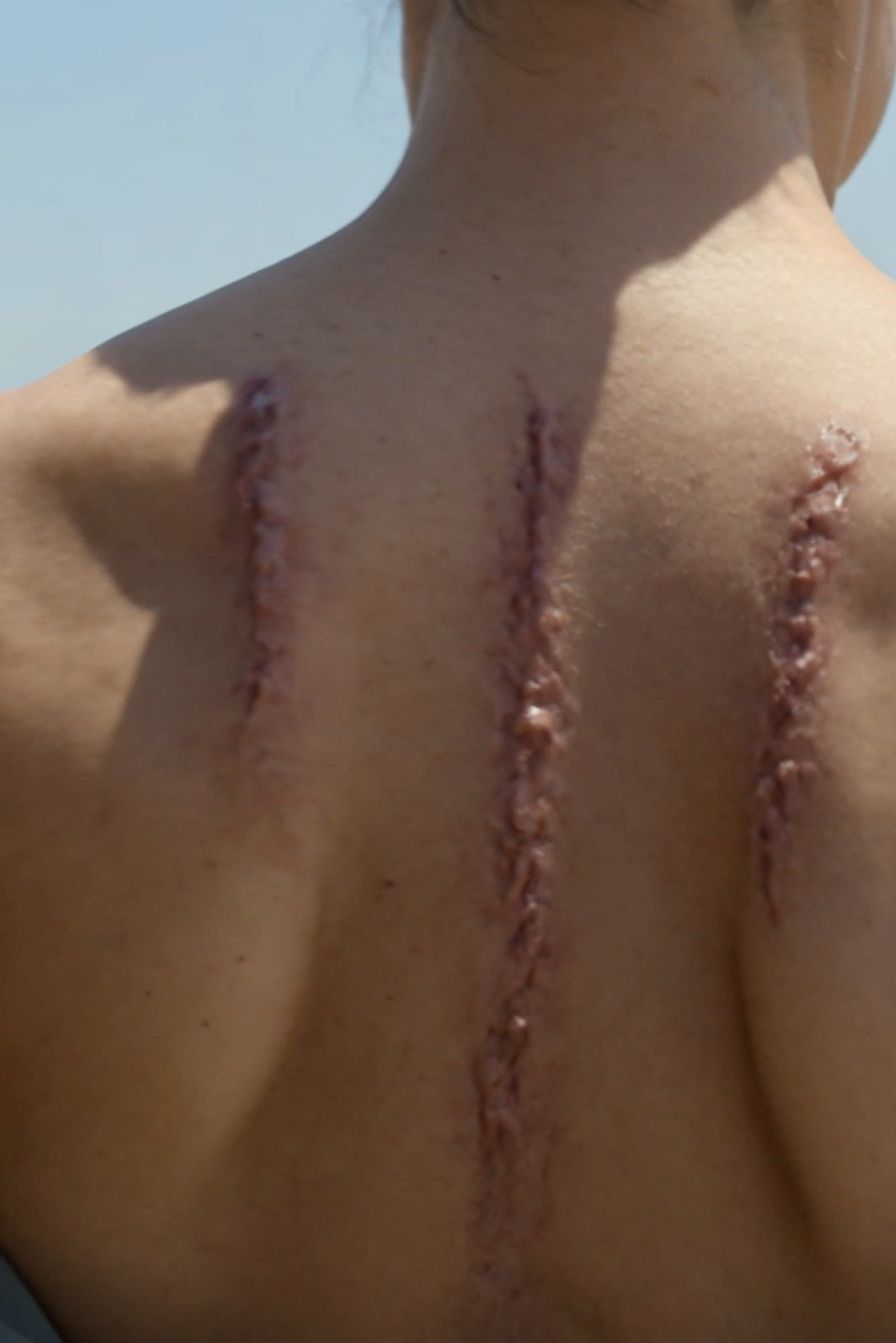
We were baking in the noon heat when she stepped onto our training field. No name tape. No rank. Old, sun-faded jacket. Blank Velcro like a dare.
“You’re lost, ma’am?” Sergeant Brenner called out, all smirk and swagger.
She stood at parade rest. Perfect. Silent.
A couple guys snickered. I did too, until Brenner stalked over and grabbed her collar. “Identify yourself or get off my field.”
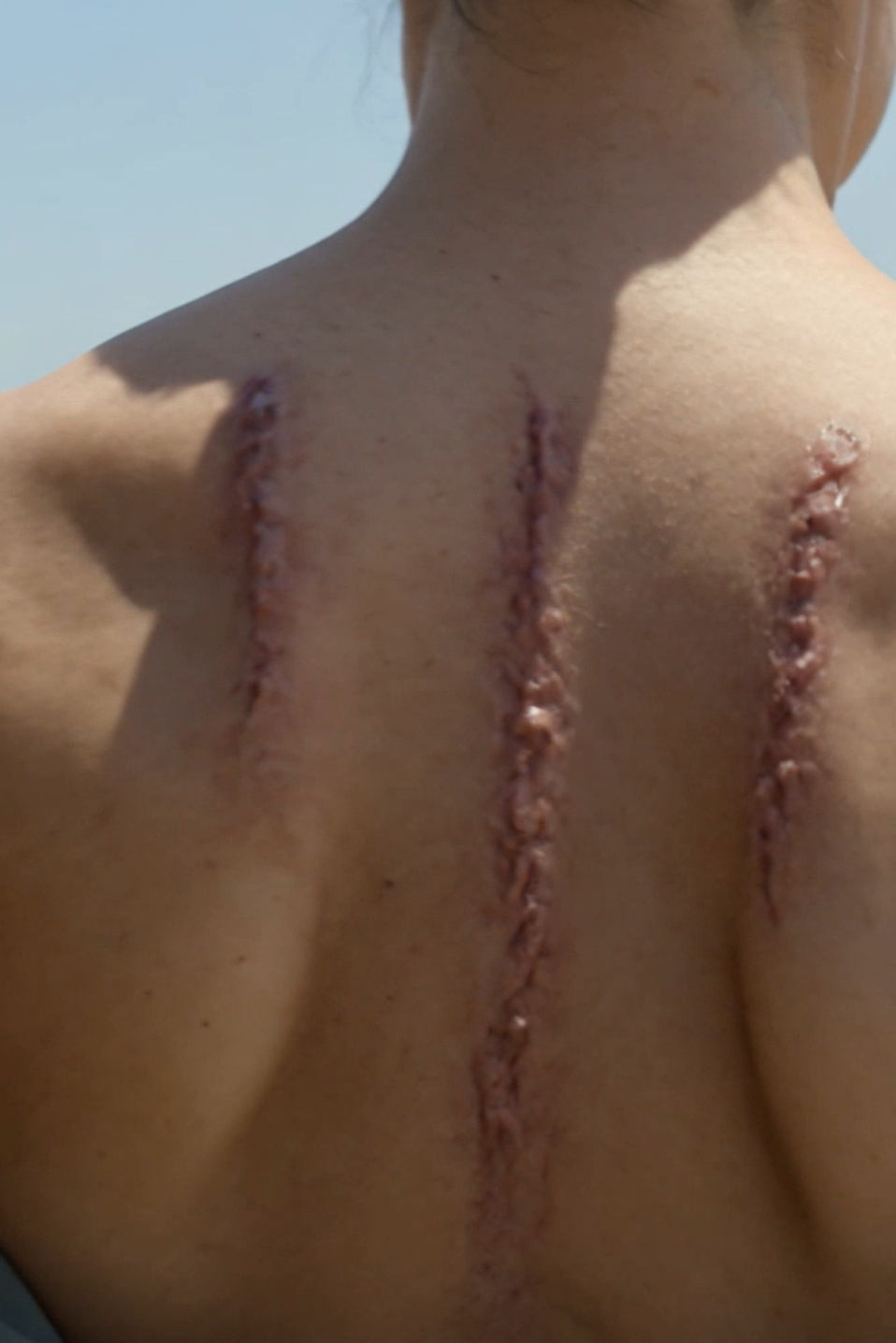
She didn’t flinch. She just let the jacket slide off her shoulders.
I swallowed hard. The laughter died in my throat.
Three clean, vicious scars ripped across her back – rope-deep, surgical ugly. Not training. Not a bar fight. The kind of marks you only bring home from someone else’s basement.
Brenner’s face went chalk white. He let go like he’d been burned.
A black staff car screamed to a stop on the grass. Doors flew open. General Hale – our base commander – strode straight past all of us. Brenner snapped to a shaky salute, voice cracking. “Sir, I was just – “
The General didn’t look at him. He looked at her. His hands were trembling.
He took off his cap and, in front of two hundred recruits, dropped to his knees in the dirt.
“Mara?” he whispered. His voice broke. “We buried you seven years ago.”
She turned. Her eyes were bone-dry, like the tears ran out a long time ago. She pulled a scorched dog tag from her pocket and pressed it into his palm.
“You didn’t bury me, Dad,” she rasped. “You buried my cover story.”
She leaned in and said something only he could hear.
I watched the color drain from his face, then flood back hot. He stood up so fast his cap fell. He turned to Sergeant Brenner, jaw tight, and the five words he said next didn’t just end Brenner’s career – they detonated it.
“Michael Thorne, you are under arrest.”
The name hung in the air, heavy and wrong. Sergeant Brenner wasn’t Sergeant Brenner. He was Michael Thorne. And the name on Mara’s scorched dog tag?
It was his.
Brenner, or Thorne, just stared. The smirk was gone, replaced by a mask of pure, primal panic. His eyes darted from the General to Mara, then to us, as if hoping one of us would say it was all a bad joke.
No one moved. No one breathed. The only sound was the wind kicking up dust around our boots.
Two military police officers, who had been standing by the General’s car, moved in. They were efficient and silent, their faces grim. They didn’t slam Thorne against a hood or shout commands.
It was worse than that. It was quiet.
They flanked him, and one of them simply said, “Sir, hands behind your back.”
Thorne opened his mouth, then closed it. He looked like a man who had seen a ghost, and the ghost was now pointing a finger right at him. He complied without a word, his body rigid with shock.
As they led him away, he looked back one last time. Not at the General, the man whose life he had just shattered twice over. He looked at Mara.
There was no hatred in his look. No anger. Just a kind of dawning, horrified understanding.
The General picked up his cap from the dirt, dusting it off with a hand that still shook. He didn’t put it back on.
He turned to Mara, and for a second, he wasn’t a General. He was just a father who had found something precious he thought was lost forever. His face was a wreck of emotions — grief, disbelief, and a staggering, earth-shattering joy.
“My office,” he said, his voice thick.
She just nodded, pulling the faded jacket back over her scarred shoulders. It was like she was putting a shield back on.
The General turned to his aide. “Dismiss the recruits for the day. Confine them to the barracks. No base leave until further notice.”
Then he looked at me. For some reason, his eyes locked on mine. “You. Private. Come with me.”
My heart hammered against my ribs. Me? I was a nobody, just one face in a crowd of green uniforms.
I scrambled to follow, my mind racing. I walked a few paces behind them as they crossed the field, the General and his ghost of a daughter. They didn’t speak. They just walked in a bubble of silence so heavy it felt like you could touch it.
We entered the administration building, the air conditioning a sudden shock after the oppressive heat. We walked down a long, polished hallway lined with portraits of stern-looking men. Past commanders.
The General’s office was at the very end. It was large and imposing, with a massive oak desk and flags standing in the corners. He walked straight to a small bar in the corner and poured two glasses of water, his hands still unsteady.
He handed one to Mara. She took it, but didn’t drink.
He then looked at me, standing awkwardly by the door. “At ease, Private. What’s your name?”
“Thomas, sir,” I managed to say. “Private Matthew Thomas.”
“Thomas,” he repeated, his eyes far away. “I need a witness. I need someone to hear this who isn’t already part of it. I need a record that isn’t just mine.”
I didn’t understand, but I nodded. I felt like I had stumbled into a play halfway through, and I didn’t know any of the lines.
Mara finally sat down in one of the leather chairs facing the desk. She looked small in it, swallowed by the official grandeur of the room. She placed the glass of water on the desk, her hand tracing the condensation on the side.
The General sat down behind his desk, but he didn’t look like he was in command anymore. He just looked like a tired old man.
“Seven years,” he said, his voice a low whisper. “We held a memorial. I got the flag. They told me you were killed in an ambush. Thorne was the one who brought back the report. He was the sole survivor.”
Mara’s voice was flat, devoid of emotion. “There was no ambush, Dad. He sold us out.”
The words landed in the quiet room with the force of a physical blow.
“He traded the location of our safe house for a transport out of the country and three million dollars,” she continued, her gaze fixed on a point somewhere beyond the wall. “He didn’t think anyone would come looking. He told them where we were, and then he just walked away.”
“The others…?” the General asked, his voice cracking.
“Gone,” Mara said. “They were dead before they knew what was happening. I was taken.”
She paused, and I saw her fingers tighten around the armrest. “They wanted to know who I reported to. What our larger mission was. They kept me for a year.”
She didn’t need to elaborate on what “kept me” meant. The scars on her back were a testament to that year. Every line was a story I didn’t want to hear.
“How did you get away?” the General breathed.
“They got sloppy,” she said. “There was an internal power struggle in the organization that bought me from Thorne. During the chaos, I found an opportunity. A loose lock. A distracted guard. It wasn’t heroic. It was just… a chance.”
She took a sip of water, her first one. “I spent the next six years staying dead. I couldn’t come back. I didn’t know who was compromised. I didn’t know who to trust.”
The General buried his face in his hands. A muffled sob escaped him. It was the most heartbreaking sound I had ever heard. This powerful man, this leader of thousands, was completely broken.
“I thought you were gone,” he whispered into his palms. “I grieved for you. I visited your empty grave every Sunday.”
Mara’s expression softened for the first time. A flicker of the daughter, not the soldier, broke through.
“I know, Dad. I’m sorry,” she said softly. “But I couldn’t come home. Not yet. Not until I found him.”
This was where the story shifted. My blood ran cold.
The General looked up, confused. “Found him? How did you know he was here?”
A faint, grim smile touched Mara’s lips. “It wasn’t a coincidence. I didn’t just stumble onto this base.”
She leaned forward, her eyes catching the light. They were sharp, intelligent, and filled with a fire that had been banked for years.
“After I got out, I started hunting. It took years. Thorne was smart. He used the money to buy a new identity, a whole new life. He even enlisted again, under a new name. Brenner. He thought it was the perfect cover. Hiding in plain sight.”
“I found him six months ago, using old contacts, favors I had to call in. He was a drill sergeant at Fort Jackson.”
The General was stunned. “Then why… why now? Why here?”
“Because turning him in wasn’t enough,” Mara said, her voice dropping, becoming intensely personal. “I wanted him to stand on your field. On my father’s field. I wanted him to be exposed by the family he tried to destroy.”
The second twist slammed into me. She hadn’t been found. She had been the hunter all along.
“I pulled some strings,” she said. “Old intel markers that only a few people would recognize. I made it look like there was a special operations training slot opening up here. Something a man like Thorne, ambitious and arrogant, couldn’t resist applying for.”
“He volunteered for the transfer. He walked right into my trap.”
The sheer, calculated brilliance of it was terrifying. She had spent years not just surviving, but planning. This wasn’t a chance encounter. It was a reckoning she had designed from the ground up. She had brought the monster back to the scene of his spiritual crime.
The General stared at his daughter, seeing her for the first time in seven years. Not as the girl he had raised, but as a hardened operative, a survivor forged in fires he couldn’t imagine.
He stood up and walked around the desk. He knelt in front of her again, just as he had on the field. But this time, it wasn’t out of shock. It was out of awe.
“Mara,” he said, taking her hand. “My girl. You came home.”
Tears finally welled in her eyes. The dam she had held back for seven long years finally broke. “I’m home, Dad.”
I stood by the door, trying to be invisible, witnessing a reunion that felt sacred. All the pain, the betrayal, the years of darkness, were washed away in that moment.
The next morning, the base was buzzing with rumors. No one knew the full story, just that Sergeant Brenner was gone and the General’s dead daughter was alive.
Instead of letting the gossip fester, General Hale did something I’ll never forget. He assembled the entire base in the main auditorium.
Mara was there, standing beside him on the stage. She wasn’t an operator or a ghost anymore. She was wearing a simple blue dress. The scars were hidden, but we all knew they were there. She looked calm. Resolved.
The General stepped up to the podium.
“Yesterday,” he began, his voice clear and strong, “you witnessed an event on the training field. I will not share the classified details of what happened seven years ago. But I will share the truth that matters.”
He looked at his daughter.
“This is Mara Hale. She is a soldier. She was taken by the enemy after being betrayed by one of her own. She was declared killed in action. For seven years, she endured what most of us can only imagine in our nightmares.”
“She did not just survive. She fought her way back. She did not just come home. She brought a traitor to justice.”
A stillness fell over the packed auditorium.
“We wear these uniforms as a symbol of our commitment,” the General continued, his voice ringing with passion. “But the uniform does not make the soldier. The heart makes the soldier. The courage to face the darkness, both outside and within, makes the soldier.”
“Michael Thorne, formerly known as Sergeant Brenner, disgraced his uniform. Mara Hale, with no uniform at all, embodied its highest ideals: loyalty, courage, and an unbreakable spirit.”
He paused, letting his words sink in.
“Let this be a lesson to all of us. Never judge a person by the rank on their collar or the jacket on their back. Judge them by the scars they carry and the integrity with which they carry them.”
He stepped back and stood beside Mara. The silence held for a beat, and then one person started clapping. Then another. Within seconds, the entire auditorium was on its feet, a thunderous, rolling applause that was more than just noise. It was respect. It was gratitude. It was an apology for ever doubting.
In the weeks that followed, things on the base slowly returned to normal, but nothing was ever really the same. We all looked at each other a little differently.
I saw Mara a few more times. She was often with her father, walking by the lake on base. They didn’t always talk. Sometimes they just sat on a bench, existing in the same space, healing in the quiet. The General looked ten years younger. The grief that had carved lines into his face was gone, replaced by a soft, peaceful light.
Mara was granted a full, honorable discharge with the highest commendations. They offered her a position as an instructor, a consultant, anything she wanted. She politely declined. She said she had fought her war.
The last time I saw her, I was on guard duty at the main gate. The General was driving her. She was in the passenger seat of his personal car, not the staff car. She was leaving the base for good, starting a new life.
As they passed, she looked over at me. She rolled down the window.
“Thomas, right?” she asked.
“Yes, ma’am,” I said, snapping to attention.
She smiled a real, genuine smile. It reached her eyes. “Thank you. For being a witness.”
I didn’t know what to say. “You taught us all a lesson, ma’am.”
“No,” she said, her smile fading just a little, replaced by a quiet wisdom. “Life taught me a lesson. I’m just the one who survived to tell the story.”
She looked ahead, down the road that led away from the gates, away from the uniforms and the memories. “Don’t ever let anyone else tell you what you’re worth. And never, ever give up on coming home. No matter how long it takes.”
The car pulled away, and I watched until it was just a dot on the horizon.
I finished my tour of duty a year later. I carry that day on the training field with me always. It taught me that the deepest wounds are often the ones we can’t see, and the greatest strength isn’t in the power you command, but in the resilience of your own heart. A uniform doesn’t make you a hero. Surviving, and helping others survive, is what makes you a hero.



