
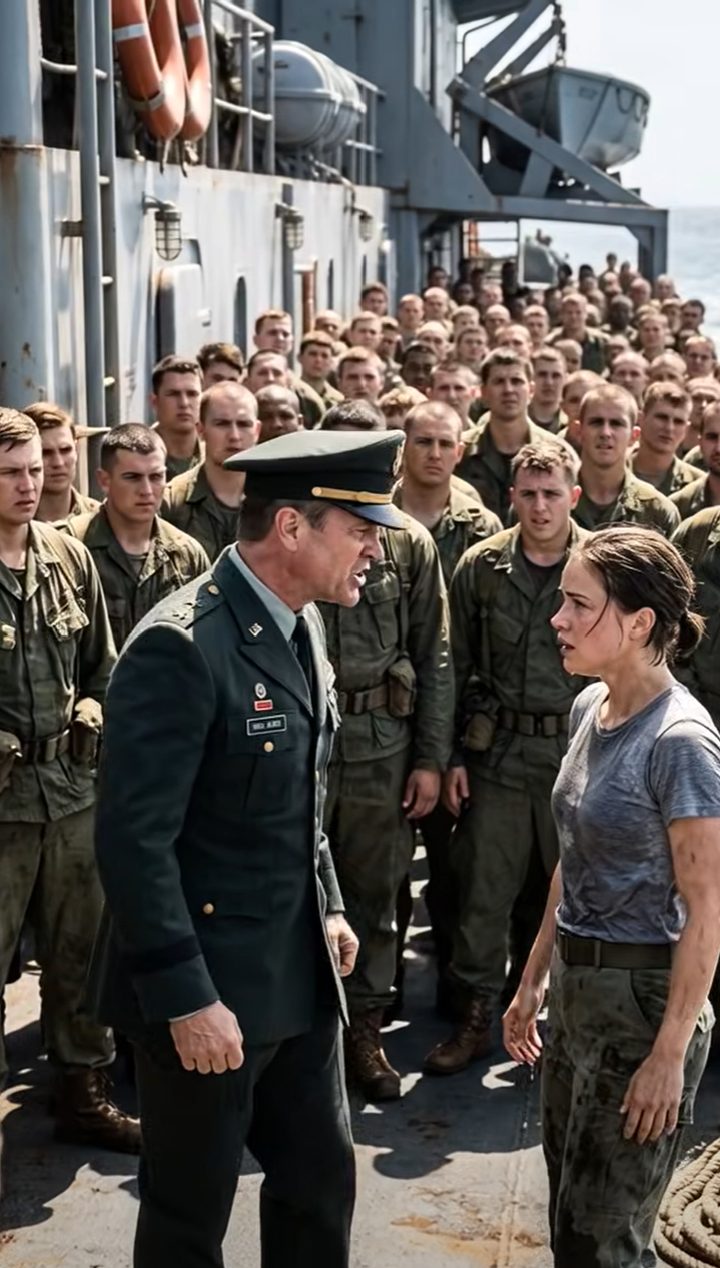
Nearly five hundred soldiers stood packed across that blistering deck – hungry, dehydrated, and too afraid to say a word. Colonel Victor Kane made sure of it.
Hannah had been watching him for three days.
She’d seen how he moved through the men – not to inspect them, but to remind them. A canteen knocked from a private’s hands. A boot deliberately placed in the path of a soldier already struggling under the weight of his pack. Small cruelties, carefully chosen, always just beneath the threshold of anything she could formally report. Kane understood power the way a surgeon understands anatomy – he knew exactly where to cut.
So when the young signalman’s legs buckled, Hannah already knew what was coming before Kane even turned around.
The kid’s name was Mercer. Nineteen years old, maybe twenty. He’d been standing at attention for four hours in direct sun while Kane sat in the shade, cutting into a steak with slow, deliberate strokes, rationing water like it was a privilege only he could grant. When Mercer’s knees finally gave, the sound of him hitting the deck seemed to echo across the entire ship.
Kane set down his fork. Stood. Straightened his collar.
Hannah watched his face as he crossed the deck – that careful blankness, the performance of a man deciding something – and she felt the full weight of what she was about to do settle into her chest like ballast.
She moved before he could raise his hand.
“Sir.” Her voice came out steadier than she felt. “He needs water. Not punishment.”
The entire deck went still.
Kane turned slowly, and a smile spread across his face – the kind cruel men wear when they think they’ve found something new to break. He asked her, almost casually, who she thought she was.
She didn’t hesitate.
“I’m the only one here still treating you like a human being.”
The quiet laughter that had been building behind him died instantly.
—
An hour later, Kane made his move – but he was too careful for something as obvious as a direct order. Instead, he gathered the men near the stern and announced that the bilge pumps along the port hull had fouled with debris. Standard procedure, he said, his voice pleasant and reasonable. Someone needed to go over the side on a line and clear them. A necessary task. Dangerous, but necessary.
He looked directly at Hannah when he said it.
She understood immediately. The fouled pumps were real enough – she’d heard the engineers discussing them that morning – but the way Kane was framing this, the angle of the ship, the current running hard off the port side, the fact that he’d chosen the longest line available and was already having it rigged with unnecessary slack – this was not a maintenance task. This was an architecture.
She stripped off her jacket.
What followed was not a challenge in any formal sense. There were no cheers, no declared competition. Kane simply kept finding reasons to send men over after her – check the secondary intake, check the drainage coupling, check it again – each one stronger than the last, each one given better equipment, a tighter line, a more favorable position along the hull.
She outlasted every single one of them.
Not because she was stronger. Because she’d spent three days watching Kane work, and she understood something the others didn’t: he always left himself a way to claim he hadn’t done anything wrong. Which meant the task was actually completable. Which meant she could complete it.
When she finally pulled herself back onto the deck – soaked, arms trembling, a bruise already darkening across her ribs from where the hull had caught her – she heard nothing. No sound from the men. Not even the wind seemed to move.
Kane stepped toward her.
Close enough that she caught it – the sharp, sour edge of whiskey beneath the salt air, the slight unevenness in his gait that she hadn’t noticed before. His mouth opened, and for a moment she thought he was going to say something quiet, something only she would hear.
Instead, his boot connected with her chest.
The force of it drove the air from her lungs before she even registered the pain – a hard, bright explosion behind her sternum, the deck tilting, the sky wheeling overhead as she went down. She heard the sound of it before she felt it fully: a dull, dense impact, the kind that doesn’t echo because the body simply absorbs it. The metal deck was hot against the back of her skull. Above her, the sun was enormous and white and completely indifferent.
She lay there for one second. Two.
And then she turned her head and looked at him.
What She Saw From the Ground
Kane’s face had gone wrong.
Not angry. Not satisfied. Something between the two that didn’t have a clean name – a kind of hunger that had already started curdling because the thing it wanted wasn’t happening. She wasn’t crying. She wasn’t begging. She wasn’t even grimacing, though the pain was genuinely bad, a deep, structural ache that told her at least one rib had taken the full force of it.
She just looked at him.
And then she got up.
Not fast. Not dramatic. She rolled to her side, got her hands under her, pushed. Her arms shook the whole way. She made it to one knee, then the other, then standing. The horizon tilted once and corrected itself. She kept her eyes on him the entire time.
The men were not moving. Four hundred and ninety-something soldiers and not one of them made a sound. She could hear the ship’s engines. She could hear the water against the hull. She could hear her own breathing, which was shallow and careful because anything deeper pulled at the damaged rib.
Kane said something. She didn’t catch all of it. Something about insubordination. Something about the next port.
She nodded slowly.
“Yes, sir,” she said. “I heard you the first time.”
What Happened Below Deck That Night
Mercer found her in the medical bay around 2100 hours.
He stood in the doorway with his cover in his hands, turning it around and around by the brim. He was still pale from the afternoon. The ship’s corpsman had already wrapped her ribs and left her with two aspirin and a look that said he understood exactly what had happened and exactly how much he could say about it.
Mercer said, “You didn’t have to do that.”
She was sitting on the edge of the cot, pulling her boot back on. The motion hurt. She did it anyway.
“I know,” she said.
He stood there another moment. “He’s done it before. To other people. Nobody ever-” He stopped. Started over. “The men are talking.”
She looked up at him then. He was so young his face still had that unfinished quality, like his features hadn’t quite committed to their final arrangement. She thought about what it meant that he was the one who’d come. Not a sergeant. Not one of the officers who’d watched the whole thing from the shade of the wheelhouse and found somewhere else to look when Kane’s boot swung.
This kid.
“What are they saying?” she asked.
Mercer’s jaw worked for a second. “That you knew he was going to do it. Before he did it.” He paused. “Did you?”
She thought about the whiskey smell. The slack in the line. The way Kane had positioned himself so his back was to the wheelhouse cameras when he stepped toward her.
“Not exactly,” she said. “But close enough.”
He nodded like that meant something to him. Then he set his cover on the cot beside her, turned around, and left. She didn’t know why he left the cover. She didn’t ask.
The Log She’d Been Keeping
What Kane didn’t know – what he couldn’t have known, because he’d never considered her worth knowing – was that Hannah had been keeping a written record since the second morning out of port.
Not a diary. Nothing sentimental. A log.
Time-stamped. Specific. The canteen, the boot in the path, the water rationing, the way he’d assigned Mercer to four hours of sun exposure without rotation when the posted duty schedule clearly called for relief at the ninety-minute mark. She’d written it in the small green notebook she kept in her left breast pocket, the one she’d had since officer candidate school, the one that had survived two deployments and a flood in a firebase outside Kandahar.
She’d been building something.
Not a complaint. Complaints went to Kane’s immediate superior, who was a man named Colonel Aldrich Pruitt, and Pruitt had known Kane for twenty-two years and played golf with him every third Saturday when they were stateside. A complaint to Pruitt was a complaint into a hole.
She was building a record for the Inspector General’s office. Specifically for a woman named Major Donna Reyes, who had a reputation for reading everything twice and throwing out nothing, and who Hannah had met exactly once at a training exercise in Fort Campbell three years ago. They’d eaten bad chicken together in a mess tent during a rainstorm and talked for two hours about what the chain of command actually protected and what it only pretended to.
Hannah had kept Reyes’s card.
It was in her other pocket.
What Kane Filed and What He Didn’t Know About Filing
He submitted the paperwork the next morning.
Conduct unbecoming. Failure to follow a lawful order. Insubordination. It was a clean, professionally worded document, the kind a man produces when he’s been composing it in his head for a while. He had it witnessed by two junior officers who’d seen enough of Kane to understand what witnessing meant for their careers.
He felt good about it. She could see that in the way he moved through breakfast, easy in his shoulders, nodding at the men who met his eyes.
What Kane had filed was real. The charges were serious. The process would be slow and grinding and would require her to answer for herself in front of people who hadn’t been there, and the burden of that was not nothing.
But he’d kicked her in front of four hundred and ninety soldiers.
In front of two wheelhouse cameras he hadn’t checked.
On a ship whose medical log would now show a treated rib injury dated the same afternoon, documented by a corpsman who had written the cause as “blunt force trauma, deck incident” because he was careful with words and careful with his own future, but who had also written it down, which meant it existed.
Kane had filed paperwork.
She had a notebook, a card, a corpsman’s report, camera footage she hadn’t personally reviewed yet but knew existed, and somewhere in the crowd of men who’d watched the whole thing, she had Mercer.
Nineteen years old. Maybe twenty. Standing at attention in the sun for four hours because Kane thought he was nobody.
What She Wrote That Night
The entry was short.
Day 4. 2230 hours. Rib injury documented, medical bay, Corpsman T. Hollis. Incident witnessed, main deck, approx. 1600 hours. Estimated 400+ personnel present. Wheelhouse camera angles: confirm coverage before port. Kane submitted conduct report, 0800 day 5 per Sgt. W. Doyle (overheard, mess corridor). Reyes contact: current.
She closed the notebook.
Outside the porthole, the water was black and moving fast. They’d make port in four days. Four days was enough.
She put the notebook back in her left pocket, the card back in her right, and lay down on the cot with Mercer’s cover still sitting next to her. She hadn’t moved it. She wasn’t sure why.
Her ribs hurt when she breathed. She breathed anyway.
Above deck, she could hear the faint sound of boots on metal. Someone doing rounds. The ship pushing through water that didn’t care about any of them, which was fine.
She didn’t need the water to care.
She just needed four more days.
—
If this one stayed with you, pass it on to someone who’d get it.
For more tales of courage, check out what happened when she was kneeling on the gravel, bleeding, while they laughed – then the convoy arrived. And if you’re looking for something completely different, you might be surprised by how drink coffee with lemon in the morning and lose belly fat in 7 days or learn how all worms and parasites crawl out immediately with a spoon a day!



