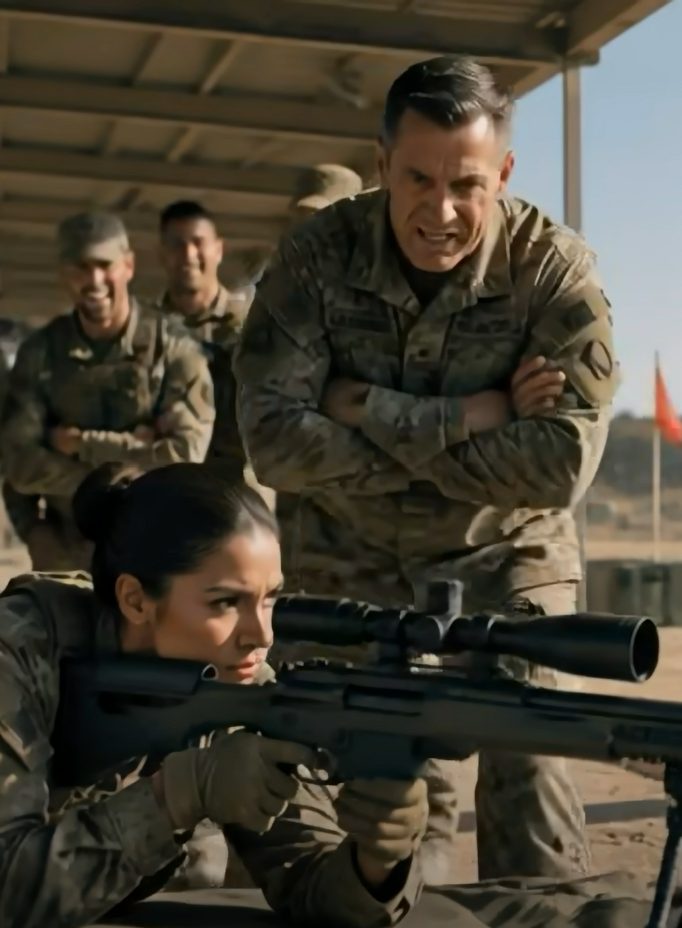
“Put it down before you hurt yourself,” Sergeant Marcus Hale said, and the men on the firing line erupted in laughter as if judgment had already been passed.
The young woman holding the sniper rifle did not blink.
The range outside Fort Bragg, North Carolina, fell into an uneasy silence. Not calm. Not respectful. Just waiting. The kind of silence that decides whether someone becomes a target or a joke.
Specialist Elena Carter stood alone on lane six, the heavy rifle resting across both hands. Morning wind dragged dust across the concrete pad and snapped the red range flag like tearing fabric. Beyond the firing line, the long field stretched under pale Carolina light toward a distant target over a thousand meters away.
To the watching soldiers, the shot seemed impossible.
To Sergeant Hale, Elena seemed worse than impossible.
She seemed out of place.
He had been running the long-range course since 0600, correcting mistakes, breaking egos, and reminding everyone that special operations did not tolerate weakness. He liked that word. Weakness. He shaped it like a warning.
Now his eyes scanned Elena’s smaller frame, her steady posture, her quiet hands, and his mouth curled slightly.
“You sure you’re in the right place, Specialist?” he asked.
A soldier behind him murmured, “She probably thinks this is admin processing.”
Another added, “Maybe she’s here for the photo.”
Laughter followed.
Elena heard every word.
She did not react.
Hale stepped closer, boots grinding against concrete.
“Answer me when I speak to you.”
Elena looked at him. “Yes, Sergeant. I’m in the right place.”
Her voice was calm. Too calm.
It irritated him.
Hale expected hesitation. He expected discomfort. He expected the small flinch people showed under pressure. She gave him nothing.
He turned toward the group under the covered bay.
“You hear that? She says she belongs here.”
The laughter faded slightly, uncertain now.
Elena’s silence made the air heavier.
Hale walked to the weapons rack, scanning the rifles prepared for qualification. He ignored the standard ones. His hand moved to the far end.
He chose the most unforgiving rifle there.
A .300 Winchester Magnum precision rifle.
Heavy barrel. Tight bolt. Sensitive trigger. Brutal recoil.
A weapon known for punishing mistakes.
Men with confidence had failed with it.
Hale carried it back.
“Since you’re so sure,” he said, “we’ll make this educational.”
He pushed the rifle toward her.
Elena took it.
The weight settled in her hands.
For a moment, Hale expected her stance to break.
It didn’t.
She adjusted once and held it steady.
One soldier stopped smiling.
Hale noticed. It pushed him further.
“That rifle is heavier than it looks,” he said. “A lot heavier than what you’re used to.”
“I understand,” Elena replied.
“No, I don’t think you do.”
He pointed downrange.
“Target is over a thousand meters. Wind is unstable. You’ll need to read mirage, adjust elevation, control recoil, and manage breathing. Everyone will see your miss.”
Elena nodded once.
Hale leaned in, voice low but audible.
“If you can’t handle it, set it down now.”
The soldiers waited for her to break.
Elena looked past him toward the distant target.
“May I use lane six?” she asked.
Hale’s expression tightened for a moment.
Not because she challenged him.
Because she didn’t.
There was no anger, no pride, no resistance. Only calm.
That unsettled him more than defiance.
He stepped aside sharply.
“By all means.”
Elena moved to the firing mat.
Her boots barely made a sound.
She lowered herself, set the rifle down, and assumed position. No hesitation. No performance. Just precision.
She checked the bipod, aligned the stock, and settled behind the scope.
The change was immediate.
The men expected hesitation.
They saw familiarity.
Her hands moved with quiet discipline, as if the rifle was already known to her.
Specialist Dylan Cross frowned.
“Hold on,” he muttered.
Private Aaron Mills leaned in. “What?”
“She knows what she’s doing,” Cross said.
“That could be fake,” Mills replied.
But his voice lacked certainty.
Hale heard the exchange and stiffened.
“When you’re ready,” he said, “fire.”
Elena did not respond.
She focused through the scope.
Wind. Dust. Distance. Breath.
The target was a faint square against the far berm, shimmering in heat distortion. The wind flag shifted, snapped, then loosened.
Elena inhaled. Held. Released slowly.
Hale watched closely, arms crossed.
The soldiers leaned forward.
Some still smirked. Others no longer did.
A whisper broke the silence.
“She’s going to miss.”
Elena’s finger tightened.
The range went still.
She fired.
The shot cracked across the field.
The rifle kicked hard. Elena absorbed it cleanly.
A moment later, the monitor flashed.
Center hit. Dead center.
No one spoke.
Silence dropped instantly.
Cross stepped forward.
Mills whispered, “That’s not right.”
“It’s electronic,” Cross said.
“Then it’s wrong,” Mills replied.
Elena remained in position, expression unchanged.
Hale moved toward the monitor, studying it, then looked through a spotting scope.
The shot was clean. Perfect.
He straightened slowly, saying nothing at first.
Elena turned her head slightly.
“Next round, Sergeant?”
That broke the tension.
Hale’s jaw tightened.
“Lucky shot,” he said quickly.
Everyone heard the hesitation behind it.
Elena calmly loaded another round.
Hale stepped closer.
“Again.”
The Second Shot
She fired again.
Same result.
The monitor registered center mass. The spotting scope confirmed it. No one reached for an excuse fast enough this time.
Cross made a sound that wasn’t quite a word. Mills had stopped talking entirely.
Hale stood with his arms still crossed, but the posture had changed. Something had gone out of it. He looked like a man holding a shape he no longer believed in.
Elena loaded a third round without being asked.
“I’ll stop when you tell me to stop,” she said. “Or I can keep going.”
Hale said nothing.
She fired.
Third shot. Third center hit.
The range was so quiet you could hear the brass casing tick against the concrete.
Private Mills sat down on the bench behind him. Not dramatically. Just sat, like his legs made a decision his brain hadn’t caught up to yet.
Hale finally uncrossed his arms.
“Where did you train?” he asked.
His voice was different. Still controlled, still clipped, but the edge was gone. It wasn’t respect yet. It was recalculation.
Elena rose from the mat. She cleared the rifle, checked the chamber, and set it down on the rest. Every step in order. Nothing showy.
“Fort Benning,” she said. “Then Bragg. Then a year and a half downrange.”
Hale’s face did something complicated.
“Downrange where.”
“Classified,” Elena said. Not smug. Just accurate.
What Hale Didn’t Know
He hadn’t read her file.
That was the part nobody said out loud, but everyone in the covered bay understood by the time she fired that third round. Sergeant Marcus Hale had looked at Elena Carter and made a complete assessment in about four seconds. He’d been wrong about all of it.
What the file would have told him, if he’d bothered: Elena had grown up outside Fayetteville, twenty minutes from the post she was standing on. Her father, Dennis Carter, had been a warrant officer, two tours in Iraq, and a man who believed his daughter could do anything she put her hands on. He’d started taking her to the range at eight years old. Not a .22. Not a starter pistol. A real rifle, with real recoil, and real expectations.
By the time she was fifteen she was shooting better than most of the men Dennis trained with.
By the time she enlisted at twenty, she’d logged more trigger time than half the NCOs in her first unit.
She hadn’t said any of that to Hale. She hadn’t said it to anyone on the range that morning. There was no version of that conversation that ended well. Either she was bragging, or she was making excuses before she’d done anything, or she was asking for the benefit of a doubt she shouldn’t need.
So she’d said nothing.
She’d just shot.
The Ones Who Watched
Cross was the first to approach her.
He was a solid soldier, three years in, two deployments, not the kind of guy who made noise for no reason. He’d been one of the ones who laughed at Hale’s first comment. Not hard, not mean, just reflexive. The kind of laugh that says I’m part of this group before you’ve decided whether the group is right.
He stood a few feet away, hands in his pockets.
“That was clean shooting,” he said.
Elena looked at him.
“Thanks.”
“I mean it. That third shot especially, the wind shifted.”
“I know.”
Cross nodded. He seemed to want to say something else. He didn’t quite get there.
Mills stayed on the bench. He was twenty-two, from somewhere in rural Georgia, and he’d spent most of the morning trying to make Hale laugh. He had a talent for it. He knew which kinds of jokes landed with sergeants and which ones got you smoked. He was good at reading rooms.
He’d read this one completely wrong.
He didn’t look at Elena directly. But he also stopped talking, which, for Mills, was its own kind of statement.
The third soldier, an older specialist named Ruiz, had said nothing during the whole episode. He’d watched from the back of the covered bay with his arms loose at his sides and his face giving away exactly nothing. When Elena fired the first shot and the monitor registered center, Ruiz had nodded once, the way you nod when something confirms what you already suspected.
He caught Elena’s eye after she cleared the rifle.
“Ruiz,” he said, by way of introduction.
“Carter,” she replied.
That was the whole conversation. It was enough.
Hale at the Spotting Scope
Hale didn’t leave the range.
That surprised some of the men. They’d half-expected him to find an administrative reason to walk away, some errand that materialized conveniently, the way authority sometimes does when it needs to save face. But he stayed.
He ran the rest of the morning’s qualification block. Corrected stances. Called out breathing errors. Did the job.
He didn’t speak to Elena directly again until the block was nearly done. The other soldiers were clearing their lanes and logging their scores. The range was getting loud again, normal range noise, brass and voices and the distant clang of the target frames being reset.
Hale stopped near lane six.
Elena was field-stripping the .300, laying the components on the mat in order, cleaning rod already in her hand.
Hale watched for a moment.
“You should have said something,” he said.
Elena looked up.
“About what.”
“Your background. Your training.”
She set the barrel down carefully.
“Would it have changed how you ran the block?”
Hale didn’t answer right away. That was its own answer.
“I run every block the same,” he said.
“I know,” Elena said. “That’s fine. That’s how it should be.”
She went back to the cleaning rod. Hale stood there another second, and then he walked away.
She didn’t watch him go.
Lane Six
The range cleared out by 1130.
Most of the soldiers headed to the vehicle bay, swapping stories, the kind that get louder and funnier with distance from whatever actually happened. Mills had apparently decided that Elena’s performance was something he’d seen coming all along. Cross set him straight on that, quietly, and Mills didn’t argue.
Ruiz stayed to help stack the target frames.
Elena finished cleaning the rifle, logged her qualification card, and walked the length of the range once before leaving. Not for any particular reason. Just to feel the distance. A thousand meters looks different when you’re standing at the near end than it does from behind a scope. Out here it was just field and sky, pale grass and red clay, the target frames small and ordinary at the far end.
She’d been shooting this distance since she was seventeen.
Her father had stood behind her the first time she’d hit it clean, and he’d said nothing. He’d just put one hand briefly on her shoulder and then stepped back. That was Dennis Carter’s version of a standing ovation.
He’d been gone four years now. Heart attack, fast, no warning, the kind that doesn’t negotiate.
She thought about him sometimes on ranges. Not every time. Just when the air felt like this, cool and moving, and the flag was snapping the same way.
She walked back to the equipment shed, signed out, and picked up her gear bag.
Cross was leaning against the wall outside, scrolling his phone. He looked up.
“You heading back to the barracks?”
“Motor pool first,” Elena said.
“I’ll walk out with you.”
They walked in silence for a minute. The post was waking up around them, vehicles moving, voices across the parade ground.
“Can I ask you something?” Cross said.
Elena glanced at him.
“Why didn’t you say anything? When Hale was doing his thing. You could’ve shut it down.”
Elena thought about it for a second.
“Saying it doesn’t prove it,” she said.
Cross looked at her.
“Shooting proves it,” she said.
He nodded slowly. Then: “Yeah. Okay.”
They reached the motor pool gate and went different directions. Elena didn’t look back.
Behind her, the range was empty. Lane six was just a concrete pad now, the mat rolled up, the rifle back in the rack.
The wind flag still snapped in the Carolina morning like it had something left to say.
—
If this one got to you, pass it on to someone who needs to see it.
If you’re looking for more stories about unexpected strength, you might also like The Woman at the Bar Didn’t Flinch Once.