
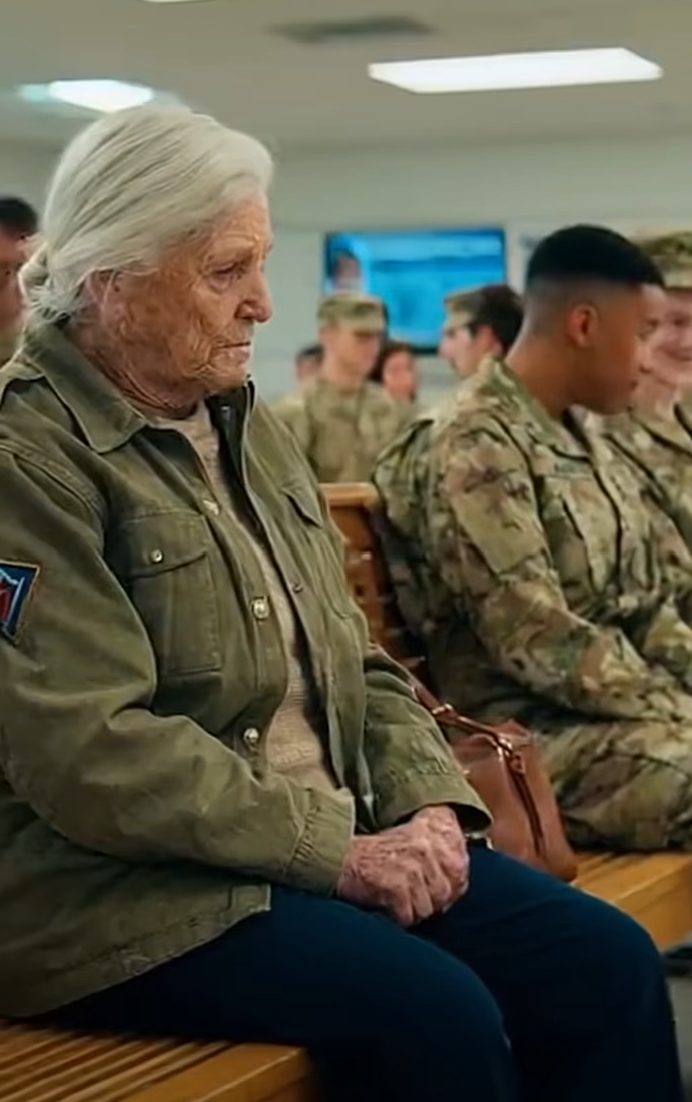
The laughter started softly – a thin ripple of sound, like wind teasing dead leaves on an autumn road. Then came sharper snickers, quick and cruel. Whispers. The hiss of mockery.
In the crowded waiting room of the Fort Breenri military base visitor center, an old woman sat by herself. Her posture was straight but small, her hands folded in her lap, fingers gripping the hem of a jacket that had clearly seen better decades.
The jacket was faded olive drab – its seams frayed, the collar missing a button, the fabric worn thin at the elbows. It hung loosely on her shoulders, like a relic refusing to die.
A teenage recruit nudged his friend, smirking.
“Bet she pulled that out of a dumpster,” he said, just loud enough for others to hear.
Laughter broke out again – louder this time. Young, uniformed, confident laughter. The kind that comes easy to those who haven’t seen what real pain looks like.
The woman didn’t move. Didn’t flinch. Her gaze remained low, fixed on her hands, as though she were somewhere far away – in another time, another life.
Then, across the room, a pair of boots stopped mid-step.
A tall, silver-haired general turned toward her. His eyes – cold steel dulled by years of command – locked on the faded patch on her sleeve. The air seemed to tighten.
The general’s breath caught. His expression changed. Not confusion. Not surprise. But something older, heavier – reverence.
He didn’t speak at first. He just walked. Slow, deliberate steps across the polished tile floor, each one echoing in a room that had suddenly gone quiet. The recruits stopped laughing. One of them – the boy who’d made the dumpster joke – sat up a little straighter, sensing something was wrong without knowing why.
The general stopped three feet in front of the old woman. He removed his cap. Tucked it under his arm.
Then he dropped to one knee.
A gasp swept through the room. Someone whispered, “What is he doing?”
The old woman finally lifted her eyes. They were pale blue, watery, but steady. She looked at the general the way you look at a ghost you’ve been expecting for fifty years.
“Ma’am,” the general said, his voice cracking like dry timber. “I never thought I’d find you. We searched. For decades, we searched.”
She said nothing. Just blinked, slowly.
The general’s hand trembled as he reached out and gently touched the patch on her sleeve – a small, faded emblem most people in the room had never seen before. A black silhouette of a sparrow over crossed keys. No unit name. No insignia number.
“Sir,” a colonel behind him stammered, “what – what unit is that? I don’t recognize – “
“You wouldn’t,” the general said, not taking his eyes off the woman. “It was never on any official roster. It was never supposed to exist.”
He turned his head slightly, addressing the room without looking at them.
“In 1968, twelve women were sent behind enemy lines. No ranks. No dog tags. No promise of rescue. Eleven of them never came home.”
The recruit who had laughed felt his stomach drop into his boots.
The general looked back at the old woman, his eyes wet now.
“Ma’am, do you remember me? I was the boy in the rice field. The one you carried for six miles with a bullet in your shoulder. The one you told to keep breathing.”
Her lips parted. For the first time, she smiled – a small, broken thing.
And then she reached into the inside pocket of that faded olive drab jacket, pulled out something wrapped in yellowed cloth, and placed it in his palm.
The general unwrapped it slowly. When he saw what was inside, his face went white.
He stood up sharply, turned to the room full of stunned recruits, and in a voice that shook the walls, he gave an order that none of them would ever forget.
What Was Inside the Cloth
The room was still holding its breath.
Thirty-some recruits, a handful of clerks, two MPs by the door – all of them frozen, watching a four-star general stand there with something small and dark in his open palm, his jaw working like he was trying to find a word in a language he’d forgotten.
It was a dog tag.
But not his.
The metal was black with age, the chain long gone, the stamped letters worn almost smooth. Someone had wrapped it in a strip of parachute silk – the yellowed cloth the old woman had kept it in – and tied it with a knot so old the fabric had fused to itself. It had been wrapped a long time. Decades, at least.
The general turned it over. Read the back.
His hand closed around it.
“Her name was Ruth Calloway,” he said. Not to anyone in particular. To the room. To the ceiling. To 1968. “She was twenty-four years old. She went in with us and she didn’t come out. We were told there was no body to recover.”
He looked at the old woman.
“Where did you get this?”
The woman’s voice, when it came, was quieter than anyone expected. Low. Unhurried. The voice of someone who had learned a long time ago that words don’t need volume to carry weight.
“She gave it to me,” she said. “The night before the extraction. She said if she didn’t make it, she wanted someone to bring it home. She said she had a sister in Macon.”
The general’s throat moved.
“Her sister died in 1987,” he said. “We tried to notify next of kin. There was no record. There was no record of any of you.”
“I know,” the woman said. “That was the point.”
The Unit That Didn’t Exist
Her name was Dorothy Hale. She was eighty-one years old. She’d driven herself to Fort Breenri that morning in a 2003 Buick with a cracked rear bumper, to sort out a paperwork problem with her late husband’s pension. Her husband, Gerald, had been a supply sergeant. Straightforward man. Thirty years of service, no combat decorations, died of a stroke in 2019 watching a Braves game.
No one at the visitor center had known anything about Dorothy before that morning, other than that she was in the wrong line and needed to be redirected to Window 4.
The jacket she wore had been Gerald’s idea. She’d put it on for the drive, she would later explain, because the car’s heater ran cold and it was the warmest thing she owned. She’d had it since 1969. She wore it maybe twice a year. She’d stopped noticing the patch a long time ago.
The patch was the thing.
The general – his name was Raymond Cooke, four stars, eighteen months from retirement, a man who had commanded operations on three continents – had seen that patch exactly once before in his life. In a rice paddy outside a village whose name he still couldn’t say out loud without his chest going tight. He’d been nineteen. A private. Delirious with fever and a through-and-through wound in his left thigh, lying in eight inches of standing water, absolutely certain he was going to die there in the mud with no one knowing where he was.
And then a woman had come out of the tree line.
She’d been wearing that jacket. That patch.
She hadn’t said her name. She hadn’t said much of anything. She’d pulled him up, gotten his arm across her shoulders, and started walking. He’d passed out twice. She’d kept walking. Six miles to a secondary extraction point, in the dark, in the rain, with a bullet lodged somewhere near her left clavicle that she didn’t mention until two days later.
He’d asked her name when they reached the treeline near the LZ. She’d said, “Doesn’t matter. Keep breathing.”
He’d kept breathing. He’d kept breathing for sixty-two more years.
He’d never found her. The unit she’d belonged to – twelve women, recruited quietly from signals intelligence, field medicine, and two names he was told never to repeat – had been a black program so deep it didn’t have a file number. When the war ended, the program ended. The women scattered or didn’t come home. The paperwork, such as it was, got buried under seventeen layers of classification that nobody had ever bothered to dig through because officially there was nothing there to find.
Cooke had tried. Three times in his career he’d pulled at that thread, and three times he’d hit a wall of “no record, no record, no record.”
And then he’d walked into the Fort Breenri visitor center on a Tuesday morning in November to sign off on a base infrastructure review, and there she was. Sitting in a plastic chair. Wearing the jacket.
What He Ordered
He turned to face the room.
Thirty recruits. A handful of clerks. The colonel who’d asked the question and still hadn’t gotten an answer he understood.
Cooke put his cap back on. Squared it.
“On your feet,” he said.
Every person in that room stood up. The clerks behind the windows. The MPs by the door. Everyone.
“Attention.”
They snapped to it. Even the civilians straightened without knowing why.
Cooke turned back to Dorothy Hale, who was still sitting, watching him with those pale blue eyes that had seen everything and given away nothing.
“Ma’am,” he said. “This room is going to stand at attention for as long as you want to sit in it. And when you’re ready to leave, I’m going to personally escort you to wherever you need to go, and we’re going to fix your pension issue, and then I’m going to make some calls. Because what was done to you – to all twelve of you – was wrong. The erasure was wrong. The silence was wrong.”
He paused.
“I don’t have the power to give you back what you lost. But I have enough rank left to make sure that patch gets on a record somewhere. That your name gets on a record somewhere. That Ruth Calloway’s name gets on a record somewhere.”
Dorothy looked at him for a long moment.
“There were eleven others,” she said.
“I know.”
“Some of them have family.”
“I know that too.”
She nodded, once. Looked down at her hands. Then back up.
“The boy who made the joke about the dumpster,” she said.
The recruit in question felt every drop of blood leave his face.
“Ma’am?” Cooke said.
“He’s young,” Dorothy said. “Don’t be too hard on him.” She looked at the boy directly, and he met her eyes and immediately wished he hadn’t, not because she was angry but because she wasn’t. “You don’t know what you don’t know,” she said. “That’s not a sin. Staying ignorant after someone shows you – that’s the sin.”
The boy said nothing. His mouth was open a little.
“Close your mouth,” she said, not unkindly.
He closed it.
The Tag Goes Home
Cooke kept the dog tag.
He made two calls before he left the building that day. The first was to a woman in the Pentagon whose job title was deliberately boring and whose actual function was to find things that weren’t supposed to be found. The second was to a historian at the Army Center of Military History who had spent twelve years working on a monograph about black programs from 1965 to 1972 and had hit the same wall Cooke had, every time.
“I have a name,” Cooke told him. “I have a patch. And I have a witness.”
The historian was quiet for a second. “Which program?”
“Sparrow.”
Another pause. Longer.
“That’s not supposed to be real,” the historian said.
“I know,” Cooke said. “It is.”
The monograph, when it finally came out – three years later, after the declassification fight that nobody outside a very small community ever heard about – ran to four hundred and twelve pages. It named all twelve women. It described their training, their deployments, their losses. It included, in an appendix, a photograph of the patch: a black sparrow over crossed keys, small enough to miss if you weren’t looking, specific enough to mean everything if you were.
Dorothy Hale attended the small ceremony where the record was formally acknowledged. She wore the jacket. Of course she wore the jacket.
Ruth Calloway’s tag was presented to the Macon chapter of the American Legion, who’d been contacted through a genealogical search that turned up a grand-niece, a twenty-six-year-old named Brenda who worked at a veterinary clinic and had never heard her great-aunt’s name spoken aloud.
Brenda held the tag for a long time without saying anything.
Then she asked, “Was she brave?”
Cooke, who was standing next to Dorothy, looked at Dorothy.
Dorothy looked at the girl.
“She kept breathing,” Dorothy said. “That’s all any of us did.”
Brenda nodded. Held the tag against her chest.
Outside, the November wind was picking up, and the flag above the building snapped and pulled at its lines, and nobody said anything for a while, which was exactly right.
—
If this one got to you, pass it on. Someone you know needs to read it.
For more moving tales, you might appreciate the story behind “My Buddy Died Seven Years Ago. His Dog Just Put His Head in My Lap.”.



