
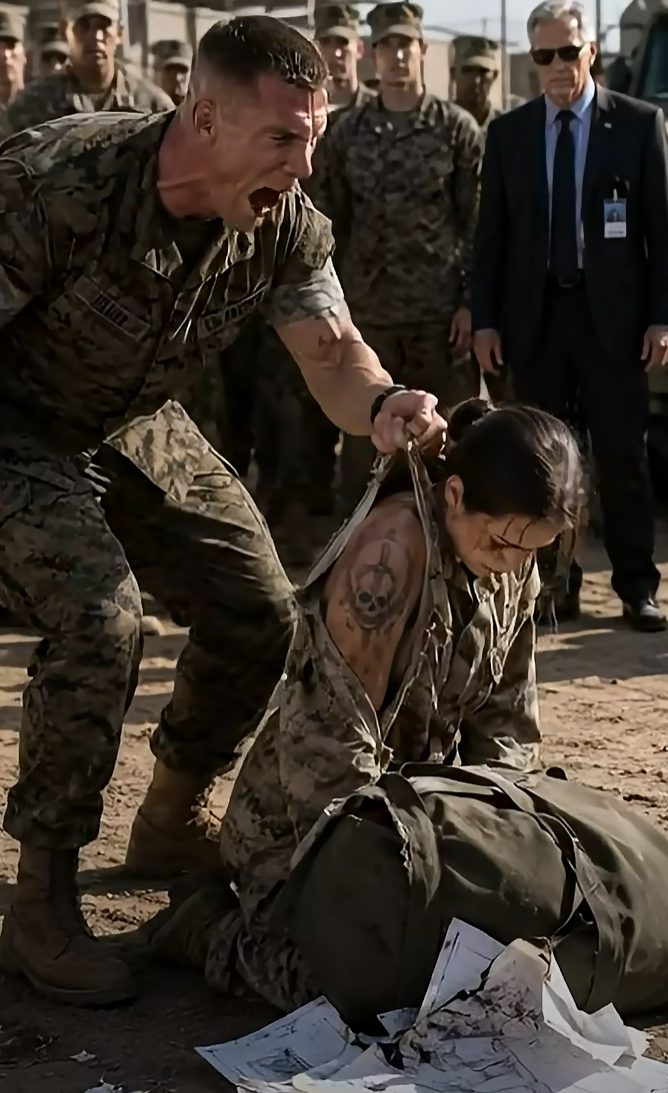
The North Carolina heat felt alive.
Heavy. Wet. Mean.
It wrapped around Fort Liberty like a damp hand around a throat, trapping diesel fumes, hot dust, and the sharp metallic smell of machinery inside the motor pool. Thirty soldiers stood sweating through their uniforms in dead silence while Master Sergeant Cole Maddox paced slowly in front of us.
Nobody moved. Nobody spoke.
Because Cole Maddox didn’t believe in leadership. He believed in pressure fractures. Break the weak. Humiliate the new. Crush people early so they never think about challenging you later.
That was his religion.
And God help anyone unlucky enough to transfer into his platoon. Especially women. Especially admin types. Especially anyone he decided looked soft.
“I swear to God,” Maddox had growled earlier that morning, spitting tobacco juice onto the concrete, “if they sent me another office princess from logistics, I’m shipping her ass right back before lunch.”
A few nervous soldiers laughed. Not because it was funny. Because survival sometimes sounds like agreement.
Then the transport truck arrived.
Old olive-drab. Canvas flaps snapping hard in the humid wind. It ground through the gate on protesting gears and rolled into the motor pool, stopping just short of where Maddox stood. A small storm of pale dust curled around the tires and slowly settled.
Every eye turned toward it.
Standing next to me, Private Reyes exhaled slow and quiet through his nose – the kind of breath a man takes when he already feels sorry for someone. Word had come down through the morning’s whisper chain: a female specialist, fresh out of a finance battalion, transferring in on medical limited duty. A walking target. Maddox would see the profile paperwork before she finished saluting.
Nobody breathed.
What Stepped Off That Truck
The canvas flap moved.
A duffel bag hit the ground first. Heavy. It landed with a flat thud and a small puff of dust, and it didn’t bounce. Then a boot. Then another. Then the soldier attached to them dropped down from the tailgate with the easy, unhurried movement of someone who’d been climbing in and out of military vehicles since before some of us started shaving.
She was short. Maybe five-four. Hispanic, mid-thirties, dark hair pulled back tight under her patrol cap. She wore her uniform the way veterans wear them – no starch, no theater, just cotton that had been washed so many times it had gone soft and pale at the elbows. Her left arm carried a brace from wrist to mid-forearm. The kind they issue after surgery. Still recent, from the look of it.
She picked up the duffel one-handed, slung it over her right shoulder, and looked around the motor pool like she was checking the weather.
No nerves. No scan for allies. No performing confidence for our benefit.
She just looked.
Maddox had gone still. I noticed it before I understood it. He’d stopped pacing mid-stride, one boot in the air almost, and now he was standing with his arms crossed watching her walk toward him. The tobacco pouch was in his hand. He wasn’t chewing.
“Specialist,” he said.
“Master Sergeant.” Her voice was flat. Midwestern flat, the kind that doesn’t go up at the end of anything.
“Garza.” He said the name like he was reading it off a wall. “Finance.”
“Was finance.” She set the duffel down in front of her. “Now I’m here.”
Reyes made a sound next to me. Not a laugh. More like a swallowed cough.
The Paper
Maddox put his hand out. She gave him a manila envelope. He opened it slowly, the way he always did – the theater of making someone wait – and pulled out her transfer packet, her profile, her service record. He read the first page. Then the second. His face didn’t change, which was unusual. Normally you could track his mood by the color creeping up his neck.
Nothing this time.
He read for longer than he needed to. Reyes leaned half an inch toward me and breathed out of the side of his mouth. “What’s in there?”
I didn’t know. I found out later.
Specialist Diane Garza. Thirty-four years old. Twelve years of service. Finance battalion, yes – but before that, military police. Before that, one deployment to Iraq, one to Afghanistan. The wrist injury was from eight months ago: a vehicle rollover outside of Djibouti during a logistics convoy. She’d been the driver. She’d pulled two soldiers out before the fuel caught. One of them had a broken leg and couldn’t move on his own. She’d dragged him thirty feet with one hand because the other wrist was already broken.
She was on limited duty because the second surgery to re-set the bones hadn’t fully healed yet.
That was the paper.
Maddox folded it back into the envelope. He handed it to her. He didn’t say anything for a long moment, and the motor pool was so quiet I could hear a fly working the air somewhere near the trucks.
“You’ll bunk in the east barracks,” he said. “Sergeant Whitfield will show you the layout. You’re on vehicle inspection and parts inventory until the profile clears.”
That was it.
No speech. No test. No theater.
He walked away.
What Didn’t Happen
Reyes turned to me with his eyebrows up. I had nothing for him.
Because here’s the thing about Maddox. He had a system, and the system was consistent, and consistency was how he kept control. New soldier arrives, he finds the edge, he pushes until something bends. It didn’t matter if you were male, female, big, small. He’d made a six-foot-four infantryman with a chest full of ribbons cry in front of the platoon inside of two weeks. He’d run a sergeant first class out of the unit on a medical discharge that everybody knew wasn’t really medical.
He didn’t skip the system. Not for anyone.
But he’d read that paper and he’d just walked away.
Garza watched him go with the same flat expression she’d had when she stepped off the truck. Then she looked at me, because I was the closest soldier standing there with my mouth slightly open like an idiot.
“Whitfield?” she said.
“That’s me.”
“Show me the barracks.”
I picked up the other end of her duffel. She didn’t tell me not to.
Inventory
She was good at the job. That part surprised some of the guys, which, looking back, says more about them than her. Parts inventory in a motor pool sounds simple until you’re actually doing it, and then it’s three hundred line items of equipment with serial numbers and condition codes and a paper trail that’ll get somebody court-martialed if it goes wrong. She moved through it methodically, one-handed, checking every item twice, flagging discrepancies in a small green notebook she kept in her left breast pocket.
By the end of the first week she’d found eleven items that had been signed out and never returned, two pieces of equipment that had been re-coded to hide damage, and one engine component that had been replaced with a civilian part and logged as military-issue.
She brought it to Maddox.
Not to make a point. Not to burn anyone. She just put the notebook on his desk, open to the right page, and stood there while he read it.
“This accurate?” he said.
“Yes.”
He looked up at her. “You talk to anyone else about this?”
“No.”
He nodded once. “Give me the notebook.”
She did.
I don’t know what he did with it. I know that the two soldiers whose names appeared most often in those discrepancies got quietly reassigned within the month. Nobody talked about it. Garza didn’t talk about it. She just went back to inventory.
The Morning It Came Out
About three weeks in, we had a PT formation at five-thirty. Garza was standing in the back row, profile still active, cleared for modified exercise only. Maddox was up front calling cadence when Specialist Trent Hollis – twenty-two years old, built like a fire hydrant, the kind of guy who thought being loud was the same as being tough – leaned over to the soldier next to him and said something. Not quiet enough.
“Must be nice to just stand there while everyone else works.”
Garza heard it. Everyone near her heard it.
She didn’t say anything. She did her modified exercises. She kept her eyes forward.
But Maddox heard it too.
He stopped calling cadence. He walked back through the formation, slow, until he was standing directly in front of Hollis. The platoon kept running in place. Maddox didn’t raise his voice.
“Hollis.”
“Master Sergeant.”
“You know where Specialist Garza got that profile?”
Hollis’s jaw moved. “Vehicle accident, Master Sergeant.”
“Vehicle accident.” Maddox said it like he was tasting it. “She was driving a seven-ton through the Djiboutian coast road at oh-two-hundred when the road gave out. You know what she did after the rollover?”
Hollis said nothing.
“She pulled Corporal Dennis Fitch out of the cab with one hand. Fitch weighed two-ten. Garza’s wrist was already snapped through. She dragged him thirty feet on gravel.” He paused. “You been to Djibouti, Hollis?”
“No, Master Sergeant.”
“You been anywhere that wasn’t stateside?”
A longer pause. “No, Master Sergeant.”
Maddox looked at him for another few seconds. “Then you don’t get an opinion on how she stands.”
He walked back to the front of the formation and called cadence like nothing happened.
Hollis didn’t say another word about her. Not ever, as far as I know.
The Last Week I Was There
I rotated out two months after Garza transferred in. Last week before I left, I ran into her in the motor pool at around nineteen-hundred, long after most of the platoon had cleared out. She was sitting on an ammo crate doing paperwork, brace still on, a bottle of water sweating next to her boot.
I asked her how the wrist was.
“Getting there,” she said. Didn’t look up.
I asked her if she’d known, when she stepped off that truck, what kind of unit she was walking into.
She looked up then. Considered the question.
“I’ve been in twelve years,” she said. “I always know what kind of unit I’m walking into.”
I asked her if it had been what she expected.
She thought about that for a second. Then she went back to her paperwork.
“Maddox is fine,” she said. “He just needed to read the paper.”
She turned a page.
I picked up my gear and left her to it. The motor pool was quiet except for the generators and the distant sound of someone running the track, and the heat outside had finally, barely, started to let go.
—
If this one hit you, pass it along to someone who’s been underestimated.
For more tales from the armed forces, check out The Janitor Told Him His Rank. The Admiral Laughed. and The Captain Told Me to Sit Down. Then He Heard My Call Sign.. If you’re looking for another story with some Southern heat, you might also enjoy reading about # Red Clay.



