
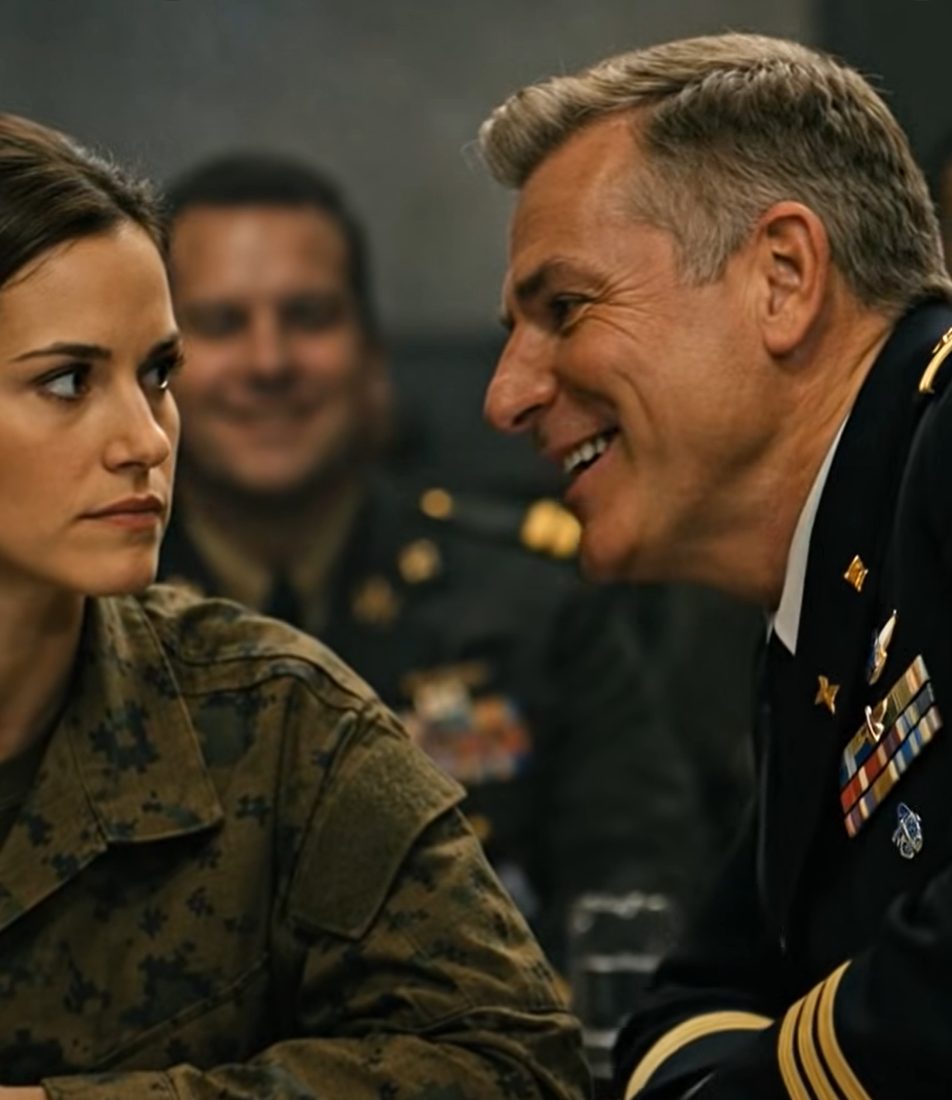
“Let’s get this over with,” General Vance said into the microphone, his voice carrying just enough amusement to draw a few quiet laughs from the officers behind him.
The sound cut sharply through the chamber – through the hum of cameras, the faint whir of overhead lights, the soft shuffle of uniforms shifting in their seats. It wasn’t just impatience. It was dismissal. A performance already decided.
Across the metal table, Staff Sergeant Mara Vale didn’t move.
No medals glinted on her chest. No decorations softened the stark lines of her uniform. It hung slightly loose on her frame, as if it belonged to someone else – someone broader, louder, more visible. But she sat still, composed in a way that made the absence of those things feel deliberate.
General Vance leaned forward, resting his forearms casually against the polished edge of the table. The cameras caught his profile perfectly – the practiced confidence, the faint curve of a smile that never quite reached his eyes.
“So, Sergeant,” he continued, tilting his head just enough to signal condescension, “what’s your confirmed kill count? One? Maybe two?”
A ripple of laughter moved through the back rows. Not loud. Not cruel, exactly. Just enough to reinforce the hierarchy already assumed.
They expected her to lower her gaze.
To hesitate.
To shrink.
Mara didn’t blink.
Her eyes met his directly – steady, unflinching, as if the question had already been asked and answered long before this room existed.
“Seventy-three,” she said.
The laughter didn’t fade.
It stopped.
Abruptly. Completely.
Like something fragile had just cracked beneath the surface.
The air shifted. The room cooled in a way no one could explain.
General Vance blinked once, the smile on his face faltering – not gone, but weakened, like it had lost its footing.
“Excuse me?” he said, a faint scoff slipping into his voice. “Seventy-three? That’s not possible. You’re an analyst.”
The Room That Forgot She Was There
She had been an analyst for four years before anyone in that building knew her name.
Not because she was invisible – she wasn’t. She was present at briefings, present in the operations center, present in the satellite imagery reviews that ran from 0300 to 0600 on the mornings that mattered most. She handed over reports. She flagged anomalies. She sat in the back row of rooms where men with stars on their collars made decisions based on the numbers she’d already verified twice.
They just didn’t look at her when they talked.
She’d grown up in Harrisburg, Pennsylvania. Her father, Dale, had worked a loading dock for twenty-two years. Her mother, Sandra, had done bookkeeping for a dental office on the same street for longer than that. Neither of them had served. Neither of them had pushed her toward it. She’d enlisted at twenty because she was good at patterns – at seeing the shape of a thing before the shape declared itself – and the Army had a specific appetite for that kind of mind.
She tested into intelligence work without trying particularly hard.
By the time she was twenty-four, she was reading satellite feeds out of a concrete room in Bagram that smelled like burned coffee and old carpet. By twenty-six, she’d been cross-assigned to a joint task force she wasn’t allowed to name in most contexts, doing work she couldn’t describe at most dinner tables.
The work had a word for it, inside the specific rooms where it happened.
Targeting.
Not pulling a trigger. Something colder. More precise. You built the file. You confirmed the pattern. You tracked the movement across six weeks of imagery until the pattern became a certainty, and then you handed the certainty to someone else and they handed it further up, and eventually the certainty became an authorization, and the authorization became an action, and the action became a number in a report that came back to your desk three days later.
Seventy-three times, that number had Mara’s name somewhere in the chain.
She hadn’t told anyone. There was no ceremony for it. No medal, obviously – the work didn’t produce medals, it produced results, and results belonged to the operation, not the analyst. She’d never expected recognition. She hadn’t enlisted for that.
But she also hadn’t expected to be summoned to a congressional oversight hearing to be made into an example.
What the Hearing Was Actually For
The hearing had been called, officially, to review the efficacy of the intelligence analysis program within the joint task force structure. Two senators wanted to cut funding. One wanted to expand it. General Vance, who had been brought in as the senior military representative, had a position that was harder to read – he’d spent the last eight years building his reputation on the backs of the field operators, the trigger-pullers, the men whose confirmed kills went on plaques and into speeches. Analysts were overhead. Support staff. The people you thanked in footnotes.
He’d looked at Mara’s file before the hearing. Thirty seconds, maybe. Saw the rank. Saw the assignment. Saw no combat deployments in the traditional sense, no marksmanship qualifications above standard, no citations that would impress anyone in his particular circle.
He’d decided what she was before she sat down.
That was the part she understood without being told. She’d spent years reading patterns. She’d read him in about forty seconds from across the table.
She’d let him ask the question anyway.
Because the question was the point.
Seventy-Three
“I’m an analyst,” she said. “That’s correct.”
Her voice was flat. Not cold – flat. The way you’d confirm a weather report.
General Vance’s jaw moved slightly, like he was working something loose. “Then explain to me how an analyst has seventy-three confirmed kills. Because that’s a number that belongs to – “
“To operators,” she said. “I know.”
One of the senators on the panel, a man named Dorsey from Ohio, leaned forward. He was sixty-one, silver-haired, had served briefly in the National Guard thirty years ago and talked about it more than the service warranted. But he was listening now. She could see it – the slight shift in his posture, the pen he’d been clicking going still.
“Sergeant Vale,” he said. “Help us understand what you mean.”
She’d prepared for this. Not with notes – she didn’t bring notes. With the same process she used for everything: she’d built the file in her head, confirmed the pattern, knew exactly where the shape of the thing was going.
“Targeting intelligence is the process of identifying, tracking, and confirming high-value targets for action,” she said. “Every confirmed kill I’m citing required a targeting package. Intelligence analysis, pattern of life, movement confirmation, positive identification. I built those packages. I confirmed those identifications. The action was taken by operators, but the authorization couldn’t have existed without the analysis.”
“So you’re claiming credit for – “
“I’m not claiming anything.” Her eyes moved back to Vance. “You asked me my confirmed kill count. I answered the question you asked.”
Vance sat back. Not all the way – just enough. A small retreat he probably didn’t notice himself making.
“That’s not what that phrase means,” he said. “In the field – “
“In the field, you pull a trigger,” she said. “In my field, you build the certainty that makes pulling the trigger legal, justified, and accurate. Seventeen of those seventy-three were targets who had been misidentified by previous analysts. I caught the errors before authorization. The other teams didn’t. I can tell you the names of the targets, the dates, the operation designations. I have them memorized.”
Dorsey’s pen was still. The two senators beside him had stopped their side conversation.
The cameras hadn’t moved. But the people operating them had gone very quiet.
What Nobody Expected Her to Say Next
“I’d also like to address the framing of this hearing,” Mara said.
She hadn’t been asked to. She hadn’t been given a prompt. She just said it, in the same flat weather-report voice, and the room didn’t stop her.
Vance’s eyes narrowed. “That’s not – “
“The framing implies that analyst work is a lesser category of military contribution,” she said. “That the measure of effectiveness is proximity to violence. I want to suggest that this framing has a cost.”
Dorsey: “What kind of cost?”
“Three of the seventeen misidentified targets I mentioned were civilian adjacent. The errors weren’t caught. Actions were taken. Those actions produced what the reports called ‘collateral outcomes.’” She paused, one beat. “People died who shouldn’t have. Because the analysis was wrong. Because the person doing the analysis wasn’t given time, resources, or the institutional respect that produces careful work.”
The room had gone to a different kind of quiet now. Not the shocked silence from the number. Something heavier.
“You’re suggesting,” Dorsey said slowly, “that the conditions we create for analysts have direct lethal consequences.”
“I’m not suggesting it,” she said. “I’m stating it. The data supports it. I have the documentation if the committee wants it.”
Vance opened his mouth. Closed it. His forearms were no longer resting casually against the table – he’d pulled them back, hands now flat against his thighs.
“Sergeant Vale.” His voice had lost the performance quality. What was left was something older and less certain. “You came here expecting this line of questioning.”
It wasn’t quite a question.
“I came here expecting to be dismissed,” she said. “I prepared accordingly.”
After the Cameras Stopped
The hearing broke for recess twenty minutes later.
Mara stood, straightened the uniform that hung slightly loose, and picked up the single folder she’d brought. Inside it: nothing she’d used. She hadn’t needed it. But she’d brought it because arriving empty-handed in rooms like that sent a message she didn’t want to send.
A junior aide from Dorsey’s office caught her in the hallway. Young guy, maybe twenty-five, still carrying the nervous energy of someone who hadn’t yet learned to hide it.
“Senator Dorsey wants to know if you’d be available to meet with his staff next week,” the aide said. “Informally. About the documentation you mentioned.”
“Tell him yes,” she said.
She kept walking.
Behind her, she could hear Vance’s voice somewhere down the hall, lower now, the performance gone from it entirely. She didn’t turn around to look. She already knew what the pattern looked like from every angle.
She’d confirmed it months ago.
The folder tucked under her arm held three years of documentation – error rates, resource allocation data, casualty cross-references, and a forty-page analysis she’d written on her own time, in the hours between 0400 and 0600 when the operations center was quiet and no one was asking her for anything.
She’d built the file.
She’d confirmed the pattern.
All she’d needed was the room.
—
If this story hit you somewhere real, pass it along to someone who needs to read it.
For more tales of unexpected courage and the moments that change everything, check out My Father Watched the Video at 0347 and Made One Phone Call, or see what happened when I Was There When He Hit Her – Nobody Moved for What Felt Like a Full Minute, and don’t miss the story of when The Admiral Slapped Her in Front of Five Thousand People. She Didn’t Even Blink..



